Have you ever written leasee and wondered whether it should actually be lessee? You’re not alone. These two spellings look and sound similar, but only one is the standard English term used in legal, property, business, and financial writing.
The correct spelling is lessee.
A lessee is a person or organization that receives the right to use property, land, equipment, a vehicle, or another asset under a lease.
In this guide, you’ll learn the difference between leasee and lessee, what lessee means, why the spelling causes confusion, how to use it correctly, and how it appears in modern legal and business documents.
Leasee or Lessee: Which Spelling Is Correct?
Lessee Is the Correct Spelling
Lessee is the established and standard spelling.
It refers to the person or organization that receives the right to use something under a lease.
For example:
The lessee must pay the monthly rent by the first day of each month.
Another example:
The company became the lessee of the commercial property in January.
Leasee Is Not the Standard Form
Leasee is generally a misspelling of lessee when the intended meaning is the person receiving rights under a lease.
The mistake is understandable because the word lease is spelled with ea. A writer may naturally assume that adding -ee creates leasee.
However, English does not always form words as predictably as that.
For formal documents, contracts, rental agreements, business correspondence, and educational writing, use lessee.
Quick Comparison
| Word | Standard spelling? | Meaning |
|---|---|---|
| Lessee | Yes | Person or organization receiving rights under a lease |
| Leasee | No, for this standard term | Common misspelling of lessee |
| Lessor | Yes | Person or organization that grants the lease |
| Lease | Yes | Agreement or arrangement giving someone the right to use an asset |
The easiest pair to remember is lessor and lessee: the lessor grants the lease, while the lessee receives the right to use the leased asset.
What Does Lessee Mean?
Lessee Definition
A lessee is a person or organization that obtains the right to possess or use an asset under a lease.
In real estate, a lessee is commonly called a tenant. In other situations, the leased item might be a vehicle, machine, office, aircraft, or other equipment.
Consider this simple example:
Sarah rents an apartment from David under a one-year lease. Sarah is the lessee, while David is the lessor.
The relationship becomes easier to understand when you focus on what each party does.
Lessee vs. Lessor
A lessor provides the right to use an asset.
A lessee receives that right.
| Role | Meaning | Example |
|---|---|---|
| Lessor | Person or organization granting the lease | Property owner |
| Lessee | Person or organization receiving the lease | Tenant |
| Lease | Contract establishing the arrangement | One-year rental agreement |
Examples of Lessee in Sentences
Here are several natural examples:
- The lessee signed the rental agreement yesterday.
- The lessee is responsible for paying the agreed rent.
- The company is the lessee of the office building.
- The vehicle remains subject to the terms agreed between the lessor and lessee.
- The lessee must return the equipment when the lease ends.
- Both the lessor and lessee signed the contract.
These examples show why the word is especially common in formal property and business writing.
Why Do People Confuse Leasee and Lessee?
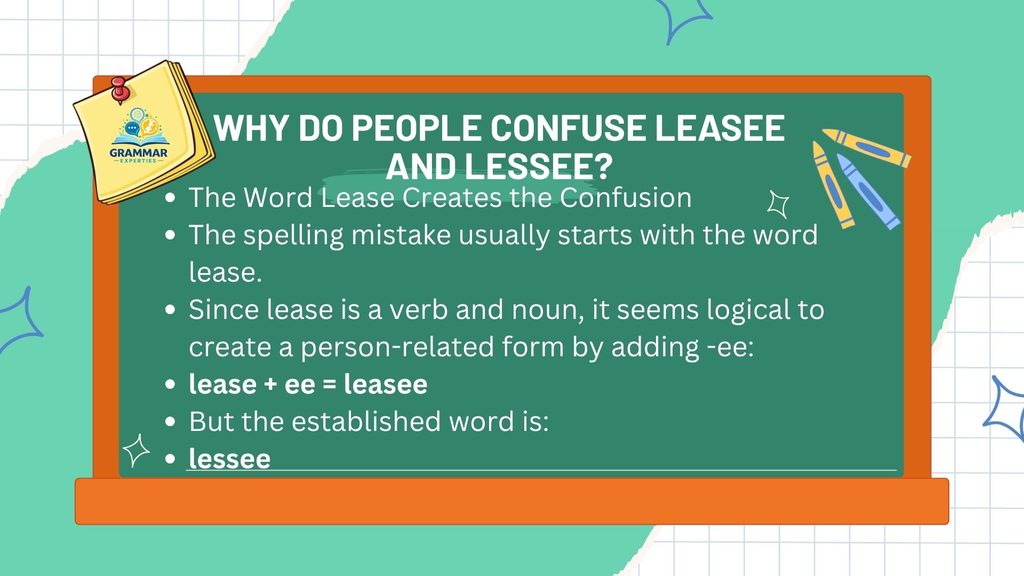
The Word Lease Creates the Confusion
The spelling mistake usually starts with the word lease.
Since lease is a verb and noun, it seems logical to create a person-related form by adding -ee:
lease + ee = leasee
But the established word is:
lessee
This is one of those English spelling patterns that cannot always be predicted simply by combining modern word parts.
The Pronunciation Makes It Harder
Lessee is pronounced approximately:
/le-SEE/
Because leasee would normally be pronounced similarly, hearing the word does not help much when you’re trying to write it.
That’s why the mistake often appears when someone knows the meaning but has only heard the term spoken.
A Simple Memory Trick
Try connecting the two legal roles:
Lessor → Lessee
Both begin with less-.
Remember:
Lessor gives; lessee gets.
This isn’t a grammatical rule, but it’s a useful memory device.
You can also remember that lessee contains two s letters:
L-E-S-S-E-E
Not:
L-E-A-S-E-E
Lessee in Legal, Property, and Business Writing
Lessee in Rental Agreements
The word lessee is frequently used in formal rental agreements because contracts need precise terminology.
For example:
The lessee shall pay the monthly rent specified in this agreement.
Here, lessee identifies the party receiving the right to use the property.
However, everyday communication would normally use tenant:
The tenant must pay rent by the first of the month.
Both can refer to the same person in an ordinary residential rental situation, but lessee is more formal and contractual.
Lessee in Vehicle Leasing
The term isn’t limited to real estate.
A person leasing a vehicle can also be a lessee.
For example:
The lessee is responsible for maintaining the vehicle according to the terms of the lease.
Consumer-leasing regulations also use the term lessee.
Lessee in Business and Accounting
Businesses can also act as lessees.
For example, a company may lease:
- Office space
- Manufacturing equipment
- Vehicles
- Warehouses
- Computers
- Retail premises
Modern financial reporting also uses lessee as a technical term.
Therefore, recognizing the spelling isn’t merely an academic exercise. Lessee remains an active term in contemporary business and financial documents.
Lessee Usage Rules and Common Mistakes
Rule 1: Use Lessee for the Recipient of a Lease
When referring to someone who receives the right to use an asset under a lease, use lessee.
Correct:
The lessee signed the agreement.
Incorrect:
The leasee signed the agreement.
Rule 2: Don’t Confuse Lessee With Lessor
These two words have opposite roles.
Lessor: grants the lease.
Lessee: receives the right to use the asset.
For example:
The lessor owns the property, while the lessee occupies it under the lease.
Rule 3: Use Tenant in Everyday Real-Estate Contexts When Appropriate
You don’t always need the formal word lessee.
For everyday writing:
The tenant moved into the apartment.
For a formal contract:
The lessee shall occupy the premises according to the terms of this agreement.
Both sentences can refer to the same general relationship, but the register is different.
Rule 4: Don’t Assume Lease + -ee Gives Leasee
This is the most common spelling trap.
English has many words ending in -ee, including employee, trainee, and payee. But established vocabulary doesn’t always follow a simple spelling formula.
Lessee has a historical origin that explains its unusual spelling.
The Origin and History of Lessee
Where Did Lessee Come From?
The spelling lessee dates back to the late 15th century.
The word developed through Anglo-French and Middle English legal vocabulary and became established as the term for the person who receives property under a lease.
This historical development helps explain why lessee doesn’t simply preserve the modern spelling of lease.
Why the History Matters
Understanding the origin can make the spelling easier to remember.
Modern English speakers see:
lease → leasee
But the historical development was different.
The established legal term evolved from older French legal vocabulary. Consequently, lessee became the conventional English spelling.
So if leasee looks more logical to you, you’re responding to modern spelling patterns rather than the word’s historical development.
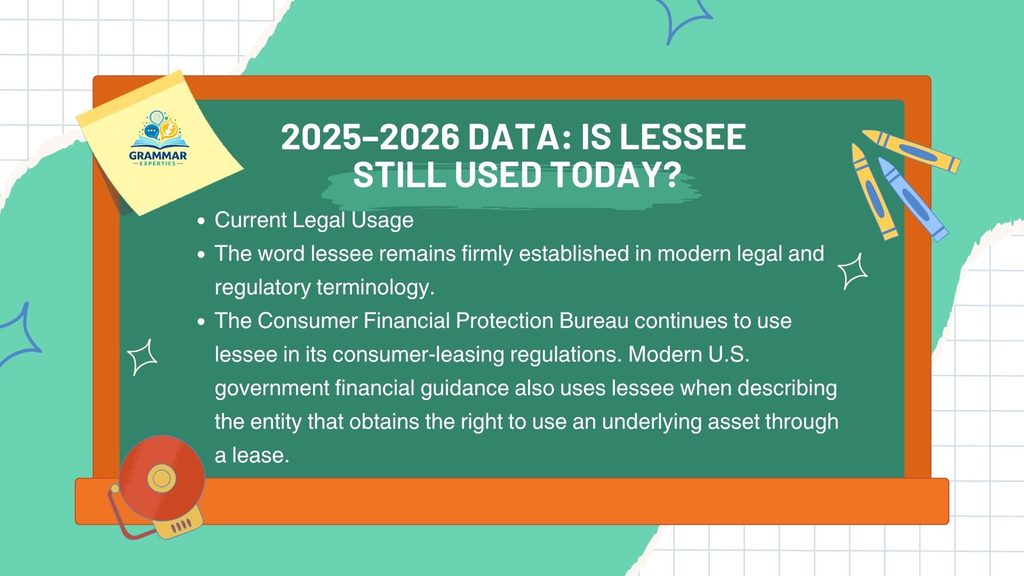
2025–2026 Data: Is Lessee Still Used Today?
Current Legal Usage
The word lessee remains firmly established in modern legal and regulatory terminology.
The Consumer Financial Protection Bureau continues to use lessee in its consumer-leasing regulations. Modern U.S. government financial guidance also uses lessee when describing the entity that obtains the right to use an underlying asset through a lease.
Current Business Usage
Contemporary corporate financial reporting continues to use terms such as:
- Lessee
- Lessor
- Operating lease
- Finance lease
- Lease liability
- Right-of-use asset
Current SEC filings from 2025 and 2026 continue to use lessee in financial reporting and lease-accounting discussions.
What This Data Shows
These current sources demonstrate that lessee is not an outdated dictionary word.
The term continues to appear in:
- Federal regulations
- Government financial guidance
- Corporate financial reporting
- Property agreements
- Consumer leasing rules
- Commercial contracts
The evidence shows that lessee remains the established spelling in professional contexts in 2026.
Real-Life Example: A Commercial Office Lease
Imagine that a small technology company signs a five-year agreement to occupy an office building.
The property owner grants the company the right to use several floors of the building. The company agrees to make monthly payments and follow the conditions specified in the lease.
In this situation, the property owner is the lessor, and the technology company is the lessee.
Suppose the contract states that the company must pay rent on the first business day of every month, maintain the office responsibly, and return the premises when the agreement ends. These obligations are part of the contractual relationship between the lessor and lessee.
If someone writes, “The leasee must pay the rent,” the intended meaning is understandable, but the spelling is not the standard form. The formal version should read, “The lessee must pay the rent.”
This distinction matters particularly in contracts because legal documents depend on consistent terminology. Government regulations and financial documents continue to use lessee as the standard terminology.
The same distinction applies to equipment and vehicle leases. A business leasing machinery or a consumer leasing a car can be described as a lessee when the relevant legal or financial context calls for that term.
Leasee vs. Lessee: Quick Checklist
Use this checklist whenever you’re unsure:
- Are you referring to someone receiving rights under a lease? → Use lessee.
- Are you referring to the person or organization granting the lease? → Use lessor.
- Are you writing a formal contract? → Use lessee, not leasee.
- Are you talking casually about residential property? → Tenant may be more natural.
- Does the word look like lease + ee? → Remember that the standard spelling is lessee.
- Are you referring to a modern business or financial lease? → Lessee remains the established technical term.
Mini Quiz : Leasee or Lessee
1. Which spelling is correct?
A) Leasee
B) Lessee
C) Leassee
D) Lessie
Answer: B) Lessee
2. What does “lessee” mean?
A) A person who grants a lease
B) A person who receives rights under a lease
C) A property seller
D) A real estate agent
Answer: B) A person who receives rights under a lease
3. Which word is generally considered a misspelling when referring to someone receiving a lease?
A) Lessee
B) Lessor
C) Leasee
D) Tenant
Answer: C) Leasee
4. Who is the lessee in a typical apartment lease?
A) The tenant
B) The landlord
C) The property agent
D) The property inspector
Answer: A) The tenant
5. What is the opposite contractual role of a lessee?
A) Buyer
B) Lessor
C) Seller
D) Borrower
Answer: B) Lessor
6. Which sentence uses “lessee” correctly?
A) The lessee signed the rental agreement.
B) The lessee sold the property to its new owner.
C) The lessee always owns the leased property.
D) The lessee is another spelling of lease.
Answer: A) The lessee signed the rental agreement.
7. How is “lessee” spelled?
A) L-E-A-S-E-E
B) L-E-S-S-E-E
C) L-E-S-E-E
D) L-E-A-S-S-E
Answer: B) L-E-S-S-E-E
8. A company rents office space under a lease. What can the company be called?
A) Lessor
B) Lessee
C) Seller
D) Landowner
Answer: B) Lessee
9. Who normally grants the right to use an asset under a lease?
A) Lessee
B) Lessor
C) Tenant
D) Buyer
Answer: B) Lessor
10. Which sentence contains the correct spelling?
A) The leasee must follow the agreement.
B) The lessee must follow the agreement.
C) The leassee must follow the agreement.
D) The lessie must follow the agreement.
Answer: B) The lessee must follow the agreement.
11. Which term is commonly used instead of “lessee” in residential property contexts?
A) Tenant
B) Seller
C) Broker
D) Purchaser
Answer: A) Tenant
12. Is “lessee” limited to people renting houses?
A) Yes
B) No
Answer: B) No
13. Which asset could have a lessee?
A) Apartment
B) Vehicle
C) Office equipment
D) All of the above
Answer: D) All of the above
14. Complete the sentence: “The _____ agreed to pay monthly rent.”
A) leasee
B) lessee
C) lesse
D) leassee
Answer: B) lessee
15. Which word refers to the agreement allowing someone to use an asset for a specified period?
A) Lessee
B) Lease
C) Lessor
D) Tenant
Answer: B) Lease
16. Which pair is correctly matched?
A) Lessee — grants the lease
B) Lessor — receives the lease
C) Lessee — receives rights under the lease
D) Leasee — property owner
Answer: C) Lessee — receives rights under the lease
17. Why is “leasee” a common spelling mistake?
A) Because people associate it with the spelling of “lease”
B) Because it is the British spelling
C) Because it is an old plural form
D) Because dictionaries recommend both spellings equally
Answer: A) Because people associate it with the spelling of “lease”
18. Which term is more appropriate in a formal lease contract?
A) Lessee
B) Leasee
C) Rentee
D) Leaser
Answer: A) Lessee
19. A landlord leases an apartment to Maria. Who is the lessee?
A) The landlord
B) Maria
C) The property manager
D) The building owner
Answer: B) Maria
20. In the sentence “The lessee returned the vehicle,” what does “lessee” refer to?
A) The vehicle manufacturer
B) The person or entity leasing the vehicle
C) The vehicle seller
D) The mechanic
Answer: B) The person or entity leasing the vehicle
21. Which spelling should you use in professional writing?
A) Leasee
B) Lessee
C) Leesee
D) Lesse
Answer: B) Lessee
22. Can a business organization be a lessee?
A) Yes
B) No
Answer: A) Yes
23. Which statement is correct?
A) A lessee always owns the asset.
B) A lessee receives the right to use an asset under a lease.
C) A lessee must sell the asset.
D) A lessee and lessor always mean the same thing.
Answer: B) A lessee receives the right to use an asset under a lease.
24. Which memory trick correctly distinguishes the two terms?
A) Lessor gets; lessee gives.
B) Lessor gives; lessee gets.
C) Lessee sells; lessor buys.
D) Lessee owns; lessor rents.
Answer: B) Lessor gives; lessee gets.
25. Complete the sentence correctly: “Both the lessor and the _____ signed the lease.”
A) leasee
B) lessee
C) leassee
D) lessie
Answer: B) lessee
Frequently Asked Questions About Leasee or Lessee
Q1:Is leasee or lessee correct?
Lessee is the correct standard spelling for the person or organization that receives the right to use something under a lease. Leasee is not the standard spelling for this term.
Q2:What does lessee mean?
A lessee is a person or organization that obtains the right to possess or use property or another asset under a lease. In real estate, the lessee is commonly called a tenant.
Q3:Is leasee a real word?
Leasee is not the standard English term for a person who receives a lease. In formal English, legal writing, and business writing, lessee is the established form.
Q4:What is the difference between lessor and lessee?
The lessor grants the right to use an asset under a lease, while the lessee receives that right. In a typical rental arrangement, the owner is the lessor and the tenant is the lessee.
Q5:Is lessee used in American English?
Yes. Lessee is used in American English, including U.S. laws, regulations, financial documents, and business writing.
Q6:Is lessee used in British English?
Yes. Lessee is also used in British English. Major British dictionaries recognize the word as a legal term referring to a person who uses property or another asset under a lease.
Q7:Is a lessee the same as a tenant?
Often, particularly in residential real estate, a tenant is the lessee. However, lessee is broader and more formal. A lessee can have rights to use different types of assets, including equipment or vehicles, not just a home or apartment.
Q8:How do you remember the spelling of lessee?
A useful memory trick is:
Lessor gives. Lessee gets.
Then remember that lessee is spelled:
L-E-S-S-E-E
Conclusion: Leasee or Lessee?
When choosing between leasee or lessee, use lessee.
A lessee is the person or organization that receives the right to use property or another asset under a lease. The word is established in legal, property, business, accounting, and regulatory English, and current sources continue to use lessee as the standard terminology.
The easiest way to remember it is:
Lessor gives. Lessee gets.
So, when writing a rental agreement, business contract, property document, or professional article, choose lessee, not leasee.
Explore more easy grammar lessons and improve your English with Grammar Expertise
References

Maimoona Mughal is an English grammar enthusiast dedicated to simplifying confusing words, grammar rules, and vocabulary through clear, accurate, and learner-friendly content that helps readers write and communicate with confidence.