If you’ve ever wondered whether “in fact” or “infact” is the correct spelling, you’re not alone. This small phrase causes a surprisingly common writing mistake, especially because it sounds like one connected word when spoken naturally.
The correct form is “in fact” two separate words. “Infact” is incorrect in standard English.
The phrase in fact means in reality, actually, or as a matter of fact. It is often used to emphasize that something is true, add information, correct an assumption, or introduce a surprising fact.
In this guide, you’ll learn exactly why “in fact” is correct, what it means, how to use it in a sentence, where to place it, and how it differs from similar expressions such as “actually” and “indeed.”
In Fact or Infact: Which One Is Correct?
“In fact” is the correct spelling
The correct expression is in fact, written as two words.
Correct: She is very talented. In fact, she won the competition twice.
Incorrect: She is very talented. Infact, she won the competition twice.
“Infact” is not the standard spelling of this expression. When writing formal, academic, professional, or published English, always use in fact.
The reason is simple: in is a preposition and fact is a noun. Together, they form the established phrase in fact.
Merriam-Webster defines in fact as meaning essentially “in truth,” while Cambridge Dictionary describes it as a discourse marker used to add information to what has just been said.
Why “infact” looks tempting
When people pronounce the phrase quickly, the words can sound connected:
“in fact” → /in-fact/
That natural pronunciation can make infact look like a reasonable spelling. However, spoken pronunciation doesn’t determine whether two words should be joined in writing.
English contains many expressions that sound like one unit but remain separate words.
For example:
- a lot, not alot
- at least, not atleast
- in fact, not infact
- of course, not ofcourse
- each other, not eachother
Therefore, remembering the phrase as two words is the easiest way to avoid the error.
Quick answer
| Form | Correct? | Explanation |
|---|---|---|
| in fact | ✅ Yes | Standard English expression |
| infact | ❌ No | Incorrect spelling |
| In fact | ✅ Yes | Correct at the beginning of a sentence |
| in Fact | ❌ Usually no | “Fact” normally does not need capitalization |
Bottom line: Use in fact, never infact, in standard English.
What Does “In Fact” Mean?
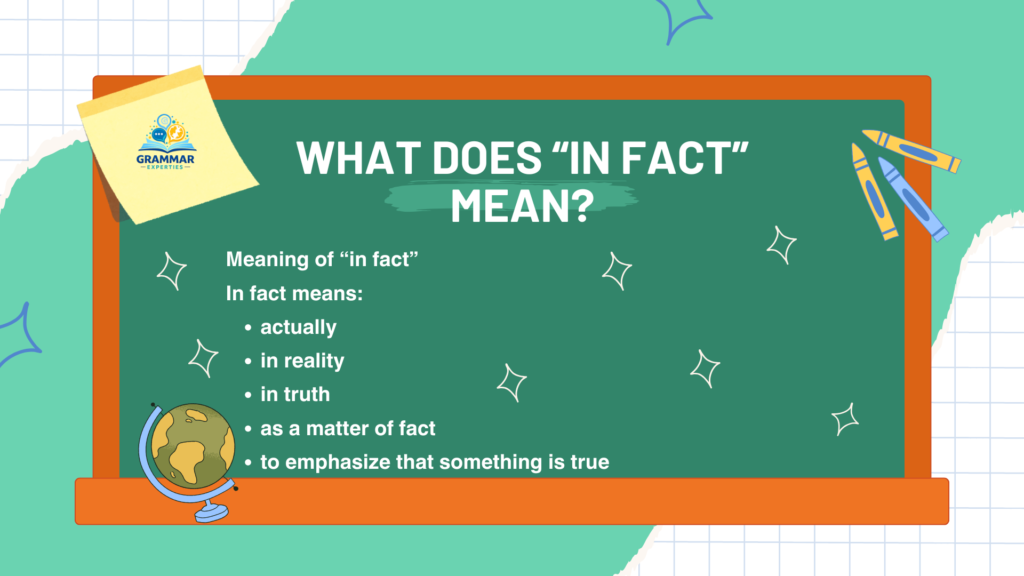
Meaning of “in fact”
In fact means:
- actually
- in reality
- in truth
- as a matter of fact
- to emphasize that something is true
It is commonly used when a writer wants to strengthen a statement or provide additional information.
For example:
I thought the test would be difficult. In fact, it was quite easy.
Here, in fact emphasizes the reality of the situation.
Another example:
Mark looks young, but in fact, he is 45.
The phrase highlights a fact that may be different from what someone expects.
Merriam-Webster gives the same basic meaning, defining in fact as “in truth.”
“In fact” as a discourse marker
In grammar, in fact can function as a discourse marker.
A discourse marker helps connect an idea to what has already been said. Cambridge Dictionary specifically identifies in fact as a discourse marker and explains that it can introduce more detailed information about a previous statement.
For example:
The restaurant was busy. In fact, every table was occupied.
The second sentence gives stronger and more specific information about the first.
Another example:
Sarah is good at mathematics. In fact, she won a national mathematics competition.
The phrase introduces information that reinforces the previous statement.
“In fact” can correct an assumption
One especially useful function of in fact is correcting something that someone might believe.
Consider:
I assumed Tom was from Canada. In fact, he was born in Australia.
The phrase signals that the information following it represents the actual situation.
You can also use it after but:
I thought the movie would be boring, but in fact, it was excellent.
Here, in fact creates a contrast between expectation and reality.
How to Use “In Fact” Correctly in a Sentence
Use “in fact” at the beginning of a sentence
One of the most common positions is at the beginning of a sentence.
In fact, I have already finished the assignment.
In fact, she knows three languages.
In fact, the problem is much simpler than it appears.
When in fact starts a sentence as an introductory expression, it is commonly followed by a comma.
Use “in fact” in the middle of a sentence
You can also place in fact within a sentence to emphasize information.
The answer is, in fact, correct.
He is, in fact, my older brother.
The situation was, in fact, worse than we expected.
When the phrase is inserted parenthetically, commas can be used to set it apart.
The exact punctuation can vary depending on sentence structure and emphasis, but the important point is that in fact remains two words.
Use “in fact” at the end of a sentence
Although less common in some formal contexts, in fact can also appear at the end of a sentence.
The trip was disappointing a complete disaster, in fact.
Cambridge Dictionary notes that in fact commonly appears in front position, while informal usage can place it at the end of a clause or sentence.
This position often sounds conversational.
Use it to strengthen a previous statement
One of the best ways to use in fact is to follow a general statement with a stronger or more specific fact.
The company has grown quickly. In fact, it doubled its workforce last year.
She is an excellent student. In fact, she received the highest grade in the class.
The weather was unusually cold. In fact, temperatures fell below freezing.
This structure is particularly useful in essays, reports, articles, and explanations.
In Fact vs. Infact: Common Mistakes to Avoid
Mistake 1: Writing “infact” as one word
The most obvious mistake is joining the two words.
❌ Infact, I already knew the answer.
✅ In fact, I already knew the answer.
Even though the incorrect version may appear in casual online writing, it should not be used in standard English.
Mistake 2: Confusing pronunciation with spelling
English pronunciation often makes separate words sound connected.
For example:
in fact
may sound almost like a single unit during fast speech.
However, spelling follows established word boundaries, not simply pronunciation.
The same principle applies to:
a lot, not alot
and
of course, not ofcourse.
Therefore, don’t use pronunciation as a guide for deciding whether in fact should be written as one word.
Mistake 3: Overusing “in fact”
Although in fact is useful, you don’t need it in every paragraph.
Compare:
The book is interesting. In fact, it is very interesting. In fact, I couldn’t put it down. In fact, I finished it in one day.
This becomes repetitive.
A better version is:
The book is interesting. In fact, I couldn’t put it down and finished it in one day.
Use the phrase when it adds emphasis, clarification, correction, or additional information.
In Fact vs. Actually vs. Indeed
These expressions can have similar meanings, but they aren’t always interchangeable.
In fact vs. actually
In fact and actually can both mean “in reality” or “really.”
I thought she was 25. In fact, she is 30.
I thought she was 25. Actually, she is 30.
Both sentences can work.
However, actually is often more conversational and can be used to correct, clarify, or politely disagree with someone.
In fact often gives stronger emphasis or introduces supporting information.
In fact vs. indeed
Indeed can also emphasize a statement.
She is a talented writer. Indeed, she has published several books.
She is a talented writer. In fact, she has published several books.
Both are possible, but they can create slightly different tones.
Indeed can sound more formal or literary, while in fact is common in both everyday and formal English.
Quick comparison
| Expression | General meaning | Typical use |
|---|---|---|
| In fact | In reality; actually | Adds or emphasizes factual information |
| Actually | Really; in reality | Corrects or clarifies information |
| Indeed | Certainly; truly | Emphasizes or confirms a statement |
| In reality | In the real situation | Strong contrast with appearance or expectation |
| As a matter of fact | In truth | More emphatic version of “in fact” |
Cambridge lists expressions such as in actual fact, as a matter of fact, in point of fact, actually, and in truth as related expressions.
Examples of “In Fact” in Everyday English
Examples in casual conversation
I thought you lived nearby. In fact, you live across town.
I wasn’t tired. In fact, I felt more energetic than usual.
She doesn’t dislike coffee. In fact, she drinks it every morning.
We expected ten people. In fact, twenty people came.
He isn’t new here. In fact, he has worked here for five years.
Examples in academic writing
The theory appears simple. In fact, it involves several complex variables.
Many students find grammar difficult. In fact, some grammatical distinctions require repeated practice.
The results were unexpected. In fact, they contradicted the original hypothesis.
In academic writing, in fact should support a meaningful point rather than simply decorate a sentence.
Examples in professional writing
The project is nearly complete. In fact, only two tasks remain.
Customer satisfaction has improved. In fact, the latest survey showed a significant increase.
The proposal is financially viable. In fact, it could reduce operating costs.
The phrase can make professional explanations clearer when it introduces evidence or a specific detail.
A Real-Life Writing Case Study: Why “In Fact” Matters
Imagine a student named Ayesha preparing an English essay. She wants to write:
“Many people believe that online learning is difficult. Infact, students can succeed when they have the right resources.”
The idea is understandable, but infact creates an obvious spelling error. A teacher or editor would normally change it to:
“Many people believe that online learning is difficult. In fact, students can succeed when they have the right resources.”
The correction does more than fix two missing spaces. It improves the credibility of the entire sentence.
Now imagine the same mistake appearing repeatedly throughout a university assignment:
Infact, the results were positive.
Infact, students preferred the flexible schedule.
Infact, attendance increased.
A reader may begin to notice the spelling rather than focus on the argument.
The corrected version is much cleaner:
In fact, the results were positive.
In fact, students preferred the flexible schedule.
In fact, attendance increased.
However, an experienced writer would probably improve the passage further by avoiding unnecessary repetition:
The results were positive. Students preferred the flexible schedule, and attendance increased as well.
This example demonstrates an important writing principle: correct spelling is essential, but effective writing also depends on variety and purpose. Use in fact when it genuinely strengthens the relationship between ideas.
What Current Writing Data Tells Us About Grammar and Punctuation
There isn’t a meaningful 2025–2026 statistic showing how many people misspell in fact specifically. Reliable language references instead document the expression as the standard two-word form. Cambridge classifies in fact as a discourse marker, while Merriam-Webster lists it as an established phrase meaning “in truth.”
However, recent research and reporting demonstrate why small writing conventions still matter.
A 2025 report on a study commissioned by Babbel found that 67% of British student respondents said they rarely or never used semicolons, while only 11% described themselves as frequent users. The report also said that more than half of respondents did not understand how to use the punctuation mark.
The lesson isn’t that every writer must memorize complicated punctuation rules. Instead, it shows that small conventions can become areas of uncertainty even for experienced language users.
For a simple phrase such as in fact, the practical solution is easier: learn the established spelling and use it consistently.
A useful rule for writers
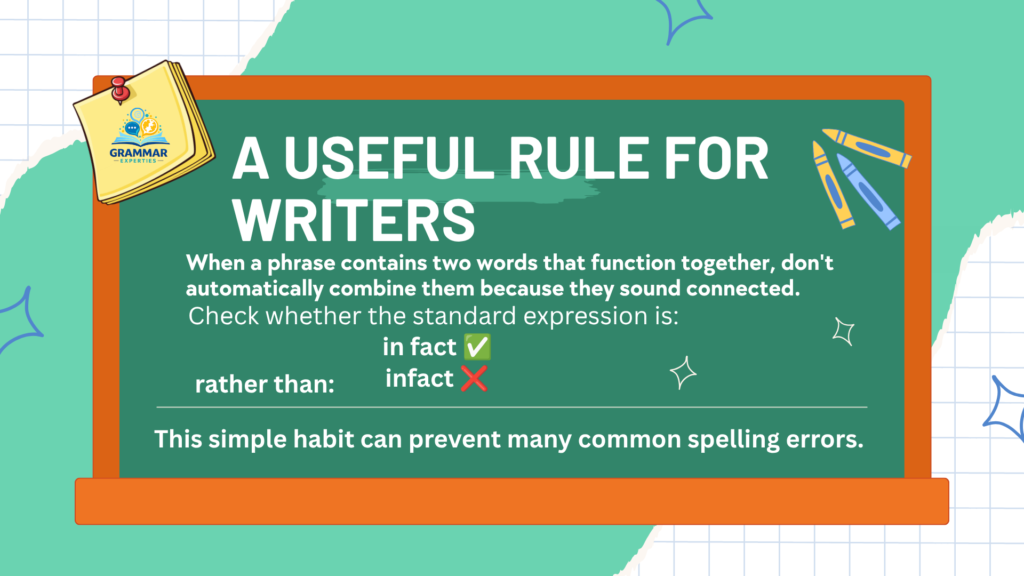
When a phrase contains two words that function together, don’t automatically combine them because they sound connected.
Check whether the standard expression is:
in fact ✅
rather than:
infact ❌
This simple habit can prevent many common spelling errors.
A Simple Step-by-Step Guide to Using “In Fact”
Step 1: Identify the idea you want to emphasize
Ask yourself whether you are stating a fact, correcting an assumption, or adding stronger information.
The exam wasn’t difficult.
Step 2: Add the supporting or surprising information
The exam wasn’t difficult. In fact, most students finished early.
Step 3: Check the spelling
Always write:
in fact
Never:
infact
Step 4: Check punctuation
When the phrase begins a sentence, a comma commonly follows it:
In fact, I already knew the answer.
When it appears parenthetically:
She was, in fact, telling the truth.
Step 5: Remove it if it adds nothing
Ask:
Does “in fact” improve the sentence?
If removing it doesn’t change the meaning or emphasis, you may not need it.
This keeps your writing concise and natural.
Common Questions About “In Fact” and “Infact”
Is “infact” a correct English word?
No. “Infact” is not the standard spelling of the expression. The correct form is “in fact,” written as two separate words.
Is it “in fact” or “infact”?
In fact is correct. Infact is incorrect in standard English.
✅ In fact, she was right.
❌ Infact, she was right.
What does “in fact” mean?
In fact means actually, in reality, or in truth. It can also introduce additional information that strengthens or clarifies a previous statement.
Should there be a comma after “in fact”?
Usually, yes, when in fact is used at the beginning of a sentence as an introductory expression:
In fact, I agree with you.
When it appears inside a sentence as an interruption or parenthetical expression, commas are commonly used around it:
He was, in fact, the first person to arrive.
Punctuation can depend on the sentence structure, so the comma isn’t simply a rule that applies in every possible position.
Can “in fact” start a sentence?
Yes. It frequently appears at the beginning of a sentence.
In fact, we had already discussed the issue.
Cambridge notes that in fact commonly occurs in front position.
Is “in fact” formal or informal?
In fact works in both everyday and formal English. It is common in conversation, academic writing, journalism, business writing, and general prose.
However, avoid using it excessively, especially when a simpler sentence would communicate the same idea.
What are synonyms for “in fact”?
Depending on the context, alternatives include:
- actually
- in reality
- in truth
- indeed
- as a matter of fact
- in actuality
- truly
Merriam-Webster’s thesaurus includes several related expressions, including actually, indeed, truly, in reality, and in truth.
Is “in fact” one word?
No. In fact is a two-word phrase. The words should remain separate.
Mini Quiz: In Fact or Infact
- Quick Fix: Which spelling is correct?
A) Infact
B) In fact
C) Infact
D) InFact
Answer: B) In fact - Two-Word Trap: How many words make up the correct expression?
A) One
B) Two
C) Three
D) Four
Answer: B) Two - Meaning Match: What does “in fact” usually mean?
A) Perhaps
B) Suddenly
C) Actually
D) Eventually
Answer: C) Actually - Spot the Winner: Which sentence is correct?
A) Infact, she was right.
B) In fact, she was right.
C) InFact, she was right.
D) In-fact, she was right.
Answer: B) In fact, she was right. - Grammar Detective: What type of expression can “in fact” function as?
A) Discourse marker
B) Pronoun
C) Article
D) Conjunction
Answer: A) Discourse marker - Fill the Gap: “I thought the movie was boring. ___, it was excellent.”
A) Infact
B) In fact
C) In-fact
D) Inf Act
Answer: B) In fact - Reality Check: Which phrase can replace “in fact” in many contexts?
A) Actually
B) Maybe
C) Perhaps
D) Almost
Answer: A) Actually - Comma Challenge: Which sentence uses punctuation correctly?
A) In fact I agree with you.
B) In, fact I agree with you.
C) In fact, I agree with you.
D) In fact I, agree with you.
Answer: C) In fact, I agree with you. - True or False Twist: “Infact” is the standard spelling in English.
A) True
B) False
Answer: B) False - Complete the Sentence: “She is talented. ___, she won the competition twice.”
A) In fact
B) Infact
C) In-fact
D) Factin
Answer: A) In fact - Meaning Hunt: “In fact” can be used to introduce information that is:
A) Less certain
B) Unrelated
C) Stronger or more specific
D) Always imaginary
Answer: C) Stronger or more specific - Choose the Professional Version:
A) Infact, the project is complete.
B) In fact, the project is complete.
C) In-fact, the project is complete.
D) Infact the project is complete.
Answer: B) In fact, the project is complete. - Expectation Buster: Which sentence correctly uses “in fact” to correct an assumption?
A) I thought Tom was 20. In fact, he is 30.
B) I thought Tom was 20. Infact, he is 30.
C) I thought Tom was 20. In-fact, he is 30.
D) I thought Tom was 20. Fact in, he is 30.
Answer: A) I thought Tom was 20. In fact, he is 30. - Grammar Snap: Which word should NOT be joined to “in” in this expression?
A) fact
B) reality
C) truth
D) All of these
Answer: D) All of these - Find the Error: What is wrong with this sentence?
“Infact, I already knew the answer.”
A) “Infact” should be “in fact”
B) “I” should be lowercase
C) “answer” should be plural
D) Nothing
Answer: A) “Infact” should be “in fact” - Synonym Sprint: Which expression is closest in meaning to “in fact”?
A) In reality
B) By chance
C) At first
D) On purpose
Answer: A) In reality - Sentence Builder: Which version is correctly written?
A) The test was easy infact.
B) The test was easy, in fact.
C) The test was easy infact,
D) The test was easy in-fact.
Answer: B) The test was easy, in fact. - Formal English Challenge: Which spelling should you use in an academic essay?
A) Infact
B) In fact
C) In-fact
D) Infact.
Answer: B) In fact - Memory Test: What is the easiest rule to remember?
A) Write it as one word
B) Add a hyphen
C) Keep “in” and “fact” separate
D) Capitalize both words
Answer: C) Keep “in” and “fact” separate - Compare & Choose: Which sentence is grammatically and orthographically correct?
A) She was, infact, correct.
B) She was in-fact correct.
C) She was, in fact, correct.
D) She was infact correct.
Answer: C) She was, in fact, correct. - Vocabulary Vault: Which word is closest to “in fact” when correcting someone?
A) Actually
B) Rarely
C) Maybe
D) Soon
Answer: A) Actually - Writing Coach: Which sentence sounds unnecessarily repetitive?
A) In fact, she won the race.
B) She won the race.
C) In fact, she won the race. In fact, she won it easily.
D) She won the race easily.
Answer: C) In fact, she won the race. In fact, she won it easily. - Capitalization Check: Which form is normally correct in the middle of a sentence?
A) In Fact
B) IN FACT
C) in fact
D) in Fact
Answer: C) in fact - Final Spelling Showdown: Which pair contains the correct and incorrect forms?
A) In fact / Infact
B) Infact / In fact
C) In-fact / In Fact
D) Inf Act / In fact
Answer: A) In fact / Infact - Ultimate Grammar Challenge: Choose the sentence that gets spelling, meaning, and punctuation right.
A) Infact I agree with her.
B) In-fact, I agree with her.
C) In fact, I agree with her.
D) In Fact I agree with her.
Answer: C) In fact, I agree with her.
FAQs About In Fact or Infact
Q1:Is “infact” one word or two?
The correct expression is two words: “in fact.” The spelling “infact” is considered incorrect in standard English.
Q2:Is “in fact” grammatically correct?
Yes. In fact is a grammatically correct phrase commonly used as a discourse marker to introduce factual, clarifying, supporting, or contrasting information.
Q3:What does “in fact” mean?
In fact means actually, in truth, or in reality. It can also introduce additional information or correct an assumption.
Q4:Can I use “in fact” at the beginning of a sentence?
Yes. This is one of its most common positions.
In fact, I had already finished the work.
A comma commonly follows the phrase when it appears at the beginning.
Q5:Can “in fact” be used in formal writing?
Yes. In fact is appropriate in academic, professional, informational, and formal writing when used naturally.
Q6:Is “in fact” the same as “actually”?
They can have similar meanings, especially when correcting an assumption. However, in fact can also introduce supporting or elaborating information, so the two expressions aren’t identical in every context.
Q7:Is “in actual fact” correct?
Yes. In actual fact is a recognized phrase meaning essentially in reality or actually. However, in fact is generally shorter and more direct.
Q8:How can I remember the correct spelling of “in fact”?
Remember that in fact contains two separate words: in + fact. A simple memory phrase is: “In truth, not infact.”
Final Verdict: In Fact or Infact?
The answer is clear: “in fact” is correct, while “infact” is incorrect.
Use in fact when you want to mean actually, in reality, or in truth, or when you want to introduce information that strengthens or clarifies a previous statement.
Remember this simple rule:
In fact = correct ✅
Infact = incorrect ❌
For example:
The best way to remember the spelling is to think of in and fact as two separate words. Even though they are pronounced closely together, they should remain separate in writing.
In fact, English grammar becomes easier when you understand the patterns behind common mistakes.
If you’re working on improving your English, don’t just memorize the correction. Practice using in fact in different sentence positions and contexts. That will make the correct form feel natural every time you write it.
Explore more easy grammar lessons and improve your English with Grammar Expertise
References:

Maimoona Mughal is an English grammar enthusiast dedicated to simplifying confusing words, grammar rules, and vocabulary through clear, accurate, and learner-friendly content that helps readers write and communicate with confidence.