If you’re wondering whether accidently or accidentally is the correct spelling, you’re not alone. This word is surprisingly easy to misspell because the middle syllables can sound compressed when we say it aloud.
The standard spelling used in modern English is accidentally. However, there is an important detail: accidently has also appeared as a variant spelling and is still listed by some dictionaries. Collins, for example, describes accidently as a now-obsolete variant, while Dictionary.com lists it as a less common acceptable spelling.
So, what should you actually write?
For formal, academic, professional, and everyday standard English, use “accidentally.”
What Is the Correct Spelling: Accidently or Accidentally?
The standard spelling is “accidentally”
Accidentally is the spelling you should normally use in modern English.
It is an adverb meaning by accident, by mistake, unintentionally, or without planning to do something.
For example:
I accidentally deleted the file.
Here, the person did not intend to delete the file.
Another example:
She accidentally broke the glass.
The glass was broken unintentionally.
The word is formed from accidental + -ly, giving us accidentally.
Is “accidently” completely wrong?
Not exactly.
This is where the spelling question becomes more interesting. Some dictionaries recognize accidently as a variant. Dictionary.com currently lists it as a less common acceptable spelling, whereas Collins labels it a now-obsolete variant of accidentally.
That means you may encounter accidently in published material, historical writing, or informal usage. Nevertheless, if you’re writing an essay, business email, website article, report, application, or other polished content, accidentally is the safer and more widely recognized choice.
Quick answer
| Spelling | Status | Recommended? |
|---|---|---|
| Accidentally | Standard modern spelling | Yes |
| Accidently | Variant/obsolete in some dictionaries | Usually avoid |
Best choice: accidentally.
Why Is “Accidentally” So Often Misspelled?
Pronunciation makes the spelling confusing
One reason people write accidently is that the word can sound as though the middle -al- disappears in fast speech.
When people pronounce a word quickly, unstressed sounds can become less noticeable. As a result, it can be tempting to spell the word the way it sounds.
However, pronunciation isn’t always a reliable guide to spelling.
For example:
- accidentally → correct standard spelling
- accidently → less common variant
The extra a helps preserve the relationship between accidental and accidentally.
Remember the word family
A useful way to remember the spelling is to build the word step by step:
accident → accidental → accidentally
Think of the word family rather than trying to memorize the entire word at once.
For example:
- an accident
- an accidental mistake
- something happened accidentally
This makes the spelling easier to recognize.
A simple spelling trick
Break the word into parts:
accidental + ly = accidentally
The base adjective is accidental, not accidentl.
Therefore:
accidental → accidentally
This is especially useful when you’re writing quickly and aren’t sure whether the a belongs in the word.
What Does “Accidentally” Mean?
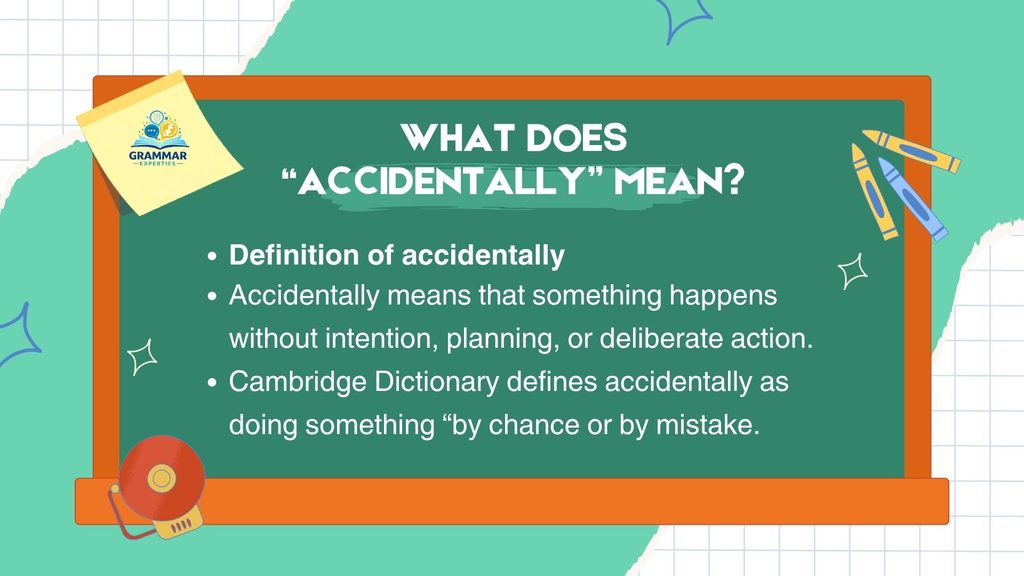
Definition of accidentally
Accidentally means that something happens without intention, planning, or deliberate action.
Cambridge Dictionary defines accidentally as doing something “by chance or by mistake.”
For example:
I accidentally sent the email to the wrong person.
The sender did not intend to send it to that person.
Another example:
He accidentally spilled coffee on his shirt.
The spilling wasn’t deliberate.
Accidentally vs. deliberately
The opposite of accidentally is often deliberately, intentionally, or on purpose.
Compare these sentences:
She accidentally opened the wrong file.
She did not mean to open it.
She deliberately opened the file.
She intended to open it.
This contrast is useful because it makes the meaning of accidentally very clear.
Accidentally vs. by accident
Accidentally and by accident can often be used interchangeably.
For example:
I accidentally deleted the message.
and:
I deleted the message by accident.
Both sentences communicate essentially the same idea.
Other related expressions include:
- by mistake
- unintentionally
- inadvertently
- unknowingly
- without meaning to
- by chance
The exact choice depends on the sentence and context.
Accidently or Accidentally in Real Writing
Example sentences with “accidentally”
Here are several natural examples:
- I accidentally locked my keys inside the car.
- She accidentally deleted the entire folder.
- He accidentally called the wrong number.
- We accidentally took the wrong train.
- I accidentally spilled water on my notebook.
- The child accidentally knocked over the lamp.
- She accidentally revealed the surprise.
- He accidentally sent the private message to the group.
- I accidentally left my wallet at home.
- They accidentally entered the wrong address.
Notice that accidentally works naturally before the main verb in many sentences.
Examples of “accidently”
You may sometimes see sentences such as:
He accidently deleted the file.
or:
She accidently broke the vase.
These examples demonstrate the variant spelling, but they don’t make it the best choice for standard contemporary writing.
For polished writing, change them to:
He accidentally deleted the file.
She accidentally broke the vase.
A useful editing rule
If you’re proofreading an article, essay, email, or professional document and you see accidently, consider changing it to accidentally unless you have a specific reason to preserve the variant.
This keeps your writing aligned with the standard spelling most readers expect.
Accidentally vs. Accidently: A Detailed Comparison
Meaning and spelling
The two forms are closely related because they are used to express the same basic idea: something happened unintentionally.
The main difference is their status in modern usage.
Accidentally is the standard spelling you’ll want in almost every contemporary writing situation.
Accidently has a history of use and is recognized by some dictionaries, but other major references treat it as obsolete or nonstandard.
Comparison table
| Feature | Accidentally | Accidently |
|---|---|---|
| Word type | Adverb | Adverb |
| Basic meaning | By accident or unintentionally | By accident or unintentionally |
| Modern standard usage | Yes | Limited |
| Common in formal writing | Yes | Not recommended |
| Common spelling choice | Yes | Much less common |
| Suitable for academic writing | Yes | Avoid |
| Suitable for professional writing | Yes | Avoid |
| British/American difference | Same standard spelling | Status may vary by dictionary |
Which one should you use?
Use accidentally when you want the safest standard form.
This is especially important in:
- Academic assignments
- Business emails
- Resumes and applications
- Reports
- Blog posts
- Website content
- Formal letters
- Educational materials
- Professional documentation
There is little practical advantage to choosing accidently when accidentally is universally recognizable and straightforward.
A Real-Life Editing Example
How one missing syllable can create a spelling problem
Imagine that a student is writing an essay about mistakes people make when using technology.
The student writes:
“I accidently deleted an important paragraph from my assignment.”
At first glance, the sentence is perfectly understandable. The meaning is clear, and most readers would know exactly what happened.
However, the student is submitting the essay for a formal English course. During proofreading, the teacher notices accidently and changes it to accidentally.
Why?
The problem isn’t the meaning. It is the spelling convention being used in formal contemporary English.
The student then checks the word family:
accident → accidental → accidentally
That pattern makes the correct spelling easier to remember.
The same lesson applies in professional writing. Imagine an employee writing:
“I accidently attached the wrong document.”
The recipient will almost certainly understand the sentence. Nevertheless, accidentally is the better standard form:
“I accidentally attached the wrong document.”
This small correction illustrates an important principle in English: a word can be understandable and even appear in dictionaries without necessarily being the preferred form for every context.
When you have two possible forms, context matters. For polished modern writing, accidentally is the practical choice.
2025–2026 Usage and Dictionary Evidence
What current reference sources show
Current dictionary evidence is more nuanced than simply calling accidently an invented spelling mistake.
Dictionary.com currently gives accidentally as the main entry and notes that accidently is sometimes used. Its usage information describes accidently as a less common acceptable spelling.
Collins takes a more restrictive position and describes accidently as a variant of accidentally that is now obsolete.
Cambridge Dictionary provides the standard entry accidentally, defining it as something done by chance or mistake.
Therefore, current reference sources agree on the practical point even though they differ somewhat in how they classify the alternative:
“Accidentally” is the standard spelling to use in contemporary writing.
A current frequency snapshot
A September 2026 third-party word-frequency index based on Wiktionary data places accidentally at frequency rank #4,911, while accidently appears at #34,363 in the same index.
These figures should not be treated as an official measurement of all English writing. They are useful only as a rough indication that accidentally has substantially broader representation in the underlying word-frequency data.
More importantly, dictionary evidence provides the stronger basis for deciding which spelling to use.
Why frequency alone isn’t enough
A word-frequency number cannot by itself determine whether a spelling is correct.
For example, a misspelling can appear thousands of times online. Repeated use doesn’t automatically turn a spelling into the preferred standard.
That is why reliable dictionaries, established usage references, and the context of your writing matter more than a simple search count.
How to Remember the Correct Spelling of Accidentally
Use the word family method
The easiest method is:
ACCIDENT → ACCIDENTAL → ACCIDENTALLY
Start with accident.
Add -al:
accidental
Then add -ly:
accidentally
This gives you the complete spelling without relying on pronunciation.
Remember the “al”
When you’re tempted to write accidently, stop and ask:
“What is the adjective?”
The answer is accidental.
Then simply add -ly:
accidental + ly = accidentally
This is one of the simplest ways to prevent the spelling error.
Proofreading tip
If you frequently type accidently, use your word processor’s spell-checking feature or create a personal proofreading list of commonly confused words.
You can also search your document for:
accidently
and replace it with:
accidentally
This is especially useful when editing long articles or reports.
Common Mistakes With Accidentally
Mistake 1: Writing “accidently”
❌ I accidently deleted the photo.
✅ I accidentally deleted the photo.
The second version is the standard choice.
Mistake 2: Confusing accidentally with accidentally on purpose
The phrase accidentally on purpose is usually humorous or intentionally contradictory.
For example:
He accidentally on purpose left the door open.
In ordinary writing, however, simply use accidentally when you mean that something wasn’t intentional.
Mistake 3: Using “accidentally” when “accidental” is needed
Remember that accidental and accidentally have different grammatical jobs.
Accidental is an adjective:
It was an accidental mistake.
Accidentally is an adverb:
I accidentally made the mistake.
This distinction can help you choose the right form.
Mistake 4: Assuming pronunciation determines spelling
English spelling doesn’t always match pronunciation perfectly.
Even though accidentally may sound compressed in normal speech, its standard spelling still contains the -al- sequence.
Accidentally in British and American English
Is the spelling different in the UK and US?
No major British-American spelling difference exists for the standard form.
The standard spelling is:
accidentally
You don’t normally change it to another form depending on whether you’re writing American or British English.
This differs from words such as:
- color / colour
- organize / organise
- center / centre
For accidentally, the standard spelling remains the same.
What about accidently?
The alternative accidently has been recorded in English usage, but dictionaries differ in how they classify it.
For a general audience, the simplest rule is:
Use accidentally in both American and British English.
That removes unnecessary ambiguity.
Sure — here are 25 mini quiz questions without docs, with the answer directly under each question.
Mini Quiz:Accidently or Accidentally
1. Which spelling is correct?
A) Accidently
B) Accidentally
C) Accidantally
D) Accidentaly
Answer: B) Accidentally
2. What does “accidentally” mean?
A) Intentionally
B) Carefully
C) By mistake or unintentionally
D) Repeatedly
Answer: C) By mistake or unintentionally
3. Choose the correct sentence.
A) I accidently deleted the file.
B) I accidentaly deleted the file.
C) I accidentally deleted the file.
D) I accidantally deleted the file.
Answer: C) I accidentally deleted the file.
4. Complete the sentence: “She ______ broke the glass.”
A) accidently
B) accidentaly
C) accidentally
D) accidantally
Answer: C) accidentally
5. What is the adjective related to “accidentally”?
A) Accidenting
B) Accidental
C) Accidentive
D) Accidented
Answer: B) Accidental
6. Which word family is correct?
A) Accident → accidentive → accidently
B) Accident → accidented → accidentaly
C) Accident → accidental → accidentally
D) Accident → accidentful → accidentelly
Answer: C) Accident → accidental → accidentally
7. True or False: “Accidentally” means deliberately.
Answer: False
8. Which phrase can often replace “accidentally”?
A) On purpose
B) With intention
C) By mistake
D) Deliberately
Answer: C) By mistake
9. Choose the correctly spelled sentence.
A) He accidently called Sarah.
B) He accidentaly called Sarah.
C) He accidantally called Sarah.
D) He accidentally called Sarah.
Answer: D) He accidentally called Sarah.
10. What part of speech is “accidentally”?
A) Noun
B) Adjective
C) Adverb
D) Preposition
Answer: C) Adverb
11. Which spelling is recommended for formal writing?
A) Accidently
B) Accidentally
C) Accidentaly
D) Accidantally
Answer: B) Accidentally
12. Complete the sentence: “I ______ sent the email to the wrong person.”
A) accidently
B) accidentally
C) accidentaly
D) accidentelly
Answer: B) accidentally
13. Which sentence uses “accidental” correctly?
A) She accidental dropped it.
B) She dropped it accidental.
C) It was an accidental mistake.
D) It was an accidentally mistake.
Answer: C) It was an accidental mistake.
14. True or False: “Accidently” has appeared as a variant form in English.
Answer: True
15. Which spelling contains the standard “-ally” ending?
A) Accidently
B) Accidentaly
C) Accidentally
D) Accidantally
Answer: C) Accidentally
16. Choose the correct sentence.
A) She accidentally spilled the coffee.
B) She accidently spilled the coffee.
C) She accidentaly spilled the coffee.
D) She accidentelly spilled the coffee.
Answer: A) She accidentally spilled the coffee.
17. Which word is the opposite of “accidentally” in many contexts?
A) Unexpectedly
B) Unintentionally
C) Deliberately
D) Randomly
Answer: C) Deliberately
18. Complete the word family: “accident → accidental → ______”
A) accidently
B) accidentaly
C) accidentally
D) accidentelly
Answer: C) accidentally
19. Which sentence means the action was not intentional?
A) He deliberately opened the door.
B) He intentionally opened the door.
C) He accidentally opened the door.
D) He carefully opened the door.
Answer: C) He accidentally opened the door.
20. Which spelling should you normally use in an academic essay?
A) Accidently
B) Accidentaly
C) Accidentally
D) Accidantally
Answer: C) Accidentally
21. True or False: “Accidentally” is the standard modern spelling.
Answer: True
22. Which sentence is grammatically and spelling-wise correct?
A) I accidentally forget my keys yesterday.
B) I accidently forgot my keys yesterday.
C) I accidentally forgot my keys yesterday.
D) I accidental forgot my keys yesterday.
Answer: C) I accidentally forgot my keys yesterday.
23. What is the easiest way to remember the spelling?
A) Accident + ly
B) Accidental + ly
C) Accident + ally
D) Accidant + ally
Answer: B) Accidental + ly
24. Which sentence correctly uses “accidentally” with “by mistake”?
A) I accidentally did it deliberately.
B) I accidentally sent it by mistake.
C) I accidentally sent it intentionally.
D) I accidentally sent it on purpose.
Answer: B) I accidentally sent it by mistake.
25. Accidently or accidentally—which should you choose for polished modern writing?
A) Accidently
B) Accidentaly
C) Accidentally
D) Both are equally preferred everywhere
Answer: C) Accidentally
Frequently Asked Questions
Q1:Is “accidently” a correct spelling?
Accidently is a recorded variant of accidentally, and some dictionaries recognize it. However, other dictionaries describe it as obsolete or nonstandard. For modern formal and professional writing, accidentally is the recommended choice.
Q2:Is “accidentally” the correct spelling?
Yes. Accidentally is the standard modern spelling and the form you should normally use in contemporary English.
Q3:What does accidentally mean?
Accidentally means doing something unintentionally, by mistake, or without planning to do it.
Example:
I accidentally deleted the email.
Q4:Why do people spell accidentally as accidently?
The spelling is often confused because the pronunciation of accidentally can make the middle -al- less noticeable in rapid speech. The word is also related to accident and accidental, which can make its spelling easy to reconstruct once you know the word family.
Q5:Is accidently accepted in English?
Some dictionaries recognize accidently as a variant, while others label it obsolete or nonstandard. So it is not accurate to say that no dictionary recognizes it. Nevertheless, accidentally is the safer standard form for current formal writing.
Q6:What is the easiest way to remember accidentally?
Remember the word family:
accident → accidental → accidentally
Think accidental + ly.
Q7:Should I use accidently in academic writing?
It’s better to use accidentally in academic writing. Academic work generally benefits from using the standard contemporary spelling rather than a less common variant.
Q8:Is accidentally the same in British and American English?
Yes. Accidentally is the standard spelling in both British and American English.
Final Answer: Accidently or Accidentally?
So, accidently or accidentally—which spelling is correct?
The best answer is accidentally.
Accidentally is the standard modern spelling and means “by accident,” “by mistake,” or “unintentionally.” Although accidently has historical usage and is still recognized as a variant by some dictionaries, it is much less suitable for polished contemporary writing.
When you’re writing an email, essay, article, report, or professional document, choose:
✅ accidentally
rather than:
⚠️ accidently
The easiest way to remember it is:
accident → accidental → accidentally
Save this spelling pattern, and you’ll be much less likely to accidentally misspell accidentally again.
Explore more easy grammar lessons and improve your English with Grammar Expertise
References

Maimoona Mughal is an English grammar enthusiast dedicated to simplifying confusing words, grammar rules, and vocabulary through clear, accurate, and learner-friendly content that helps readers write and communicate with confidence.