The short answer
For modern English, immaculate is the correct choice when you mean “perfectly clean,” “spotless,” or “without flaws.”
Emaculate does exist as a historical English verb, but it is obsolete and extremely uncommon. It is not the modern adjective people generally intend when they write something like “The house was emaculate.”
| Word | Modern standard use | Part of speech | Meaning |
|---|---|---|---|
| Immaculate | Yes | Adjective | Perfectly clean, flawless, without mistakes |
| Emaculate | No, generally obsolete | Verb | To remove spots or imperfections |
| Immaculately | Yes | Adverb | In a perfectly clean or flawless way |
| Immaculateness | Yes, uncommon | Noun | The quality of being immaculate |
Oxford defines immaculate as perfectly clean and tidy or containing no mistakes or faults. Cambridge similarly defines it as perfectly clean or tidy and perfect without mistakes.
So, if you are writing a school assignment, business email, website, report, or article, use immaculate when that is the intended meaning.
Is “emaculate” completely wrong?
Not historically.
This is where the “surprising truth” comes in.
Historical sources record emaculate as a verb. Webster’s 1828 dictionary, for example, defined it as “to take spots from” and marked it as little used.
The World English Historical Dictionary also records emaculate as an obsolete verb meaning to free something from spots or blemishes.
Therefore, saying that emaculate has never existed would be inaccurate.
The better explanation is:
Immaculate is the standard modern adjective. Emaculate is an obsolete historical verb that should not normally be substituted for immaculate in modern writing.
What Does Immaculate Mean?
Immaculate meaning and definition
Immaculate is an adjective used for something that is exceptionally clean, neat, flawless, or free from mistakes.
Oxford gives two major modern senses: something can be perfectly clean and tidy, or it can be free from mistakes and faults.
For example:
- The hotel room was immaculate.
- She arrived wearing an immaculate white dress.
- His presentation was immaculate.
- The mechanic returned my car in immaculate condition.
- The editor praised her immaculate attention to detail.
Immaculate can describe cleanliness
This is probably the most familiar use.
The kitchen was immaculate.
Here, immaculate means extremely clean and tidy.
You could replace it with words such as spotless, pristine, or impeccable, depending on the context.
Cambridge gives examples involving an immaculate garden and an immaculate white suit, reinforcing the connection between the word and exceptional cleanliness.
Immaculate can also mean flawless
The word isn’t limited to physical cleanliness.
You can describe something as immaculate when it contains no obvious errors or faults.
For example:
She delivered an immaculate performance.
This means the performance was exceptionally good and free from mistakes.
Oxford and Cambridge both explicitly include this sense.
Immaculate pronunciation
In English, immaculate is commonly pronounced approximately:
ih-MAK-yuh-lət
The spelling contains two m’s:
im + maculate → immaculate
That double m is one of the easiest parts of the word to forget.
What Does Emaculate Mean?
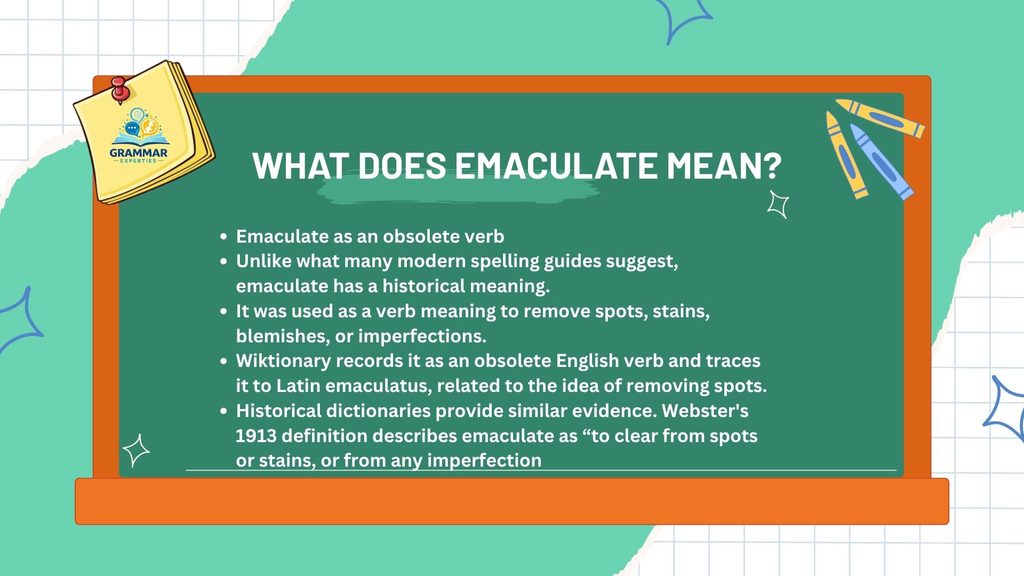
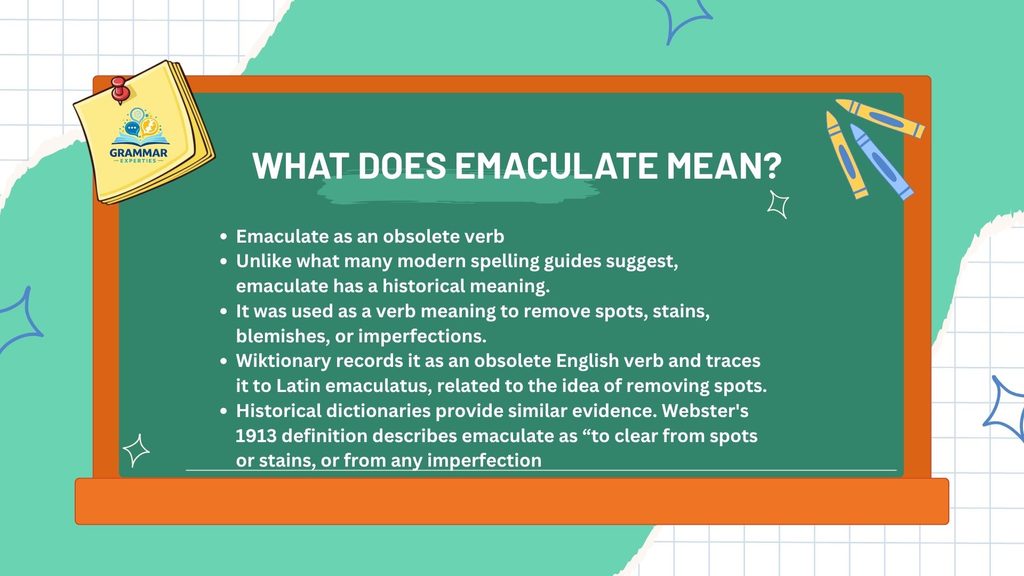
Emaculate as an obsolete verb
Unlike what many modern spelling guides suggest, emaculate has a historical meaning.
It was used as a verb meaning to remove spots, stains, blemishes, or imperfections.
Wiktionary records it as an obsolete English verb and traces it to Latin emaculatus, related to the idea of removing spots.
Historical dictionaries provide similar evidence. Webster’s 1913 definition describes emaculate as “to clear from spots or stains, or from any imperfection.”
So these two words have an interesting historical relationship:
- emaculate = historically, to remove a blemish
- immaculate = unblemished, spotless, flawless
Why “emaculate” causes confusion
The confusion becomes understandable when you look at their meanings.
Both words are historically connected with the idea of spots, stains, and imperfections.
The Latin roots are related to macula, meaning a spot or blemish. Collins traces immaculate to Latin immaculatus, from in- meaning “not” and macula meaning “blemish.”
Meanwhile, historical sources trace emaculate to Latin emaculare, meaning to clear from spots.
That means the two spellings aren’t a completely random pair.
Should you use “emaculate” today?
Generally, no.
If your sentence is:
The hotel room was ___.
The natural modern answer is:
The hotel room was immaculate.
Not:
The hotel room was emaculate.
Likewise:
Her handwriting was immaculate.
is standard modern English.
Using emaculate as an adjective in these sentences would sound incorrect to most contemporary English readers because its recorded historical use was as a verb.
Why Do People Confuse Emaculate and Immaculate?
The missing “im-” problem
One reason for the confusion is that immaculate begins with a sequence that can be difficult to hear clearly in fast speech.
The word starts:
im-maculate
The two m’s occur together, so the spelling can feel less obvious when you hear the word rather than see it.
A writer who knows the meaning but has mainly heard the word spoken may therefore produce a spelling such as:
emaculate
instead of:
immaculate
The connection with “maculate”
Another clue comes from the word maculate.
Maculate is associated with being spotted or stained, while immaculate carries the opposite idea: being free from spots or blemishes.
Collins traces immaculate to Latin immaculatus, while its historical development is connected to macula, meaning a spot or blemish.
Thinking of the word as:
im + maculate
can make the spelling easier to remember.
Similar-looking words can create spelling traps
English contains many words where prefixes and roots combine in ways that are not immediately obvious.
For example:
- immature
- impossible
- impatient
- irregular
- immaculate
The spelling of immaculate becomes easier once you recognize that the beginning is im-, followed by a root beginning with m.
So remember:
im + maculate = immaculate
not:
em + aculate = emaculate
Immaculate vs Emaculate: Examples in Real English
Correct modern examples with “immaculate”
Here are natural examples:
- The hotel room was immaculate.
- She keeps her office immaculate.
- He looked immaculate in his new suit.
- The chef’s kitchen was immaculate.
- The athlete gave an immaculate performance.
- The report was carefully edited and nearly immaculate.
- The car was returned in immaculate condition.
- Her handwriting was immaculate.
These examples demonstrate the two main modern senses: exceptional cleanliness and freedom from faults.
Historical-style use of “emaculate”
Because emaculate was a verb, a historical sentence could use it differently:
The editor sought to emaculate the text by removing its imperfections.
However, this is not normal modern English.
A modern writer would usually say:
The editor sought to clean up the text by removing its imperfections.
or:
The editor sought to correct the text.
or:
The editor removed the imperfections from the text.
A useful comparison
Consider these two sentences:
The room was immaculate.
This is standard modern English.
The editor attempted to emaculate the manuscript.
This may be understood as a historical or deliberately archaic use of emaculate, but it is not ordinary contemporary vocabulary.
Therefore, context and part of speech matter.
A 2025–2026 Data and Usage Snapshot
What current dictionary evidence shows
There is an important distinction between modern usage evidence and historical dictionary evidence.
For this article, current dictionary sources were checked in 2026. Cambridge and Oxford both list immaculate as a current adjective with meanings involving cleanliness and freedom from faults.
Collins also lists immaculate as a current adjective and gives both its modern meanings and its Latin origin. Its current American-English material cites the 2025 edition of Webster’s New World College Dictionary.
A 2025 International Spelling Bee master list also includes immaculate among its competition words, providing another contemporary example of the word’s continued place in formal spelling education.
What the evidence does not show
There is no sound reason to invent a precise 2025–2026 worldwide search-volume number for “emaculate vs immaculate.”
Search-volume estimates can vary considerably by database, country, language, time period, and keyword tool. Therefore, a responsible spelling guide should not present an unsupported number as a universal statistic.
What the current evidence does establish is more useful for the spelling question:
- 3 major current dictionary sources—Cambridge, Oxford, and Collins—recognize immaculate as a current English word.
- Historical sources document emaculate as an obsolete verb rather than the ordinary modern adjective many writers intend.
- Contemporary spelling resources continue to include immaculate as an established English spelling.
This distinction is much more meaningful than an unverified search-volume figure.
A Real-Life Writing Case Study: How One Letter Can Change the Word
The workplace example
Imagine that a property manager has just prepared a report about a newly renovated apartment.
The manager writes:
“The apartment was emaculate after the renovation.”
The meaning is easy enough to understand. The manager clearly intends to say that the apartment is exceptionally clean.
However, a professional editor reviewing the report would probably change the sentence to:
“The apartment was immaculate after the renovation.”
Why?
Because immaculate is the established modern adjective for this meaning. Cambridge defines it as perfectly clean or tidy, while Oxford gives the closely related sense of being perfectly clean and without marks or flaws.
Now consider a different situation. The manager is researching historical English and finds emaculate in an old dictionary. That discovery does not mean the original sentence was necessarily correct. The historical word existed, but it functioned as a verb and is now obsolete.
This is an important lesson for writers: a word can exist historically without being the appropriate modern word for a particular sentence.
English contains many obsolete words that survive in old dictionaries but have disappeared from normal contemporary writing. Therefore, checking a dictionary isn’t only about asking, “Does this sequence of letters exist?” You also need to ask, “What part of speech is it? What does it mean today? And would a modern reader understand it in this context?”
For everyday communication, the practical answer remains straightforward: if you mean exceptionally clean, polished, or flawless, choose immaculate.
How to Remember the Correct Spelling of Immaculate
Use the “IM + MACULATE” trick
Break the word into two visual pieces:
IM + MACULATE
Then put them together:
IMMACULATE
This helps you remember the two m’s.
Connect it with “imperfection”
Another useful memory association is:
immaculate = without blemish
The word has historically been associated with the idea of being free from spots or stains.
Think:
No blemish → immaculate
Remember the adjective
When you want to describe a thing as spotless or flawless, use the adjective:
immaculate
Examples:
- immaculate room
- immaculate clothes
- immaculate garden
- immaculate record
- immaculate performance
- immaculate condition
If you are describing how something was done, the adverb is:
immaculately
For example:
She was immaculately dressed.
Oxford lists immaculately as the adverbial form of immaculate.
Quick Comparison Checklist
Which word should you choose?
Use this checklist when you are unsure:
- Are you describing something as perfectly clean? → immaculate
- Are you describing something as flawless? → immaculate
- Are you describing something as free from errors? → immaculate
- Are you describing someone’s polished appearance? → immaculate
- Are you writing ordinary modern English? → immaculate
- Did you find emaculate in an old dictionary? → It may be an obsolete historical verb
- Are you using emaculate as a modern adjective meaning spotless? → Avoid it.
Immaculate vs Emaculate at a glance
| Feature | Immaculate | Emaculate |
|---|---|---|
| Standard modern word? | Yes | No, generally obsolete |
| Common today? | Yes | Extremely rare |
| Part of speech | Adjective | Historical/obsolete verb |
| Main meaning | Spotless, flawless, perfect | To remove spots or imperfections |
| Example | “The room was immaculate.” | Historical use: “to emaculate the text” |
| Suitable for normal modern writing? | Yes | Generally no |
| Latin connection | immaculatus | emaculatus |
Mini Quiz:Emaculate vs Immaculate
- Which spelling is correct for the modern adjective meaning “perfectly clean” or “flawless”?
A) Emaculate
B) Immaculate
C) Emmaculate
D) Immacculat
Answer: B) Immaculate
- What does immaculate mean?
A) Very noisy
B) Perfectly clean or flawless
C) Extremely expensive
D) Very old
Answer: B) Perfectly clean or flawless
- Is emaculate recorded as a historical English word?
A) Yes
B) No
Answer: A) Yes
- What part of speech was historical emaculate?
A) Noun
B) Verb
C) Pronoun
D) Preposition
Answer: B) Verb
- Which sentence is correct?
A) The room was emaculate.
B) The room was immaculate.
C) The room was emmaculate.
D) The room was immacculate.
Answer: B) The room was immaculate.
- What did historical emaculate mean?
A) To make louder
B) To remove spots or imperfections
C) To decorate
D) To make heavier
Answer: B) To remove spots or imperfections
- Which word is commonly used today for something spotless?
A) Emaculate
B) Immaculate
C) Emacculate
D) Emmaculate
Answer: B) Immaculate
- True or False: Immaculate can describe something that is free from mistakes.
Answer: True
- Which sentence uses immaculate correctly?
A) She wore an immaculate white dress.
B) She wore an emaculate white dress.
C) She wore an emmaculate white dress.
D) She wore an immacculate white dress.
Answer: A) She wore an immaculate white dress.
- Which is a synonym of immaculate?
A) Spotless
B) Dirty
C) Messy
D) Stained
Answer: A) Spotless
- Which spelling contains the correct beginning?
A) Emaculate
B) Immaculate
C) Emmaculate
D) Imacculate
Answer: B) Immaculate
- Fill in the blank: “The hotel room was ______.”
A) emaculate
B) immaculate
C) emmaculate
D) immacculate
Answer: B) immaculate
- Which word means “flawless”?
A) Immaculate
B) Emaculate
C) Emmaculate
D) Emacculate
Answer: A) Immaculate
- True or False: Emaculate is the standard modern adjective for a spotless room.
Answer: False
- Which phrase is correctly spelled?
A) Emaculate condition
B) Immaculate condition
C) Emmaculate condition
D) Immacculate condition
Answer: B) Immaculate condition
- Which word should you use in formal modern writing when describing error-free work?
A) Emaculate
B) Immaculate
C) Emacculate
D) Emmaculate
Answer: B) Immaculate
- What is the correct adverb form of immaculate?
A) Emaculately
B) Immaculately
C) Immacculately
D) Emmaculately
Answer: B) Immaculately
- Complete the sentence: “She was ______ dressed for the ceremony.”
A) emaculate
B) immaculate
C) emmaculate
D) immacculate
Answer: B) immaculate
- Which word is associated with the idea of being free from blemishes?
A) Immaculate
B) Emaculate
C) Both only as modern adjectives
D) Neither
Answer: A) Immaculate
- What is the easiest spelling trick for immaculate?
A) Think “em + aculate”
B) Think “im + maculate”
C) Think “em + maculate”
D) Think “im + cculate”
Answer: B) Think “im + maculate”
- True or False: Immaculate is used in both British and American English.
Answer: True
- Which sentence is correctly written?
A) His performance was immaculate.
B) His performance was emaculate.
C) His performance was emmaculate.
D) His performance was immacculate.
Answer: A) His performance was immaculate.
- Which word is generally obsolete today?
A) Immaculate
B) Immaculately
C) Emaculate
D) Spotless
Answer: C) Emaculate
- Which sentence best demonstrates the meaning “perfectly clean”?
A) The kitchen was immaculate.
B) The kitchen was emaculate.
C) The kitchen was noisy.
D) The kitchen was expensive.
Answer: A) The kitchen was immaculate.
- Which statement is most accurate?
A) Emaculate is the standard modern spelling of immaculate.
B) Immaculate is the standard modern adjective, while emaculate is an obsolete historical verb.
C) Both are equally common modern adjectives.
D) Neither word exists in English.
Answer: B) Immaculate is the standard modern adjective, while emaculate is an obsolete historical verb.
Frequently Asked Questions
Q1:Is “emaculate” or “immaculate” correct?
Immaculate is the correct modern adjective when you mean perfectly clean, spotless, flawless, or free from mistakes. Emaculate is recorded historically as an obsolete verb meaning to remove spots or imperfections.
Q2:Is emaculate a real English word?
Yes, historically. Dictionaries and historical word sources record emaculate as an obsolete verb. It meant to remove spots, stains, or imperfections.
However, that does not make it the normal modern alternative to immaculate.
Q3:What does immaculate mean?
Immaculate means perfectly clean, extremely neat, flawless, or without mistakes. Cambridge and Oxford both recognize these modern meanings.
Q4:Why do people spell immaculate as emaculate?
The mistake can happen because the pronunciation of immaculate makes the double m less obvious when the word is heard rather than seen. Writers may also be unfamiliar with the im- + maculate structure.
Q5:Is immaculate an adjective?
Yes. Immaculate is an adjective.
For example:
She wore an immaculate dress.
The related adverb is immaculately:
She was immaculately dressed.
Oxford lists both forms.
Q6:What is the opposite of immaculate?
Depending on context, possible opposites include dirty, stained, messy, flawed, imperfect, faulty, or blemished.
The best opposite depends on what immaculate describes.
For example:
- immaculate room → messy or dirty room
- immaculate record → flawed or imperfect record
- immaculate performance → error-filled or poor performance
Q7:What are synonyms for immaculate?
Common synonyms include spotless, pristine, flawless, impeccable, perfect, unblemished, and faultless.
Cambridge specifically lists words such as faultless, flawless, and impeccable among related terms.
Q8:Is “immaculate” used in both British and American English?
Yes. Immaculate is used in both British and American English. The spelling remains immaculate; pronunciation can vary slightly between varieties of English. Oxford provides both British and American pronunciation information.
Conclusion: Emaculate vs Immaculate
The emaculate vs immaculate question has a surprisingly interesting answer.
For normal modern English, choose immaculate when you mean perfectly clean, spotless, flawless, or free from mistakes. Cambridge, Oxford, and Collins all support these modern meanings.
But emaculate isn’t simply a word that someone invented yesterday as a typo. Historical English sources record it as an obsolete verb meaning to remove spots or imperfections.
That historical distinction explains why the two forms can feel strangely connected.
For today’s writing, remember the simple rule:
Immaculate = spotless, flawless, or perfect.
So write:
The room was immaculate.
not:
The room was emaculate.
If you’re trying to improve your English spelling and avoid confusing word pairs, checking both the modern meaning and the historical status of a word can save you from more than one spelling trap.
When in doubt, remember: IM + MACULATE = IMMACULATE.
Explore more easy grammar lessons and improve your English with Grammar Expertise
References

Maimoona Mughal is an English grammar enthusiast dedicated to simplifying confusing words, grammar rules, and vocabulary through clear, accurate, and learner-friendly content that helps readers write and communicate with confidence.