Have you ever stopped while writing and wondered whether fair or fare is the correct word? You are not alone. These two words sound alike, but they have different spellings, meanings, and grammatical uses. That makes fair or fare a common source of confusion in English writing.
The good news is that the difference is easier to understand once you connect each word with its meaning. Fair commonly means reasonable, equal, acceptable, light-colored, or an event where people gather. Fare, on the other hand, commonly refers to the price of transportation, food, or the way someone or something performs in a particular situation.
For example:
- The teacher gave everyone a fair chance.
- The bus fare has increased.
- We visited the school fair.
- How did you fare in the examination?
This guide explains fair vs. fare, their meanings, parts of speech, common mistakes, real examples, and easy ways to remember which spelling to use.
Fair or Fare: What Is the Difference?
Fair means reasonable, equal, or an event
Fair has several meanings, but one of its most common uses is to describe something that is reasonable, just, or equal.
For example:
The manager made a fair decision.
Here, fair means reasonable and impartial.
It can also describe something that is neither extremely good nor extremely bad:
She received a fair score on the test.
Another common meaning relates to an event, market, exhibition, or festival:
We went to the book fair on Saturday.
A fair can also be an outdoor event with games, rides, food, and entertainment.
Other examples include:
- Everyone deserves a fair opportunity.
- The company offered him a fair price.
- The students organized a science fair.
- She has fair skin and light-colored hair.
- We had fair weather during our trip.
Cambridge Dictionary lists several uses of fair, including meanings connected with justice, reasonableness, acceptable quality, weather, light coloring, and public events.
Fare means a travel price, food, or how someone performs
Fare has a different set of meanings.
The most familiar meaning is the amount of money paid for transportation:
The bus fare is $2.
You can use fare for buses, trains, taxis, airplanes, and other forms of transportation.
For example:
- The train fare was expensive.
- I don’t have enough money for the taxi fare.
- What is the air fare to London?
- The airline reduced its fares.
- We shared the taxi fare.
Fare can also refer to food, especially the type of food served:
The restaurant serves traditional Italian fare.
Finally, fare works as a verb meaning to do, progress, succeed, or experience a particular result:
How did you fare in the exam?
This is why the expression fare well is correct when you mean “do well” or “succeed.”
Cambridge Dictionary identifies fare as a noun for transportation payment and food, and as a verb meaning to succeed or be treated in a particular way.
Fair or fare: the quickest distinction
A useful shortcut is:
| Word | Main meaning | Example |
|---|---|---|
| fair | reasonable or equal | That is a fair decision. |
| fair | public event | We went to the school fair. |
| fair | light-colored | She has fair hair. |
| fair | pleasant weather | We enjoyed fair weather. |
| fare | transportation cost | The bus fare is high. |
| fare | type of food | The restaurant serves local fare. |
| fare | perform or progress | How did you fare? |
Therefore, neither spelling is universally “correct.” The correct choice depends on what you mean.
Fair vs. Fare: Meanings and Examples
How to use fair correctly
Use fair when you mean something is just, reasonable, equal, or acceptable.
Consider these sentences:
The teacher gave every student a fair chance.
That seems like a fair price.
It was a fair competition.
Everyone should receive fair treatment.
In each sentence, fair relates to reasonableness or equality.
You can also use fair when referring to an event:
The annual book fair begins tomorrow.
Our school is holding a charity fair.
Thousands of visitors attended the county fair.
Another meaning relates to physical appearance:
She has fair hair.
And fair can describe weather:
We enjoyed fair weather throughout the weekend.
How to use fare correctly
Use fare when talking about transportation costs.
For example:
The train fare has increased.
How much is the bus fare?
I paid the taxi fare in cash.
The airline offers a cheaper fare for children.
Notice that fare is about the money charged for transportation.
The word can also describe food:
The café serves traditional British fare.
The restaurant specializes in vegetarian fare.
This use is somewhat more formal than simply saying “food,” but it remains correct.
Fare as a verb
One of the most important differences between these words is that fare can function as a verb.
For example:
How did you fare in the interview?
The team fared well during the tournament.
The company fared poorly after the policy changed.
I hope you fare well in your new position.
Here, fare means to perform, progress, or experience a particular result.
This is why How did you fare? is correct when asking how someone performed.
Fair or Fare in Common Expressions
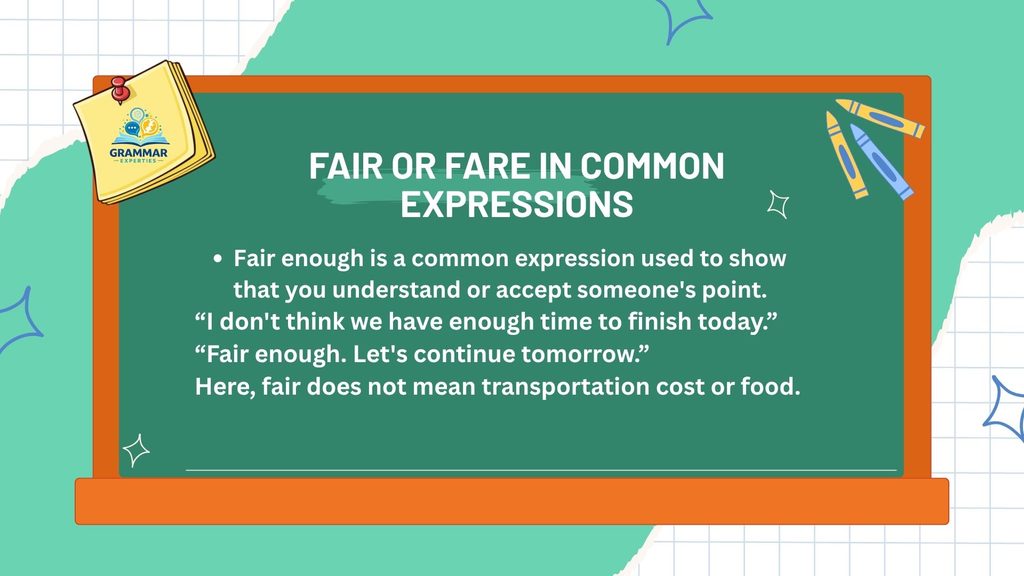
“Fair enough”
Fair enough is a common expression used to show that you understand or accept someone’s point.
“I don’t think we have enough time to finish today.”
“Fair enough. Let’s continue tomorrow.”
Here, fair does not mean transportation cost or food.
“Fair and square”
The phrase fair and square means honestly and according to the rules.
She won the competition fair and square.
The word is fair, not fare.
“Fare well”
When you mean “do well” or “perform well,” use fare.
I hope you fare well in your new job.
The students fared well on the final exam.
This distinction is especially useful because fare well sounds exactly like “fair well” when spoken.
“Farewell”
The word farewell is also connected historically with the expression fare well.
They said their farewells before leaving.
Do not write fairwell when you mean goodbye.
The spelling farewell is standard.
“Fair price” vs. “fare price”
These expressions have completely different meanings.
The seller offered a fair price.
Here, fair means reasonable.
But:
The bus fare was $5.
Here, fare means the amount charged for transportation.
A useful memory trick is to associate fare with transportation:
bus fare → train fare → taxi fare → air fare
Meanwhile:
fair price → fair treatment → fair decision → fair chance
Common Mistakes With Fair and Fare
“The taxi fair was expensive”
Incorrect:
The taxi fair was expensive.
Correct:
The taxi fare was expensive.
The word refers to the money paid for transportation, so fare is required.
“The decision was fare”
Incorrect:
The judge made a fare decision.
Correct:
The judge made a fair decision.
The meaning is “reasonable or impartial,” so use fair.
“How did you fair?”
Incorrect:
How did you fair in the competition?
Correct:
How did you fare in the competition?
Here, fare is a verb meaning “perform” or “do.”
“We went to the school fare”
Incorrect:
We went to the school fare.
Correct:
We went to the school fair.
A school event is a fair.
“The restaurant serves traditional fair”
Incorrect:
The restaurant serves traditional fair.
Correct:
The restaurant serves traditional fare.
Here, fare means the type of food served.
These mistakes happen because fair and fare are homophones. They sound alike but have different meanings and spellings.
A Simple Way to Remember Fair or Fare
Use “fair” for fairness
Think of fair as being connected with:
- equality
- justice
- reasonable treatment
- acceptable prices
- public events
- light colors
- pleasant weather
For example:
Everyone should receive a fair chance.
If you can replace the word with just, reasonable, or equal, fair is probably correct.
Use “fare” for travel costs
Think of fare when you see:
- bus fare
- train fare
- taxi fare
- air fare
- travel fare
For example:
I need money for my bus fare.
If you can replace the word with travel cost or ticket price, use fare.
Use “fare” when talking about performance
There is another useful connection:
How did you fare?
means:
How did you do?
So whenever the sentence asks about someone’s performance or progress, fare may be the correct choice.
A simple three-question test can help:
- Does it mean fair or reasonable? → fair
- Does it mean transportation cost or food? → fare
- Does it mean perform or progress? → fare
Fair or Fare: Current Usage and Reference Data
What current dictionary evidence shows
As of 2026, major English-learning reference sources continue to distinguish fair and fare as separate words with different meanings and grammatical functions.
Current Cambridge Dictionary entries identify fair as an adjective and noun with meanings including reasonable or equal treatment and public events. Its current fare entry identifies the word as a noun for transportation payment and food and as a verb meaning to succeed or progress.
This gives us a useful current reference framework:
- Fair: adjective + noun, with several established meanings.
- Fare: noun + verb, with established uses involving transportation, food, and performance.
- Fair and fare: pronounced alike in standard English varieties represented by the dictionaries, making spelling—not pronunciation—the key distinction in writing.
The Cambridge entry also provides numerous corpus examples of fare, including fare better, fare poorly, and transportation-related uses. These examples demonstrate that the verb remains part of contemporary English usage.
There is no reliable universal 2025–2026 statistic showing that a particular percentage of writers confuse fair and fare. Search-volume websites and informal articles may publish numbers, but those figures should not be presented as authoritative language-usage statistics without a transparent methodology.
Therefore, this guide uses current dictionary evidence rather than inventing a numerical “confusion rate.”
Why this matters for modern writing
Digital communication makes spelling especially important because readers usually encounter fair and fare in written form.
A pronunciation-based memory will not help much because the words sound alike. Instead, writers need to identify the meaning and grammatical role.
For example:
The hotel offered a fair price.
versus:
The hotel quoted the airline fare.
The pronunciation may be similar, but the meaning determines the spelling.
A Real-Life Example: A Small Spelling Error With a Different Meaning
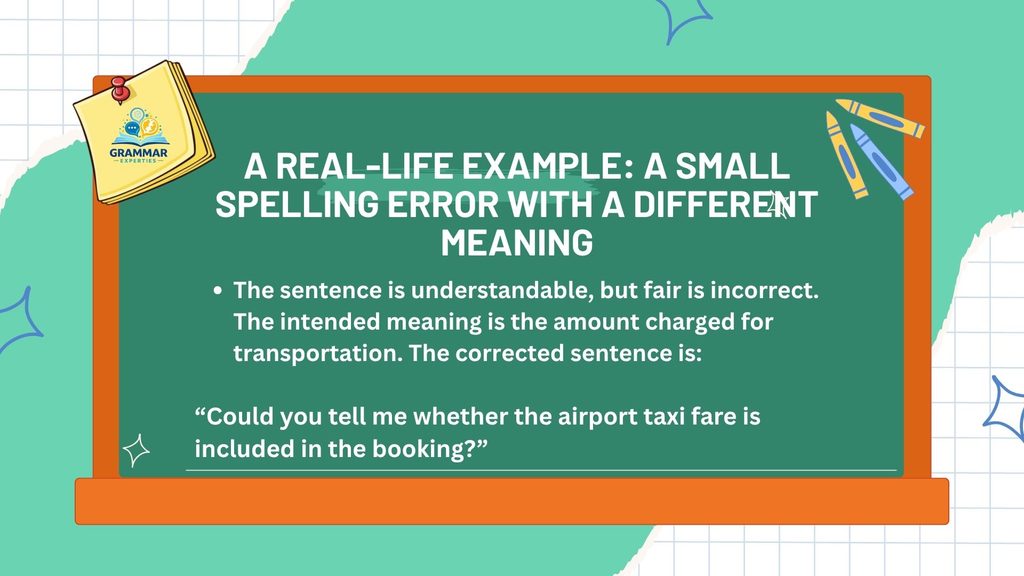
Imagine that a traveler is writing an email to a hotel before an international trip. She wants to ask whether the airport transportation is affordable, so she writes:
“Could you tell me whether the airport taxi fair is included in the booking?”
The sentence is understandable, but fair is incorrect. The intended meaning is the amount charged for transportation. The corrected sentence is:
“Could you tell me whether the airport taxi fare is included in the booking?”
Now imagine a different situation. The same traveler receives a quote from the hotel and wants to say that the amount seems reasonable. She might write:
“The airport transfer price seems fair.”
This time, fair is correct because she is describing the price as reasonable.
The two sentences demonstrate why pronunciation cannot determine the spelling. In speech, fair and fare can sound the same, but their meanings are different.
The same issue appears in education. A student might write, “How did you fair on the test?” because the student associates the sound with the word fair. The correct sentence is “How did you fare on the test?” because fare functions as a verb meaning “perform” or “do.”
This distinction is useful beyond grammar exercises. It can prevent errors in emails, business documents, travel information, school assignments, website content, and professional communication. The easiest approach is to stop focusing on pronunciation and ask what the word means in the sentence.
Fair vs. Fare: Quick Comparison Checklist
Use this checklist whenever you are unsure.
| If you mean… | Use | Example |
|---|---|---|
| Just or reasonable | fair | That is a fair decision. |
| Equal treatment | fair | Everyone deserves a fair chance. |
| Reasonable price | fair | They offered a fair price. |
| Public event | fair | We attended the book fair. |
| Light-colored hair or skin | fair | She has fair hair. |
| Pleasant, dry weather | fair | The weather was fair. |
| Transportation cost | fare | The bus fare is $3. |
| Type of food | fare | They serve traditional fare. |
| Performance or progress | fare | How did you fare? |
| Doing well or badly | fare | The team fared well. |
The one-line memory rule
Fair = just, reasonable, equal, or an event.
Fare = travel cost, food, or performance.
If you remember that distinction, most fair or fare questions become straightforward.
Fair or Fare: Example Sentences
Examples with fair
- The teacher gave every student a fair opportunity.
- That seems like a fair price.
- We visited the local fair last weekend.
- The referee made a fair decision.
- Everyone deserves fair treatment.
- She has fair hair.
- We enjoyed fair weather during our vacation.
- The competition was fair and transparent.
- He asked for a fair share of the profits.
- The school is organizing a charity fair.
Examples with fare
- The bus fare is $2.
- The train fare increased this month.
- We split the taxi fare.
- What is the cheapest air fare?
- The restaurant serves traditional local fare.
- How did you fare in the interview?
- The students fared well on the exam.
- The company fared poorly during the difficult period.
- I hope you fare well in your new position.
- The airline offers several different fares.
Mini Quiz:Fair or Fare
1. Choose the correct word:
The teacher gave every student a ___ chance.
A) Fair
B) Fare
C) Fear
D) Faer
Answer: A) Fair
2. Choose the correct word:
How much is the bus ___?
A) Fair
B) Fare
C) Fear
D) Faer
Answer: B) Fare
3. Which sentence is correct?
A) The judge made a fare decision.
B) The judge made a fair decision.
C) The judge made a fear decision.
D) The judge made a faer decision.
Answer: B) The judge made a fair decision.
4. Choose the correct word:
How did you ___ in the competition?
A) Fair
B) Fare
C) Fear
D) Faer
Answer: B) Fare
5. Choose the correct word:
We visited the school ___ last Saturday.
A) Fare
B) Fair
C) Fear
D) Faer
Answer: B) Fair
6. What does “fair” mean in “a fair price”?
A) Transportation cost
B) Reasonable price
C) Food
D) Performance
Answer: B) Reasonable price
7. What does “fare” mean in “bus fare”?
A) A reasonable decision
B) A public event
C) Transportation cost
D) Light color
Answer: C) Transportation cost
8. True or False:
“Fare” can refer to the type of food served.
Answer: True
9. Choose the correct expression:
A) Fair well
B) Fare well
C) Fear well
D) Faer well
Answer: B) Fare well
10. Choose the correct word:
The airline ___ was quite expensive.
A) Fair
B) Fare
C) Fear
D) Faer
Answer: B) Fare
11. Choose the correct word:
She has ___ hair.
A) Fare
B) Fair
C) Fear
D) Faer
Answer: B) Fair
12. Which word means “reasonable or just”?
A) Fare
B) Fair
C) Fear
D) Faer
Answer: B) Fair
13. Choose the correct word:
The restaurant serves traditional Italian ___.
A) Fair
B) Fare
C) Fear
D) Faer
Answer: B) Fare
14. True or False:
“Fair price” means the price charged for transportation.
Answer: False
Correction: “Fair price” means a reasonable or acceptable price.
15. Which sentence is correct?
A) The train fair increased.
B) The train fare increased.
C) The train fear increased.
D) The train faer increased.
Answer: B) The train fare increased.
16. Which of these can “fare” mean?
A) Transportation cost
B) Type of food
C) Perform or progress
D) All of the above
Answer: D) All of the above
17. Choose the correct word:
Everyone deserves ___ treatment.
A) Fare
B) Fair
C) Fear
D) Faer
Answer: B) Fair
18. Choose the correct word:
The team ___ well during the tournament.
A) Fair
B) Fare
C) Faired
D) Fared
Answer: D) Fared
19. Choose the correct word:
The taxi ___ was $20.
A) Fair
B) Fare
C) Fear
D) Faer
Answer: B) Fare
20. What does “fare” mean in “How did you fare on the exam?”
A) How much did you pay?
B) How did you perform?
C) Which event did you attend?
D) Was the exam fair?
Answer: B) How did you perform?
21. Which sentence uses “fair” correctly?
A) The bus fair was expensive.
B) The taxi fair was $10.
C) The competition was fair.
D) How did you fair?
Answer: C) The competition was fair.
22. Which sentence uses “fare” correctly?
A) She received fare treatment.
B) The train fare increased.
C) He made a fare decision.
D) It was a fare competition.
Answer: B) The train fare increased.
23. Choose the correct word:
The two teams received ___ treatment.
A) Fare
B) Fair
C) Fear
D) Faer
Answer: B) Fair
24. Which memory rule is correct?
A) Fair = reasonable; Fare = travel cost, food, or performance
B) Fair = travel cost; Fare = reasonable
C) Fair and fare always have the same meaning
D) Fare is only used for buses
Answer: A) Fair = reasonable; Fare = travel cost, food, or performance
25. Choose the correct word:
I hope you ___ well in your new career.
A) Fair
B) Fare
C) Fear
D) Faer
Answer: B) Fare
Fair or Fare: FAQs
Q1:Is “fair” or “fare” correct?
Both fair and fare are correct English words, but they have different meanings. Use fair for meanings such as reasonable, equal, light-colored, or a public event. Use fare for transportation costs, food, or someone’s performance.
Q2:Is it “bus fair” or “bus fare”?
The correct expression is bus fare. Fare means the amount of money paid to travel by bus, train, taxi, or another form of transportation.
The bus fare has increased.
Q3:Is it “fair well” or “fare well”?
The standard expression meaning “do well” is fare well.
I hope you fare well in your new job.
However, fair well can occur in a literal or unusual context where fair is being used as a verb, but it is not the normal expression for wishing someone success.
Q4:Is “fair price” correct?
Yes. Fair price is correct when you mean a reasonable or acceptable price.
The seller offered me a fair price for the car.
Q5:Is it “fair” or “fare” for food?
Use fare when you mean the type of food served.
The restaurant offers traditional Italian fare.
Q6:Is “How did you fare?” correct?
Yes. How did you fare? is grammatically correct. Here, fare is a verb meaning “how did you do?” or “how did you perform?”
Q7:Are fair and fare homophones?
Yes. Fair and fare are homophones in standard varieties of English because they are pronounced alike while having different spellings and meanings.
Q8:What is the easiest way to remember fair and fare?
Associate fair with fairness: fair treatment, fair decision, fair chance.
Associate fare with travel and performance: bus fare, train fare, how did you fare?
Conclusion: Fair or Fare – Which One Is Correct?
So, fair or fare? The answer depends on the meaning.
Use fair when you mean reasonable, equal, impartial, light-colored, pleasant in terms of weather, or a public event. Use fare when you mean a transportation cost, a type of food, or the way someone or something performs.
Remember these four examples:
- Fair treatment
- Fair price
- Bus fare
- How did you fare?
Once you focus on meaning instead of pronunciation, the distinction becomes much easier.
If you are writing an email, article, assignment, business document, or website content, take a second to check the context before choosing fair or fare. A small spelling difference can completely change the meaning of a sentence.
For more clear explanations of commonly confused English words and spelling mistakes, explore related grammar and usage guides and keep building your vocabulary one word at a time.
Explore more easy grammar lessons and improve your English with Grammar Expertise
References

Maimoona Mughal is an English grammar enthusiast dedicated to simplifying confusing words, grammar rules, and vocabulary through clear, accurate, and learner-friendly content that helps readers write and communicate with confidence.