If you have ever wondered whether the correct spelling is shiney or shiny, you are not alone. The two forms look almost identical, and the confusion is understandable because the word comes from shine. It may seem logical to keep the final e and write shiney. However, standard English uses shiny.
Shiny is the correct spelling when you mean something that is bright, glossy, polished, or reflective. Shiney is generally a misspelling of shiny and should be avoided in standard English.
In this guide, you’ll learn the difference between shiney vs shiny, why the mistake happens, how to use shiny correctly, and an easy way to remember the spelling.
Shiney vs Shiny: Which Spelling Is Correct?
The short answer is simple:
Shiny is the correct spelling. Shiney is generally incorrect when you mean bright, glossy, or reflective.
The word shiny is an adjective. It describes something that reflects light or has a smooth, bright, or glossy appearance. Cambridge Dictionary lists shiny as an adjective and gives examples involving shiny hair, shoes, leather, marble, and other surfaces.
| Spelling | Correct? | Meaning | Example |
|---|---|---|---|
| shiny | ✅ Yes | Bright, glossy, polished, or reflective | The car looks shiny. |
| shiney | ❌ No, in standard usage | Usually intended to mean shiny | The car looks shiney. |
Therefore, if you’re writing an essay, email, article, product description, school assignment, or business document, choose shiny.
The quick spelling rule
Remember this simple transformation:
shine → shiny
Not:
shine → shiney
The final e disappears before the adjective ending -y.
Why does “shiney” look correct?
The confusion comes from the base word shine.
A writer may naturally think:
shine + y = shiney
That looks reasonable at first. However, English spelling does not always preserve the final silent e when a word changes form.
The established adjective is:
shine → shiny
So although shiney may look logical, it is not the standard spelling of the adjective.
What Does “Shiny” Mean?
Shiny means bright or glossy because a surface reflects light. It can describe objects, materials, hair, shoes, furniture, vehicles, packaging, and many other things.
For example:
- The new car has a shiny black finish.
- She wore shiny black shoes.
- His hair looked shiny in the sunlight.
- The polished table was smooth and shiny.
- I found a shiny coin on the ground.
Cambridge Dictionary also records shiny in both British and American English, with the pronunciation /ˈʃaɪ.ni/.
Shiny as an adjective
The word shiny normally functions as an adjective because it describes a noun.
For example:
She bought a shiny necklace.
Here, shiny describes the necklace.
Another example:
The floor looks shiny after cleaning.
Here, shiny describes the appearance of the floor.
Shiny can describe more than objects
Although shiny commonly describes physical surfaces, it can also be used figuratively.
For example:
The company launched a shiny new website.
In this sentence, shiny does not necessarily mean the website literally reflects light. It can suggest that something is new, attractive, impressive, or appealing.
This figurative use is especially common in informal English.
Shiny, shinier, and shiniest
The word also has comparative and superlative forms:
- shiny
- shinier
- shiniest
Examples:
This car is shiny.
This car is shinier than mine.
That is the shiniest car in the showroom.
Notice that none of these forms uses shiney.
Why Is “Shiney” a Common Spelling Mistake?
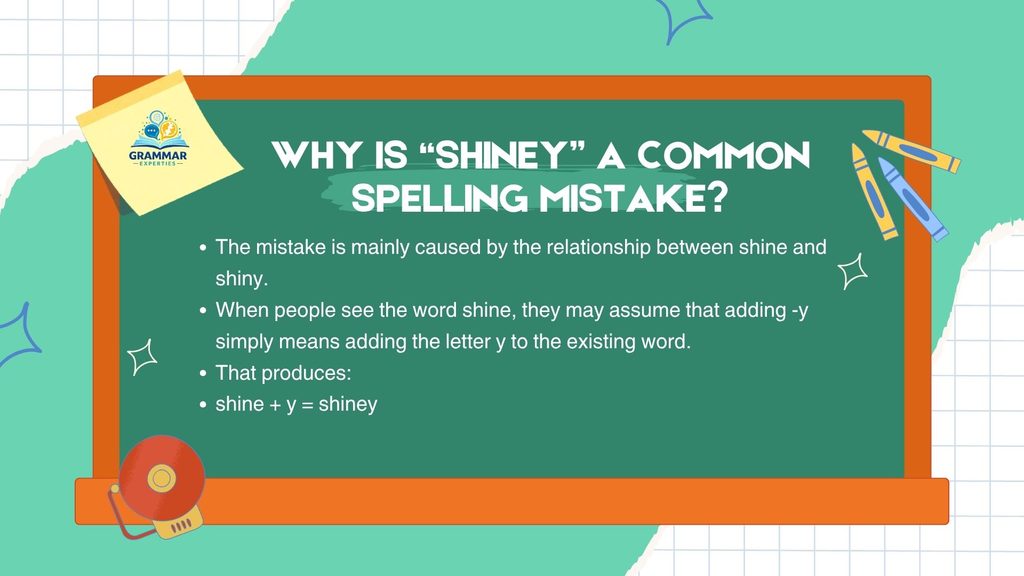
The mistake is mainly caused by the relationship between shine and shiny.
When people see the word shine, they may assume that adding -y simply means adding the letter y to the existing word.
That produces:
shine + y = shiney
But the standard spelling removes the final e:
shine → shiny
This type of spelling change is familiar in several English words.
For example:
- noise → noisy
- ice → icy
- spice → spicy
- scare → scary
- shine → shiny
These examples can help you recognize the pattern.
The pronunciation does not solve the problem
Another reason the error survives is pronunciation.
Shiny is pronounced approximately SHY-nee. The final e in shine is not pronounced separately, so hearing the word does not tell you whether an e belongs in the spelling.
That means this is primarily a spelling issue rather than a pronunciation issue.
The easiest memory trick
Use this rule:
Shine loses its e before becoming shiny.
Think of it as:
SHINE → SHINY
If you remember that transformation, you can avoid the extra e.
Shiny vs Shiney in Real-World Writing
The difference may seem small, but correct spelling matters when your writing needs to look polished and professional.
Imagine a product description that says:
This phone has a shiney metal finish.
The reader will probably understand the sentence. However, the spelling error can make the description look less carefully edited.
The professional version is:
This phone has a shiny metal finish.
In school and academic writing
Always use shiny in school assignments, essays, reports, and examinations.
Incorrect:
The bird had shiney feathers.
Correct:
The bird had shiny feathers.
In business writing
The same rule applies to emails, reports, brochures, advertisements, and product pages.
Incorrect:
Our new model comes with a shiney exterior.
Correct:
Our new model comes with a shiny exterior.
In everyday writing
Even in casual messages, shiny remains the correct spelling.
For example:
Look at that shiny new bike!
There is no need to switch to shiney just because the writing is informal.
In search queries and online content
You may encounter shiney online because people make spelling mistakes, type quickly, or intentionally use unusual spellings for usernames and names.
However, frequency of appearance does not automatically make a spelling standard.
For edited English, use shiny.
Shiney vs Shiny: Comparison Guide
The following table gives you a quick way to distinguish the two forms.
| Feature | Shiny | Shiney |
|---|---|---|
| Standard English spelling | ✅ Yes | ❌ No |
| Part of speech | Adjective | Not standard as this adjective |
| Meaning | Bright, glossy, polished, reflective | Usually intended to mean shiny |
| Formal writing | ✅ Use it | ❌ Avoid it |
| Academic writing | ✅ Use it | ❌ Avoid it |
| Business writing | ✅ Use it | ❌ Avoid it |
| Common phrases | Shiny shoes, shiny hair, shiny surface | No standard equivalent |
| Comparative | Shinier | Not shineyer |
| Superlative | Shiniest | Not shineyest |
The distinction is straightforward: shiny is the standard adjective.
Shiny vs Shining: Are They the Same?
People sometimes confuse shiny with shining because both words are related to shine. However, they are not always interchangeable.
Shiny usually describes an appearance or surface.
The floor is shiny.
Shining often describes something that is actively producing or reflecting light, or it can function as the present participle of shine.
The sun is shining.
Compare these:
She has shiny hair.
The sun is shining through the window.
The first sentence describes the appearance of the hair. The second describes an ongoing action or condition involving light.
Shiny vs glossy
Glossy is a close synonym of shiny, particularly when discussing surfaces.
For example:
The magazine has a glossy cover.
You could sometimes use:
The magazine has a shiny cover.
However, glossy often emphasizes a smooth, polished surface, while shiny focuses more broadly on brightness or reflected light.
Shiny vs bright
Bright is broader than shiny.
A light can be bright without being shiny:
The bright lamp filled the room.
A surface can be shiny because it reflects light:
The shiny floor reflected the ceiling lights.
Therefore, choose the word according to what you want to describe.
A Simple Case Study: Correcting “Shiney” in a Product Description
Imagine a small online store preparing a product page for a new black handbag. The first draft says:
“This elegant handbag features a shiney exterior, silver hardware, and a comfortable adjustable strap.”
The meaning is obvious, but the spelling error makes the product description look less polished.
An editor reviewing the page notices the word shiney and checks whether it is the standard adjective. The correct form is shiny, so the sentence becomes:
“This elegant handbag features a shiny exterior, silver hardware, and a comfortable adjustable strap.”
The change involves only one letter, but it improves the professionalism of the sentence.
Now imagine that the same mistake appears on ten product pages. A customer may not consciously identify the problem, but repeated spelling errors can make the website appear poorly edited.
The lesson is useful beyond ecommerce. Whether you’re writing a school assignment, blog article, email, advertisement, resume, or business report, small spelling details contribute to the overall quality of your writing.
The practical editing process is simple: identify the base word shine, remember that the adjective is shiny, and replace shiney whenever it is being used as the ordinary adjective.
2025–2026 Data and Evidence Snapshot

There is an important distinction between dictionary evidence and internet search frequency.
A search engine may show instances of shiney, but those occurrences can come from misspellings, usernames, names, brands, or other nonstandard uses. They should not be treated as evidence that shiney has become an accepted alternative spelling.
Current dictionary evidence remains clear. Cambridge Dictionary lists shiny as an English adjective in its British and American entries and defines it in relation to brightness caused by reflected light. Its current entries also list shinier and shiniest as the comparative and superlative forms.
Google’s current people-first guidance likewise emphasizes creating useful, reliable content that satisfies the reader rather than writing primarily to manipulate search rankings. Google Search Essentials, updated in December 2025, recommends using the words people actually search for while prioritizing helpful, reliable content.
For this spelling question, the practical evidence can therefore be summarized as follows:
- 1 standard adjective: shiny
- 2 major English varieties checked in Cambridge: UK and US
- 2 accepted comparative forms: shinier and shiniest
- 1 recommended standard spelling: shiny
- 1 common mistaken form: shiney
The key point is not how often the misspelling appears online. The important question is which form is recognized and appropriate in standard edited English.
How to Remember “Shiny” Correctly
If you frequently confuse shiney vs shiny, use one of these memory techniques.
Remember “shine without e”
Think:
SHINE – E + Y = SHINY
Start with:
SHINE
Remove the final E:
SHIN
Add Y:
SHINY
This gives you the correct five-letter spelling.
Connect shiny with similar patterns
You can also remember similar transformations:
- ice → icy
- noise → noisy
- spice → spicy
- shine → shiny
These examples show why keeping the final e is unnecessary in shiny.
Watch for the “shiney” trap
Whenever you type:
shiney
stop and ask:
Am I describing something bright, glossy, or reflective?
If the answer is yes, change it to:
shiny
That quick check can prevent the error.
Examples of “Shiny” in Sentences
Here are several natural examples:
- The polished floor looked shiny.
- She bought a pair of shiny black shoes.
- The children were fascinated by the shiny object.
- His new bicycle has a shiny silver frame.
- Her hair looked shiny after she washed it.
- The manufacturer gave the product a shiny finish.
- The kitchen has shiny white cabinets.
- The coin was old but surprisingly shiny.
- We wrapped the gift in shiny paper.
- The freshly washed car looked shiny in the sunlight.
Incorrect examples
These sentences contain the common spelling mistake:
- The car looks shiney. ❌
- She has shiney hair. ❌
- I bought shiney shoes. ❌
- The floor became shiney after polishing. ❌
Correct them to:
- The car looks shiny. ✅
- She has shiny hair. ✅
- I bought shiny shoes. ✅
- The floor became shiny after polishing. ✅
Mini Quiz:Shiney vs Shiny
- Which spelling is correct?
A) Shiney
B) Shiny
C) Shinney
D) Shinie
Answer: B) Shiny
- Which sentence is correct?
A) The car is shiney.
B) The car is shiny.
C) The car is shinney.
D) The car is shine.
Answer: B) The car is shiny.
- What does shiny mean?
A) Rough
B) Dark
C) Bright or reflective
D) Heavy
Answer: C) Bright or reflective
- True or False: Shiney is the standard spelling of the adjective.
Answer: False
- Complete the sentence: “She wore ______ black shoes.”
A) shiney
B) shiny
C) shinney
D) shine
Answer: B) shiny
- What is the correct comparative form of shiny?
A) Shineyer
B) Shinyer
C) Shinier
D) Shineier
Answer: C) Shinier
- What is the correct superlative form of shiny?
A) Shinyest
B) Shineyest
C) Shiniest
D) Shineiest
Answer: C) Shiniest
- True or False: The correct spelling is shiny, without the final e from shine.
Answer: True
- Which sentence is correct?
A) Her hair looks shiny.
B) Her hair looks shiney.
C) Her hair looks shinney.
D) Her hair looks shine.
Answer: A) Her hair looks shiny.
- Which word is closest in meaning to shiny when describing a surface?
A) Glossy
B) Rough
C) Dull
D) Dry
Answer: A) Glossy
- What is the base word related to shiny?
A) Shin
B) Shine
C) Shiney
D) Shining
Answer: B) Shine
- Which phrase is correctly spelled?
A) Shiney shoes
B) Shiny shoes
C) Shinney shoes
D) Shinie shoes
Answer: B) Shiny shoes
- Which spelling should you use in a formal essay?
A) Shiney
B) Shiny
C) Shiney
D) Shinney
Answer: B) Shiny
- Complete the sentence: “The polished table looked ______.”
A) shiney
B) shiny
C) shinney
D) shineyly
Answer: B) shiny
- Which spelling contains an unnecessary e?
A) Shiny
B) Shinier
C) Shiney
D) Shiniest
Answer: C) Shiney
- Which transformation is correct?
A) Shine → Shiney
B) Shine → Shiny
C) Shine → Shinney
D) Shine → Shineie
Answer: B) Shine → Shiny
- Which sentence is correct?
A) The floor became shiney after cleaning.
B) The floor became shiny after cleaning.
C) The floor became shinney after cleaning.
D) The floor became shine after cleaning.
Answer: B) The floor became shiny after cleaning.
- True or False: Shinier is the comparative form of shiny.
Answer: True
- True or False: Shinyest is the correct superlative form of shiny.
Answer: False
- Which word describes a surface that reflects light?
A) Dull
B) Shiny
C) Rough
D) Matte
Answer: B) Shiny
- Complete the sentence: “The coin was surprisingly ______.”
A) shiney
B) shiny
C) shinney
D) shine
Answer: B) shiny
- Which sentence is correct?
A) This car is shinier than mine.
B) This car is shineyer than mine.
C) This car is shinyer than mine.
D) This car is shineier than mine.
Answer: A) This car is shinier than mine.
- Which sentence uses the superlative correctly?
A) It is the shinyest object here.
B) It is the shineyest object here.
C) It is the shiniest object here.
D) It is the shineiest object here.
Answer: C) It is the shiniest object here.
- True or False: Shiney is generally a misspelling when the intended word is shiny.
Answer: True
- Which sentence is completely correct?
A) The shiney car looked beautiful.
B) The shinney car looked beautiful.
C) The shiny car looked beautiful.
D) The shine car looked beautiful.
Answer: C) The shiny car looked beautiful.
Frequently Asked Questions About Shiney vs Shiny
Q1:Is it shiny or shiney?
Shiny is the correct spelling. Shiney is generally a misspelling when you mean something bright, glossy, polished, or reflective.
Q2:Why is shiny spelled without an e?
The standard form is shiny, formed from shine with the final e removed before the adjective ending -y.
Q3:Is shiney a word?
Shiney is not the standard spelling of the adjective meaning bright or glossy. It can potentially appear as a deliberately chosen name, username, title, or other proper name, but ordinary English writing should use shiny.
Q4:What does shiny mean?
Shiny means bright, glossy, polished, or reflective. Cambridge Dictionary defines a shiny surface as bright because it reflects light.
Q5:Is shiny an adjective?
Yes. Shiny is an adjective because it describes a noun.
For example:
The shiny car was parked outside.
Q6:What is the comparative form of shiny?
The comparative form is shinier.
Example:
This table is shinier than the old one.
Q7:What is the superlative form of shiny?
The superlative form is shiniest.
Example:
That was the shiniest object in the room.
Q8:Is shiny the same as shining?
No. They are related but have different uses. Shiny usually describes an appearance or surface, while shining commonly describes the action or state of producing or reflecting light.
Final Verdict: Shiney or Shiny?
When you’re choosing between shiney vs shiny, the answer is clear: shiny is the correct standard spelling.
Use shiny when describing something that is bright, glossy, polished, smooth, or reflective:
The car has a shiny finish.
She wore shiny black shoes.
The floor looks shiny after cleaning.
Avoid shiney in standard English because it is generally a misspelling caused by keeping the final e from shine.
The easiest rule to remember is:
shine → shiny
So, whenever you’re unsure, drop the e and write shiny.
Explore more easy grammar lessons and improve your English with Grammar Expertise
References
Cambridge Dictionary — Shiny
Google Search Central — Creating Helpful, Reliable, People-First Content

Maimoona Mughal is an English grammar enthusiast dedicated to simplifying confusing words, grammar rules, and vocabulary through clear, accurate, and learner-friendly content that helps readers write and communicate with confidence.