
Hoofs or Hooves: Which Is Correct?
The short answer
Both hoofs and hooves are correct.
The singular noun is:
hoof
The two accepted plural forms are:
hoof → hoofs
hoof → hooves
Cambridge Dictionary lists both hoofs and hooves as plural forms of hoof. Its American Dictionary entry also recognizes both forms.
However, if you’re choosing one form for ordinary modern writing, hooves is usually the safest choice.
What does “hoof” mean?
A hoof is the hard part at the end of the foot of certain animals, particularly animals such as horses, cattle, sheep, goats, and deer.
For example:
- The horse lifted one hoof.
- The cow injured its hoof.
- The deer had a small hoofprint in the mud.
When you’re talking about more than one hoof, you can use either hooves or hoofs.
Quick comparison
| Form | Correct? | Commonness | Example |
|---|---|---|---|
| Hoof | Yes | Singular | The horse injured its hoof. |
| Hooves | Yes | Very common | The horses’ hooves were muddy. |
| Hoofs | Yes | Less common | The horses’ hoofs were muddy. |
So, you don’t need to worry that hoofs is automatically a spelling mistake. It isn’t.
Why Are Both Hoofs and Hooves Correct?
Hoof → hooves
Hooves is the plural form you’ll most often encounter in modern general writing.
It follows a pattern that appears in several English words where a word ending in -f develops a plural ending in -ves.
For example:
- hoof → hooves
- leaf → leaves
- wolf → wolves
- wife → wives
However, English doesn’t apply this pattern consistently to every word ending in -f. That’s one reason plural forms can be difficult for English learners.
Examples such as these show why it’s better to learn the accepted plural of each word rather than assume every -f word changes to -ves.
Hoof → hoofs
Hoofs is also a legitimate plural.
It simply adds the regular plural ending -s:
hoof + s = hoofs
You may encounter this form in British English, older writing, specialized contexts, quotations, or writing where the author prefers the regular plural pattern.
The Chicago Manual of Style notes that hooves is the most common plural in American English, while hoofs is used in British English.
Why does English allow both?
English has accumulated different plural patterns over centuries. Some nouns developed irregular or alternative plural forms, while others retained a straightforward -s plural.
As a result, hoof ended up with two established plural forms:
- hooves
- hoofs
This isn’t unusual in English. Language often preserves older forms while newer or more common forms develop alongside them.
Hoofs or Hooves: Which One Should You Use?

Use “hooves” for most modern writing
If you’re writing a blog post, school assignment, article, general website content, or everyday sentence, hooves is usually the best choice.
For example:
The horse’s hooves were covered in mud.
The farmer checked the cattle’s hooves carefully.
The deer left several hoofprints in the snow.
Choosing hooves helps your writing sound natural to most contemporary English readers.
When can you use “hoofs”?
You can use hoofs when the context calls for it or when you’re following a particular regional, historical, or stylistic preference.
For example:
The horses’ hoofs struck the frozen ground.
The sentence is grammatically acceptable. It simply sounds less common to many modern readers than:
The horses’ hooves struck the frozen ground.
If you’re editing someone else’s writing, don’t automatically change hoofs to hooves. First consider the author’s intended variety and style.
British and American usage
Regional preference can influence which form you see more often.
The Chicago Manual of Style states that hooves is the most common plural in American English and identifies hoofs as the British English form.
Cambridge provides a broader picture by recognizing both forms and showing examples of each in its dictionary and corpus material.
This means you should avoid saying:
“Hoofs is wrong.”
A more accurate statement is:
“Hooves is generally the more common modern choice, but hoofs is also correct.”
Hoofs or Hooves in Modern English: 2025–2026 Evidence
Current dictionary evidence
Modern dictionary evidence confirms that both forms remain valid.
Cambridge Dictionary gives hoof as the singular noun and lists hoofs or hooves as its plural forms. The American Dictionary section also recognizes both plural spellings.
This is important because online spelling discussions sometimes incorrectly label hoofs as obsolete or incorrect.
It isn’t.
Regional usage evidence
The Chicago Manual of Style provides a useful regional distinction: hooves is the most common plural in American English, while hoofs is used in British English. The guidance is based on the 18th edition of the manual, published in 2024, making it particularly relevant to current usage.
So, for 2025–2026 writing, the practical takeaway is simple:
Hooves is the safer general-purpose choice, but hoofs remains a correct alternative.
What the current data does and doesn’t show
There isn’t a single authoritative percentage that tells us exactly what proportion of English speakers use hooves versus hoofs worldwide.
Therefore, it’s better not to invent a precise percentage.
Instead, reliable dictionary and style-guide evidence gives us a clear qualitative picture:
- Both forms are recognized.
- Hooves is highly common in modern English.
- Hoofs remains grammatically valid.
- Regional English can influence the preferred form.
That’s more useful for writers than an unsupported statistic.
How to Use Hoofs and Hooves Correctly
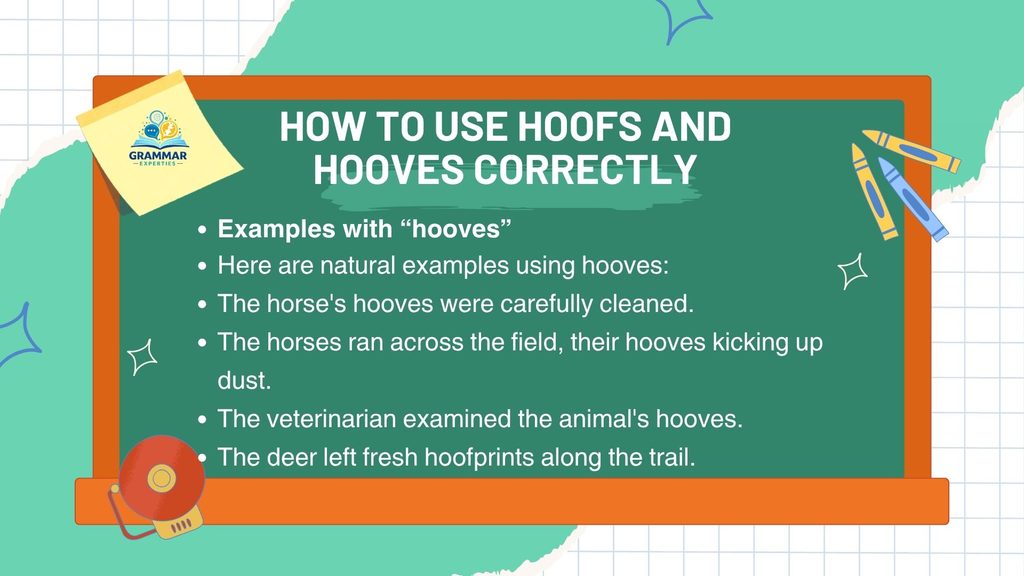
Examples with “hooves”
Here are natural examples using hooves:
- The horse’s hooves were carefully cleaned.
- The horses ran across the field, their hooves kicking up dust.
- The veterinarian examined the animal’s hooves.
- The deer left fresh hoofprints along the trail.
- The goat had damaged one of its hooves.
- The sound of hooves echoed through the valley.
- The farmer checks the cattle’s hooves regularly.
- Mud covered the horse’s hooves after the ride.
Examples with “hoofs”
Hoofs can also be used correctly:
- The horses’ hoofs struck the ground.
- The farmer inspected the animals’ hoofs.
- The sound of galloping hoofs came from the stable.
- The cattle lifted their hoofs as they crossed the stream.
- The old poem described the horse’s shining hoofs.
Notice that changing hooves to hoofs doesn’t change the basic meaning.
Common mistakes
One common mistake is assuming that only hooves is correct.
For example:
❌ “Hoofs is always wrong.”
That’s incorrect because dictionaries recognize hoofs as a valid plural form.
Another mistake is using the singular form when you mean several feet:
❌ The horses injured one hoofs.
Correct:
✅ The horses injured their hooves.
Or:
✅ The horses injured their hoofs.
The possessive also matters:
horse’s hoof = one hoof belonging to one horse
horse’s hooves = several hooves belonging to one horse
horses’ hooves = hooves belonging to multiple horses
A Real-Life Editing Case Study: Choosing Between Hoofs and Hooves
Choosing a form for a modern article
Imagine you’re editing a 2026 article about horse care. The original draft contains this sentence:
“Regular inspection of your horse’s hoofs is essential for maintaining healthy feet.”
You check the sentence and wonder whether hoofs should be changed.
Technically, there is no grammatical error. Hoofs is an accepted plural form. However, you’re writing for a broad modern audience, including American and international English readers.
In that situation, changing the sentence to:
“Regular inspection of your horse’s hooves is essential for maintaining healthy feet.”
would probably make the wording feel more familiar to a larger general audience.
Now consider a different situation. You’re editing a historical novel containing dialogue written in an intentionally old-fashioned style:
“The hoofs of the mighty horses thundered across the field.”
Here, automatically replacing hoofs with hooves might actually weaken the author’s chosen style.
This demonstrates an important editing principle: correctness and preferred usage aren’t always the same thing.
Both spellings can be correct, but the context determines which one sounds most appropriate.
Preserving an author’s intended style
Suppose you’re proofreading a British publication that consistently uses hoofs.
You don’t need to replace every occurrence with hooves simply because hooves is more familiar to you.
Instead, check:
- the publication’s style guide
- the target audience
- regional English
- the author’s established word choices
- whether the text is historical or modern
Good editing isn’t just about replacing words with the form you personally prefer. It’s about choosing the form that fits the communication goal.
Mini Quiz:Hoofs or Hooves
1. What is the singular form of “hooves”?
A. Hoof
B. Hooves
C. Hoofs
D. Hooving
Answer: A. Hoof
2. Which two forms are accepted plurals of “hoof”?
A. Hoofs and hooves
B. Hoofes and hooves
C. Hoofs and hoofies
D. Hooves and hoofsies
Answer: A. Hoofs and hooves
3. Which plural form is generally more common in modern English?
A. Hoof
B. Hoofs
C. Hooves
D. Hoofes
Answer: C. Hooves
4. Which sentence is correct?
A. The horse injured its hooves.
B. The horse injured its hoofs only one.
C. The horse injured its hoove.
D. The horse injured its hoofes.
Answer: A. The horse injured its hooves.
5. Is “hoofs” a correct English word?
A. Yes
B. No
C. Only as a verb
D. Only in spelling tests
Answer: A. Yes
6. What does “hoof” refer to?
A. A horse’s mane
B. The hard part at the end of certain animals’ feet
C. An animal’s tail
D. A type of saddle
Answer: B. The hard part at the end of certain animals’ feet
7. Choose the correct sentence.
A. The horse’s hooves were muddy.
B. The horse’s hooves was muddy.
C. The horse hooves was muddy.
D. The horse’s hoofes were muddy.
Answer: A. The horse’s hooves were muddy.
8. Which spelling is usually the safest choice for general modern writing?
A. Hoofes
B. Hoofs
C. Hooves
D. Hoovess
Answer: C. Hooves
9. Which sentence correctly uses “hoofs”?
A. The horses’ hoofs hit the ground.
B. The horses’ hoofes hit the ground.
C. The horses’ hooveses hit the ground.
D. The horses’ hoof hit the ground.
Answer: A. The horses’ hoofs hit the ground.
10. What is the plural of “hoof”?
A. Hoofes only
B. Hooves or hoofs
C. Hoofies
D. Hoofsies
Answer: B. Hooves or hoofs
11. Which sentence uses “hooves” correctly?
A. The deer left hoofprints in the snow.
B. The deer left hoovesprint in the snow.
C. The deer left hoofsprints only.
D. The deer left hoofprintes.
Answer: A. The deer left hoofprints in the snow.
12. Which form is associated with British usage in the Chicago Manual of Style?
A. Hooves
B. Hoofs
C. Hoofes
D. Hooving
Answer: B. Hoofs
13. Which plural is identified as the most common American English form by the Chicago Manual of Style?
A. Hoofs
B. Hooves
C. Hoofes
D. Hoof
Answer: B. Hooves
14. Which sentence is grammatically correct?
A. The farmer checked the cow’s hooves.
B. The farmer checked the cow’s hoofses.
C. The farmer checked the cows hoof.
D. The farmer checked the cow hoove.
Answer: A. The farmer checked the cow’s hooves.
15. Can “hoofs” and “hooves” have the same basic meaning?
A. Yes
B. No
C. Only when talking about birds
D. Only when used as verbs
Answer: A. Yes
16. Which word is spelled correctly?
A. Hooves
B. Hoofes
C. Hoovves
D. Hooveses
Answer: A. Hooves
17. Complete the sentence: “The veterinarian examined the horse’s _____.”
A. hooves
B. hoofes
C. hoovess
D. hoofies
Answer: A. hooves
18. Which statement is correct?
A. Only “hooves” is correct.
B. Only “hoofs” is correct.
C. Both “hooves” and “hoofs” are accepted plurals.
D. Neither form is correct.
Answer: C. Both “hooves” and “hoofs” are accepted plurals.
19. Which sentence uses the singular correctly?
A. The horse has one hoof.
B. The horse has one hooves.
C. The horse has one hoofs.
D. The horse has one hoofes.
Answer: A. The horse has one hoof.
20. Which sentence correctly refers to several horses?
A. The horses lifted their hooves.
B. The horses lifted their hoof.
C. The horses lifted their hoofes.
D. The horses lifted their hoove.
Answer: A. The horses lifted their hooves.
21. Which word means a mark left by an animal’s hoof?
A. Hoofprint
B. Hoofing
C. Hooveship
D. Hoofness
Answer: A. Hoofprint
22. Which sentence is correct?
A. The sound of hooves echoed through the valley.
B. The sound of hoofes echoed through the valley.
C. The sound of hoove echoed through the valley.
D. The sound of hoofs were echoed through the valley.
Answer: A. The sound of hooves echoed through the valley.
23. If you are writing for a broad modern audience, which form is generally preferable?
A. Hoofes
B. Hoofs
C. Hooves
D. Hoofies
Answer: C. Hooves
24. Which sentence contains an incorrect plural?
A. The horse injured its hoof.
B. The horses injured their hooves.
C. The horses injured their hoofs.
D. The horses injured their hoofes.
Answer: D. The horses injured their hoofes.
25. What is the best final rule to remember?
A. Hoofs is always wrong.
B. Hooves is always wrong.
C. Both are correct, but hooves is generally the better default for modern writing.
D. Neither form can be used as a plural.
Answer: C. Both are correct, but hooves is generally the better default for modern writing.
FAQs About Hoofs or Hooves
Q1:Is “hooves” the correct plural of hoof?
Yes. Hooves is a correct and very common plural of hoof. Cambridge Dictionary also recognizes hoofs as an alternative plural.
Q2:Is “hoofs” also correct?
Yes. Hoofs is a valid plural form of hoof. It is less common in much modern general usage, but it isn’t a spelling error.
Q3:Which is more common, hoofs or hooves?
Hooves is generally the more common choice in modern English. The Chicago Manual of Style specifically identifies it as the most common American English plural.
Q4:Should I use hoofs or hooves in American English?
For most American English writing, hooves is the safest and most natural choice. However, hoofs is still a recognized plural form.
Q5:Is hoofs British English?
Hoofs is associated with British usage in the Chicago Manual of Style, but it isn’t exclusively British. Both hoofs and hooves are recognized by Cambridge.
Q6:What is the plural of hoof?
The plural can be hooves or hoofs.
Singular: hoof
Plural: hooves / hoofs
Q7:Are “hoofs” and “hooves” pronounced differently?
Generally, they are pronounced similarly because the difference is primarily in spelling and plural formation rather than meaning.
Q8:Which spelling should I use in an SEO article?
For a broad modern audience, hooves is usually the better choice because it is highly familiar and widely used. You can still mention hoofs as the accepted alternative to answer readers who encounter that spelling.
Final Verdict: Hoofs or Hooves?
So, hoofs or hooves—which spelling is correct?
The answer is both.
Hooves is the more common modern choice and is especially useful for general American English and broad international audiences. Hoofs is also a legitimate plural form and appears in British English and other contexts.
If you’re unsure which one to choose, remember this simple rule:
hoof → hooves is the best default for most modern writing.
But don’t mark hoofs as incorrect. It’s an accepted English plural.
Understanding this small distinction can make your writing more accurate and help you recognize both forms when reading books, articles, dictionaries, or other English-language content.
Explore more easy grammar lessons and improve your English with Grammar Expertise
References
Chicago Manual of Style — Hooves or Hoofs?

Maimoona Mughal is an English grammar enthusiast dedicated to simplifying confusing words, grammar rules, and vocabulary through clear, accurate, and learner-friendly content that helps readers write and communicate with confidence.