Have you ever stopped while writing and wondered whether proove or prove is the correct spelling? You’re not alone. Because the noun proof contains two “o” letters, it can seem logical to write the verb as “proove.” However, standard modern English uses prove, with only one “o.”
Prove is the correct spelling. It is a verb meaning to show that something is true, accurate, valid, or genuine by using evidence, facts, reasoning, or experience. Proove is not the standard modern spelling, although it has appeared historically as an obsolete form of prove.
This guide explains the difference between proove and prove, defines prove, shows how to use it correctly, explains why the spelling is confusing, and gives you simple examples and memory tricks.
Proove or Prove: Which Spelling Is Correct?
The correct spelling is “prove”
Prove is the correct spelling in modern standard English.
Use prove when you mean “to demonstrate that something is true or correct” or “to show something through evidence or experience.”
For example:
- The evidence helped prove his claim.
- Can you prove that the statement is correct?
- She worked hard to prove her ability.
- The experiment may prove the theory.
- He needed documents to prove his identity.
The spelling proove is generally considered incorrect in present-day standard English.
Is “proove” a real word?
There is an interesting historical detail here. Proove has existed as an obsolete spelling of prove. Historical English sometimes used forms that differ from modern spelling.
Today, however, you should not use proove in ordinary writing. If you’re writing an email, essay, report, article, application, or academic paper, choose prove.
So the simple answer is:
| Spelling | Modern English | Meaning |
|---|---|---|
| prove | Correct | To demonstrate or establish something |
| proove | Incorrect in modern standard English | Historical/obsolete spelling or modern misspelling |
If you’re unsure, remember: prove has one “o.”
What Does “Prove” Mean?
Prove means to show that something is true
The most common meaning of prove is to establish the truth, correctness, or validity of something through evidence or reasoning.
For example:
The scientist conducted several experiments to prove the theory.
Here, prove means to provide sufficient evidence supporting the theory.
Other examples include:
- The documents prove that she owned the property.
- The video helped prove his innocence.
- We need more evidence to prove the claim.
- The results proved that the method worked.
Prove can also mean “show through experience”
The verb prove is not limited to formal evidence. It can also describe something that turns out to have a particular quality after experience or observation.
For example:
The new system proved to be effective.
This means that experience showed the system was effective.
Similarly:
- The journey proved difficult.
- Her decision proved successful.
- The new strategy proved useful.
- The meeting proved more complicated than expected.
Common forms of “prove”
The main forms of the verb are:
- Base form: prove
- Third-person singular: proves
- Present participle: proving
- Past tense: proved
- Past participle: proved / proven
Examples:
I need to prove my point.
She proves her argument with evidence.
He is proving his ability.
They proved their case.
The method has proven effective.
Notice that none of these forms becomes proove.
Why Do People Confuse Proove and Prove?
The influence of “proof”
One major reason for the confusion is the related noun proof.
Consider these two words:
- proof
- prove
Because proof contains “oo,” writers may naturally assume that its related verb should be spelled proove.
However, English does not always preserve the same vowel pattern between related words.
For example:
- proof → prove
- belief → believe
- relief → relieve
- shelf → shelve
Therefore, you should not assume that a related noun and verb will always have identical vowel patterns.
English spelling does not always follow pronunciation
Prove is pronounced approximately like “proov.” Because the pronunciation contains a long vowel sound, some writers may instinctively add another “o.”
This is especially easy to do when typing quickly.
The problem becomes more noticeable when you’re familiar with words such as:
- room
- broom
- school
- smooth
- choose
- groove
Many English words use oo, so proove can visually appear reasonable even though it is not the standard modern spelling.
The historical connection
The spelling confusion becomes even more interesting when you look at the history of the word.
Historical sources record proove as an obsolete spelling of prove. In modern English, however, prove became the established spelling.
The modern verb ultimately traces back through Old French to Latin probare, meaning to test, approve, or demonstrate. The related noun proof developed through a different historical spelling path, which helps explain why the two words are not spelled identically.
So, while proove may look logical, modern English has settled on prove.
How to Use “Prove” Correctly in a Sentence
Prove + noun
You can use prove directly before a noun when you demonstrate something.
Examples:
- She wants to prove her point.
- The evidence proved his innocence.
- They must prove their identity.
- The experiment proved the theory.
Prove + that-clause
You can also use prove before a clause beginning with that.
Examples:
- The evidence proved that he was telling the truth.
- The experiment proved that the method was effective.
- She proved that the accusation was false.
This structure is especially common in academic, scientific, legal, and professional writing.
Prove to be
Another useful construction is prove to be.
Examples:
- The decision proved to be successful.
- The problem proved to be more complicated than expected.
- The new product proved to be popular.
- The treatment proved to be effective.
In these examples, prove means that something was eventually shown or found to have a particular quality.
Prove vs. proven
You may also wonder whether proved or proven is correct.
Both forms can be used, although their distribution varies by context and variety of English.
For example:
The theory was proved correct.
The theory has been proven correct.
In American English, proven is especially common as a past participle and adjective:
This is a proven method.
However, proved remains fully established, particularly in British English and in many formal contexts.
The important point is that neither form is spelled proove.
Proove vs. Prove: Quick Comparison Guide
Side-by-side comparison
| Feature | Prove | Proove |
|---|---|---|
| Standard modern spelling | Yes | No |
| Common modern English verb | Yes | No |
| Means “demonstrate” | Yes | No |
| Used in academic writing | Yes | No |
| Used in professional writing | Yes | No |
| Historical spelling | No | Yes, obsolete |
| Example | “Can you prove it?” | “Can you proove it?” |
A simple rule to remember
When you mean demonstrate, establish, or show, use:
PROVE
Not:
PROOVE
A useful memory trick is:
Proof has two o’s, but prove has one.
You don’t need to make the spelling of the noun and verb match. English has many related words that change spelling.
Real-Life Writing Example: Catching “Proove” Before It Becomes a Mistake
Imagine a university student preparing a research assignment about consumer behavior. While drafting the conclusion, the student writes:
“The results proove that online reviews influence purchasing decisions.”
At first glance, the sentence looks perfectly understandable. The reader can easily recognize what the writer means. However, the spelling still needs correction.
The student checks the word and notices the connection between proof and prove. Because proof has two “o” letters, the student had automatically added the second “o” to the verb. After checking a reliable dictionary, the student changes the sentence to:
“The results prove that online reviews influence purchasing decisions.”
The corrected sentence is clearer and follows standard English spelling.
This small correction may seem insignificant, but spelling accuracy matters in academic and professional communication. A reader evaluating an assignment, business proposal, report, or application may notice repeated spelling errors even when the underlying ideas are strong. Correcting proove to prove removes an unnecessary distraction.
The same issue can occur in everyday situations. Someone writing an email might type, “I can proove that the payment was made,” while preparing a formal complaint. Replacing it with “I can prove that the payment was made” makes the sentence immediately correct.
The lesson is simple: when you mean show something to be true, use prove.
What Current Digital Data Tell Us About Spelling Accuracy
More writing happens online
Spelling questions remain relevant because an enormous amount of everyday communication now happens through digital platforms.
DataReportal’s Digital 2025 Global Overview reported approximately 5.56 billion internet users worldwide at the beginning of 2025, representing about 67.9% of the world’s population. Its April 2025 global update put the figure at approximately 5.64 billion, or 68.7% of the global population.
By its Digital 2026 report, DataReportal reported that the number of internet users had passed 6 billion, with internet adoption reaching approximately 73.2% of the world’s population.
These figures do not measure how many people misspell proove, and there is no reliable 2025–2026 global statistic showing the exact number of people who make this particular spelling mistake. That distinction matters. Instead, the broader data show why accurate digital writing continues to matter: billions of people communicate, study, work, publish, and search online.
For a word such as prove, knowing the standard spelling helps you avoid a small but noticeable error in emails, schoolwork, business documents, websites, and online content.
Why dictionary checks still matter
A quick dictionary check can settle spelling questions more reliably than guessing from pronunciation or from a related word.
Cambridge Dictionary lists prove as a verb meaning to show that something is true or to show a particular quality after a period of time. It gives forms including proved and, mainly in American English, proven.
Therefore, when you’re uncertain about proove or prove, checking a reputable dictionary gives you a much stronger answer than relying on what looks familiar.
Common Mistakes With “Prove”
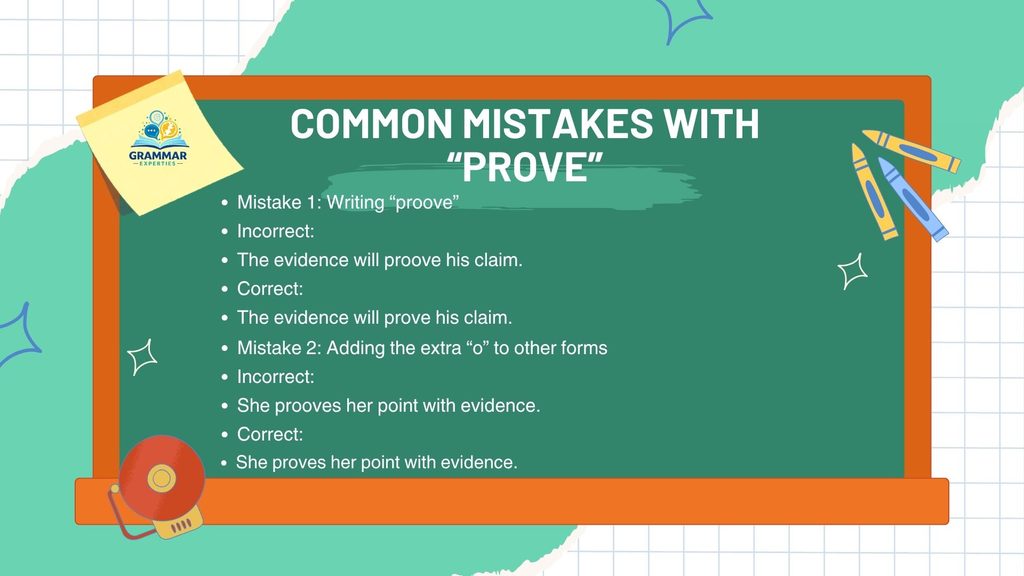
Mistake 1: Writing “proove”
Incorrect:
The evidence will proove his claim.
Correct:
The evidence will prove his claim.
Mistake 2: Adding the extra “o” to other forms
Incorrect:
She prooves her point with evidence.
Correct:
She proves her point with evidence.
Incorrect:
He is prooving the theory.
Correct:
He is proving the theory.
The extra “o” does not belong in the verb’s standard forms.
Mistake 3: Confusing “prove” with “proof”
Remember the difference:
- prove = verb
- proof = noun
Examples:
We need to prove the claim.
We need proof of the claim.
The two words are closely related, but they do not have identical spellings.
Mini Quiz:Proove or Prove
1. Which spelling is correct in modern English?
A) Proove
B) Prove
C) Proov
D) Prooue
Answer: B) Prove
2. What does “prove” mean?
A) To hide something
B) To demonstrate that something is true
C) To remove something
D) To repeat something
Answer: B) To demonstrate that something is true
3. Choose the correct sentence:
A) The evidence will proove his claim.
B) The evidence will prove his claim.
C) The evidence will prooving his claim.
D) The evidence will prooved his claim.
Answer: B) The evidence will prove his claim.
4. What is the noun related to “prove”?
A) Prooving
B) Proven
C) Proof
D) Proove
Answer: C) Proof
5. Choose the correctly spelled sentence:
A) She wants to proove her point.
B) She wants to prove her point.
C) She wants to proovee her point.
D) She wants to prooved her point.
Answer: B) She wants to prove her point.
6. True or False: “Prove” is the standard modern spelling.
A) True
B) False
Answer: A) True
7. What is the correct third-person singular form?
A) Prooves
B) Proves
C) Proovs
D) Proove
Answer: B) Proves
8. What is the correct -ing form of “prove”?
A) Prooving
B) Proveing
C) Proving
D) Prooved
Answer: C) Proving
9. Which is the correct past tense?
A) Prooved
B) Proveed
C) Proved
D) Prooving
Answer: C) Proved
10. Which word can be used as a past participle or adjective?
A) Prooven
B) Proven
C) Prooving
D) Proove
Answer: B) Proven
11. True or False: “Proove” is the standard modern spelling of the verb.
A) True
B) False
Answer: B) False
12. Why do people sometimes write “proove”?
A) Because “proof” has two o’s
B) Because it is always pronounced with two syllables
C) Because “proved” is spelled “prooved”
D) Because it is a plural noun
Answer: A) Because “proof” has two o’s
13. Which sentence correctly uses “prove” and “proof”?
A) We need to prove the claim and provide proof.
B) We need to proof the claim and provide prove.
C) We need to proove the claim and provide proof.
D) We need to prove the claim and provide prooving.
Answer: A) We need to prove the claim and provide proof.
14. Choose the correct sentence:
A) The plan proved to be effective.
B) The plan prooved to be effective.
C) The plan prooving to be effective.
D) The plan proove to be effective.
Answer: A) The plan proved to be effective.
15. Which spelling should you use in formal writing?
A) Proove
B) Prove
C) Proov
D) Prooue
Answer: B) Prove
16. Choose the correctly spelled sentence:
A) The documents prove his identity.
B) The documents proove his identity.
C) The documents prooving his identity.
D) The documents prooved his identity.
Answer: A) The documents prove his identity.
17. Which spelling is NOT standard modern English?
A) Prove
B) Proves
C) Proving
D) Proove
Answer: D) Proove
18. Choose the correct sentence:
A) Can you prove that statement?
B) Can you proove that statement?
C) Can you prooves that statement?
D) Can you prooving that statement?
Answer: A) Can you prove that statement?
19. Which sentence correctly uses “proven”?
A) This is a proven method.
B) This is a prooven method.
C) This is a prooving method.
D) This is a proove method.
Answer: A) This is a proven method.
20. What is the easiest way to remember the spelling of “prove”?
A) Always use two o’s
B) Use one o in prove
C) Replace v with b
D) Add an extra e
Answer: B) Use one o in prove
21. Which sentence is correct?
A) The results proove the theory.
B) The results prove the theory.
C) The results prooving the theory.
D) The results prooved the theory.
Answer: B) The results prove the theory.
22. Complete the sentence: “We need evidence to ___ the claim.”
A) Proove
B) Proving
C) Proved
D) Prove
Answer: D) Prove
23. Which sentence contains the correct spelling?
A) His actions proved his honesty.
B) His actions prooved his honesty.
C) His actions proove his honesty.
D) His actions prooving his honesty.
Answer: A) His actions proved his honesty.
24. Which statement is correct?
A) Proove is preferred in formal English.
B) Proove is the modern spelling of proof.
C) Prove is the standard modern English spelling.
D) Proove and prove are equally standard today.
Answer: C) Prove is the standard modern English spelling.
25. Choose the correct sentence:
A) I can proove that I am right.
B) I can prove that I am right.
C) I can prooves that I am right.
D) I can prooving that I am right.
Answer: B) I can prove that I am right.
Proove or Prove: Frequently Asked Questions
Q1:Is “proove” correct spelling?
No. Prove is the correct modern English spelling. Proove is not the standard modern spelling, although it has historical use as an obsolete form.
Q2:Is proove a real English word?
Historically, yes. Historical sources record proove as an obsolete spelling of prove. In modern standard English, however, it is generally treated as a misspelling rather than the normal form of the verb.
Q3:What is the correct spelling: proove or prove?
The correct spelling is prove.
For example:
Can you prove that the statement is true?
Q4:What does prove mean?
Prove means to show or establish that something is true, correct, valid, or genuine using evidence, reasoning, facts, or experience.
For example:
The documents prove that the payment was made.
Q5:What is the past tense of prove?
The standard past tense is proved.
Example:
The experiment proved successful.
The past participle can be proved or proven, depending on the grammatical construction and variety of English.
Q6:Why do people spell prove as proove?
The mistake is understandable because the related noun proof has two “o” letters. The pronunciation of prove can also encourage writers to add another “o.” However, the standard spelling of the verb is prove.
Q7:Is “proven” related to prove?
Yes. Proven is a commonly used past participle of prove, particularly in American English, and it is also widely used as an adjective.
Example:
This is a proven strategy.
Q8:How can I remember the spelling of prove?
Use this simple reminder:
Proof has two O’s; prove has one.
When you mean “demonstrate” or “show to be true,” write prove.
Final Verdict: Proove or Prove?
The answer is clear: prove is the correct spelling in modern standard English.
Use prove when you want to show that something is true, accurate, valid, or genuine. Its common forms include proves, proving, proved, and proven. Avoid proove in normal modern writing.
Although proove has a historical connection as an obsolete spelling, that does not make it the appropriate choice for today’s emails, essays, reports, websites, applications, or professional documents.
The easiest rule to remember is:
Proof = noun. Prove = verb.
So, if you’re choosing between proove or prove, choose prove every time in modern standard English.
Before publishing your next piece of writing, take a moment to check uncertain spellings against a reliable dictionary. That small habit can make your writing more accurate, polished, and professional.
Explore more easy grammar lessons and improve your English with Grammar Expertise
References
Cambridge Dictionary – Prove
Cambridge Dictionary – Proof

Maimoona Mughal is an English grammar enthusiast dedicated to simplifying confusing words, grammar rules, and vocabulary through clear, accurate, and learner-friendly content that helps readers write and communicate with confidence.