Have you ever written ambience and wondered whether it should actually be ambiance? You are not alone. These two spellings often confuse English learners, writers, bloggers, and even experienced speakers.
The good news is that both ambience and ambiance are correct spellings. They are nouns used to describe the atmosphere, character, mood, or overall feeling of a place or situation.
The main difference is related to spelling preference and regional usage rather than meaning. Ambience is especially common in British English, while ambiance is also widely used, particularly in American English. However, both forms are recognized in English.
In this guide, you will learn the meaning of ambience and ambiance, their differences, British and American usage, pronunciation, sentence examples, common mistakes, and the easiest way to choose the right spelling.
What Is the Difference Between Ambience and Ambiance?
Both spellings are correct
The easiest answer is:
Ambience and ambiance are two accepted spellings of the same noun.
Both words describe the atmosphere, character, mood, or general feeling of a place or situation.
For example:
The restaurant has a relaxing ambience.
You can also write:
The restaurant has a relaxing ambiance.
Both sentences are correct.
Oxford Learner’s Dictionaries defines ambience as the character and atmosphere of a place and lists ambiance as an alternative form. Cambridge also recognizes the two spellings.
Therefore, you should not automatically consider ambiance a spelling mistake.
Is ambience more traditional?
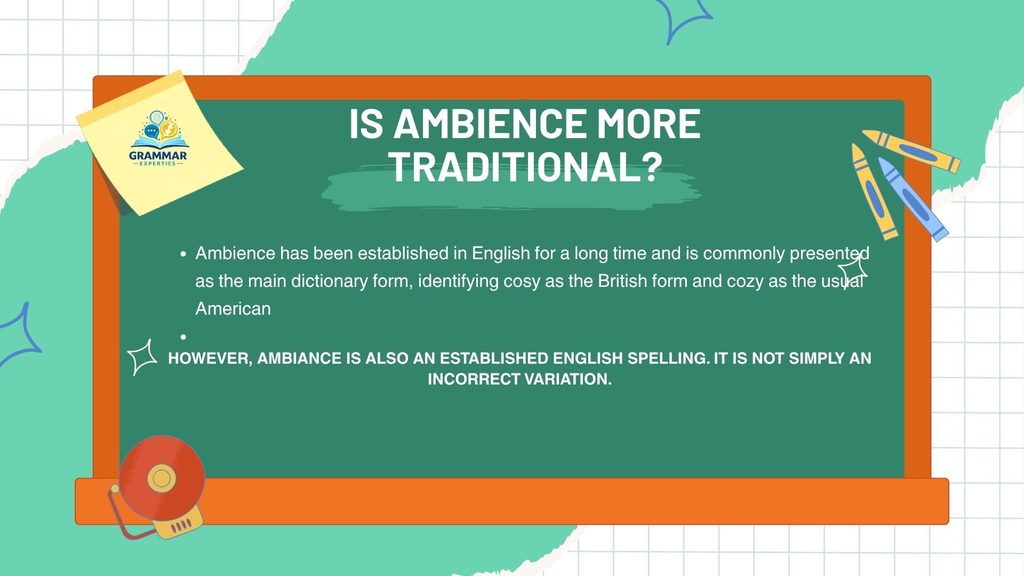
Ambience has been established in English for a long time and is commonly presented as the main dictionary form.
However, ambiance is also an established English spelling. It is not simply an incorrect variation.
For example:
The hotel has a peaceful ambience.
And:
The hotel has a peaceful ambiance.
Both sentences communicate the same idea.
Does the meaning change?
No.
Consider these examples:
The soft lighting created a romantic ambience.
The soft lighting created a romantic ambiance.
The meaning is essentially identical. In both sentences, the writer is describing the atmosphere created by the environment.
Ambience Meaning and Ambiance Meaning Explained
What does ambience mean?
Ambience is a noun that means the atmosphere, character, mood, or general quality of a place.
For example:
The café has a warm and welcoming ambience.
Here, ambience describes the overall feeling created by the café’s lighting, furniture, music, decoration, and surroundings.
Another example is:
The peaceful ambience of the garden helped me relax.
The word does not refer to one specific object. Instead, it describes the combined impression created by the environment.
What does ambiance mean?
Ambiance has the same basic meaning.
For example:
The hotel is known for its elegant ambiance.
This means that the hotel has an elegant atmosphere or character.
You can replace ambiance with ambience:
The hotel is known for its elegant ambience.
The meaning remains unchanged.
What can create ambience or ambiance?
Many elements can contribute to the atmosphere of a place, including:
- Lighting
- Music
- Furniture
- Colors
- Decorations
- Scents
- Architecture
- Temperature
- Noise
- People
- Interior design
For example, a restaurant with dim lighting, soft music, comfortable chairs, and warm colors may have a cozy ambience.
A modern restaurant with bright lights, minimalist furniture, and energetic music may have a lively ambiance.
Ambience or Ambiance in British and American English
Which spelling should British English use?
Ambience is a very natural choice in British English.
British English commonly uses ambience, although ambiance is also recognized.
Examples:
The hotel has a peaceful ambience.
The restaurant’s ambience was impressive.
The old theatre has a unique ambience.
If you are writing primarily for a British audience, ambience is an excellent default choice.
Which spelling should American English use?
American English uses both ambience and ambiance.
The spelling ambiance is particularly familiar to many American readers, but ambience is also valid.
For example:
The restaurant has a romantic ambiance.
Or:
The restaurant has a romantic ambience.
Neither sentence is grammatically incorrect.
What should international writers choose?
If you write for an international audience, choose the spelling that matches your publication’s style.
A practical approach is:
| Situation | Recommended Choice |
|---|---|
| British English | Ambience |
| American English | Ambiance or Ambience |
| International audience | Either |
| Formal writing | Follow your style guide |
| Website content | Choose one and stay consistent |
| English-learning content | Explain that both are correct |
Consistency is more important than trying to declare one spelling universally correct.
How to Use Ambience or Ambiance in a Sentence
Ambience or ambiance for restaurants
Restaurants are among the most common places where these words are used.
Examples:
The restaurant has a cozy ambience.
The restaurant has a sophisticated ambiance.
Soft music created a relaxing ambience.
Candlelight gave the dining room a romantic ambiance.
In each example, the word describes the overall atmosphere of the restaurant.
Ambience or ambiance for homes
You can also use either spelling when describing a home.
Examples:
Warm lighting creates a comfortable ambience in the living room.
The wooden furniture gives the house a traditional ambiance.
Plants and natural colors improved the room’s ambience.
Here, the word describes the atmosphere or feeling created by the home’s surroundings.
Ambience or ambiance for events and places
These words can describe many different locations and events, including:
- Weddings
- Parties
- Hotels
- Cafés
- Shops
- Offices
- Theatres
- Gardens
- Parks
- Cities
- Neighborhoods
Examples:
The wedding had a joyful ambience.
The festival had a lively ambiance.
The historic building has a distinctive ambience.
The quiet library creates a peaceful ambiance.
Ambience or ambiance for situations
Although these words are often used for physical places, they can also describe the general atmosphere of a situation.
For example:
The tense ambience of the meeting made everyone uncomfortable.
Or:
The tense ambiance of the meeting made everyone uncomfortable.
Again, changing the spelling does not change the basic meaning.
Ambience vs Ambiance: Quick Comparison
The easiest way to remember the difference
There is no major difference in meaning between the two spellings.
| Feature | Ambience | Ambiance |
|---|---|---|
| Correct spelling? | Yes | Yes |
| Part of speech | Noun | Noun |
| Meaning | Atmosphere or character | Atmosphere or character |
| British English | Common | Accepted |
| American English | Used | Used |
| Restaurant context | Yes | Yes |
| Formal writing | Yes | Yes |
| Informal writing | Yes | Yes |
| Alternative spelling | Main form | Alternative form |
Both forms can describe the same atmosphere or character.
A simple memory trick
Think of the two spellings as different roads leading to the same destination:
Ambience = atmosphere
Ambiance = atmosphere
You do not need to memorize two different definitions.
Instead, remember that English allows both spellings.
Real-Life Example: Choosing a Spelling for a Restaurant Review
Imagine that a travel website is publishing a restaurant review for readers in the United Kingdom.
The restaurant is a small seaside café with soft lighting, wooden furniture, quiet music, and a relaxed atmosphere.
The writer might say:
The restaurant’s warm ambience immediately makes visitors feel at home.
That spelling fits naturally with British English usage.
Now imagine that the same restaurant is being reviewed for an American lifestyle website.
The writer might choose:
The restaurant’s warm ambiance immediately makes visitors feel at home.
The spelling has changed, but the description has not. The restaurant still has the same atmosphere, and the reader receives the same basic meaning.
This example demonstrates an important feature of English spelling: regional preferences do not always create different meanings. Sometimes they simply provide different accepted forms.
The same principle applies to students, bloggers, and business writers. You do not need to rewrite a sentence simply because you encounter the alternative spelling. First determine whether the spelling is actually incorrect.
In this case, both forms are accepted.
For editors, the best approach is to consider the intended variety of English and the publication’s style guide. If the website consistently uses British English, ambience may be the more natural choice. If it follows an American style and already uses ambiance, continuing with that spelling may provide better consistency.
Ambience and Ambiance: What Current Reference Sources Show
What do major dictionaries say?
For spelling questions, authoritative dictionaries are more useful than informal spelling polls.
Major reference sources recognize the relationship between the two forms:
- Oxford Learner’s Dictionaries lists ambience and gives ambiance as an alternative.
- Cambridge Dictionary recognizes ambience and provides ambiance as another spelling.
- Collins Dictionary recognizes the word and its alternative form.
This provides strong evidence that neither spelling should automatically be classified as an error.
What about 2025–2026 usage?
Current dictionary resources continue to recognize both forms.
However, it is important not to invent unsupported statistics. Dictionary entries establish whether a spelling is recognized, but they do not necessarily provide a precise percentage of speakers using each form.
Therefore, the reliable 2025–2026 conclusion is:
Both ambience and ambiance remain accepted English spellings.
The exact popularity of each form can vary according to country, publication, audience, and context.
Common Mistakes With Ambience and Ambiance
Mistake 1: Assuming ambiance is misspelled
A common mistake is seeing ambiance and automatically changing it to ambience.
That correction is unnecessary.
Ambiance is an accepted spelling.
For example:
The restaurant has a sophisticated ambiance.
This sentence is perfectly acceptable.
Mistake 2: Assuming ambience is wrong in American English
The opposite assumption is also incorrect.
Some writers believe that American English must use ambiance. That is too strict.
American English can use both forms.
For example:
The hotel has a relaxing ambience.
This sentence is not incorrect simply because it uses ambience.
Mistake 3: Treating the words as different concepts
You may occasionally encounter claims that ambience refers to physical atmosphere while ambiance refers to emotional atmosphere.
There is no need to follow this distinction.
Both words can describe the character, atmosphere, mood, or general feeling of a place.
Mistake 4: Switching between spellings without a reason
If you use ambience in one paragraph and ambiance in another without any reason, your writing may look inconsistent.
For professional content, choose the spelling that fits your audience and use it consistently.
Ambience or Ambiance: Which One Should You Use?
Choose ambience when…
Ambience is a strong choice when:
- You are writing in British English.
- Your publication traditionally uses ambience.
- Your organization’s style guide prefers it.
- Your existing content already uses ambience.
- You want to follow the spelling commonly presented as the main dictionary form.
Example:
The peaceful ambience of the garden made the evening unforgettable.
Choose ambiance when…
Ambiance can be a good choice when:
- Your audience commonly uses American English.
- Your organization’s style guide prefers it.
- Your existing content consistently uses ambiance.
- You want to maintain the spelling in an existing piece of content.
Example:
The restaurant’s sophisticated ambiance attracts visitors from across the city.
A practical checklist
Before choosing your spelling, ask:
- Who is my audience?
- Am I using British or American English?
- Does my organization have a style guide?
- Which spelling do I already use elsewhere?
- Will changing the spelling create unnecessary inconsistency?
If there is no specific style requirement, either spelling is acceptable.
Mini Quiz:Ambience or Ambiance
1. Which spelling is correct?
A) Ambience
B) Ambiance
C) Both A and B
D) Neither
Answer: C) Both A and B
2. What does “ambience” or “ambiance” mean?
A) The price of something
B) The atmosphere or mood of a place
C) The size of a building
D) A type of food
Answer: B) The atmosphere or mood of a place
3. Which spelling is especially common in British English?
A) Ambiance
B) Ambience
C) Ambians
D) Ambiants
Answer: B) Ambience
4. Which spelling is widely used in American English?
A) Ambience
B) Ambiance
C) Ambiens
D) Ambiancee
Answer: B) Ambiance
5. Choose the correct sentence.
A) The restaurant has a relaxing ambience.
B) The restaurant has a relaxing ambiants.
C) The restaurant has a relaxing ambians.
D) The restaurant has a relaxing ambien.
Answer: A) The restaurant has a relaxing ambience.
6. Is “ambiance” considered a misspelling of “ambience”?
A) Yes
B) No
C) Only in American English
D) Only in British English
Answer: B) No
7. What is the closest synonym of “ambience”?
A) Atmosphere
B) Distance
C) Measurement
D) Direction
Answer: A) Atmosphere
8. Which sentence correctly uses “ambiance”?
A) The café has a warm and welcoming ambiance.
B) The café has a warm and welcoming ambiants.
C) The café has a warm and welcoming ambians.
D) The café has a warm and welcoming ambien.
Answer: A) The café has a warm and welcoming ambiance.
9. What can influence the ambience of a restaurant?
A) Lighting
B) Music
C) Decoration
D) All of the above
Answer: D) All of the above
10. Which word refers to the overall feeling or atmosphere of a place?
A) Ambience
B) Ambition
C) Amplitude
D) Ambulance
Answer: A) Ambience
11. Complete the sentence: “The soft lighting created a romantic _____.”
A) ambiance
B) ambians
C) ambiant
D) ambiances
Answer: A) ambiance
12. Complete the sentence: “The hotel is known for its elegant _____.”
A) ambience
B) ambiants
C) ambiant
D) ambients
Answer: A) ambience
13. Which pair represents two accepted spellings of the same word?
A) Ambience and Ambiance
B) Ambience and Ambiencee
C) Ambiance and Ambians
D) Ambiant and Ambience
Answer: A) Ambience and Ambiance
14. Which spelling would generally be a natural choice in British English?
A) Ambiance
B) Ambience
C) Ambians
D) Ambiant
Answer: B) Ambience
15. Which spelling would generally be a natural choice in American English?
A) Ambience
B) Ambiance
C) Ambiants
D) Ambiencee
Answer: B) Ambiance
16. Choose the correctly spelled sentence.
A) I loved the peaceful ambiance of the garden.
B) I loved the peaceful ambians of the garden.
C) I loved the peaceful ambiant of the garden.
D) I loved the peaceful ambien of the garden.
Answer: A) I loved the peaceful ambiance of the garden.
17. Can “ambience” describe the mood of a room?
A) Yes
B) No
C) Only outdoors
D) Only in restaurants
Answer: A) Yes
18. Which sentence uses “ambience” correctly?
A) The candles added to the cozy ambience.
B) The candles added to the cozy ambians.
C) The candles added to the cozy ambiant.
D) The candles added to the cozy ambien.
Answer: A) The candles added to the cozy ambience.
19. What is the main difference between “ambience” and “ambiance”?
A) They have completely different meanings.
B) One is a noun and the other is a verb.
C) They have the same meaning but differ mainly in spelling preference.
D) One refers only to weather.
Answer: C) They have the same meaning but differ mainly in spelling preference.
20. Which word is NOT a correct spelling of the word meaning “atmosphere”?
A) Ambience
B) Ambiance
C) Ambians
D) Both A and B
Answer: C) Ambians
21. Which sentence sounds natural?
A) The restaurant’s ambience was warm and inviting.
B) The restaurant’s ambience was expensive and tall.
C) The restaurant’s ambience was three miles long.
D) The restaurant’s ambience was twenty dollars.
Answer: A) The restaurant’s ambience was warm and inviting.
22. Which of these can contribute to a wedding venue’s ambience?
A) Flowers
B) Lighting
C) Music
D) All of the above
Answer: D) All of the above
23. If you are writing for a British audience, which spelling is usually the better choice?
A) Ambiance
B) Ambience
C) Ambians
D) Ambiant
Answer: B) Ambience
24. If you are writing for an American audience, which spelling is usually the better choice?
A) Ambience
B) Ambiance
C) Ambiens
D) Ambiants
Answer: B) Ambiance
25. What is the best conclusion about “ambience” and “ambiance”?
A) Only ambience is correct.
B) Only ambiance is correct.
C) Both are correct spellings, with regional preferences.
D) Neither spelling is correct.
Answer: C) Both are correct spellings, with regional preferences.
Frequently Asked Questions
Q1:Is ambience or ambiance correct?
Both are correct. Ambience and ambiance are accepted spellings of the same noun. Major dictionaries recognize ambiance as an alternative spelling of ambience.
Q2:Is ambience British or American?
Ambience is used in both British and American English. It is especially familiar in British English, but American English also recognizes and uses it.
Q3:Is ambiance American English?
Ambiance is widely used in American English, but it is not exclusively American. It is also recognized as an English spelling in British English.
Q4:Do ambience and ambiance have different meanings?
No. In ordinary English, ambience and ambiance have the same basic meaning: the atmosphere, character, mood, or overall quality of a place or situation.
Q5:Which spelling is more common: ambience or ambiance?
Usage varies according to region and source. Ambience is a well-established form, while ambiance is also widely used, especially in American English. It is better to follow your audience and style guide than rely on an unsupported percentage.
Q6:How do you pronounce ambience?
In British English, ambience is commonly pronounced approximately AM-bee-uhns. Pronunciation can vary between British and American English. Dictionary pronunciation guides provide audio and phonetic information for the word.
Q7:What is the plural of ambience?
The plural form is ambiences.
The plural of ambiance is ambiances.
However, the singular forms are much more common because writers usually discuss the overall atmosphere of a place.
Can I use ambiance in formal writing?
Yes. Ambiance is an accepted spelling and can be used in formal writing. The key is to follow the appropriate regional variety of English and maintain consistency.
Conclusion: Ambience or Ambiance?
So, ambience or ambiance which spelling is correct?
The answer is simple: both are correct.
Ambience and ambiance are alternative spellings of the same noun. Both describe the atmosphere, character, mood, or overall feeling of a place or situation.
If you are writing for a British English audience, ambience is a natural choice. If you are writing for an American audience, ambiance is also a familiar option, although ambience remains valid.
The most important rule is consistency. Choose the spelling that fits your audience, regional English, and style guide, then use it consistently.
So, the next time you write about the atmosphere of a restaurant, hotel, home, event, or city, you do not need to worry about choosing between a correct and incorrect spelling.
Explore more easy grammar lessons and improve your English with Grammar Expertise
References
Oxford Learner’s Dictionaries – Ambience
Cambridge Dictionary – Ambience

Maimoona Mughal is an English grammar enthusiast dedicated to simplifying confusing words, grammar rules, and vocabulary through clear, accurate, and learner-friendly content that helps readers write and communicate with confidence.