Have you ever wondered whether to write authorized or authorised? You may see both spellings in business emails, official documents, websites, and everyday writing. This can make it difficult to know which version is correct.
The good news is that both authorized and authorised are correct spellings. The difference depends on the variety of English you use. Authorized is the standard American English spelling, while authorised is commonly used in British English.
In this guide, you will learn what both spellings mean, when to use each version, how they appear in real sentences, and how to choose the right spelling for your audience.
Authorized or Authorised: The Quick Answer
Both spellings are correct, but they belong to different regional spelling conventions.
| Spelling | English variety | Example |
|---|---|---|
| Authorized | American English | The manager authorized the payment. |
| Authorised | British English | The manager authorised the payment. |
The two words have the same meaning: to give someone official permission or approval to do something.
For example:
- American English: Only authorized employees can enter this room.
- British English: Only authorised employees can enter this room.
Neither spelling is inherently more correct or more professional. The best choice depends on your intended audience and the spelling style you follow.
What Does Authorized or Authorised Mean?
Both authorized and authorised mean officially permitted, approved, or given the authority to do something. They are the past-tense and past-participle forms of the verb authorize or authorise. They can also function as adjectives.
Definition of Authorized and Authorised
According to the Cambridge Dictionary, authorized means having official permission to do something or for something to happen. The dictionary identifies authorised as the usual British English spelling.
Here are some examples:
- The bank authorized the transfer.
- Only authorised personnel may enter the laboratory.
- She is an authorized representative of the company.
- The council authorised the construction project.
Each sentence describes permission, approval, or authority. The spelling changes according to regional preference, but the meaning remains the same.
How to Use Authorized in a Sentence
Use authorized when writing in American English or following a style guide that prefers American spelling.
Examples:
- The director authorized additional funding.
- Only authorized users can access the account.
- The company hired an authorized service provider.
- The government authorized the new program.
Notice that American English generally uses the letter z in authorize, authorized, and authorizing.
How to Use Authorised in a Sentence
Use authorised when writing in British English or following a British-style spelling convention.
Examples:
- The director authorised additional funding.
- Only authorised users can access the account.
- The company hired an authorised service provider.
- The government authorised the new programme.
British English commonly uses the letter s in authorise, authorised, and authorising.
Remember that other words in the same sentence may also follow regional spelling differences. For example, British English often uses programme, whereas American English generally uses program.
Authorized or Authorised: Key Differences Between American and British English
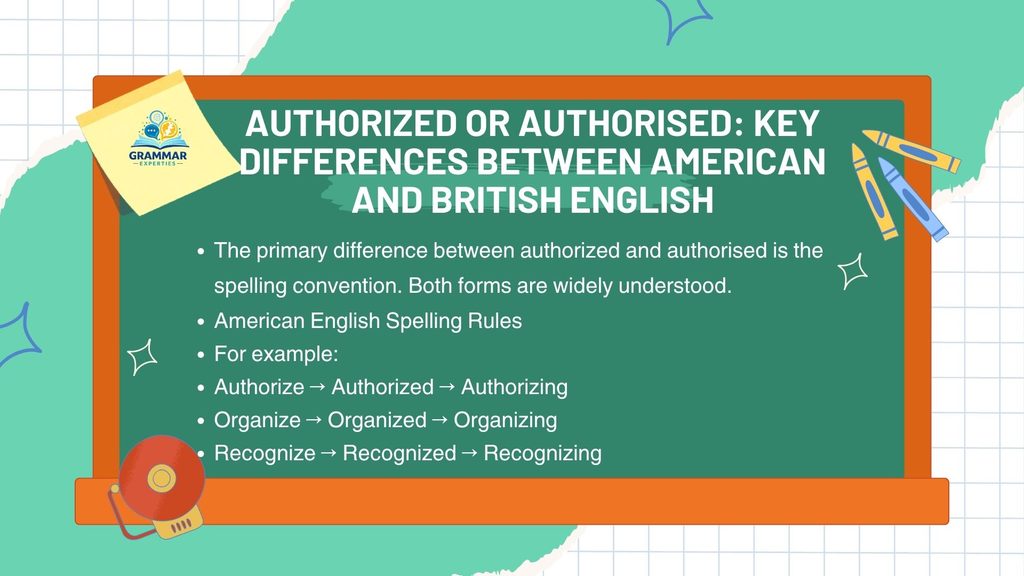
The primary difference between authorized and authorised is the spelling convention. Both forms are widely understood, but the preferred form varies across English-speaking regions.
American English Spelling Rules
American English typically uses -ize in words such as authorize, organize, and recognize. Their related forms follow the same pattern.
For example:
- Authorize → Authorized → Authorizing
- Organize → Organized → Organizing
- Recognize → Recognized → Recognizing
If you are writing for an American company, university, government agency, or publication that follows US English, choose authorized.
Example:
“The account holder authorized the bank to process the transaction.”
British English Spelling Rules
British English commonly uses -ise in words such as authorise, organise, and recognise. Their related forms follow that spelling pattern.
For example:
- Authorise → Authorised → Authorising
- Organise → Organised → Organising
- Recognise → Recognised → Recognising
If you are writing for a British audience, authorised is generally the natural choice.
Example:
“The account holder authorised the bank to process the transaction.”
One important detail is that British English does not always require -ise. Some British dictionaries and style guides also accept or prefer –ize spellings in particular contexts. Therefore, follow your organisation’s preferred style rather than assuming every British publication uses -ise.
Authorized vs Authorised Comparison Table
| Feature | Authorized | Authorised |
|---|---|---|
| Main spelling convention | American English | British English |
| Verb form | Authorize | Authorise |
| Past tense | Authorized | Authorised |
| Present participle | Authorizing | Authorising |
| Related noun | Authorization | Authorisation |
| Meaning | Official permission or approval | Official permission or approval |
| Typical usage | US documents and websites | UK-style documents and websites |
The table shows that these differences are systematic. Once you recognise the pattern, it becomes easier to choose the appropriate form in other words as well.
Why Do Authorized and Authorised Have Different Spellings?
English spelling developed over many centuries, and different countries adopted different conventions. American and British English gradually established their own preferences in dictionaries, educational materials, publishing, and official communication.
The History of American and British Spelling
English spelling was not completely standardised when British settlers established communities in North America. Over time, American dictionaries and educational systems helped establish distinctive US spelling conventions.
Lexicographer Noah Webster played an important role in popularising several American spelling preferences. Some changes became widely accepted, while others did not.
The differences between authorized and authorised reflect these broader spelling traditions. They are not evidence that one version is grammatically incorrect.
Does the Spelling Change the Meaning?
No. Both words communicate the same idea of official permission or approval.
Consider these sentences:
- The manager authorized the employee to approve purchases.
- The manager authorised the employee to approve purchases.
The sentences have the same meaning. Only the spelling differs.
However, consistency matters in formal writing. If you use authorized throughout an American English document, switching to authorised without a reason may look like an editing mistake.
Which Spelling Should International Writers Use?
International writers should consider their audience, publication requirements, and the English variety used by their organisation.
For example, an international business writing to a US client may prefer authorized. A company preparing documentation for a UK audience may choose authorised.
In countries where British English is commonly taught or used in official communication, authorised may be more familiar. Nevertheless, the requirements of a particular employer, university, examination board, or publication should take priority.
Real-Life Example: Choosing the Right Spelling in Business Communication
Imagine that a software company operates in both the United States and the United Kingdom. Its employees prepare account instructions, customer support messages, website content, and internal security policies.
The American team writes:
“Only authorized administrators can change account permissions.”
The British team writes:
“Only authorised administrators can change account permissions.”
Both statements are correct. Each team uses the spelling convention that suits its readers.
Now imagine that the company publishes one international help centre. Its editorial team must decide which spelling to use across all articles. If it chooses American English, the team should write authorized, authorization, and authorizing consistently. If it chooses British English with the -ise convention, it should use authorised, authorisation, and authorising.
The team should also review related words, such as centre versus center and colour versus color, wherever regional spelling differences apply.
This example illustrates a practical writing principle: consistency is more important than treating one accepted spelling as universally superior. A reader will generally understand both forms, but a consistent document looks more polished and is easier to edit.
The same approach works for students, bloggers, freelancers, and job applicants. Before writing, identify the expected English variety. Then apply it consistently throughout the document. If a client supplies a style guide, follow that guide even when its preferences differ from your personal habits.
How to Choose Between Authorized and Authorised
You can select the correct form by following a few simple steps.
Step 1: Identify Your Audience
Ask yourself who will read your writing.
- Writing primarily for readers in the United States? Use authorized.
- Writing primarily for readers in the United Kingdom? Authorised is a common choice.
- Writing for an international audience? Follow your organisation’s established spelling style.
Step 2: Check Your Style Guide
Some organisations follow American spelling conventions, while others use British English. Universities, publishers, government agencies, and businesses may have their own requirements.
If a style guide specifies authorize, use authorized. If it specifies authorise, use authorised.
Step 3: Keep Related Words Consistent
Do not check only the word authorized. Review related forms throughout the document.
| American English | British English |
|---|---|
| Authorize | Authorise |
| Authorized | Authorised |
| Authorizing | Authorising |
| Authorization | Authorisation |
| Unauthorized | Unauthorised |
These are common regional pairings. Follow your chosen style guide if it specifies a different accepted convention.
Step 4: Review the Entire Document
After editing, check that you have not mixed spelling conventions accidentally.
For instance, an American English document might contain the sentence:
“The authorized user received authorization to access the system.”
A British English version might read:
“The authorised user received authorisation to access the system.”
Both versions are consistent and correct within their respective conventions.
Common Mistakes to Avoid When Using Authorized or Authorised
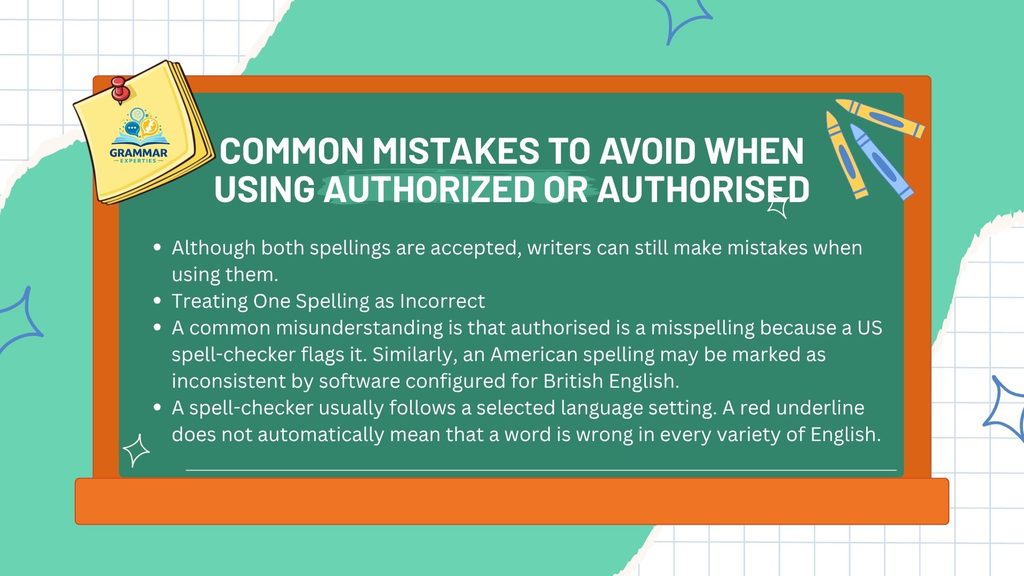
Although both spellings are accepted, writers can still make mistakes when using them.
Treating One Spelling as Incorrect
A common misunderstanding is that authorised is a misspelling because a US spell-checker flags it. Similarly, an American spelling may be marked as inconsistent by software configured for British English.
A spell-checker usually follows a selected language setting. A red underline does not automatically mean that a word is wrong in every variety of English.
Mixing American and British Spellings
Using both forms in the same document without a clear reason can make your writing appear inconsistent.
For example:
“In the US office, the manager authorized the request. The UK office authorised the second request.”
This wording may be appropriate when describing two different offices and preserving their local terminology. However, if both sentences belong to a single document using one style, choose a consistent spelling.
Confusing Authorized With Authorization
Authorized describes someone or something that has permission or refers to an action of granting permission. Authorization is the noun referring to permission or the act of granting it.
Examples:
- Correct: The employee is authorized to access the files.
- Correct: The employee received authorization to access the files.
- Incorrect usage: The employee received authorized to access the files.
Choosing the right word form is just as important as choosing the right regional spelling.
Mini Quiz:Authorized or Authorised
1. Which spelling is standard in American English?
A. Authorised B. Authorized C. Authorizied D. Authorizzed
Answer: B. Authorized
2. Which spelling is commonly used in British English?
A. Authorised B. Authorizd C. Authorizied D. Authorizzed
Answer: A. Authorised
3. What do authorized and authorised mean?
A. Officially permitted B. Publicly announced C. Privately rejected D. Temporarily confused Answer: A. Officially permitted
4. Are authorized and authorised both correct spellings?
A. Yes B. No Answer: A. Yes
5. Complete the sentence using American English: “The manager ___ the payment.”
A. Authorised B. Authorizied C. Authorized D. Authorizd
Answer: C. Authorized
6. Complete the sentence using British English: “Only ___ staff may enter.”
A. Authorizd B. Authorized C. Authorizied D. Authorised
Answer: D. Authorised
7. Which is the standard American English noun?
A. Authorisation B. Authorization C. Authorizement D. Authorizasion
Answer: B. Authorization
8. Which noun is commonly used in British English?
A. Authorizement B. Authorizasion C. Authorisation D. Authoriztion
Answer: C. Authorisation
9. Is “authorised” always incorrect in English?
A. Yes B. No Answer: B. No
10. Which sentence uses the correct American English spelling?
A. The team authorized the request. B. The team authorizd the request. C. The team authorizied the request. D. The team authorizzed the request.
Answer: A. The team authorized the request.
11. What is the American English present participle of “authorize”?
A. Authorised B. Authorizing C. Authorizied D. Authoriszing
Answer: B. Authorizing
12. What is the common British English present participle of “authorise”?
A. Authorizying B. Authorizied C. Authorizing D. Authorising
Answer: D. Authorising
13. Which statements are correct?
A. Both spellings have the same basic meaning. B. Authorized is standard in American English. C. Authorised is never correct. D. Authorised is commonly used in British English.
Answers: A, B, and D
14. Which spelling should you use in a US English document?
A. Authorised B. Authorizzed C. Authorized D. Authorizd
Answer: C. Authorized
15. Which spelling suits a UK document following the -ise convention?
A. Authorised B. Authorizd C. Authorizied D. Authorizzed Answer: A. Authorised
16. Complete the sentence: “She received ___ to access the files.”
A. Authorize B. Authorization C. Authorizing D. Authorizes
Answer: B. Authorization
17. Complete the sentence: “The employee is ___ to approve refunds.”
A. Authorization B. Authorize C. Authorized D. Authorizing
Answer: C. Authorized
18. What is the usual American English spelling of the opposite of “authorized”?
A. Unauthorised B. Unauthorizd C. Unauthorizied D. Unauthorized
Answer: D. Unauthorized
19. What is the common British English spelling of the opposite of “authorised”?
A. Unauthorised B. Unauthorizd C. Unauthorizzed D. Unauthorizied
Answer: A. Unauthorised
20. Which are correctly spelled American English forms?
A. Authorize B. Authorized C. Authorisation D. Authorizing
Answers: A, B, and D
21. Which sentence is correct in British English?
A. The director authorised the project. B. The director authorizied the project. C. The director authorizd the project. D. The director authorizzed the project.
Answer: A. The director authorised the project.
22. Which sentence is correct in American English?
A. Only authorised users can log in. B. Only authorizied users can log in. C. Only authorized users can log in. D. Only authorizd users can log in.
Answer: C. Only authorized users can log in.
23. Does the spelling difference change the meaning?
A. Yes, completely B. No, the meaning stays the same C. Only in questions D. Only in formal writing
Answer: B. No, the meaning stays the same
24. What should you do when writing for an international audience?
A. Mix both spellings randomly B. Always use British spelling C. Always use American spelling D. Follow the required style guide consistently
Answer: D. Follow the required style guide consistently
25. What is the main difference between “authorized” and “authorised”?
A. Their meanings B. Their pronunciation in every accent C. Their regional spelling conventions D. Their grammatical function
Answer: C. Their regional spelling conventions
Frequently Asked Questions
1. Is authorized or authorised correct?
Both are correct. Authorized is the standard American English spelling, while authorised is commonly used in British English.
2. Is authorised British English?
Yes. Authorised is a common British English spelling. However, some British dictionaries and style guides also accept authorized.
3. Is authorized American English?
Yes. Authorized is the standard spelling in American English and is widely used in US business, legal, educational, and technical documents.
4. Do authorized and authorised mean the same thing?
Yes. Both mean officially permitted, approved, or given authority to do something. The difference is regional spelling, not meaning.
5. Should I write authorized or authorised on my CV?
Use the spelling convention appropriate for the job market and employer. For a US application, choose authorized. For a UK application, authorised is usually appropriate. Follow the employer’s instructions if it specifies a style.
6. Is authorization or authorisation correct?
Both forms are correct. Authorization is the usual American English spelling, while authorisation is commonly used in British English. Keep the noun consistent with the verb form you use.
7. Does Google consider authorised a spelling mistake?
The spelling is not inherently incorrect. Search engines can generally understand regional spelling variations, but you should choose the form that best serves your intended readers and use it consistently.
8. How can I remember the difference between authorized and authorised?
Use this simple reminder: American English usually uses Z; British English commonly uses S for this word family. Think of authorize and authorized for US writing, and authorise and authorised for British-style writing.
Conclusion: Authorized or Authorised – Which Spelling Should You Use?
The answer to authorized or authorised is straightforward: both spellings are correct, and the best choice depends on your audience.
Use authorized in American English. Use authorised when following the common British English -ise convention. Both forms mean officially permitted or given approval, so neither is universally better than the other.
The most important rule is to maintain consistency. Choose the appropriate English variety, check your organisation’s style guide, and apply the same spelling convention throughout your writing.
Explore more easy grammar lessons and improve your English with Grammar Expertise
References
Merriam-Webster’s Dictionary of Law — Authorize
Cambridge Dictionary — Authorized

Maimoona Mughal is an English grammar enthusiast dedicated to simplifying confusing words, grammar rules, and vocabulary through clear, accurate, and learner-friendly content that helps readers write and communicate with confidence.