Have you ever wondered whether to write withdraw money or make a withdrawal? Although withdraw and withdrawal have similar meanings, they serve different grammatical purposes. Using the wrong word can make a sentence sound unnatural or grammatically incorrect.
The difference is simple: withdraw is a verb, while withdrawal is a noun. You withdraw money from a bank account, but you make a withdrawal from that account. The same distinction applies to leaving a competition, removing an application, or stepping away from an activity.
In this guide, you will learn the meaning of withdraw and withdrawal, their grammatical differences, common mistakes, practical examples, and easy ways to remember which word to use.
What Is the Difference Between Withdraw and Withdrawal?
The main difference between withdraw and withdrawal is their part of speech. Although both relate to removing, taking back, or stepping away from something, they are not interchangeable.
What Does Withdraw Mean?
Withdraw is a verb that means to take something back, remove something, or stop participating in an activity.
Examples:
- I want to withdraw money from my bank account.
- She decided to withdraw her application.
- The team may withdraw from the competition.
- He chose to withdraw from the discussion.
In each sentence, withdraw describes an action.
What Does Withdrawal Mean?
Withdrawal is a noun that refers to the act or process of withdrawing, or the amount or instance involved in that action.
Examples:
- I made a withdrawal from my savings account.
- Her withdrawal from the competition surprised everyone.
- The bank processed my cash withdrawal.
- The company announced its withdrawal from the agreement.
Here, withdrawal names an action, event, or process rather than expressing the action through a verb.
Withdraw vs. Withdrawal at a Glance
| Feature | Withdraw | Withdrawal |
|---|---|---|
| Part of speech | Verb | Noun |
| Meaning | To take back, remove, or leave | The act, process, or instance of withdrawing |
| Example | I will withdraw money. | I made a withdrawal. |
| Common context | Taking action | Naming an action or event |
| Correct phrase | Withdraw an application | Application withdrawal |
Easy rule: If you are describing what someone does, use withdraw. If you are naming the action or event, use withdrawal.
How to Use Withdraw and Withdrawal Correctly
Choosing the correct word becomes easier when you identify the role it plays in your sentence.
When Should You Use Withdraw?
Use withdraw when a person or organization performs an action. It commonly appears after words such as will, can, may, must, and to.
Examples:
- I need to withdraw cash before travelling.
- You can withdraw your application before the deadline.
- The athlete decided to withdraw from the race.
- They will withdraw the offer tomorrow.
The word also changes form according to tense:
- Present: I withdraw money regularly.
- Past: I withdrew money yesterday.
- Present participle: I am withdrawing money now.
- Past participle: I have withdrawn money before.
Notice that the past tense is withdrew, and the past participle is withdrawn, not withdrawed.
When Should You Use Withdrawal?
Use withdrawal when referring to an action, event, amount, or process.
Examples:
- The bank confirmed my cash withdrawal.
- The deadline for application withdrawal is Friday.
- The student’s withdrawal from the course was unexpected.
- The company completed its withdrawal from the project.
Because withdrawal is a noun, it can appear after articles and adjectives.
Examples:
- A bank withdrawal
- A large cash withdrawal
- The voluntary withdrawal
- An official withdrawal request
Common Grammar Patterns
| Sentence pattern | Correct example |
|---|---|
| Need to + verb | I need to withdraw cash. |
| Will + verb | She will withdraw her request. |
| Make a + noun | He made a withdrawal. |
| Request a + noun | I submitted a withdrawal request. |
| Complete the + noun | They completed the withdrawal. |
These patterns help you choose the correct word without memorizing every possible sentence.
Withdraw or Withdrawal: Examples in Everyday Situations
Both words appear in banking, education, employment, business, and everyday conversations. Understanding the context helps you choose the right form.
Banking and Financial Transactions
In banking, withdraw describes taking money out of an account, while withdrawal refers to the transaction itself.
Examples:
- Correct: I need to withdraw $100 from my account.
- Correct: I made a withdrawal of $100.
- Incorrect: I need to withdrawal $100 from my account.
- Incorrect: I made a withdraw of $100.
If you are writing a banking form, you might see terms such as cash withdrawal, withdrawal limit, or withdrawal request. These are nouns describing a transaction, restriction, or request.
Education and Applications
The distinction also applies to academic and administrative situations.
Examples:
- The student decided to withdraw from the course.
- The student’s withdrawal from the course was approved.
- She wants to withdraw her university application.
- Her application withdrawal was confirmed.
The first sentence in each pair describes an action. The second names the action or the resulting administrative event.
Business, Sports, and Everyday Communication
The words can also describe removing an offer, leaving a competition, or stepping away from a commitment.
Examples:
- The company plans to withdraw its proposal.
- The withdrawal of the proposal surprised the client.
- The runner had to withdraw from the race.
- The athlete’s withdrawal was announced before the final.
These examples show that the distinction remains the same regardless of the subject: withdraw is the action, and withdrawal names the action or event.
Common Mistakes and Easy Ways to Remember the Difference
English learners sometimes confuse these words because they share the same root and refer to related ideas. A few simple grammar rules can help you avoid the most common errors.
Mistakes to Avoid
| Incorrect sentence | Correct sentence |
|---|---|
| I want to withdrawal money. | I want to withdraw money. |
| She made a withdraw. | She made a withdrawal. |
| He will withdrawal his application. | He will withdraw his application. |
| The withdraw was successful. | The withdrawal was successful. |
| I withdrawed the request. | I withdrew the request. |
Remember that withdraw has irregular past-tense forms. Use withdrew for the simple past and withdrawn with helping verbs such as has, have, or had.
A Simple Memory Trick
Use this quick method whenever you are unsure:
- Look for an action. If someone is doing something, use withdraw.
- Look for a thing or event. If you are naming the transaction or process, use withdrawal.
- Check the words around it. Phrases such as to withdraw, will withdraw, and can withdraw usually require the verb. Phrases such as a withdrawal, the withdrawal, and withdrawal request use the noun.
For example:
- I plan to withdraw my application.
- I submitted a withdrawal request.
Both sentences are correct because each word serves a different grammatical function.
Real-Life Case Study: Correcting a Banking Message
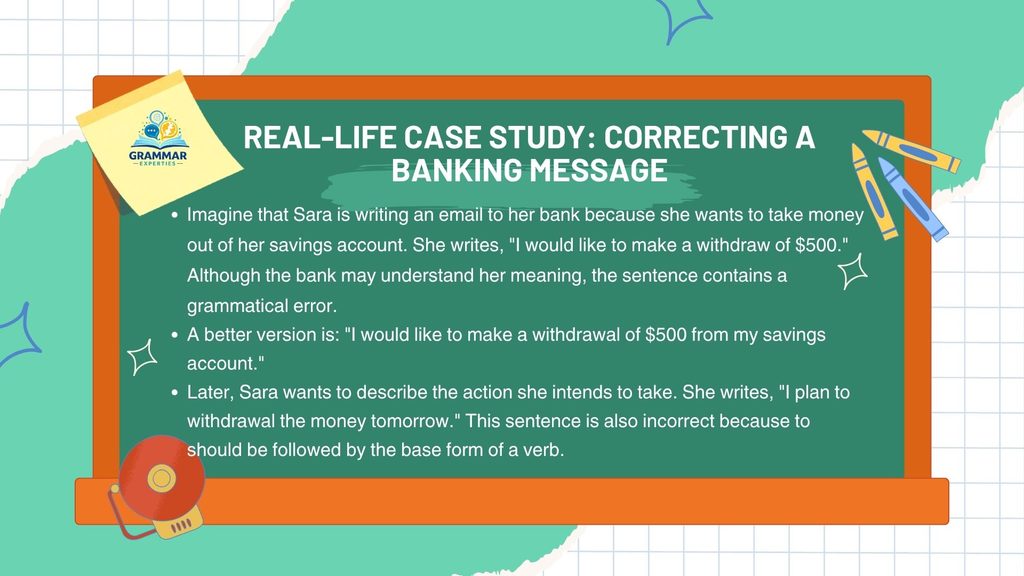
Imagine that Sara is writing an email to her bank because she wants to take money out of her savings account. She writes, “I would like to make a withdraw of $500.” Although the bank may understand her meaning, the sentence contains a grammatical error.
A better version is: “I would like to make a withdrawal of $500 from my savings account.”
Later, Sara wants to describe the action she intends to take. She writes, “I plan to withdrawal the money tomorrow.” This sentence is also incorrect because to should be followed by the base form of a verb.
The correct version is: “I plan to withdraw the money tomorrow.”
Now suppose the bank confirms the transaction. Sara could write, “My withdrawal has been processed successfully.” In this sentence, withdrawal is a noun describing the completed transaction.
This example demonstrates how the same situation can require both words in different sentences. The key is to identify whether the sentence describes an action, names a transaction, or reports an event. Once Sara understands this distinction, she can write clearer emails, complete banking forms accurately, and avoid similar mistakes in other contexts.
2025–2026 Data and Why the Word Matters in Modern Communication
The difference between withdraw and withdrawal is a grammar question, so there is no meaningful industry statistic that directly measures how often people confuse these two words. However, recent payment research provides useful context for understanding why banking-related terminology remains relevant.
What Recent Payment Statistics Show
According to the Federal Reserve’s 2025 Diary of Consumer Payment Choice, published on May 13, 2025:
- U.S. consumers made an average of 48 payments per month in 2024.
- Cash accounted for 14% of consumer payments by number.
- Credit cards accounted for 35% and debit cards for 30% of consumer payments.
The Federal Reserve’s July 2026 initial findings from its 2025 triennial payments study also reported that noncash payments reached 236.6 billion transactions in 2024, with ATM cash withdrawals declining in both number and value.
These figures describe payment activity, not grammar errors. They nevertheless illustrate why clear financial language is useful when people discuss cash withdrawals, account activity, payment records, and banking instructions.
Why Correct Word Choice Still Matters
Using the correct word can make financial messages, application forms, emails, and professional documents easier to understand.
For example, a bank statement might label an entry “Cash Withdrawal,” while a customer might write, “I want to withdraw cash.” Both expressions communicate the same general activity, but each fits its grammatical context.
For writers and businesses, clear terminology also supports readable content. Google’s guidance on helpful content emphasizes creating useful, reliable information that meets readers’ needs rather than writing primarily for search rankings.
Mini Quiz:Withdraw or Withdrawal
1. Which word is a verb?
A. WithdrawB. WithdrawalC. WithdrawnD. Withdrawingly
2. Which word is a noun?
A. WithdrawB. WithdrawsC. WithdrawalD. Withdrawing
3. Choose the correct word: “I need to ___ some money.”
A. withdrawalB. withdrawC. withdrawnD. withdrawalize
4. Choose the correct word: “The bank approved my ___.”
A. withdrawB. withdrewC. withdrawalD. withdrawing
5. Which sentence is grammatically correct?
A. She made a withdraw.B. She made a withdrawal.C. She made withdraw money.D. She made withdrawing.
6. Complete the sentence: “He decided to ___ from the competition.”
A. withdrawalB. withdrawC. withdrawnD. withdrawals
7. Complete the sentence: “Her sudden ___ surprised everyone.”
A. withdrawB. withdrawsC. withdrawalD. withdrew
8. Which sentence uses “withdraw” correctly?
A. The withdrawal was large.B. Please withdraw your application.C. His withdraw was delayed.D. We discussed the withdrawaling.
9. Which sentence uses “withdrawal” correctly?
A. They will withdrawal tomorrow.B. She withdrawal the request.C. The withdrawal took two days.D. He withdrawal from school.
10. Complete the sentence: “The customer requested a cash ___.”
A. withdrawB. withdrawalC. withdrewD. withdrawn
11. What is the past tense of “withdraw”?
A. WithdrawedB. WithdrewC. WithdrawalD. Withdrawn
12. What is the past participle of “withdraw”?
A. WithdrewB. WithdrawsC. WithdrawnD. Withdrawal
13. Complete the sentence: “She has ___ her application.”
A. withdrawB. withdrewC. withdrawnD. withdrawal
14. Complete the sentence: “The ___ of troops began at dawn.”
A. withdrawB. withdrewC. withdrawalD. withdrawn
15. Which word fits? “The company plans to ___ the product.”
A. withdrawalB. withdrawC. withdrawnD. withdrawals
16. Which phrase is correct?
A. withdrawal money from a bankB. withdraw money from a bankC. withdrawn money from a bank yesterday (as a command)D. withdrawal from money
17. Complete the sentence: “He experienced withdrawal symptoms.” What is “withdrawal” here?
A. A verbB. A nounC. An adjectiveD. A conjunction
18. Choose the correct sentence.
A. They withdrawed the offer.B. They withdrew the offer.C. They withdrawal the offer.D. They withdrawn the offer.
19. Complete the sentence: “The withdrawal ___ processed yesterday.”
A. wereB. areC. wasD. have
20. Which word completes the sentence? “You can ___ your consent at any time.”
A. withdrawalB. withdrawC. withdrawnD. withdrew
21. Which is the correct noun phrase?
A. withdraw requestB. withdrawal requestC. withdrew requestD. withdrawn request (for the act itself)
22. Complete the sentence: “The athlete announced his ___ from the race.”
A. withdrawB. withdrawalC. withdrewD. withdrawn
23. Which sentence is correct?
A. I withdrawed my savings last week.B. I withdrew my savings last week.C. I withdrawal my savings last week.D. I withdrawn my savings last week.
24. Complete the sentence: “The bank charges a fee for each ___.”
A. withdrawB. withdrawalC. withdrewD. withdrawn
25. What is the main difference between “withdraw” and “withdrawal”?
A. Both are always verbs.B. Withdraw is a noun; withdrawal is a verb.C. Withdraw is a verb; withdrawal is a noun.D. Both are adjectives.
Frequently Asked Questions (FAQs)
Q1: What Is the Difference Between Withdraw and Withdrawal?
Withdraw is a verb that describes taking something back, removing money, or leaving an activity. Withdrawal is a noun that names the action, process, or event.
Example: “I will withdraw money” and “I made a withdrawal.”
Q2: Is Withdraw a Noun or a Verb?
Withdraw is a verb. It describes an action performed by a person or organization.
Example: “She decided to withdraw her application.”
Q3: Is Withdrawal a Noun or a Verb?
Withdrawal is a noun. It refers to the act or process of withdrawing, or a particular transaction or event.
Example: “The bank confirmed the withdrawal.”
Q4: Should I Write Withdraw Money or Withdrawal Money?
Use withdraw money when describing the action.
Correct: “I need to withdraw money from my account.”
You can use withdrawal when naming the transaction: “I made a cash withdrawal.”
Q5: What Is the Past Tense of Withdraw?
The simple past tense of withdraw is withdrew. Its past participle is withdrawn.
Examples:
- Past tense: “He withdrew his application yesterday.”
- Past participle: “He has withdrawn his application.”
Withdrawed is incorrect in standard English.
Q6: Is It Correct to Say Make a Withdraw?
No. The standard expression is make a withdrawal because the phrase requires a noun.
Correct: “I made a withdrawal from my bank account.”
Incorrect: “I made a withdraw from my bank account.”
Q7: Can Withdrawal Be Used Outside Banking?
Yes. Withdrawal is used in education, business, sports, agreements, and other contexts.
Examples:
- Withdrawal from a university course
- Withdrawal of a job application
- Withdrawal from a competition
- Withdrawal of a business offer
In each example, the word refers to an action, process, or event.
Q8: How Can I Remember When to Use Withdraw or Withdrawal?
Remember this simple rule: You withdraw something, but you make a withdrawal.
Use withdraw after expressions such as to, will, and can when the sentence requires a verb. Use withdrawal after words such as a or the when the sentence requires a noun.
Conclusion: Withdraw or Withdrawal?
Understanding withdraw or withdrawal is straightforward once you recognize the difference between a verb and a noun. Withdraw describes an action, such as taking money out of an account or removing an application. Withdrawal names that action, transaction, or event.
Remember these two examples:
- “I want to withdraw money from my account.”
- “I want to make a withdrawal from my account.”
Both sentences are correct because each word serves a different grammatical purpose.
Whether you are writing an email, completing a banking form, preparing an assignment, or improving your English vocabulary, applying this simple rule will help you communicate more clearly.
Explore more easy grammar lessons and improve your English with Grammar Expertise
References
https://www.oxfordlearnersdictionaries.com/definition/english/withdraw
https://www.oxfordlearnersdictionaries.com/us/definition/english/withdrawal

Maimoona Mughal is an English grammar enthusiast dedicated to simplifying confusing words, grammar rules, and vocabulary through clear, accurate, and learner-friendly content that helps readers write and communicate with confidence.