Have you ever wondered whether to write trys or tries? You’re not alone. English spelling rules can be confusing, especially when a word ends in the letter y. Choosing the wrong spelling can make your emails, school assignments, blog posts, and professional documents look less polished.
The correct spelling is tries, not trys, in standard English. We use tries when talking about someone making an effort or when referring to multiple attempts. The rule is simple: when a verb ends in a consonant followed by y, change the y to i and add es to form the third-person singular present tense.
In this simple grammar guide, you’ll learn the difference between trys and tries, understand the spelling rule, explore practical examples, and discover how to avoid similar mistakes in everyday writing.
Trys or Tries: Which Spelling Is Correct?
When comparing trys and tries, tries is the correct spelling in standard English. The word trys is generally a spelling mistake when you intend to use the verb try or its plural noun form.
The word tries has two common grammatical uses. It can describe an action performed by one person or thing, or it can refer to more than one attempt.
For example:
- Correct: She tries to finish her homework early.
- Incorrect: She trys to finish her homework early.
- Correct: He made three tries before succeeding.
- Incorrect: He made three trys before succeeding.
Both examples demonstrate why context matters. In the first sentence, tries is a verb. In the second, it is a plural noun.
What Does Tries Mean?
Tries is a form of the verb try, meaning to make an effort, attempt something, or test whether something works. It is also the plural form of the noun try, which means an attempt.
Examples:
- My brother tries to learn a new word every day.
- She tries different methods to solve the problem.
- The team made several tries before finding the right solution.
The meaning changes slightly depending on whether tries is a verb or a noun, but its spelling remains the same.
Is Trys Ever Correct?
In ordinary English writing, trys is not the standard spelling of the verb or plural noun try.
However, the letter sequence might appear in a proper name, brand, username, or specialized identifier. Such uses do not make trys the standard grammatical form of try.
For schoolwork, business communication, articles, and everyday writing, use tries.
Why Is Tries the Correct Spelling?
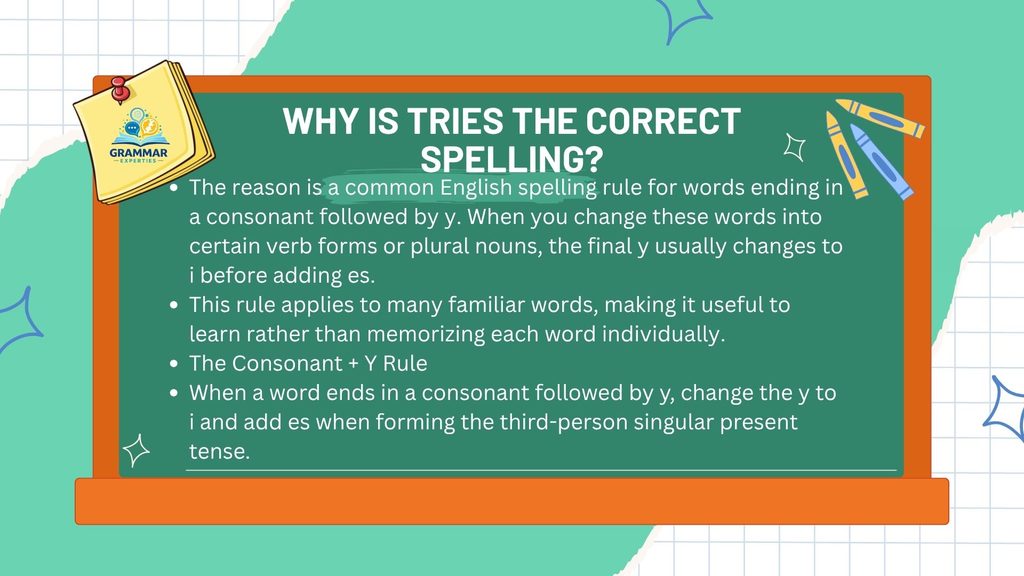
The reason is a common English spelling rule for words ending in a consonant followed by y. When you change these words into certain verb forms or plural nouns, the final y usually changes to i before adding es.
This rule applies to many familiar words, making it useful to learn rather than memorizing each word individually.
The Consonant + Y Rule
When a word ends in a consonant followed by y, change the y to i and add es when forming the third-person singular present tense.
The pattern looks like this:
Try → Tries
Other examples include:
| Base word | Correct form | Example |
|---|---|---|
| Cry | Cries | The baby cries at night. |
| Fly | Flies | The bird flies over the trees. |
| Study | Studies | Maria studies every evening. |
| Carry | Carries | He carries a heavy bag. |
| Reply | Replies | She replies to every email. |
| Apply | Applies | The student applies for a scholarship. |
Notice that each base word ends in a consonant followed by y. The spelling changes when the appropriate ending is added.
What Happens When a Word Ends in a Vowel + Y?
The rule is different when a word ends in a vowel followed by y. In this case, keep the y and add s.
| Base word | Correct form | Example |
|---|---|---|
| Play | Plays | He plays football. |
| Enjoy | Enjoys | She enjoys reading. |
| Stay | Stays | The dog stays indoors. |
| Buy | Buys | My father buys fresh fruit. |
| Say | Says | She says hello every morning. |
Therefore, you write tries but plays. The difference comes from the letter immediately before the final y.
How to Remember the Rule Easily
Use this simple memory trick:
- Consonant + y: Change y to i and add es when the grammatical form requires it.
- Vowel + y: Keep y and add s for the third-person singular present tense.
For example, try becomes tries, while enjoy becomes enjoys.
Remember that this rule does not apply to every word ending in y in exactly the same way. For instance, the past tense of try is tried, while the continuous form is trying. Always consider the grammatical form you need.
How to Use Tries Correctly in Sentences
Understanding the spelling rule is important, but knowing how to use tries in real sentences is equally valuable. The word commonly appears in conversations, schoolwork, professional writing, and everyday communication.
Tries as a Verb
Use tries when the subject is a third-person singular noun or pronoun in the simple present tense.
Common subjects include he, she, it, and singular nouns such as the student, my friend, or the teacher.
Examples:
- She tries to improve her English every day.
- He tries to arrive at work on time.
- The teacher tries to explain the lesson clearly.
- My friend tries new recipes every weekend.
- The company tries to provide excellent customer service.
- This method tries to solve the problem efficiently.
In each sentence, tries describes an action performed by a singular subject.
Tries as a Plural Noun
The word tries can also be the plural of the noun try. In this context, it means multiple attempts or efforts.
Examples:
- She needed three tries to solve the puzzle.
- His first two tries were unsuccessful.
- After several tries, I finally opened the lock.
- The player made multiple tries to score.
- My first few tries at baking bread were unsuccessful.
In these sentences, tries refers to attempts rather than actions performed by a subject.
Common Sentence Mistakes to Avoid
Some spelling errors happen because writers apply the wrong rule or confuse the subject of a sentence.
| Incorrect sentence | Correct sentence |
|---|---|
| He trys to help everyone. | He tries to help everyone. |
| She trys a new recipe. | She tries a new recipe. |
| It trys to connect to the internet. | It tries to connect to the internet. |
| I made two trys. | I made two tries. |
There is another important distinction: I try, you try, and we try are correct because these subjects take the base form in the simple present tense. Use tries with third-person singular subjects, such as he, she, and it.
Try, Tries, Tried, and Trying: Understanding the Differences
The verb try has several forms. Choosing the correct one depends on the subject, tense, and structure of the sentence.
Learning these forms will help you avoid mistakes beyond the trys or tries spelling question.
Comparison Table of Try Forms
| Word | Grammatical use | Example |
|---|---|---|
| Try | Base form; used with I, you, we, they | I try to exercise regularly. |
| Tries | Third-person singular present; plural noun | She tries her best. |
| Tried | Simple past and past participle | He tried to call me. |
| Trying | Present participle or gerund | They are trying again. |
Each form serves a different purpose, so you cannot replace one with another in every sentence.
When Should You Use Try?
Use try with subjects such as I, you, we, and they in the simple present tense. It also follows modal verbs such as can, should, and will.
Examples:
- I try to read every night.
- They try to finish their work early.
- You should try a different approach.
- We will try again tomorrow.
When Should You Use Tries?
Use tries with a third-person singular subject in the simple present tense. It can also be the plural of the noun try.
Examples:
- She tries to help her classmates.
- The machine tries to restart automatically.
- His first three tries were unsuccessful.
When Should You Use Tried or Trying?
Use tried for completed past actions or as a past participle. Use trying for continuous actions or when the verb functions as a gerund.
Examples:
- She tried to contact the manager yesterday.
- He is trying to learn Spanish.
- Trying again can help you improve.
Choosing the right form makes your sentences clearer and grammatically correct.
Real-Life Example: How One Small Spelling Mistake Changes a Document
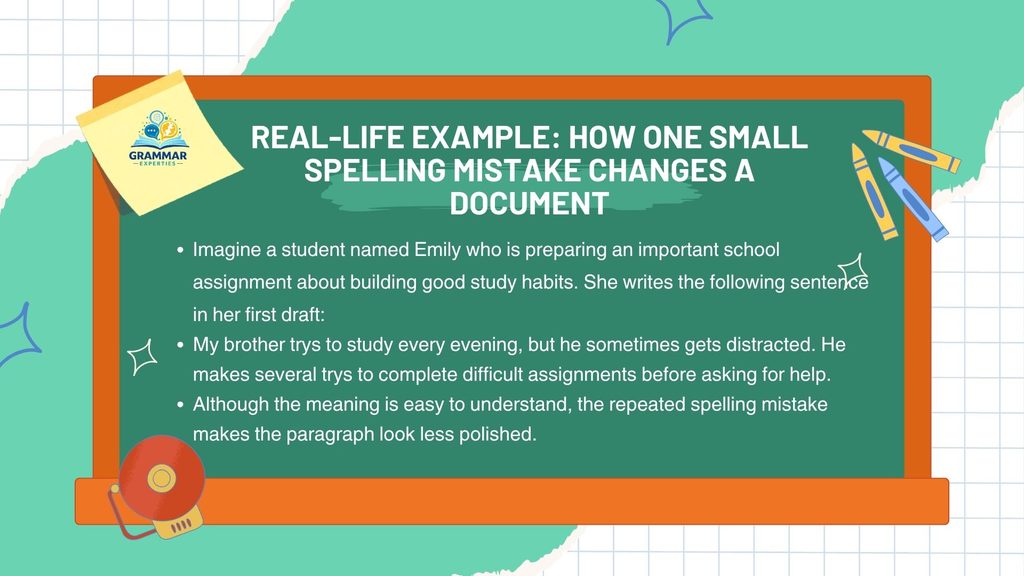
Imagine a student named Emily who is preparing an important school assignment about building good study habits. She writes the following sentence in her first draft:
My brother trys to study every evening, but he sometimes gets distracted. He makes several trys to complete difficult assignments before asking for help.
Although the meaning is easy to understand, the repeated spelling mistake makes the paragraph look less polished.
Emily reviews the spelling rule for words ending in a consonant followed by y. She learns that the third-person singular form of try is tries. She also discovers that the plural noun is spelled tries.
She corrects her paragraph:
My brother tries to study every evening, but he sometimes gets distracted. He makes several tries to complete difficult assignments before asking for help.
The corrected paragraph communicates the same ideas, but its spelling is now standard English.
Emily then checks the other verb forms in her assignment. She changes he study to he studies and confirms that they try is correct when the subject is plural.
This example illustrates a useful lesson: spelling mistakes can occur even when a writer understands the intended meaning. Learning a simple rule can help you correct several words, not just one.
The practical takeaway is to review words ending in y whenever you proofread. Check the subject, identify the grammatical form, and apply the appropriate spelling pattern. This approach is useful for students, bloggers, job applicants, and professionals who want their writing to appear clear and accurate.
Spelling Statistics, Grammar Resources, and Practical Checks
A common question is whether trys is simply less popular than tries or whether it is actually incorrect. Authoritative dictionary entries provide a more reliable answer than guessing based on how frequently a word appears online.
What the Available Data Tells Us in 2025–2026
As of October 2026, dictionary evidence confirms that tries is the standard form. Merriam-Webster lists tries as the plural of the noun try, while its verb entry identifies related forms such as tried and trying.
However, there is no verified, representative 2025–2026 statistic available here that measures exactly how many English writers misspell tries as trys. Giving a percentage without reliable evidence would be misleading.
Instead, these are the verifiable facts that help answer the spelling question:
- Standard verb form: Tries is the third-person singular present form of try.
- Standard plural noun: Tries is the plural of the noun try.
- Related spelling pattern: Words such as cry and study follow the consonant-plus-y rule in the third-person singular present tense.
- Editorial recommendation: Check dictionary entries and established grammar references when uncertain.
These facts are more useful than an unsupported claim about the frequency of the error.
How to Check Your Spelling Reliably
Use this quick checklist whenever you are unsure whether to write trys or tries.
- Identify the base word. Is it try?
- Determine how the word is being used. Is it a verb or a plural noun?
- If it is the third-person singular present form of the verb, write tries.
- If you mean multiple attempts, write tries.
- Read the entire sentence again to check subject-verb agreement.
For additional guidance, consult these established resources:
Using reliable references helps you distinguish established spelling rules from assumptions and unsupported statistics.
Mini Quiz:Trys or Tries
Grammar practice • Beginner-friendly • Answers included
1. Which spelling is correct in standard English?
A. Trys B. Tries C. Tryes D. Triess
Answer: B. Tries
2. Choose the correct word: She ___ to learn English every day.
A. trys B. try C. tries D. tryes
Answer: C. tries
3. What is the plural of the noun “try”?
A. Trys B. Tryes C. Tries D. Try’s
Answer: C. Tries
4. Fill in the blank: He ___ his best to win the competition.
A. tries B. try C. trys D. trying
Answer: A. tries
5. Which sentence is grammatically correct?
A. She trys to help me. B. She tries to help me. C. She try to help me. D. She tryes to help me.
Answer: B. She tries to help me.
6. What is the base form of “tries”?
A. Tried B. Trying C. Try D. Tries
Answer: C. Try
7. Complete the sentence: My brother ___ to arrive early.
A. try B. trys C. tries D. tried
Answer: C. tries
8. Which spelling rule applies to “try → tries”?
A. Double the final consonant. B. Change y to i and add es. C. Remove the final letter. D. Add only s.
Answer: B. Change y to i and add es.
9. Choose the correct sentence.
A. He trys a new recipe. B. He try a new recipe. C. He tries a new recipe. D. He tryes a new recipe.
Answer: C. He tries a new recipe.
10. Fill in the blank: I ___ to exercise every morning.
A. tries B. try C. trys D. trying
Answer: B. try
11. Which word is the correct past tense of “try”?
A. Tries B. Tryed C. Tried D. Trys
Answer: C. Tried
12. Complete the sentence: The machine ___ to restart automatically.
A. trys B. tries C. try D. tryes
Answer: B. tries
13. Which word follows the same spelling pattern as “try → tries”?
A. Play → plays B. Enjoy → enjoys C. Cry → cries D. Stay → stays
Answer: C. Cry → cries
14. Choose the correct plural noun: She made three ___ before succeeding.
A. trys B. tries C. tryes D. try’s
Answer: B. tries
15. Which sentence is correct?
A. They tries again. B. They trys again. C. They try again. D. They tryes again.
Answer: C. They try again.
16. What is the correct third-person singular form of “study”?
A. Studys B. Studyies C. Studies D. Studyes
Answer: C. Studies
17. Fill in the blank: She is ___ to solve the puzzle.
A. tries B. try C. trying D. trys
Answer: C. trying
18. Which word is correct when talking about a singular subject, such as “he”?
A. He try to improve. B. He tries to improve. C. He trys to improve. D. He tryes to improve.
Answer: B. He tries to improve.
19. True or False: “Trys” is the standard spelling of the third-person singular present form of “try.”
Answer: False. The correct spelling is tries.
20. True or False: “She tries hard” is a grammatically correct sentence.
Answer: True. The verb tries agrees with the singular subject she.
21. Which word correctly completes the sentence? The bird ___ to fly out of the cage.
A. try B. trys C. tries D. tryes
Answer: C. tries
22. Which spelling is correct after the vowel + y combination in “play”?
A. Plaies B. Plays C. Playes D. Plaieses
Answer: B. Plays
23. Complete the sentence: We will ___ again tomorrow.
A. tries B. trys C. try D. trying
Answer: C. try
24. Which sentence uses “tries” as a plural noun?
A. She tries to cook dinner. B. He tries to help. C. Her first two tries were unsuccessful. D. It tries to connect.
Answer: C. Her first two tries were unsuccessful.
25. Choose the correctly spelled sentence.
A. The student trys to answer every question. B. The student tryes to answer every question. C. The student tries to answer every question. D. The student try to answer every question.
Answer: C. The student tries to answer every question.
Frequently Asked Questions About Trys or Tries
Q1: Is it trys or tries?
Tries is correct in standard English when you mean the third-person singular form of try or the plural noun meaning attempts. Trys is generally a misspelling in these contexts.
Q2: Why is tries spelled with ies?
The base word try ends in a consonant followed by y. In the third-person singular present tense, the y changes to i and es is added, producing tries.
Q3: What is the plural of try?
The plural noun is tries.
Example: She made four tries before she succeeded.
Q4: Is tries a verb or a noun?
It can be either. As a verb, it describes an action, as in He tries to improve. As a noun, it means attempts, as in Her first two tries failed.
Q5: Is trys ever a correct English word?
Not as the standard spelling of the verb form or plural noun discussed in this guide. It may appear in a proper name, username, or specialized identifier, but those uses are different.
Q6: What is the difference between try and tries?
Try is the base form used with subjects such as I, you, we, and they in the simple present tense. Tries is used with third-person singular subjects, such as he, she, and it. It is also the plural of the noun try.
Q7: Is it tries or try’s?
Use tries for the plural noun or third-person singular verb. Use try’s only when the context requires a possessive form of the singular noun try, as in The try’s outcome surprised everyone. Such possessive constructions are uncommon.
Q8: What are some other words that follow the same spelling rule?
Examples include cry → cries, study → studies, carry → carries, and reply → replies. These words change the final y to i and add es in the third-person singular present tense.
Conclusion: Trys or Tries?
When deciding between trys or tries, remember that tries is the correct spelling in standard English. Use it when describing an action performed by a third-person singular subject or when referring to multiple attempts.
The rule is easy to remember: when a verb ends in a consonant followed by y, change the y to i and add es for the third-person singular present tense. That is why we write she tries, he tries, and the machine tries, rather than trys.
Keep this rule in mind when writing emails, assignments, articles, and other everyday documents. If you are uncertain about a word, consult a trusted dictionary and check how it functions in the sentence.
Explore more easy grammar lessons and improve your English with Grammar Expertise
References
Read the Merriam-Webster entry for Try
Read the Cambridge Dictionary entry for Try.

Maimoona Mughal is an English grammar enthusiast dedicated to simplifying confusing words, grammar rules, and vocabulary through clear, accurate, and learner-friendly content that helps readers write and communicate with confidence.