Introduction
Have you ever wondered whether to write fiend or feen? These two spellings may sound similar in some contexts, but they do not have the same status in standard English. Choosing the correct spelling helps you communicate clearly and avoid mistakes in schoolwork, emails, articles, and everyday writing.
The correct spelling is fiend when you mean an evil or cruel person, a demon, or someone extremely enthusiastic about something. Feen is not the standard spelling of this word, although it may appear as informal slang, a name, or a phonetic spelling in certain contexts.
In this guide, you will learn the meaning of fiend, why people confuse it with feen, how to use it in sentences, and which spelling to choose in different situations.
What Is the Correct Spelling: Fiend or Feen?
The correct standard English spelling is fiend. The spelling feen is not the standard form when referring to an evil person, a demon, or an enthusiastic person.
Why Is Fiend Correct?
The word fiend is an established English noun. It has been used for centuries to describe an evil spirit or a person who behaves cruelly. In modern English, it can also describe someone who has an intense enthusiasm for a particular activity or thing.
Examples:
- The villain was portrayed as a cruel fiend.
- My brother is a coffee fiend who drinks several cups every day.
- The story described a terrifying fiend lurking in the forest.
In each sentence, fiend is the correct spelling.
Why Do People Write Feen?
People may write feen because they are unsure how to spell the word they hear. In some accents, the pronunciation of fiend may sound different from what a learner expects. Informal online writing and phonetic spellings can also contribute to confusion.
However, if you are writing a formal essay, professional email, school assignment, or standard English article, use fiend.
Fiend vs. Feen at a Glance
| Word | Standard spelling? | Meaning or usage |
|---|---|---|
| Fiend | Yes | An evil person, demon, or enthusiastic person |
| Feen | No, not for the standard meaning of fiend | May appear as slang, a name, or a nonstandard spelling |
Quick answer: If you mean an evil person or someone obsessed with something, write fiend, not feen.
What Does Fiend Mean?
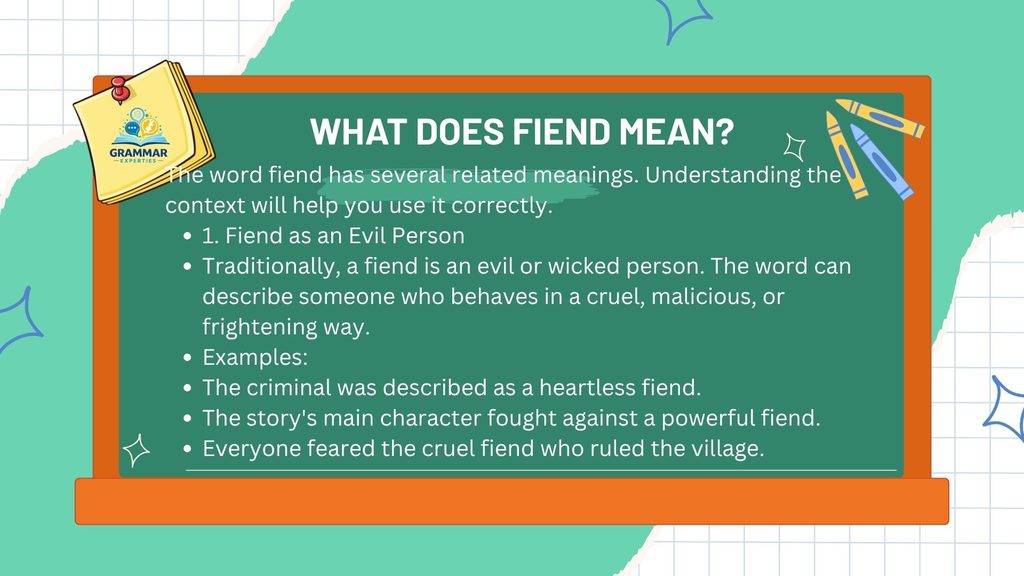
The word fiend has several related meanings. Understanding the context will help you use it correctly.
1. Fiend as an Evil Person
Traditionally, a fiend is an evil or wicked person. The word can describe someone who behaves in a cruel, malicious, or frightening way.
Examples:
- The criminal was described as a heartless fiend.
- The story’s main character fought against a powerful fiend.
- Everyone feared the cruel fiend who ruled the village.
This meaning is common in fiction, fantasy stories, horror writing, and dramatic descriptions.
2. Fiend as a Demon or Evil Spirit
Fiend can also refer to a demon or another evil supernatural being. Writers often use the word in myths, legends, fantasy novels, and horror stories.
Examples:
- The hero defeated the fiend in the final battle.
- An ancient legend warned villagers about a dangerous fiend.
- The fantasy novel featured a fiend with supernatural powers.
In these examples, fiend refers to a frightening or evil creature rather than an ordinary person.
3. Fiend as an Enthusiastic Person
In informal English, fiend can describe someone who is extremely interested in or enthusiastic about something. It is often used in phrases such as coffee fiend, fitness fiend, and chocolate fiend.
Examples:
- She is a fitness fiend who exercises every morning.
- My uncle is a technology fiend who loves testing new gadgets.
- He is a chocolate fiend and always keeps sweets in his desk.
This usage is usually playful rather than insulting. The context determines whether the word sounds negative or affectionate.
Is Feen a Real Word?
The answer depends on how the word is being used. Feen is not the standard English spelling of fiend, but that does not mean the sequence of letters can never appear as a word or name.
Feen in Informal Language
People sometimes use nonstandard spellings in text messages, online conversations, song lyrics, or social media posts. Such spellings may represent pronunciation, personal style, or community-specific slang.
However, an informal spelling does not automatically become interchangeable with a standard English word.
Examples:
- Standard: He is a coffee fiend.
- Nonstandard for this meaning: He is a coffee feen.
If you are trying to communicate the usual meaning of fiend, the first sentence is the appropriate choice for standard writing.
Feen as a Name or Slang Term
Feen may appear as a surname, username, proper name, or specialized slang expression. Its meaning can vary according to the community or context in which it appears.
Therefore, it would be inaccurate to claim that every occurrence of feen is necessarily a spelling error. If it is someone’s name or a deliberate slang term, its spelling may be intentional.
How to Decide Which Form to Use
Ask yourself what you want to communicate.
- If you mean an evil person, use fiend.
- If you mean someone extremely enthusiastic about something, use fiend.
- If Feen is a person’s actual name, preserve that spelling.
- If you are quoting slang or a lyric, retain the original wording when appropriate.
This simple check can prevent unnecessary spelling mistakes.
Fiend or Feen: Common Examples and Usage
Examples make the difference easier to understand. The following sentences demonstrate the standard spelling and show how the meaning changes with context.
Examples Using Fiend Correctly
- The villain was a fiend who showed no mercy.
- She is a book fiend who reads three novels a week.
- The villagers believed a supernatural fiend haunted the castle.
- My cousin is a gaming fiend who spends hours playing strategy games.
- The detective described the murderer as a cruel fiend.
- He is a music fiend who collects rare records.
- The children heard a frightening story about a forest fiend.
Notice that fiend works in several situations. It can describe a cruel person, a supernatural creature, or an enthusiast.
Incorrect and Correct Usage
| Incorrect usage for the standard meaning | Correct usage |
|---|---|
| He is a coffee feen. | He is a coffee fiend. |
| The story’s villain was a feen. | The story’s villain was a fiend. |
| She is a fitness feen. | She is a fitness fiend. |
| The hero fought a dangerous feen. | The hero fought a dangerous fiend. |
These corrections apply when the intended word is fiend. They do not apply to an intentional proper name or a distinct slang expression.
A Simple Memory Trick
Remember the spelling F-I-E-N-D by connecting it to the familiar word friend. Both words end in -iend, although their meanings and pronunciations differ.
You can use this reminder whenever you are unsure whether to write fiend or feen.
Real-Life Example: Choosing Between Fiend and Feen
Imagine a student named Alex is writing a short story for an English assignment. One character is a terrifying creature that frightens everyone in a village. Alex writes, “The villagers believed a dangerous feen lived in the mountains.”
Before submitting the assignment, Alex checks the spelling. The intended meaning is an evil or frightening creature, so the correct word is fiend. Alex revises the sentence to read, “The villagers believed a dangerous fiend lived in the mountains.”
Later, Alex writes another sentence about a friend who loves coffee: “Maya is a coffee feen.” Again, the intended meaning is someone who is very enthusiastic about coffee. The standard version is “Maya is a coffee fiend.”
These two examples demonstrate why context matters. In the first sentence, fiend describes a frightening creature. In the second, it describes a person’s enthusiasm. Although the meanings differ, the spelling remains the same.
Alex also discovers that feen might appear in a username or a piece of informal online writing. That does not mean it should replace fiend in a school assignment. By identifying the intended meaning rather than relying only on how a word sounds, Alex can make the correct spelling choice.
The lesson is straightforward: when you mean an evil being or an enthusiastic person, choose fiend. When a different spelling is intentional, check its specific context instead of automatically treating it as a typo.
Fiend or Feen: Language Facts and Statistics for 2025–2026
Spelling questions often arise because English pronunciation and spelling do not always match perfectly. Nevertheless, it is important to distinguish verified information from unsupported statistics.
What Can Reliable Language Resources Confirm?
Established dictionaries such as Merriam-Webster and Cambridge Dictionary document fiend as an English word. Their dictionary entries are useful for checking its spelling, pronunciation, definitions, and examples.
For current digital writing practices, Google Search Central explains how helpful, reliable, people-first content supports a good search experience. These principles also make spelling guides more useful when they answer a question directly and provide accurate examples.
Are There Verified Statistics About Fiend and Feen in 2026?
There is no specific, verified 2025–2026 statistic presented here that establishes how many people confuse fiend with feen. Providing an exact percentage or search-volume figure without reliable data would be misleading.
You can investigate search interest using which allows users to compare search terms over time and across locations. Keep in mind that search interest is a relative measure, not a direct count of spelling mistakes or the number of people who use a word.
For a reliable spelling decision, dictionary evidence is more useful than an unsupported popularity claim.
Mini Quiz:Fiend or Feen
1. Which is the correct standard English spelling?
A. Feen B. Fiend C. Fieend D. Feind
Answer: B. Fiend
2. What does “fiend” mean in “He is a coffee fiend”?
A. Someone who dislikes coffee B. Someone who sells coffee C. Someone who really loves coffee D. Someone who grows coffee
Answer: C. Someone who really loves coffee
3. Complete the sentence: “The villain was a cruel ____.”
A. Feen B. Fieend C. Fiend D. Feind
Answer: C. Fiend
4. True or False: “Fiend” can describe a demon or evil spirit.
Answer: True
5. Which sentence uses “fiend” to describe enthusiasm?
A. The fiend haunted the old castle. B. Mia is a fitness fiend. C. The fiend frightened the villagers. D. The villagers feared the fiend.
Answer: B. Mia is a fitness fiend.
6. Complete the sentence: “My brother is a gaming ____.”
A. Feen B. Feind C. Fieend D. Fiend
Answer: D. Fiend
7. What part of speech is “fiend” primarily used as?
A. Noun B. Preposition C. Conjunction D. Determiner
Answer: A. Noun
8. True or False: “Feen” is the standard spelling for someone who loves chocolate intensely.
Answer: False. The standard spelling is fiend.
9. Complete the sentence: “The hero fought a dangerous ____ in the legend.”
A. Feen B. Fiend C. Feind D. Fieend
Answer: B. Fiend
10. Which word is closest in meaning to “fiend” when describing a cruel person?
A. Benefactor B. Companion C. Villain D. Mentor
Answer: C. Villain
11. Which spelling should you use in a formal essay when referring to an evil spirit?
A. Feen B. Feind C. Fieend D. Fiend
Answer: D. Fiend
12. Which sentences use “fiend” correctly?
A. She is a book fiend who reads every day. B. The story featured a terrifying fiend. C. He is a coffee feen who loves espresso. D. My cousin is a fitness fiend.
Answer: A, B, and D
13. Which word is a common misspelling of “fiend”?
A. Friend B. Feind C. Field D. Find
Answer: B. Feind
14. When might “Feen” be intentional rather than a spelling mistake?
A. In a formal description of a demon B. In a sentence about a cruel villain C. As a person’s actual surname D. In a spelling test asking for an evil spirit
Answer: C. As a person’s actual surname
15. Which sentence is correct in standard English?
A. My sister is a music fiend. B. My sister is a music feen. C. My sister is a music feind. D. My sister is a music fieend.
Answer: A. My sister is a music fiend.
16. What is a useful way to remember the spelling of “fiend”?
A. It always begins with “ph.” B. It ends with “-een” only. C. It contains two “e” letters in a row. D. It shares the ending “-iend” with “friend.”
Answer: D. It shares the ending “-iend” with “friend.”
17. What does “forest fiend” most likely mean in a scary story?
A. A helpful forest guide B. A frightening or evil creature C. A person who sells trees D. A person who studies weather
Answer: B. A frightening or evil creature
18. Which source is suitable for checking the standard definition of “fiend”?
A. An anonymous comment B. An unverified social media post C. A reputable dictionary D. A random username
Answer: C. A reputable dictionary
19. Complete the sentence: “He is a chocolate ____ and always keeps sweets nearby.”
A. Fiend B. Feen C. Feind D. Fieend
Answer: A. Fiend
20. What should you do if “Feen” is a character’s deliberate name in a story?
A. Always replace it with fiend. B. Delete the name. C. Change it to friend. D. Keep the intended name spelling.
Answer: D. Keep the intended name spelling.
21. Which statement about “fiend” is accurate?
A. It is only used as a verb. B. It can describe both an evil being and an enthusiast. C. It always means a kind friend. D. It is never used informally.
Answer: B. It can describe both an evil being and an enthusiast.
22. Correct this sentence: “She is a book feen.”
A. She is a book friend. B. She is a book field. C. She is a book fiend. D. She is a book feind.
Answer: C. She is a book fiend.
23. What should you avoid when writing an article about “fiend or feen”?
A. Checking a dictionary B. Giving example sentences C. Explaining the context D. Inventing statistics without evidence
Answer: D. Inventing statistics without evidence
24. Which phrase is spelled correctly in standard English?
A. A fitness fiend B. A fitness feen C. A fitness feind D. A fitness fieend
Answer: A. A fitness fiend
25. What is the main lesson of “Fiend or Feen: Which Spelling Is Correct?”
A. Feen always replaces fiend in formal writing. B. Fiend is the standard spelling for the usual meanings discussed. C. Fiend is never a noun. D. Both spellings are always interchangeable.
Answer: B. Fiend is the standard spelling for the usual meanings discussed.
Frequently Asked Questions About Fiend or Feen
Q1: Is fiend or feen the correct spelling?
Fiend is the correct standard spelling when referring to an evil person, a demon, or someone extremely enthusiastic about something. Feen is not the standard spelling for these meanings.
Q2: What does fiend mean in simple English?
A fiend can mean an evil or cruel person, a demon, or someone who loves something intensely. For example, a coffee fiend is someone who really enjoys coffee.
Q3: Is feen an actual English word?
Feen may appear as a name, informal slang, or a nonstandard spelling. However, it is not the standard form of fiend. Its meaning depends on the context.
Q4: Why do people confuse fiend and feen?
People may confuse them because of pronunciation, unfamiliarity with the word, or informal writing habits. Checking the intended meaning and a reliable dictionary can resolve the confusion.
Q5: How do you use fiend in a sentence?
You can write, “My sister is a fitness fiend who never misses a workout.” In this sentence, fiend means someone who is extremely enthusiastic about fitness.
Q6: Can fiend be used as a compliment?
Yes. Although fiend can describe an evil person, it can also be used playfully to describe an enthusiastic person. Calling someone a book fiend, for instance, suggests that they love reading.
Q7: Is fiend a noun or a verb?
Fiend is primarily used as a noun in standard English. It names a person, creature, or enthusiast. For example, “The fiend escaped” uses it as a noun.
Q8: What is the easiest way to remember the spelling of fiend?
Remember that fiend ends in -iend, just like friend. The meanings are different, but the shared ending can help you recall the correct spelling.
Conclusion: Fiend or Feen Which One Should You Use?
When deciding between fiend or feen, choose fiend for standard English writing. It is the established spelling for an evil person, a demon, or someone who is extremely enthusiastic about a particular interest.
Although feen may appear in names, slang, or informal contexts, it should not replace fiend when you mean the standard English word.
Remember these key points:
- Fiend is the correct standard spelling.
- A fiend can be an evil person, a demon, or an enthusiastic individual.
- Feen is not the standard spelling for those meanings.
- Context matters when a different spelling is being used intentionally.
Explore more easy grammar lessons and improve your English with Grammar Expertise
References
https://dictionary.cambridge.org/dictionary/english/fiend
https://www.oxfordlearnersdictionaries.com/us/definition/english/fiend

Maimoona Mughal is an English grammar enthusiast dedicated to simplifying confusing words, grammar rules, and vocabulary through clear, accurate, and learner-friendly content that helps readers write and communicate with confidence.