Have you ever confused coral vs corral while writing a sentence? These two words look and sound similar, but they have completely different meanings. Choosing the wrong one can change the meaning of your sentence, especially when you’re writing about marine life, colors, farms, or animals.
The good news is that understanding the difference between coral and corral is simple once you learn what each word means and how to use it correctly.
Coral usually refers to marine organisms, coral reefs, or a pinkish-orange color. Corral, on the other hand, refers to an enclosure used to keep animals or the act of gathering people or things into a controlled space.
In this guide, you’ll discover their definitions, spelling differences, pronunciation, practical examples, and easy memory tricks to help you use both words confidently in 2026.
Coral vs Corral: What Is the Difference?
The main difference between coral and corral is their meaning and spelling. Although the words sound similar, they are not interchangeable.
- Coral: A marine organism, the hard material it produces, or a pinkish-orange color.
- Corral: An enclosed area for keeping animals or the act of gathering people or things into a particular place.
For example:
- Correct: We explored a beautiful coral reef during our vacation.
- Correct: The rancher moved the horses into the corral.
- Incorrect: We explored a beautiful corral reef.
- Incorrect: The rancher moved the horses into the coral.
The first pair uses each word according to its meaning. In the second pair, the words are mixed up and make the sentences incorrect for the intended meaning.
What Does Coral Mean?
Coral is a noun that commonly refers to marine animals that form hard structures, the material those structures produce, or a color resembling pinkish orange.
Corals are marine invertebrates that can form reefs in suitable ocean environments. Coral reefs provide habitats for many marine species and are important parts of ocean ecosystems.
Examples:
- The divers photographed colorful coral beneath the water.
- My sister bought a coral necklace.
- She wore a coral dress to the summer party.
In these examples, coral refers to marine life, jewelry material, or a color.
What Does Corral Mean?
Corral can function as both a noun and a verb.
As a noun, it means a fenced enclosure used to keep animals. As a verb, it means to gather, control, or direct people or things into a particular area.
Examples:
- The farmer repaired the wooden corral.
- The rancher corralled the cattle before sunset.
- The teacher corralled the students into the classroom before the assembly.
Notice that the meaning of corral is connected with containment, gathering, or control rather than marine life or color.
Coral vs Corral at a Glance
| Feature | Coral | Corral |
|---|---|---|
| Main meaning | Marine organism, reef material, or color | Animal enclosure or act of gathering |
| Part of speech | Mainly a noun | Noun and verb |
| Common context | Oceans, reefs, jewelry, fashion | Farms, ranches, groups, organization |
| Spelling | One final L | Two final Ls |
| Example | Coral reefs support marine life. | The horses entered the corral. |
Why Are Coral and Corral Often Confused?
Coral and corral are commonly confused because their spellings differ by just one letter, and their pronunciations are similar in many English accents.
However, their meanings belong to different contexts. Learning to recognize those contexts is one of the easiest ways to avoid spelling mistakes.
Similar Pronunciation
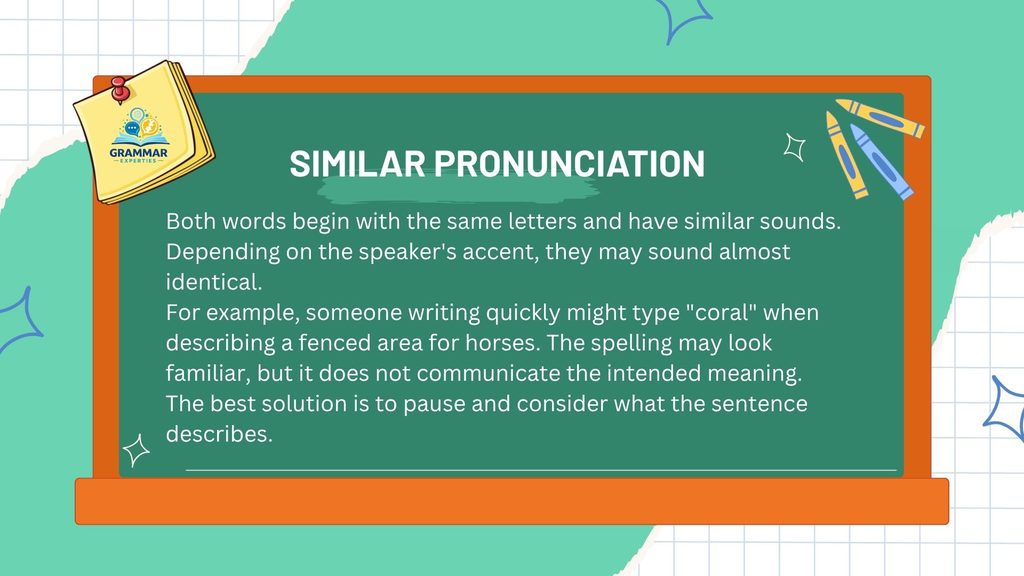
Both words begin with the same letters and have similar sounds. Depending on the speaker’s accent, they may sound almost identical.
For example, someone writing quickly might type “coral” when describing a fenced area for horses. The spelling may look familiar, but it does not communicate the intended meaning.
The best solution is to pause and consider what the sentence describes.
Different Final Letters
The spelling difference is small but important:
- Coral: One L at the end.
- Corral: Two Ls at the end.
A useful trick is to associate the double L in corral with the idea of an enclosure that holds livestock in one place. This is a memory aid, not the word’s historical origin.
Different Contexts
Context often makes the correct word obvious.
Consider these sentences:
- The aquarium contains colorful coral.
- The cowboy led the horses into the corral.
- She chose coral curtains for her bedroom.
- The organizer corralled everyone near the entrance.
Words such as reef, aquarium, and color suggest coral. Words such as horses, livestock, and gathered often point to corral.
How to Use Coral and Corral Correctly
The easiest way to use coral and corral correctly is to identify the meaning you want to communicate before choosing the spelling.
When to Use Coral
Use coral when referring to marine organisms, reef structures, or the color associated with coral.
Examples:
- Marine life: The photographer captured an image of coral growing near the reef.
- Jewelry: She wore a coral pendant with her evening dress.
- Color: The designer painted the walls a soft coral shade.
- Ocean conservation: Scientists are studying how rising sea temperatures affect coral.
- Fashion: He bought a coral shirt for his beach vacation.
In each example, coral refers to something related to marine life or a color.
When to Use Corral
Use corral when describing an animal enclosure or the act of bringing people, animals, or objects together.
Examples:
- Animal enclosure: The horses rested inside the corral.
- Ranch work: The rancher will corral the cattle before nightfall.
- Gathering people: The event staff corralled the guests near the stage.
- Organizing objects: She corralled the loose papers into a single folder.
- Managing a group: The coach corralled the players before explaining the strategy.
The verb does not always involve animals. It can also describe gathering people or things into one place, sometimes with the sense of keeping them organized or under control.
A Simple Step-by-Step Memory Trick
Use this quick checklist whenever you are unsure which spelling to choose.
- Identify the subject. Are you talking about ocean life, a color, animals, or a group of people?
- Check the intended meaning. Marine life or color usually calls for coral. An enclosure or gathering action usually calls for corral.
- Check the spelling. Write coral with one final L and corral with two.
- Read the sentence again. Make sure the word fits naturally.
For example, if your sentence is “The rancher moved the horses into the ___,” the reference to horses and an enclosure tells you to use corral.
If the sentence is “The diver photographed the colorful ___,” the ocean context points to coral.
Real-Life Example: Choosing Between Coral and Corral
Imagine that a travel blogger is writing two short sections for a vacation website. The first section describes a snorkeling trip, while the second discusses a visit to a working ranch.
In the snorkeling section, the blogger writes:
“Visitors can explore a beautiful corral reef filled with colorful fish.”
The sentence contains a spelling mistake. A reef is associated with coral, so the correct sentence is:
“Visitors can explore a beautiful coral reef filled with colorful fish.”
Later, the blogger describes the ranch experience:
“Guests can watch the horses resting in the coral.”
Here, the intended meaning is a fenced enclosure. The correct sentence is:
“Guests can watch the horses resting in the corral.”
The two errors are easy to understand because the words are visually similar. However, each mistake creates a different problem. The first misnames a marine feature, while the second fails to identify the animal enclosure correctly.
To prevent these errors, the blogger can use a simple editing method: underline each occurrence of coral or corral and check the surrounding words. Terms such as reef, ocean, and snorkeling usually indicate coral. Terms such as horses, cattle, and fence usually indicate corral.
This method is useful for students, travel writers, bloggers, and anyone who edits text quickly. Instead of memorizing every sentence, readers learn to connect spelling with meaning. Once the distinction becomes familiar, choosing the correct word becomes much easier.
Coral vs Corral: Usage Trends and Language Facts in 2025–2026
Understanding how these words are defined and used is more useful than relying on guesses about which spelling is more popular.
What Do Reliable Dictionaries Say?
The Cambridge Dictionary defines coral in relation to marine organisms and the hard structures they form. It also recognizes coral as a color term. Its entry for corral identifies an enclosure for animals and the verb meaning to move or gather people or animals into a controlled space.
These definitions establish the central distinction: coral concerns marine life or color, while corral concerns containment or gathering.
What Can We Verify About 2025–2026 Usage?
As of 2026, the dictionary definitions provide a reliable basis for distinguishing these words. However, no verified annual statistic is presented here showing exactly how often English writers confuse coral and corral during 2025 or 2026.
It would be misleading to invent a percentage, claim that one spelling mistake has increased by a specific amount, or present an unsupported search-volume figure as a verified language statistic.
For writers and learners, the practical evidence is clear:
- Coral is appropriate for marine organisms, reefs, and the associated color.
- Corral is appropriate for animal enclosures and gathering or controlling groups.
- Context is the most dependable way to distinguish the words when their pronunciation sounds similar.
Why Does This Matter for Writers?
Correct spelling helps readers understand your meaning without stopping to interpret an unexpected word. It also improves clarity in educational articles, travel guides, nature writing, and everyday communication.
Mini Quiz:Coral vs Corral
1. Which word refers to a hard, colorful material formed by marine animals?
A) Corral B) Coral C) Corrall D) Corel
Answer: B) Coral
2. Which word means an enclosure for livestock?
A) Coral B) Corral C) Correll D) Corel
Answer: B) Corral
3. The Great Barrier Reef is made up largely of _____.
A) Corrals B) Corals C) Cores D) Correls
Answer: B) Corals
4. The farmer placed the horses inside the _____.
A) coral B) corral C) corel D) corall
Answer: B) corral
5. Which spelling is correct for a marine organism that helps build reefs?
A) Corral B) Coral C) Correll D) Corrol
Answer: B) Coral
6. The rancher built a fence around the cattle _____.
A) coral B) corral C) corel D) corall
Answer: B) corral
7. Which word is associated with tropical reefs?
A) Corral B) Coral C) Both D) Neither
Answer: B) Coral
8. The cowboy led the cattle into the _____.
A) coral B) corral C) corell D) corol
Answer: B) corral
9. She wore a beautiful _____ necklace.
A) corral B) coral C) corel D) corrall
Answer: B) coral
10. Which word can be used as a verb meaning to gather or confine livestock in an enclosure?
A) Coral B) Corral C) Corel D) Coroll
Answer: B) Corral
11. Scientists studied the colorful _____ beneath the sea.
A) corral B) coral C) corel D) corrall
Answer: B) coral
12. The ranch hands moved the sheep into the _____.
A) coral B) corral C) corel D) corrol
Answer: B) corral
13. Which word is commonly used when discussing marine ecosystems?
A) Corral B) Coral C) Both D) Neither
Answer: B) Coral
14. The horses were kept safely inside the fenced _____.
A) coral B) corral C) corel D) coroll
Answer: B) corral
15. Which sentence uses coral correctly?
A) The farmer repaired the coral for his cows. B) Coral reefs provide habitats for many marine species. C) The horses entered the coral. D) The rancher built a coral for his cattle.
Answer: B) Coral reefs provide habitats for many marine species.
16. Which sentence uses corral correctly?
A) The divers admired the colorful corral reef. B) Coral is often found in marine environments. C) The farmer placed the cattle in the corral. D) She bought a coral for the horses to live in.
Answer: C) The farmer placed the cattle in the corral.
17. Coral reefs are found mainly in which environment?
A) Deserts B) Oceans C) Mountains D) Forests
Answer: B) Oceans
18. A corral is most commonly associated with which activity?
A) Raising livestock B) Studying ocean reefs C) Growing flowers D) Building ships
Answer: A) Raising livestock
19. Choose the correct word: “The diver photographed a bright orange _____ reef.”
A) corral B) coral C) corel D) corrall
Answer: B) coral
20. Choose the correct word: “The rancher repaired the fence around the horse _____.”
A) coral B) corral C) corel D) coroll
Answer: B) corral
21. Which word has one “r” in the middle?
A) Coral B) Corral C) Both D) Neither
Answer: A) Coral
22. Which word has a double “r” in the middle?
A) Coral B) Corral C) Both D) Neither
Answer: B) Corral
23. “The children learned how _____ reefs support sea life.” Which word completes the sentence?
A) corrals B) corals C) corels D) corroles
Answer: B) corals
24. “The rancher opened the gate of the _____.” Which word completes the sentence?
A) coral B) corral C) corel D) corrall
Answer: B) corral
25. What is the main difference between coral and corral?
A) They have exactly the same meaning. B) Coral relates to marine life, while a corral is an enclosure for livestock. C) Coral is a type of fence, while corral is a sea animal. D) Both words refer only to ocean life.
Answer: B) Coral relates to marine life, while a corral is an enclosure for livestock.
Frequently Asked Questions About Coral vs Corral
Q1: What is the difference between coral and corral?
Coral refers to marine organisms, reef material, or a pinkish-orange color. Corral refers to an enclosure for animals or the act of gathering people, animals, or things into one place.
Q2: Is coral or corral the correct spelling?
Both spellings are correct English words. The right choice depends on your meaning. Use coral for marine life or color and corral for an enclosure or gathering action.
Q3: Is a coral reef or a corral reef correct?
Coral reef is correct. A coral reef is a marine structure formed by reef-building corals and associated materials. Corral reef is a spelling error when referring to this ocean habitat.
Q4: Does corral mean to gather people?
Yes. As a verb, corral can mean to gather or direct people into a particular place, sometimes to keep them organized or under control.
Example: The organizers corralled the visitors near the entrance.
Q5: Can coral be used as a color?
Yes. Coral is also the name of a color generally associated with pinkish orange. For example, “She chose a coral dress for the wedding.”
Q6: How do you remember the spelling of corral?
Remember that corral has a double L at the end. Associate the word with a fenced enclosure that holds animals together. Coral, with one final L, can remind you of ocean life or a color.
Q7: Are coral and corral pronounced the same?
Their pronunciations are similar and may sound nearly identical in some accents. However, pronunciation varies among English speakers, and the words have different meanings and spellings.
Q8: What is the plural of corral?
The plural noun is corrals.
Example: The ranch has several corrals for separating the animals.
The word coral is often used as a noncount noun when referring to the material or marine life collectively, although the plural corals is also used when referring to different kinds or individual organisms.
Conclusion: Coral vs Corral Made Simple
The difference between coral vs corral comes down to meaning, spelling, and context.
Use coral when writing about marine organisms, coral reefs, or a pinkish-orange color. Use corral when referring to a fenced enclosure for animals or the act of gathering people, animals, or objects into a particular place.
Remember the simple rule: coral has one final L, while corral has two. When you are unsure, look at the surrounding words. A sentence about reefs or color points toward coral, while a sentence about horses, cattle, or gathering people often calls for corral.
Now that you understand the distinction, you can use both words more confidently in your writing.
Explore more easy grammar lessons and improve your English with Grammar Expertise
References

Maimoona Mughal is an English grammar enthusiast dedicated to simplifying confusing words, grammar rules, and vocabulary through clear, accurate, and learner-friendly content that helps readers write and communicate with confidence.