Have you ever wondered whether the correct spelling is kindergarten or kindergarden? You’re not alone. Many English learners and native speakers make this mistake because the word’s pronunciation can sound similar to the way it is incorrectly spelled.
The correct spelling is kindergarten. The word kindergarden is a common misspelling in standard English. Although the incorrect version may seem logical because a kindergarten is associated with children and learning, the final part of the word comes from the German word Garten, meaning garden.
In this guide, you’ll learn the correct spelling, meaning, pronunciation, origin, and usage of kindergarten. You’ll also find practical examples, a comparison table, spelling tips, and answers to frequently asked questions.
Kindergarten or Kindergarden: Which Spelling Is Correct?
The correct spelling is kindergarten, not kindergarden. Kindergarten refers to an early educational setting for young children or, in some countries, the first formal grade of elementary education.
The confusion happens because some speakers pronounce the final part of the word with a sound that resembles “garden.” However, the standard English spelling retains the letter t.
Why Is Kindergarten the Correct Spelling?
The word kindergarten comes from German. It combines Kinder, meaning “children,” and Garten, meaning “garden.” The German spelling was retained when the word entered English.
The word is associated with Friedrich Fröbel, a German educator who developed the kindergarten concept during the nineteenth century. His approach emphasized learning through play, exploration, and activities suited to young children.
For example:
- Correct: My daughter starts kindergarten next month.
- Incorrect: My daughter starts kindergarden next month.
The first sentence uses the accepted English spelling.
Is Kindergarden Ever Correct?
In standard modern English, kindergarden is considered a misspelling of kindergarten. It may appear in informal messages, online searches, or writing by people who are unsure of the spelling, but it is not the recommended form.
If you’re writing a school application, an educational article, an email to a teacher, or a professional document, always use kindergarten.
Kindergarten vs. Kindergarden: Quick Comparison
| Feature | Kindergarten | Kindergarden |
|---|---|---|
| Spelling status | Correct | Common misspelling |
| Standard English usage | Yes | No |
| Meaning | Early childhood educational setting or school grade | Intended meaning is usually kindergarten |
| Suitable for formal writing | Yes | No |
| Example | He attends kindergarten. | He attends kindergarden. |
Quick answer: If you need to choose between the two spellings, use kindergarten.
What Does Kindergarten Mean?
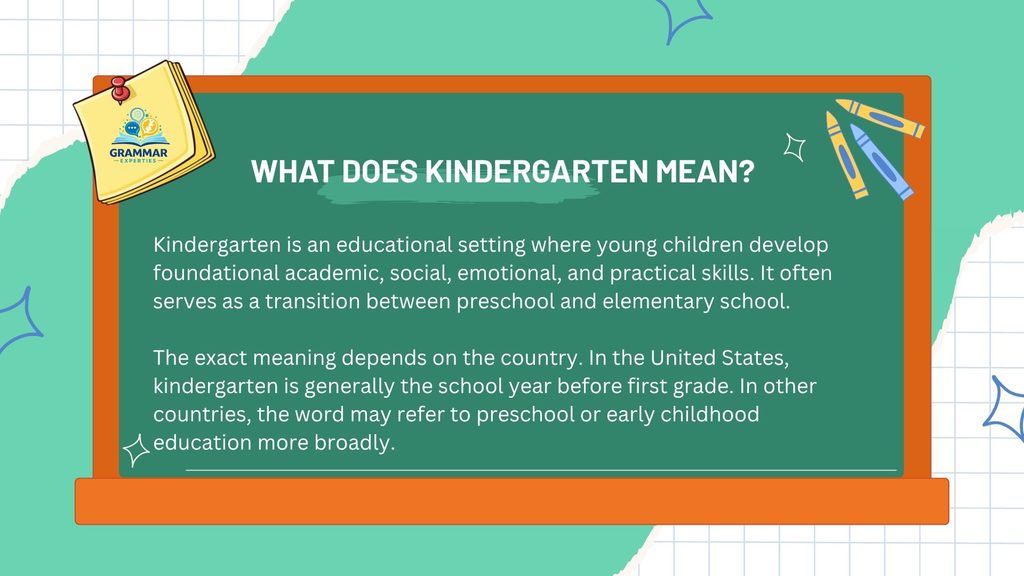
Kindergarten is an educational setting where young children develop foundational academic, social, emotional, and practical skills. It often serves as a transition between preschool and elementary school.
The exact meaning depends on the country. In the United States, kindergarten is generally the school year before first grade. In other countries, the word may refer to preschool or early childhood education more broadly.
Kindergarten Meaning in Simple English
In simple terms, kindergarten is a place where young children learn through structured activities, play, stories, songs, and interaction with classmates.
Children may learn to recognize letters, count numbers, follow instructions, share materials, and communicate their needs.
For example:
- The children read stories in kindergarten.
- My son is learning to count in kindergarten.
- The kindergarten teacher helped the children practice writing their names.
Each example uses the word to describe an early educational experience.
What Do Children Learn in Kindergarten?
Kindergarten introduces children to essential skills that support later learning. Lessons are often designed to be interactive and appropriate for children’s developmental stages.
Common learning areas include:
- Language and literacy: Recognizing letters, listening to stories, and developing vocabulary.
- Early mathematics: Counting, identifying shapes, and comparing quantities.
- Social skills: Sharing, cooperating, and taking turns.
- Creative activities: Drawing, painting, singing, and imaginative play.
- Physical development: Practicing movement, coordination, and everyday classroom routines.
- Problem-solving: Exploring simple questions and learning to try different solutions.
For example, a teacher might ask children to count five blocks, identify their colors, and then work together to build a tower. One activity can support mathematics, language, cooperation, and problem-solving.
Is Kindergarten the Same as Preschool?
Not always. The difference depends on the education system.
Preschool usually refers to programs for children before they enter compulsory or formal school grades. Kindergarten may be the final early-childhood stage or a formal school grade.
In the United States, kindergarten commonly follows preschool and precedes first grade. However, the terms can overlap in other countries.
Why Do People Spell Kindergarten as Kindergarden?
People often write kindergarden because the pronunciation of kindergarten can be misleading. When spoken quickly, the final syllables may sound similar to the familiar English word garden.
Understanding the word’s origin and spelling pattern makes the correct version easier to remember.
Pronunciation Can Cause Confusion
English spelling does not always match pronunciation perfectly. Some sounds change depending on accent, speaking speed, and regional speech patterns.
Because kindergarten contains a word that resembles the familiar English word garden, people may unconsciously replace the ending with the English spelling of garden.
However, the correct spelling is still kindergarten.
Compare these sentences:
- I packed my child’s lunch for kindergarten.
- The children planted flowers in the garden.
Both words have similar-looking endings, but they serve different purposes and have different spellings.
Common Kindergarten Spelling Mistakes
Here are some errors to watch for when writing about early childhood education:
| Incorrect form | Correct form |
|---|---|
| Kindergarden | Kindergarten |
| Kindergarden teacher | Kindergarten teacher |
| Kindergarden classroom | Kindergarten classroom |
| Kindergarden student | Kindergarten student |
| Kindergarden school | Kindergarten school |
The simplest proofreading method is to remember the correct spelling: k-i-n-d-e-r-g-a-r-t-e-n.
Easy Ways to Remember the Correct Spelling
Try these practical techniques:
- Remember the German origin: Kindergarten comes from Kinder and Garten.
- Practice the whole word: Write kindergarten several times rather than focusing only on its ending.
- Use it in a sentence: “My nephew attends kindergarten.”
- Check before publishing: Use a reliable dictionary or spelling checker when you’re uncertain.
- Create a visual reminder: Write “Kindergarten has a T” in your spelling notes.
These techniques can help students, parents, teachers, and English learners remember the correct form.
How to Use Kindergarten Correctly in a Sentence
The word kindergarten is a noun. It can refer to a school grade, an educational setting, or the learning environment in which young children participate.
Using it in different sentence structures can help you understand how it works.
Everyday Examples of Kindergarten
Here are ten examples using the correct spelling:
- My little brother will start kindergarten in September.
- The kindergarten teacher welcomed the new students.
- Our school has three kindergarten classrooms.
- She enjoys reading books to kindergarten children.
- The children learned about shapes in kindergarten today.
- His kindergarten experience helped him make new friends.
- Parents attended a kindergarten orientation meeting.
- The kindergarten students painted pictures of animals.
- My cousin teaches kindergarten at a local school.
- The school organized a special event for kindergarten families.
Notice that kindergarten remains the same regardless of whether it refers to the class, the setting, or the educational stage.
Kindergarten in Different Contexts
The word can appear in academic writing, everyday conversation, school communication, and online content.
In an academic context:
“Kindergarten programs can introduce children to early literacy and numeracy.”
In a conversation:
“My daughter is excited about starting kindergarten.”
In a school announcement:
“Kindergarten registration will open next month.”
In a blog post:
“Choosing the right kindergarten can help families prepare for their child’s first school experience.”
Each sentence uses the accepted spelling naturally.
Real-Life Example: A Parent Preparing for Kindergarten
Imagine a parent named Sara who is preparing her five-year-old son for his first school year. She begins by searching online for school supplies, classroom activities, and registration requirements. During her search, she types “kindergarden supplies” into a search engine because she believes the word ends with garden.
She finds useful results but notices that the school website consistently uses kindergarten. She checks the spelling and learns that kindergarten is the standard form.
Sara then corrects her search phrase and prepares a list of items her son needs, including a backpack, pencils, crayons, and a water bottle. When she writes an email to the teacher, she uses the sentence, “My son will be joining kindergarten this fall.”
This small correction helps Sara communicate more clearly. It also helps her recognize the spelling when she encounters it in school documents, educational websites, and classroom announcements.
The example illustrates an important lesson: spelling mistakes often happen because a word sounds like another familiar word. Learning the origin of kindergarten gives Sara a reason to remember the correct spelling instead of relying only on pronunciation.
In everyday writing, this kind of understanding is more useful than memorizing a word without knowing why it is spelled that way.
Kindergarten Statistics and the Importance of Early Education
Kindergarten is part of a broader early-learning system that introduces children to school routines and foundational skills. Enrollment data also show how important early education is to families and communities.
What Do Education Statistics Tell Us?
Early childhood education plays an important role in many education systems. In the United States, children commonly enter kindergarten around age five, although eligibility requirements vary by state and school district.
Preschool and kindergarten participation can vary according to family circumstances, program availability, location, and school policies. Therefore, enrollment figures should be understood within their specific country and educational context.
It is also important to distinguish kindergarten enrollment from preschool enrollment. The two categories may be reported separately in education statistics, and their definitions can differ between countries.
Why Early Learning Matters
Early education can give children opportunities to develop language, social interaction, number recognition, and classroom routines.
For example, listening to a story can build vocabulary and comprehension. Counting classroom objects can introduce basic mathematical concepts. Working in groups can help children practice communication and cooperation.
However, every child develops at a different pace. Kindergarten programs, teaching approaches, and enrollment requirements also vary by location.
What These Facts Mean for Parents and Educators
For parents, the practical takeaway is to check local school requirements, age eligibility, registration dates, and the skills a child will be expected to develop.
For teachers, early education provides opportunities to support children’s learning through age-appropriate activities and classroom interaction.
For writers and students, the spelling lesson remains straightforward: whether discussing enrollment, classroom activities, or education policy, the correct term is kindergarten.
Mini Quiz:Kindergarten or Kindergarden
Mini Quiz
1. Which spelling is correct?
A. Kindergarden B. Kindergarten C. Kindergärten D. Kindergartin
Answer: B. Kindergarten
2. Which sentence is correct?
A. My son starts kindergarden next week. B. My son starts kindergarten next week. C. My son starts kindergartin next week. D. My son starts kindergardn next week.
Answer: B. My son starts kindergarten next week.
3. What does kindergarten generally refer to?
A. A university course B. A workplace training program C. An early educational setting for young children D. A high school examination
Answer: C. An early educational setting for young children
4. Is “kindergarden” the standard spelling in English?
A. Yes B. No C. Only in formal writing D. Only in American English
Answer: B. No
5. Where does the word “kindergarten” originate?
A. German B. Spanish C. Italian D. Portuguese
Answer: A. German
6. What does the German word “Kinder” mean?
A. Teachers B. Books C. Children D. Schools
Answer: C. Children
7. What does “Garten” mean in German?
A. Classroom B. Garden C. Playground D. Teacher
Answer: B. Garden
8. Which sentence uses “kindergarten” correctly?
A. She teaches at a kindergarten. B. She teaches at a kindergarden. C. She teaches at a kindergartin. D. She teaches at a kindergardn.
Answer: A. She teaches at a kindergarten.
9. What part of speech is “kindergarten”?
A. Verb B. Adjective C. Adverb D. Noun
Answer: D. Noun
10. Which word is the correct plural of “kindergarten”?
A. Kindergartens B. Kindergarties C. Kindergarden D. Kindergartenses
Answer: A. Kindergartens
11. Which sentence is spelled correctly?
A. The kindergarden teacher welcomed us. B. The kindergarten teacher welcomed us. C. The kindergartin teacher welcomed us. D. The kindergardn teacher welcomed us.
Answer: B. The kindergarten teacher welcomed us.
12. Why do people often misspell “kindergarten”?
A. It has no vowels. B. It is always written with a hyphen. C. Its pronunciation can remind people of the word “garden.” D. It is a new English word.
Answer: C. Its pronunciation can remind people of the word “garden.”
13. Which activity is common in kindergarten?
A. Writing a university thesis B. Learning letters and numbers C. Studying advanced calculus D. Preparing for a professional license
Answer: B. Learning letters and numbers
14. Which spelling should you use in a formal school application?
A. Kindergarden B. Kindergartin C. Kindergarten D. Kindergardn
Answer: C. Kindergarten
15. Which sentence is correct?
A. The children enjoyed their kindergarten activities. B. The children enjoyed their kindergarden activities. C. The children enjoyed their kindergartin activities. D. The children enjoyed their kindergardn activities.
Answer: A. The children enjoyed their kindergarten activities.
16. Which word is commonly associated with kindergarten?
A. Preschool B. Laboratory C. Courtroom D. Factory
Answer: A. Preschool
17. Complete the sentence: “The children learned to count in ______.”
A. kindergarden B. kindergarten C. kindergartin D. kindergardn
Answer: B. kindergarten
18. Which spelling mistake should you correct?
“The kindergarden students painted pictures.”
A. Students B. Painted C. Pictures D. Kindergarden
Answer: D. Kindergarden
19. Who is associated with the development of the kindergarten concept?
A. Isaac Newton B. Friedrich Fröbel C. Charles Darwin D. Thomas Edison
Answer: B. Friedrich Fröbel
20. Which sentence uses the plural correctly?
A. Several kindergartens opened nearby. B. Several kindergarden opened nearby. C. Several kindergartenes opened nearby. D. Several kindergartins opened nearby.
Answer: A. Several kindergartens opened nearby.
21. True or False: “Kindergarden” is the standard spelling in English.
Answer: False. The standard spelling is kindergarten.
22. True or False: Kindergarten can help children develop early literacy and social skills.
Answer: True. Kindergarten activities often support language development, cooperation, and foundational learning.
23. Which sentence is correct?
A. My niece will attend kindergarden this year. B. My niece will attend kindergarten this year. C. My niece will attend kindergartin this year. D. My niece will attend kindergardn this year.
Answer: B. My niece will attend kindergarten this year.
24. Which is the best way to remember the spelling of “kindergarten”?
A. Replace the ending with “garden.” B. Remove the letter T. C. Memorize the correct spelling and practice it in sentences. D. Always add a hyphen.
Answer: C. Memorize the correct spelling and practice it in sentences.
25. Choose the correctly spelled sentence.
A. Kindergarten helps young children prepare for school. B. Kindergarden helps young children prepare for school. C. Kindergartin helps young children prepare for school. D. Kindergardn helps young children prepare for school.
Answer: A. Kindergarten helps young children prepare for school.
Final takeaway: Always use kindergarten, not kindergarden, in your writing. Practice these questions to remember the correct spelling and use the word confidently.
Frequently Asked Questions About Kindergarten or Kindergarden
1. Is it kindergarten or kindergarden?
Kindergarten is the correct spelling in standard English. Kindergarden is a common misspelling and should be avoided in formal writing.
2. Why is kindergarten spelled with a T?
The word comes from the German Kindergarten, formed from Kinder (children) and Garten (garden). English retains the German spelling, including the letter t.
3. What does kindergarten mean?
Kindergarten is an early educational setting for young children or the school grade before first grade in systems such as the United States.
4. How do you pronounce kindergarten?
Pronunciation varies by accent. In American English, it is commonly pronounced approximately “KIN-der-gar-ten.” The ending may sound similar to garden, which helps explain the common spelling mistake.
5. Is kindergarden an acceptable alternative spelling?
No. Although it appears in informal writing, kindergarden is not the standard spelling recommended for English writing.
6. Is kindergarten the same as preschool?
Not necessarily. Preschool generally refers to early education before formal school grades. Kindergarten often follows preschool and may be a formal grade before first grade, depending on the country.
7. What is the plural of kindergarten?
The standard plural is kindergartens.
Example: “Several kindergartens in the area offer full-day programs.”
8. How can I remember the correct spelling of kindergarten?
Remember that the word is spelled kindergarten, with a t before the final en. You can also remember its German origin: Kinder means children, and Garten means garden.
Conclusion: Kindergarten or Kindergarden?
When choosing between kindergarten and kindergarden, the answer is clear: kindergarten is the correct spelling. The alternative kindergarden is a common spelling mistake caused by pronunciation and the familiar English word garden.
The word refers to an early educational setting for young children or, in some education systems, the grade before first grade. Understanding its meaning, German origin, pronunciation, and common usage makes it easier to spell correctly.
Remember these key points:
- Use kindergarten in formal and informal writing.
- Avoid kindergarden as a spelling variant.
- Write kindergartens when using the plural.
- Check school terminology and enrollment requirements in your country.
Explore more easy grammar lessons and improve your English with Grammar Expertise
References
Kindergarten: Word Origin and History
Educational Enrollment Data, May 2026

Maimoona Mughal is an English grammar enthusiast dedicated to simplifying confusing words, grammar rules, and vocabulary through clear, accurate, and learner-friendly content that helps readers write and communicate with confidence.