If you’re wondering whether oversite or oversight is the correct spelling, you’re dealing with a surprisingly common English mix-up. The two words look and sound very similar, but they don’t normally have the same meaning.
In everyday English, oversight is the correct word when you mean a mistake caused by failing to notice something or the act of supervising something. For example, “The missing attachment was an oversight” is correct.
Oversite, on the other hand, has a much narrower technical use. In construction terminology, it can refer to concrete or another layer placed over prepared ground beneath a floor.
So, which one should you use? Let’s look at oversite vs oversight, their meanings, differences, examples, and an easy way to remember the correct spelling.
Quick Answer: Oversite vs Oversight
Oversight is the correct spelling for the common English word.
It has two major meanings:
- A mistake or omission caused by failing to notice something.
- Supervision, management, or responsible monitoring.
For example:
- “Leaving her name off the list was an oversight.”
- “The committee provides oversight of the project.”
Oversite is not normally used for either of these meanings. However, it does appear as a specialized construction term referring to a layer or slab laid over prepared ground.
Therefore, if you’re writing an email, essay, report, article, or business document and mean an omission, mistake, or supervision, choose oversight.
What Does “Oversight” Mean?
Oversight is a noun with two important meanings. Interestingly, these meanings can seem almost opposite.
Oversight Meaning: A Mistake or Omission
The first meaning of oversight is an error caused by failing to notice, remember, or do something.
For example:
- “Forgetting to attach the file was an oversight.”
- “The incorrect date was an oversight.”
- “She apologized for the oversight.”
- “The missing signature was a simple oversight.”
- “Leaving that detail out was an unfortunate oversight.”
Here, oversight can be similar to words such as mistake, omission, error, lapse, or slip.
However, “oversight” often sounds more neutral and professional than “blunder.”
Oversight Meaning: Supervision or Management
The second meaning refers to watchful supervision, control, or responsibility for monitoring something.
For example:
- “The board provides financial oversight.”
- “The manager has oversight of the project.”
- “The agency provides regulatory oversight.”
- “The program operates under government oversight.”
In these sentences, oversight doesn’t mean a mistake. It means supervision or responsible monitoring.
A Simple Way to Understand the Two Meanings
Look at the context.
If oversight means something you failed to notice, it refers to a mistake or omission.
If it describes something you’re responsible for monitoring, it means supervision.
| Sentence | Meaning |
|---|---|
| “Forgetting the deadline was an oversight.” | Mistake |
| “The committee provides oversight.” | Supervision |
| “The missing document was an oversight.” | Omission |
| “The agency has regulatory oversight.” | Monitoring |
Oversite vs Oversight: What’s the Difference?
The main difference is meaning and context.
Oversight is the standard word used in general English. Oversite has a much narrower technical use, particularly in construction.
Oversight Is the Standard English Word
Use oversight when talking about:
- mistakes
- forgotten details
- omissions
- supervision
- management
- regulation
- monitoring
- accountability
Examples:
- “The error was an unfortunate oversight.”
- “She is responsible for project oversight.”
- “The committee will provide financial oversight.”
- “The missing information was an oversight.”
Oversite Has a Specialized Construction Meaning
Oversite can be used in construction terminology for a layer of concrete or similar material placed over prepared ground, often beneath a building floor.
For example:
“The workers completed the oversite concrete before installing the floor.”
In this sentence, oversite isn’t a typo for “oversight.” It refers to a specialized construction concept.
Oversite vs Oversight Comparison Table
| Feature | Oversight | Oversite |
|---|---|---|
| Common English word | Yes | No |
| Means a mistake | Yes | No |
| Means an omission | Yes | No |
| Means supervision | Yes | No |
| Used in business writing | Yes | Rarely |
| Used in everyday English | Yes | Rarely |
| Construction terminology | Not normally | Yes |
| Standard spelling for “mistake” | Yes | No |
| Standard spelling for “supervision” | Yes | No |
Bottom line: If you’re not discussing a specialized construction term, oversight is almost certainly the word you need.
Why Do People Confuse Oversite and Oversight?
The confusion is easy to understand because the two words sound almost identical when spoken.
They Contain Familiar Sound-Alike Words
The words site and sight are already easy to confuse.
- Sight relates to seeing.
- Site refers to a location or place.
For example:
- “The beautiful view was a wonderful sight.”
- “The workers arrived at the construction site.”
Because site is so common, people may naturally type oversite when they actually mean oversight.
Oversight Is Related to Oversee
Another useful clue is the relationship between oversight and oversee.
Oversee means to supervise, manage, or watch over something.
For example:
“The director will oversee the project.”
The related noun is:
“The director has oversight of the project.”
This connection makes oversight easier to remember.
Pronunciation Doesn’t Always Help
When you’re speaking, oversite and oversight can sound nearly identical.
That’s why the spelling usually has to be remembered from context.
If you’re writing about supervision or an omission, think:
oversee → oversight
Not:
oversee → oversite
How to Use “Oversight” Correctly in a Sentence
The easiest way to master the word is to see it in realistic examples.
Examples Meaning “Mistake”
- “Forgetting to send the invoice was an oversight.”
- “The wrong address was included due to an oversight.”
- “Please accept my apology for the oversight.”
- “The missing page appears to have been an oversight.”
- “It was a minor oversight, and we corrected it immediately.”
- “The employee admitted that the error was an oversight.”
- “The scheduling conflict was caused by an oversight.”
In each example, oversight means an accidental mistake or omission.
Examples Meaning “Supervision”
Now consider the second meaning:
- “The committee provides financial oversight.”
- “The manager has oversight of the new project.”
- “The agency is responsible for regulatory oversight.”
- “Independent oversight can improve accountability.”
- “The board maintains oversight of company operations.”
- “The program operates under strict government oversight.”
- “The director has overall oversight of the department.”
Here, oversight means supervision, monitoring, or responsibility.
Examples of Incorrect Usage
When you mean a mistake or supervision, these sentences are incorrect:
❌ “Leaving the information out was an oversite.”
✅ “Leaving the information out was an oversight.”
❌ “The manager has oversite of the project.”
✅ “The manager has oversight of the project.”
❌ “Please excuse my oversite.”
✅ “Please excuse my oversight.”
The correction is simple: use oversight for the standard English meanings.
Is “Oversite” Ever Correct?
Yes, but only in a specialized context.
Oversite in Construction
In construction terminology, oversite can refer to a concrete layer or slab placed over prepared ground beneath a building floor.
For example:
“The contractor completed the oversite concrete before the floor installation began.”
In a construction document, therefore, oversite can be a legitimate technical term.
When Should You Avoid “Oversite”?
Outside specialized construction terminology, avoid oversite when you mean:
- an error
- an omission
- supervision
- monitoring
- management
- accountability
- regulatory control
If you’re writing general business English, academic English, professional correspondence, or an everyday message, oversight is the appropriate choice for these meanings.
Real-Life Example: A Common Business Writing Oversight
Imagine that a marketing manager sends an important proposal to a client. The proposal contains all the major information, but the manager accidentally forgets to attach the pricing document.
The client replies, “I don’t see the pricing sheet.”
The manager checks the sent email and realizes that the attachment is missing. They respond:
“I’m sorry. The missing attachment was an oversight. I’ll send it immediately.”
Here, oversight describes an accidental omission. The manager didn’t intentionally leave out the document. They simply failed to notice that the attachment was missing.
Now imagine a different situation. The company’s senior manager is responsible for reviewing the marketing team’s work and ensuring that proposals follow company policies. In that context, you could say:
“The senior manager provides oversight of the marketing team’s proposals.”
Notice the difference. In the first example, oversight means an unintentional mistake. In the second, it means supervision.
This example shows why context matters. The spelling remains exactly the same, but the meaning changes.
Oversight Usage and Dictionary Evidence in 2026
Current dictionary references support oversight as the standard English spelling for its two common meanings.
What Merriam-Webster Says
Merriam-Webster defines oversight in relation to both responsible supervision and an inadvertent omission or error.
This supports the two major meanings discussed throughout this guide.
What Cambridge Dictionary Says
Cambridge Dictionary also recognizes oversight as both a mistake caused by failing to notice something and responsibility for a job or activity and ensuring that it is done correctly.
What This Means for Writers
The practical rule is simple:
Use “oversight” in ordinary English.
Use “oversite” only when you’re deliberately referring to the specialized construction term.
This makes oversight the safer spelling for:
- websites
- emails
- essays
- business reports
- academic writing
- workplace communication
- general articles
- professional documents
A Simple Trick to Remember “Oversight”
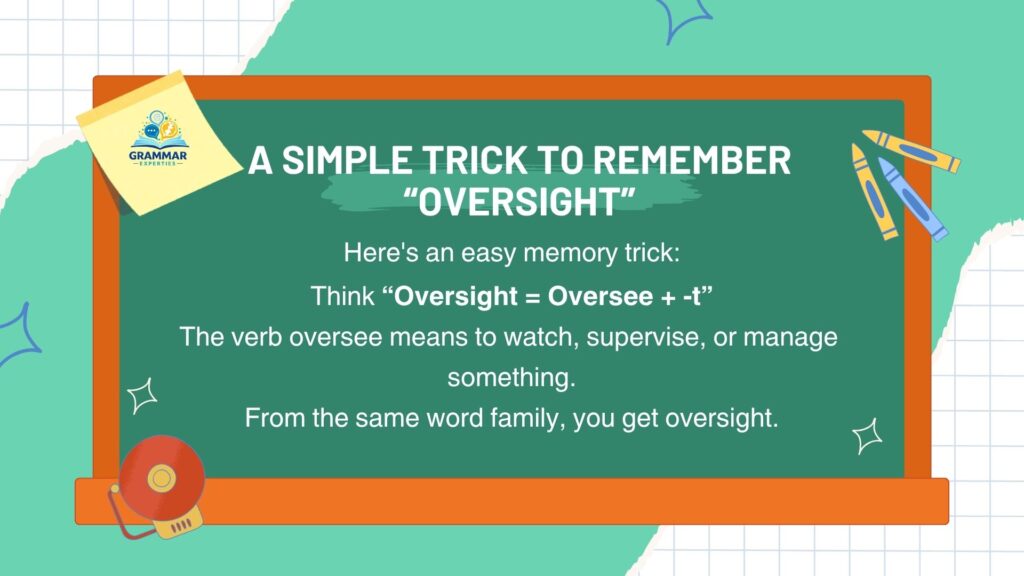
Here’s an easy memory trick:
Think “Oversight = Oversee + -t”
The verb oversee means to watch, supervise, or manage something.
From the same word family, you get oversight.
So remember:
oversee → oversight
You can also connect the word to the phrase “keep an eye on.”
If you’re talking about keeping an eye on something, you probably mean oversight.
And if you failed to keep an eye on something and missed it, that can also be an oversight.
This connection makes the spelling much easier to remember.
Common Mistakes With Oversite and Oversight
Mistake 1: Using “Oversite” for an Error
❌ “The missing information was an oversite.”
✅ “The missing information was an oversight.”
When the meaning is mistake or omission, always choose oversight.
Mistake 2: Using “Oversite” for Supervision
❌ “The department provides oversite of the project.”
✅ “The department provides oversight of the project.”
When the meaning is supervision or management, use oversight.
Mistake 3: Assuming “Oversite” Is Always Wrong
This is the opposite mistake.
Although oversite isn’t the standard spelling for the common word, it can appear as a specialized construction term.
So the most accurate rule is:
Oversight = standard English for mistake or supervision. Oversite = specialized construction terminology.
Mistake 4: Confusing Oversight With Oversee
These words are related, but they have different grammatical roles.
- Oversee = verb
- Oversight = noun
For example:
✅ “She will oversee the project.”
✅ “She has oversight of the project.”
Don’t write:
❌ “She will oversight the project.”
Oversight in Everyday English
In everyday communication, oversight is the word you’re most likely to need.
Whether you’re writing a text message, work email, school assignment, or social media post, use oversight when you mean that something was accidentally missed.
Everyday Examples
- “Sorry, leaving your name off the invitation was an oversight.”
- “I made an oversight when checking the schedule.”
- “The missing information was simply an oversight.”
- “It was an honest oversight, not an intentional omission.”
- “Please forgive my oversight.”
Workplace Examples
Professional communication frequently uses oversight in both of its common meanings.
For an error:
“The incorrect figure was an oversight, and I’ve corrected it.”
For supervision:
“The finance director has oversight of the department’s annual budget.”
This flexibility makes oversight a particularly useful word in business English.
Oversight Synonyms You Can Use
Choosing a synonym can sometimes make your writing clearer, especially when the two meanings of oversight could cause confusion.
When Oversight Means a Mistake
Possible alternatives include:
- mistake
- error
- omission
- lapse
- slip
- blunder
- inattention
For example:
“The missing attachment was an oversight.”
You could also say:
“The missing attachment was an omission.”
However, the tone changes slightly. Oversight often sounds softer and more professional.
When Oversight Means Supervision
Possible alternatives include:
- supervision
- management
- monitoring
- control
- direction
- administration
- regulation
For example:
“The committee provides financial oversight.”
could become:
“The committee provides financial supervision.”
Both are understandable, although financial oversight is often more natural in professional contexts.
Is Oversight Always a Negative Word?
No.
When oversight means an error, it usually has a negative meaning because something was accidentally missed.
For example:
“The incorrect date was an oversight.”
But when oversight means supervision, it can be completely positive or neutral.
For example:
“Independent oversight helps ensure that the project follows the rules.”
In this case, oversight represents accountability and responsible monitoring, not a mistake.
So the meaning depends entirely on context.
Can Oversight Mean Both an Error and Supervision?
Yes. This is one of the most interesting features of the word.
The same spelling can describe two very different ideas:
Oversight = failing to notice something
and
Oversight = watching or supervising something
Compare:
“The missing report was an oversight.”
with:
“The committee provides oversight of the report.”
The first describes something that was missed. The second describes careful supervision.
Context tells your reader which meaning you intend.
Oversite vs Oversight: Quick Decision Checklist
Before choosing the spelling, ask yourself:
- Are you describing a mistake? → Oversight
- Are you describing an omission? → Oversight
- Are you describing supervision? → Oversight
- Are you describing monitoring or accountability? → Oversight
- Are you discussing a specialized construction layer or concrete work? → Oversite
- Are you writing a normal email, essay, report, or article? → Usually Oversight
The One-Second Rule
If you’re unsure, replace the word with mistake or supervision.
If the sentence still makes sense, you almost certainly need oversight.
For example:
“The missing attachment was a mistake.”
Therefore:
“The missing attachment was an oversight.”
Likewise:
“The committee provides supervision.”
Therefore:
“The committee provides oversight.”
This quick test can help you avoid the most common spelling error.
Data and Usage Perspective for 2025–2026
For a spelling question like oversite vs oversight, dictionary evidence is more useful than forcing unreliable search-volume figures into the article.
Modern search behavior continues to bring users to dictionary and grammar resources when they encounter confusing spellings. Established references such as Merriam-Webster and Cambridge Dictionary distinguish oversight as the standard general-English noun, while specialized references document oversite in its technical construction sense.
The important practical takeaway for writers in 2025–2026 is therefore not a particular search-volume number. It is contextual accuracy:
General English → oversight
Specialized construction terminology → oversite
This distinction also follows an important E-E-A-T principle: when explaining language, rely on established dictionary evidence rather than presenting unsupported usage statistics as fact.
Related Words: Oversight, Oversee, Overlook, and Supervise
These words are closely related, but they don’t work the same way in a sentence.
Oversight vs Oversee
Oversee is a verb meaning to supervise or manage something.
- “The manager will oversee the project.”
- “She oversees the company’s daily operations.”
Oversight is a noun.
- “The manager has oversight of the project.”
- “The project requires careful oversight.”
A simple way to remember this is:
Oversee = action
Oversight = responsibility or supervision
Oversight vs Overlook
Overlook can mean to fail to notice something.
For example:
“I overlooked the spelling mistake.”
When you turn that idea into a noun, you can use oversight:
“The spelling mistake was an oversight.”
However, overlook has other meanings too. It can also mean to have a view of something from above:
“The hotel overlooks the lake.”
So don’t treat oversight and overlook as interchangeable in every situation.
Oversight vs Supervision
Supervision and the supervision-related meaning of oversight are very close.
For example:
“The project operates under the supervision of an experienced manager.”
You could also say:
“The project operates under the oversight of an experienced manager.”
Both can work, although the exact choice depends on context and style.
Final Examples to Test Your Understanding
Consider these sentences:
- The missing signature was an oversight.
- The government agency provides regulatory oversight.
- The contractor installed the oversite concrete layer.
- Forgetting the deadline was an oversight.
- The board maintains financial oversight.
- The construction team prepared the oversite before continuing the flooring work.
The pattern is clear: oversight dominates ordinary English, while oversite belongs to a much narrower technical context.
Mini Quiz: Oversite vs Oversight
1. The missing attachment was an ______.
A) Oversite
B) Oversight
C) Oversee
D) Oversightt
Answer: B) Oversight
2. Which word means an accidental mistake or omission?
A) Oversite
B) Overlook
C) Oversight
D) Oversee
Answer: C) Oversight
3. The committee provides financial ______.
A) Oversite
B) Oversight
C) Oversee
D) Site
Answer: B) Oversight
4. Which spelling is normally correct in everyday English?
A) Oversite
B) Oversight
C) Over-sight
D) Oversee
Answer: B) Oversight
5. “Please excuse my ______.”
A) Oversite
B) Oversight
C) Oversee
D) Site
Answer: B) Oversight
6. Which word can refer to a specialized construction term?
A) Oversight
B) Oversite
C) Overlook
D) Overseer
Answer: B) Oversite
7. Forgetting the deadline was an ______.
A) Oversite
B) Oversight
C) Oversee
D) Site
Answer: B) Oversight
8. Which sentence is correct?
A) The error was an oversite.
B) The error was an oversight.
C) The error was an oversee.
D) The error was an over sight.
Answer: B) The error was an oversight.
9. The manager has ______ of the project.
A) Oversite
B) Oversight
C) Oversee
D) Overlook
Answer: B) Oversight
10. Which word is a verb meaning “to supervise”?
A) Oversight
B) Oversite
C) Oversee
D) Oversightful
Answer: C) Oversee
11. The wrong date was an unfortunate ______.
A) Oversite
B) Oversight
C) Oversee
D) Site
Answer: B) Oversight
12. Which word is associated with regulatory supervision?
A) Oversite
B) Oversight
C) Overlook
D) Site
Answer: B) Oversight
13. Which spelling should you use in a professional email for a missed detail?
A) Oversite
B) Oversight
C) Oversee
D) Over sight
Answer: B) Oversight
14. “The board maintains corporate ______.”
A) Oversite
B) Oversight
C) Oversee
D) Oversightful
Answer: B) Oversight
15. Which word may appear in specialized construction terminology?
A) Oversight
B) Oversite
C) Oversee
D) Overlook
Answer: B) Oversite
16. Which word means supervision or monitoring?
A) Oversite
B) Oversight
C) Site
D) Overlook
Answer: B) Oversight
17. “Leaving her name off the list was an ______.”
A) Oversite
B) Oversight
C) Oversee
D) Site
Answer: B) Oversight
18. Which sentence uses “oversight” correctly?
A) The manager will oversight the team.
B) The manager provides oversight of the team.
C) The workers poured the oversight concrete.
D) The oversight is a construction site.
Answer: B) The manager provides oversight of the team.
19. Which word is related to “oversee”?
A) Oversight
B) Oversite
C) Site
D) Sightsee
Answer: A) Oversight
20. A missed detail in a report is usually called an ______.
A) Oversite
B) Oversight
C) Oversee
D) Overseer
Answer: B) Oversight
21. Which sentence is spelled correctly?
A) The missing signature was an oversite.
B) The missing signature was an oversight.
C) The missing signature was an over-see.
D) The missing signature was an oversee.
Answer: B) The missing signature was an oversight.
22. “The agency provides regulatory ______.”
A) Oversite
B) Oversight
C) Oversee
D) Overlook
Answer: B) Oversight
23. Which spelling contains “sight” rather than “site”?
A) Oversite
B) Oversight
C) Oversee
D) Oversiting
Answer: B) Oversight
24. Which statement is true?
A) Oversite always means a mistake.
B) Oversight only means supervision.
C) Oversight can mean a mistake or supervision.
D) Oversite is always the standard spelling.
Answer: C) Oversight can mean a mistake or supervision.
25. Final challenge: You mean “an accidental omission.” Which word wins?
A) Oversite
B) Oversee
C) Oversight
D) Overlook
Answer: C) Oversight
Frequently Asked Questions
Q1:Is “oversite” a correct word?
Yes, oversite can be a legitimate specialized construction term. However, it isn’t the standard spelling of oversight when you mean a mistake, omission, or supervision.
Q2:Is “oversight” the correct spelling?
Yes. Oversight is the standard spelling when you mean an accidental mistake, omission, supervision, or responsible monitoring.
Q3:What is the difference between oversite and oversight?
Oversight generally means an omission/error or supervision. Oversite has a narrow construction-related meaning involving material or concrete placed over prepared ground.
Q4:Is “oversite” a misspelling of “oversight”?
It can be. If someone writes oversite when they mean a mistake or supervision, it is normally a spelling error. However, oversite can be correct when used as the specialized construction term.
Q5:What does “oversight” mean in a sentence?
It can mean either a mistake caused by failing to notice something or supervision and responsibility for monitoring something.
For example:
- “The missing file was an oversight.” — mistake
- “The board provides oversight.” — supervision
Q6:What is the plural of oversight?
The plural is oversights.
Example:
“The report contained several minor oversights.”
Q7:What is the difference between oversight and overlook?
Overlook can be a verb meaning to fail to notice something, while oversight is a noun.
For example:
“I overlooked the typo.”
and:
“The typo was an oversight.”
Q8:How do you remember the spelling of oversight?
Connect oversight with oversee. Both relate to watching, supervising, or noticing something. When you mean the standard noun, remember the spelling with -sight, not -site.
Conclusion: Oversite or Oversight?
So, oversite vs oversight isn’t as complicated as it first appears.
For almost all general English situations, oversight is the spelling you want. It can describe an unintentional mistake or omission, such as forgetting an attachment, or supervision and responsible monitoring, such as regulatory oversight.
Oversite has a legitimate but highly specialized construction meaning, so it shouldn’t automatically be labeled a typo. Outside that technical context, however, using oversite when you mean a mistake or supervision will usually be incorrect.
The easiest rule to remember is:
Mistake or omission → oversight
Supervision or monitoring → oversight
Specialized construction term → oversite
So, the next time you hesitate over oversite vs oversight, check the meaning before choosing the spelling. In ordinary English, oversight is almost certainly the word you’re looking for.
Explore more easy grammar lessons and improve your English with Grammar Expertise
References

Maimoona Mughal is an English grammar enthusiast dedicated to simplifying confusing words, grammar rules, and vocabulary through clear, accurate, and learner-friendly content that helps readers write and communicate with confidence.