Confused about where vs were? You’re not alone. These two words look and sound similar, but they have completely different meanings and grammatical jobs. One is mainly connected with place or location, while the other is a past-tense form of the verb “be.”
For example, compare these sentences:
- Where are my keys?
- They were on the kitchen table.
The first sentence asks about a location. The second describes a past state or situation.
Once you understand that simple difference, choosing between where and were becomes much easier. In this guide, you’ll learn their meanings, pronunciation, grammar rules, common mistakes, examples, memory tricks, and the difference between where, were, and we’re.
Where vs Were: What’s the Difference?
The quickest answer is simple:
Where refers to a place, position, or location. Were is a past-tense form of the verb be.
Cambridge Dictionary describes where as a word used to ask about or refer to a place, and it can also introduce clauses connected with a place or situation.
Merriam-Webster defines were as the past tense for the second-person singular and plural forms of be, as well as the past subjunctive form.
| Word | Meaning | Grammar Role | Example |
|---|---|---|---|
| Where | Place or location | Adverb/conjunction/relative word | Where do you live? |
| Were | Past form of “be” | Verb | They were happy. |
| We’re | We are | Contraction | We’re ready. |
So, where and were are not interchangeable.
Where = Place or Location
Use where when you are talking about a place, position, direction, or location.
Examples:
- Where is the nearest bank?
- Where did you put my phone?
- I know where she lives.
- This is the house where I grew up.
- Where are we going tonight?
A useful question to ask yourself is:
“Am I talking about a place?”
If the answer is yes, where is usually the correct choice.
Were = Past Form of “Be”
Use were when you need the past form of be with subjects such as you, we, and they.
Examples:
- You were late.
- We were tired.
- They were excited.
- The students were ready.
- You were correct.
You can often recognize were because another subject comes before it.
For example:
They were at school.
Here, were acts as the verb.
The Easy Rule to Remember
Think of it this way:
Where = Where is the place?
Were = What was the past situation?
For example:
- Where were you yesterday?
- We were at home.
Notice that both words can appear in the same sentence. They simply perform different jobs.
Where: Meaning, Grammar, and Examples
Understanding where becomes easier when you look at its different uses.
Where as a Question Word
The most common use of where is to ask about location.
Examples:
- Where do you live?
- Where is my notebook?
- Where did they go?
- Where can I buy this?
- Where are the children?
In each sentence, where asks for information about a place.
For example:
Where did you park the car?
The expected answer might be:
I parked it near the library.
Therefore, whenever you ask about a location, where is the natural choice.
Where in Statements
Where isn’t limited to questions. You can also use it in statements.
Examples:
- I know where he works.
- She remembers where they met.
- Tell me where you bought that jacket.
- I forgot where I left my wallet.
Here, where introduces information about a location.
Cambridge also notes that where can introduce relative clauses, such as in “the restaurant where we ate.”
Where as a Relative Word
Consider this sentence:
This is the school where I studied.
The word where connects “school” with the information about studying there.
More examples:
- That is the restaurant where we had dinner.
- I visited the town where my grandfather was born.
- This is the room where we held the meeting.
- She showed me the park where they used to play.
In all these examples, where connects an idea with a place.
Were: Meaning, Grammar, and Examples
Unlike where, the word were functions as a verb.
It is a past form of be.
Were With You, We, and They
Examples:
- You were busy.
- We were hungry.
- They were happy.
- You were right.
- We were at the office.
- They were students.
Compare the present and past forms:
| Present | Past |
|---|---|
| You are | You were |
| We are | We were |
| They are | They were |
For example:
We are ready.
becomes:
We were ready.
The second sentence places the situation in the past.
Were in Questions
Were is also common in questions.
Examples:
- Were you tired?
- Were they at home?
- Were we supposed to wait?
- Were you happy with the result?
- Were the children asleep?
Notice the difference between where and were:
Where were you?
Here, where asks about the location, while were is the verb.
This is one of the easiest sentences to use when learning the distinction.
Were in Hypothetical Statements
There is another important use of were.
You may see were in hypothetical or unreal situations:
If I were you, I would apologize.
This is a traditional example of the subjunctive mood.
Other examples include:
- If she were here, she would help us.
- I wish he were more careful.
- If I were rich, I would travel the world.
- He talks as though he were the manager.
So don’t assume that were always means something actually happened in the past. It can also appear in hypothetical constructions.
Where vs Were: How to Choose the Correct Word
The easiest way to avoid mistakes is to focus on meaning and grammar, not spelling alone.
Ask the “Place” Question
If the sentence asks or tells you about a place, use where.
Examples:
- ___ is the train station?
- Do you know ___ she lives?
- This is the café ___ we met.
Correct:
- Where is the train station?
- Do you know where she lives?
- This is the café where we met.
Ask the “Be” Question
If you can replace the word with a form of be, you probably need were.
Example:
They ___ happy yesterday.
Try replacing the blank:
They were happy yesterday.
That works.
Another example:
We ___ at school.
Correct:
We were at school.
Use the “Place vs Past” Test
Here’s a simple three-second test:
Does the sentence involve a place? → WHERE
Does the sentence describe a past state or situation? → WERE
Examples:
___ is your office?
Place → Where
They ___ in the office yesterday.
Past state → Were
This quick test works in most everyday situations.
Where vs Were vs We’re
Many people don’t confuse only two words. They also mix up where, were, and we’re.
These words sound similar in some accents, which makes the confusion even easier.
Where
Where = place or location.
Example:
Where is your bag?
Were
Were = past form of be.
Example:
They were at school.
We’re
We’re = we are.
Example:
We’re going to school.
Merriam-Webster defines we’re as the contraction of we are.
| Word | Meaning | Example |
|---|---|---|
| Where | Place | Where are you? |
| Were | Past form of be | We were there. |
| We’re | We are | We’re ready. |
A Simple Substitution Trick
When you see we’re, expand it to we are.
We’re happy.
becomes:
We are happy.
If the expanded version makes sense, we’re is correct.
You cannot use this test with where or were because they have different grammatical functions.
Common Where vs Were Mistakes
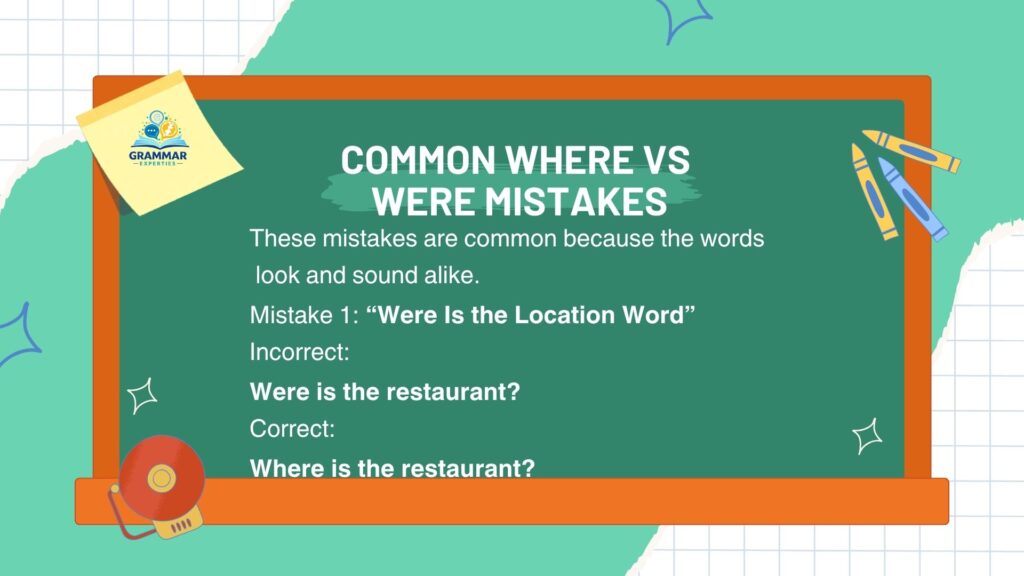
These mistakes are common because the words look and sound alike.
Mistake 1: “Were Is the Location Word”
Incorrect:
Were is the restaurant?
Correct:
Where is the restaurant?
Why?
Because the sentence asks for a location.
Mistake 2: “Where” as the Past Verb
Incorrect:
They where very tired.
Correct:
They were very tired.
Why?
The sentence describes their past condition, so were is required.
Mistake 3: Confusing “Were” and “We’re”
Incorrect:
Were going to the park.
Correct:
We’re going to the park.
Why?
The intended meaning is:
We are going to the park.
Mistake 4: Missing the Difference in “Where Were”
Some learners think only one of the words should appear.
But both can be correct:
Where were you yesterday?
Here:
- Where = asks for the location.
- Were = past form of “be.”
Another example:
Where were they staying?
Again, both words have different jobs.
A Real-Life Example: How One Small Word Changes the Meaning
Imagine a student writing an email to a teacher after missing a class.
The student wants to ask about the location of the assignment:
“Were can I find the homework?”
The teacher can probably understand the intended meaning, but the sentence contains the wrong word.
The correct version is:
“Where can I find the homework?”
Now imagine a different sentence:
“The students where absent yesterday.”
This time, the problem goes in the opposite direction. The writer needs were, because the sentence describes the students’ past condition:
“The students were absent yesterday.”
This distinction matters in schoolwork, professional emails, applications, reports, and online communication. A single incorrect word can make polished writing look careless, even when the intended meaning is obvious.
Now consider the sentence:
“Where were the documents stored?”
This sentence contains both words correctly. Where asks about the location, while were functions as the past-tense verb.
That example is worth remembering because it demonstrates the entire rule in one sentence.
The practical lesson is simple: don’t choose between where and were because they look or sound similar. First identify the job the word needs to perform. If you’re asking about a place, choose where. If you’re using the past form of be, choose were. Once you start checking the grammatical role rather than the spelling, these mistakes become much easier to catch.
2025–2026 English Usage and Learning Data
There is no reliable 2025–2026 statistic showing exactly how many people confuse where and were. It would be misleading to invent a percentage for this particular error.
However, recent English-learning data shows why clear grammar guidance remains useful.
The EF English Proficiency Index 2025 analyzed test results from approximately 2.2 million adults across 123 countries and regions. For the first time, its methodology included all four major skills: reading, listening, speaking, and writing.
The 2025 index also reported that speaking was the weakest skill in more than half of the countries measured, highlighting continuing differences in English ability around the world.
For Pakistan, the 2025 EF EPI reports a score of 493, compared with a global average of 488 in the index. It also reports a writing score of 515 for Pakistan.
These numbers do not prove that people confuse where and were. Instead, they provide broader evidence that English proficiency and accurate written communication remain important learning goals.
For grammar learners, the practical takeaway is clear: mastering small distinctions such as where vs were can help make everyday English more accurate and easier to understand.
Where vs Were Comparison Table
Use this quick reference whenever you’re unsure.
| Feature | Where | Were |
|---|---|---|
| Main meaning | Place/location | Past form of “be” |
| Grammar function | Adverb, conjunction, relative word | Verb |
| Talks about location? | Yes | No |
| Talks about past states? | No | Yes |
| Used with “you”? | Not as a verb | Yes |
| Example | Where is the hotel? | They were at the hotel. |
| Memory clue | Where = place | Were = past be |
Quick Decision Checklist
Before choosing the word, ask:
- Am I asking about a place? → Use where.
- Am I referring to a location? → Use where.
- Am I describing a past state with you, we, or they? → Use were.
- Can the word be replaced by “were” as a form of “be”? → Use were.
- Does “we are” make sense? → Use we’re, not where or were.
Where vs Were Examples in Everyday English
Seeing the words in realistic sentences makes the difference easier to remember.
Everyday Questions
- Where are my glasses?
- Where did you park?
- Where is the meeting?
- Where were you last night?
- Where were the children playing?
Notice the final two examples. Where asks about location, while were is the past-tense verb.
School and Academic Writing
- Where can I find the research paper?
- The students were ready for the exam.
- I forgot where I saved my assignment.
- We were in the library.
- Where were the results published?
Workplace Communication
- Where is the client meeting?
- The documents were sent yesterday.
- Do you know where the report is?
- We were waiting for your response.
- Where were the files stored?
Casual Conversation
- Where are you going?
- We were just talking about you.
- Where were you this morning?
- They were at the mall.
- Do you remember where we parked?
Pronunciation: Why Where and Were Are Easy to Confuse
Pronunciation can make these words particularly confusing.
In many varieties of English, where and were have similar or overlapping pronunciations, although the exact pronunciation varies by accent.
Cambridge gives pronunciations for where in both British and American English, while dictionary sources distinguish the words by their grammatical roles and meanings.
That’s why relying only on sound isn’t always enough.
Instead, focus on the sentence.
For example:
___ did you go?
The sentence asks about a destination, so the answer is:
Where did you go?
Now:
They ___ at home.
The sentence needs a verb, so the answer is:
They were at home.
In other words, meaning beats sound when you’re choosing between these words.
Mini Quiz: Where vs Were
- ___ did you leave your phone?
A) Were
B) Where
✅ Answer: B) Where - They ___ excited about the trip.
A) Where
B) Were
✅ Answer: B) Were - ___ are my keys?
A) Where
B) Were
✅ Answer: A) Where - We ___ at the library yesterday.
A) Where
B) Were
✅ Answer: B) Were - Do you know ___ she lives?
A) Were
B) Where
✅ Answer: B) Where - You ___ very helpful yesterday.
A) Where
B) Were
✅ Answer: B) Were - ___ were you last night?
A) Where
B) Were
✅ Answer: A) Where - The children ___ playing outside.
A) Where
B) Were
✅ Answer: B) Were - ___ is the nearest restaurant?
A) Were
B) Where
✅ Answer: B) Where - I remember ___ we met.
A) Where
B) Were
✅ Answer: A) Where - They ___ late for the meeting.
A) Where
B) Were
✅ Answer: B) Were - ___ did you buy that jacket?
A) Where
B) Were
✅ Answer: A) Where - We ___ surprised by the news.
A) Where
B) Were
✅ Answer: B) Were - This is the house ___ I grew up.
A) Were
B) Where
✅ Answer: B) Where - ___ the students ready for the test?
A) Where
B) Were
✅ Answer: B) Were - Can you tell me ___ the station is?
A) Where
B) Were
✅ Answer: A) Where - You ___ right about the answer.
A) Where
B) Were
✅ Answer: B) Were - ___ did your friends go?
A) Where
B) Were
✅ Answer: A) Where - The books ___ on the desk.
A) Where
B) Were
✅ Answer: B) Were - I forgot ___ I parked my car.
A) Were
B) Where
✅ Answer: B) Where - ___ you at home yesterday?
A) Where
B) Were
✅ Answer: B) Were - ___ can I find the information?
A) Where
B) Were
✅ Answer: A) Where - They ___ happy with the results.
A) Where
B) Were
✅ Answer: B) Were - Do you remember ___ we had dinner?
A) Were
B) Where
✅ Answer: B) Where - ___ were the documents stored?
A) Where
B) Were
✅ Answer: A) Where
FAQs About Where vs Were
Q1:Is “where” or “were” correct?
Both are correct words, but they are used differently. Where refers to a place or location, while were is a past form of the verb be.
Q2:What is the easiest way to remember where vs were?
Remember:
Where = place. Were = past be.
If you’re asking “what place?” use where. If you’re describing a past state with you, we, or they, use were.
Q3:Is “where were you” grammatically correct?
Yes. Where were you? is completely correct. Where asks about the person’s location, while were is the past-tense verb.
Q4:Can where and were be used in the same sentence?
Yes. For example:
Where were you yesterday?
Each word performs a different grammatical function.
Q5:Is “were” always past tense?
Usually, were is the past form of be, but it can also appear in hypothetical or contrary-to-fact constructions, such as:
If I were you, I would wait.
This is an example of the subjunctive use of were. Merriam-Webster also identifies were as a past subjunctive form of be.
Q6:What is the difference between where and we’re?
Where refers to a place. We’re is short for we are.
Examples:
- Where are you?
- We’re ready.
Q7:What is the difference between were and we’re?
Were is a past form of be. We’re means we are.
Examples:
- We were tired yesterday.
- We’re tired today.
Q8:Is “were” a verb?
Yes. Were is a form of the verb be. It functions as a past-tense verb in sentences such as “They were happy.”
Final Answer: Where vs Were
So, where vs were isn’t really a choice between two spellings of the same word. They are two different words with different grammatical functions.
Use where when you’re talking about a place, position, direction, or location:
Where is the nearest store?
Use were when you’re using the past form of be:
They were at the store.
And remember we’re:
We’re = we are.
The fastest memory trick is:
WHERE = PLACE
WERE = PAST BE
WE’RE = WE ARE
Once you train yourself to look at the meaning and grammatical role of the word, you’ll rarely confuse these three forms again.
If you want to improve your everyday English, keep practicing common confusing words like these. A few minutes of focused practice can make your writing clearer, more natural, and more professional.
Explore more easy grammar lessons and improve your English with Grammar Expertise
References

Maimoona Mughal is an English grammar enthusiast dedicated to simplifying confusing words, grammar rules, and vocabulary through clear, accurate, and learner-friendly content that helps readers write and communicate with confidence.