Have you ever typed “seing” and wondered whether it looks right? You’re not alone. The words seing vs seeing can cause confusion because English spelling doesn’t always work exactly as pronunciation suggests.
The correct spelling is seeing. The spelling seing is generally incorrect when you want to use the present participle of the verb see.
For example:
- Correct: I am seeing a movie tonight.
- Incorrect: I am seing a movie tonight.
But why does seeing have two e’s? When should you use it? Is “seing” ever correct? And how can you remember the spelling without having to check a dictionary every time?
This guide answers all of those questions with simple explanations, examples, grammar rules, a comparison table, common mistakes, and practical tips.
Seing vs Seeing: Which Spelling Is Correct?
Seeing is the correct spelling in standard English. Seing is a misspelling of seeing when the intended word is the present participle or gerund of see.
The basic form is:
see → seeing
The verb see means to perceive something with your eyes, but it can also mean to understand, meet someone, visit someone, watch something, or recognize something.
Merriam-Webster lists seeing as one of the forms of the verb see, alongside saw, seen, and sees.
The Correct Spelling Is “Seeing”
If you are describing an action involving the verb see, use seeing.
Examples:
- I am seeing a beautiful landscape.
- She is seeing her doctor tomorrow.
- We are seeing a movie tonight.
- He enjoys seeing new places.
- I remember seeing that building before.
Notice the spelling:
see + ing = seeing
The two e’s remain in the word.
Is “Seing” a Word?
In ordinary modern English writing, seing is not the standard spelling of the present participle of see.
Therefore, if you write:
I am seing the problem.
you should correct it to:
I am seeing the problem.
The error usually happens because writers assume that one of the two e’s should disappear when –ing is added.
That assumption is understandable, but it doesn’t apply here.
Quick Answer: Seing or Seeing?
| Word | Correct? | Explanation |
|---|---|---|
| Seeing | ✅ Yes | Standard present participle/gerund of “see” |
| Seing | ❌ No | Common misspelling of “seeing” |
| See | ✅ Yes | Base form of the verb |
| Saw | ✅ Yes | Simple past form |
| Seen | ✅ Yes | Past participle |
So, whenever you mean the ongoing form of see, remember:
SEE + ING = SEEING
What Does Seeing Mean?
The word seeing is the present participle and gerund form of see. Its exact meaning depends on how it functions in a sentence.
Merriam-Webster gives see several meanings, including perceiving something with the eyes, recognizing something, understanding something, watching something, reading something, attending an event, and meeting someone.
Seeing as an Action
The most common meaning relates to visual perception.
For example:
- I am seeing a bird outside.
- She is seeing the mountains for the first time.
- We were seeing strange lights in the distance.
Here, seeing describes the act of perceiving something visually.
Seeing as Understanding
The verb see can also mean understand.
For example:
I’m finally seeing why you were upset.
Here, the person isn’t necessarily looking at something with their eyes. Instead, seeing means understanding or recognizing an idea.
Another example:
After reading the explanation, I started seeing the problem differently.
This use is common in everyday English.
Seeing Someone
Seeing can also refer to meeting or spending time with someone.
For example:
I’m seeing my cousin this weekend.
It can also describe a romantic relationship:
She has been seeing someone for several months.
Cambridge’s grammar guidance notes that the continuous form seeing can be used when “see” refers to an arrangement to meet someone or to being in a romantic relationship.
Why Is Seeing Spelled With Two E’s?
One of the biggest reasons people search for seing vs seeing is the unusual-looking combination of vowels.
The spelling becomes clearer when you start with the base verb:
SEE
Then add the suffix:
SEE + ING
The result is:
SEEING
There is no need to remove an e.
The Basic Spelling Pattern
Think of the word as two visible parts:
SEE + ING
This gives:
SEEING
Compare it with:
- see → seeing
- agree → agreeing
- flee → fleeing
- free → freeing
These words retain the final e of their base spelling because that e is part of the written form of the word.
Why “Seing” Looks Tempting
The misspelling seing may look reasonable because English has many words where a final silent e disappears before -ing.
For example:
- make → making
- write → writing
- take → taking
- dance → dancing
That creates a useful general spelling rule:
Many verbs ending in a silent e drop that e before adding -ing.
However, see is different.
The word see does not follow that pattern.
You don’t write:
see → se + ing → seing
Instead:
see → seeing
A Simple Memory Trick
When you’re unsure, don’t think of seeing as a single difficult word.
Break it into:
SEE + ING
If you can spell see, simply keep it intact and add -ing.
That gives you:
SEEING
This is one of the easiest ways to avoid writing seing.
How to Use Seeing Correctly in a Sentence
Knowing that seeing is correct is only the first step. You also need to know how it works grammatically.
Seeing can function as a present participle, part of a continuous verb phrase, or a gerund.
Seeing in the Present Continuous
When seeing forms part of a continuous verb phrase, it describes an action or situation in progress.
Examples:
- I am seeing the doctor tomorrow.
- She is seeing a movie with her friends.
- They are seeing the sights of London.
- We are seeing a lot of improvement.
However, see has some special grammatical behavior.
Cambridge Grammar explains that when see means ordinary visual perception, English commonly uses forms such as can see rather than the simple continuous form I’m seeing.
For example:
I can see the mountain.
rather than:
I’m seeing the mountain.
But the continuous form is natural when see has another meaning, such as an arranged meeting:
I’m seeing my dentist tomorrow.
Seeing as a Gerund
A gerund is an -ing form that functions like a noun.
For example:
Seeing is believing.
Here, seeing acts as the subject of the sentence.
Another example:
Seeing the results changed her opinion.
In this sentence, seeing the results functions as a noun-like phrase.
Seeing After Certain Verbs
You can also use seeing after certain verbs and expressions.
Examples:
- I remember seeing that film.
- She enjoys seeing her grandchildren.
- They discussed seeing a specialist.
- He avoided seeing the message.
The important point is that the spelling remains seeing, never seing.
Seeing vs Seing: Common Examples
The easiest way to understand the difference is to look at real sentence patterns.
Everyday Examples
Correct:
I am seeing my friend later.
Incorrect:
I am seing my friend later.
Correct:
Are you seeing what I mean?
Incorrect:
Are you seing what I mean?
Correct:
She enjoys seeing new places.
Incorrect:
She enjoys seing new places.
Correct:
We were seeing the same problem.
Incorrect:
We were seing the same problem.
Examples in Formal Writing
The correct spelling matters just as much in professional and academic writing.
Instead of:
The researcher is seing a clear pattern in the results.
write:
The researcher is seeing a clear pattern in the results.
Instead of:
Students may have difficulty seing the distinction.
write:
Students may have difficulty seeing the distinction.
Instead of:
After seing the evidence, the committee changed its decision.
write:
After seeing the evidence, the committee changed its decision.
A single missing letter may seem minor, but repeated spelling errors can make otherwise strong writing look less polished.
Seing vs Seeing: Comparison Table
Here is a quick reference you can save for future proofreading.
| Feature | Seing | Seeing |
|---|---|---|
| Standard English spelling | ❌ No | ✅ Yes |
| Base verb | Incorrect form | See |
| Present participle | ❌ | ✅ |
| Gerund | ❌ | ✅ |
| Meaning | Usually intended as “seeing” | Looking, perceiving, understanding, meeting, etc. |
| Example | I am seing him. ❌ | I am seeing him. ✅ |
| Recommended in formal writing | No | Yes |
The Formula to Remember
Use this simple formula:
SEE + ING = SEEING
Not:
SEE + ING = SEING
That one visual reminder can prevent the mistake.
A Real-Life Example: Catching “Seing” in Everyday Writing
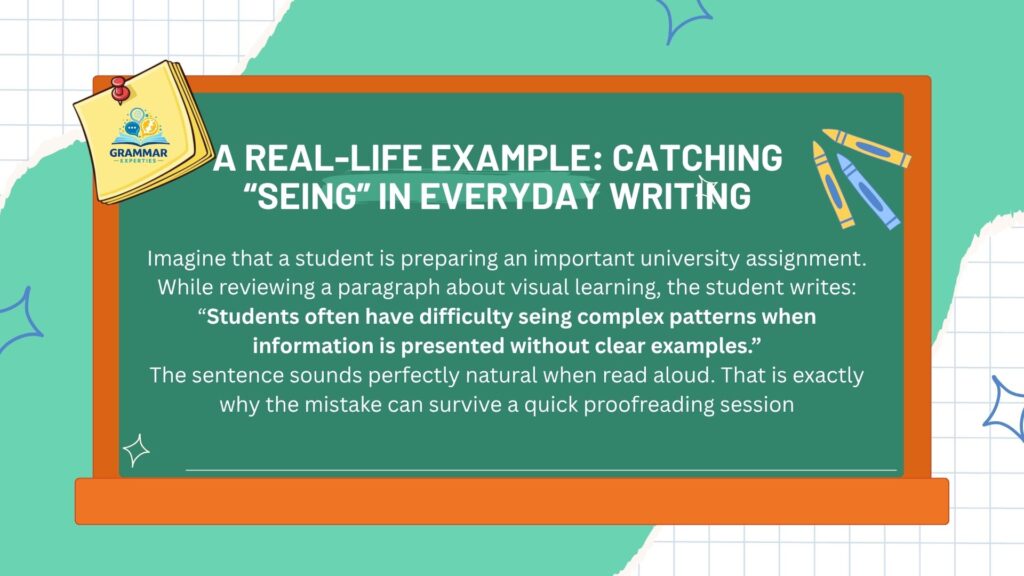
Imagine that a student is preparing an important university assignment. While reviewing a paragraph about visual learning, the student writes:
“Students often have difficulty seing complex patterns when information is presented without clear examples.”
The sentence sounds perfectly natural when read aloud. That is exactly why the mistake can survive a quick proofreading session. The problem isn’t pronunciation; seing and seeing are likely to sound nearly identical in normal speech.
During proofreading, the student notices that the word doesn’t look familiar. They check the verb’s base form and find see. From there, the spelling becomes straightforward:
see + ing = seeing
The corrected sentence is:
“Students often have difficulty seeing complex patterns when information is presented without clear examples.”
The student then searches the rest of the document for seing and finds two more instances. Correcting all three makes the assignment more polished.
This example shows why proofreading should focus not only on how a sentence sounds but also on how individual words are constructed. A spelling mistake such as seing can be especially easy to miss because the pronunciation doesn’t provide a useful clue. The best practical solution is to remember the structure of the word: seeing contains the complete base word see followed by -ing.
2025–2026 Data & Usage Notes
There isn’t a reliable public statistic showing an exact percentage of English writers who misspell seeing as seing. Claims such as “X% of people spell seeing incorrectly” should therefore be treated cautiously unless they come from a documented spelling study.
However, current authoritative dictionary and search resources provide useful evidence about the standard form.
Merriam-Webster’s current entry lists the verb forms of see as saw, seen, seeing, sees, confirming seeing as the standard present-participle form. Its entry was updated in March 2026.
Cambridge Dictionary also identifies seeing as the relevant form and provides current grammar guidance for how see behaves in different constructions.
Google also explains that its autocomplete predictions are based partly on real searches and considers factors such as language, location, trending interest, and previous searches. That means autocomplete can help reveal what people search for, but it should not be treated as a formal measure of spelling correctness.
Google Trends similarly distinguishes between an exact search term and a broader topic, which is important when comparing spelling variants.
Therefore, the strongest evidence for the spelling question is straightforward:
Seeing is the established standard spelling.
Common Mistakes With Seeing
Even people who know the correct spelling can make related mistakes.
Mistake 1: Writing “Seing”
Incorrect:
I was seing a movie.
Correct:
I was seeing a movie.
Remember:
SEE + ING
Mistake 2: Assuming Every Verb Drops Its Final E
English spelling rules have exceptions and special patterns.
For example:
- hope → hoping
- write → writing
- make → making
But:
- see → seeing
Don’t apply the silent-e rule automatically to every verb.
Mistake 3: Confusing Seeing With Seen
Seeing and seen are different forms.
Examples:
I am seeing the doctor tomorrow.
I have seen the doctor already.
Seeing is the present participle/gerund form, while seen is the past participle of see. Merriam-Webster identifies seen as the past participle of see.
Mistake 4: Using “I’m Seeing” for Every Meaning of See
Grammar matters as well as spelling.
For ordinary visual perception, English often prefers:
I can see the screen.
rather than:
I’m seeing the screen.
But I’m seeing is perfectly natural when see means meeting someone:
I’m seeing my manager at 3 p.m.
Cambridge specifically notes this distinction in its grammar guidance.
How to Remember the Correct Spelling of Seeing
If you regularly confuse seing vs seeing, use one of these memory tricks.
Remember “See” Stays Whole
Think:
SEE → SEEING
The word see doesn’t lose an e.
Imagine putting a small block labeled ING after SEE:
SEE | ING
That gives you SEEING.
Say the Letters in Your Head
When proofreading, silently spell it:
S-E-E-I-N-G
This can be especially useful when you’re writing quickly.
Connect It With “Seen”
Another useful trick is to remember that see has several familiar forms:
- see
- sees
- saw
- seen
- seeing
Once you recognize seeing as one of the normal forms of see, the spelling becomes easier to remember.
Use a Quick Proofreading Test
Ask yourself:
“Am I trying to write the -ing form of SEE?”
If yes, write:
SEEING
This quick question can catch the error before you submit an essay, email, article, or report.
When Should You Use Seeing?
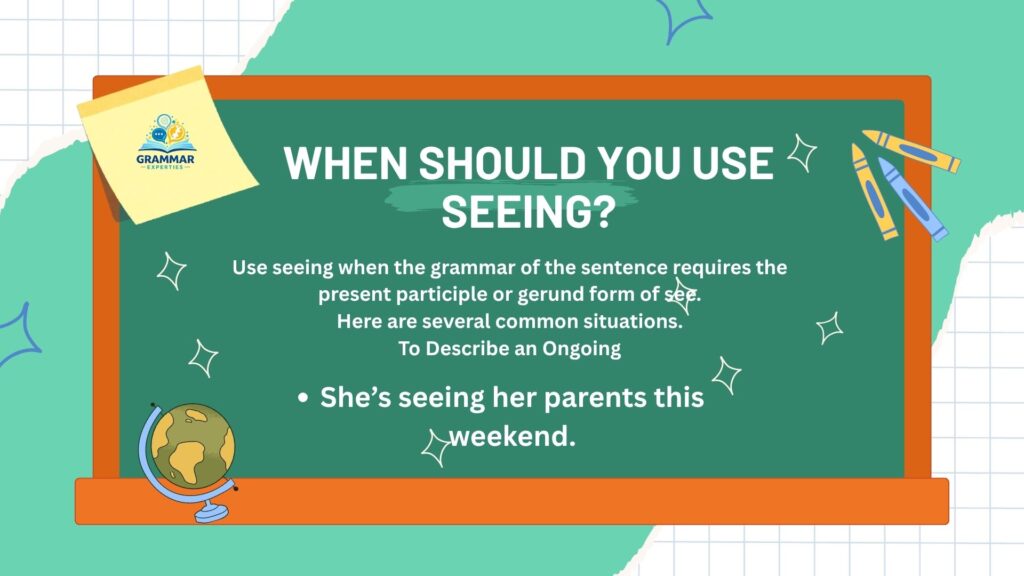
Use seeing when the grammar of the sentence requires the present participle or gerund form of see.
Here are several common situations.
To Describe an Ongoing or Planned Meeting
I’m seeing my doctor tomorrow.
She’s seeing her parents this weekend.
To Describe a Romantic Relationship
He is seeing someone new.
This use is recognized in standard English grammar.
To Talk About the Experience of Looking
I enjoy seeing the ocean at sunrise.
We loved seeing the historic buildings.
To Mean Understanding or Recognizing
I’m seeing the problem now.
She began seeing the situation differently.
In Expressions
The word also appears in familiar expressions.
For example:
Seeing is believing.
This expression means that witnessing something yourself can make it easier to accept as true. Merriam-Webster lists seeing is believing as an established phrase.
Mini Quiz: Seing vs Seeing
1. Which spelling is correct?
A) Seing
B) Seeing
C) Seein
D) Seeeing
Answer: B) Seeing
2. Choose the correct sentence:
A) I am seing my friend.
B) I am seeing my friend.
C) I am seen my friend.
D) I am seeeing my friend.
Answer: B) I am seeing my friend.
3. What is the -ing form of “see”?
A) Seing
B) Sawing
C) Seeing
D) Seen
Answer: C) Seeing
4. Fill in the blank:
“She is _____ a beautiful sunset.”
A) seing
B) seeing
C) seen
D) saw
Answer: B) seeing
5. Which word is spelled incorrectly?
A) Seeing
B) Seen
C) Seing
D) See
Answer: C) Seing
6. What is the correct formula?
A) See + ing = Seeing
B) Se + ing = Seing
C) Saw + ing = Sawing
D) Seen + ing = Seeing
Answer: A) See + ing = Seeing
7. Choose the correct sentence:
A) Are you seing the difference?
B) Are you seeing the difference?
C) Are you seen the difference?
D) Are you saw the difference?
Answer: B) Are you seeing the difference?
8. Which spelling belongs in formal writing?
A) Seing
B) Seeing
C) See-ing
D) Seeying
Answer: B) Seeing
9. Complete the sentence:
“I enjoy _____ new places.”
A) seing
B) saw
C) seeing
D) seen
Answer: C) seeing
10. What does “seeing” mean in “I’m seeing my doctor tomorrow”?
A) Meeting
B) Sleeping
C) Forgetting
D) Writing
Answer: A) Meeting
11. Which is the correct spelling?
A) See-ing
B) Seing
C) Seeing
D) Seeying
Answer: C) Seeing
12. Choose the correct sentence:
A) Seeing is believing.
B) Seing is believing.
C) Seein is believing.
D) Seeying is believing.
Answer: A) Seeing is believing.
13. Fill in the blank:
“We are _____ the sights of the city.”
A) seing
B) seeing
C) seen
D) saw
Answer: B) seeing
14. What is the base verb of “seeing”?
A) Saw
B) Seen
C) See
D) Sees
Answer: C) See
15. Which sentence is correct?
A) She is seing someone new.
B) She is seeing someone new.
C) She is seen someone new.
D) She is saw someone new.
Answer: B) She is seeing someone new.
16. Why does “seeing” have two e’s?
A) Because it comes from “see” + “ing”
B) Because “ing” requires two e’s
C) Because it comes from “saw”
D) Because the spelling is optional
Answer: A) Because it comes from “see” + “ing”
17. Choose the correct word:
“After _____ the evidence, he changed his mind.”
A) seing
B) seeing
C) saw
D) sees
Answer: B) seeing
18. Which one is NOT the standard spelling?
A) Seeing
B) See
C) Seen
D) Seing
Answer: D) Seing
19. Choose the correct sentence:
A) I remember seing that movie.
B) I remember seeing that movie.
C) I remember seen that movie.
D) I remember saw that movie.
Answer: B) I remember seeing that movie.
20. What is the present participle of “see”?
A) Saw
B) Seen
C) Seeing
D) Sees
Answer: C) Seeing
21. Which spelling mistake commonly occurs with “seeing”?
A) Removing one e
B) Adding two t’s
C) Changing s to c
D) Removing the i
Answer: A) Removing one e
22. Complete the sentence:
“I’m finally _____ why this happened.”
A) seing
B) seeing
C) saw
D) seen
Answer: B) seeing
23. Which spelling should you choose for an English essay?
A) Seing
B) Seeing
C) Seeying
D) Seein
Answer: B) Seeing
24. What is the easiest way to remember “seeing”?
A) SEE + ING
B) SE + ING
C) SAW + ING
D) SEEN + ING
Answer: A) SEE + ING
25. Final challenge: Which sentence is completely correct?
A) I am seing the problem now.
B) I am seeing the problem now.
C) I am seen the problem now.
D) I am saw the problem now.
Answer: B) I am seeing the problem now.
Frequently Asked Questions About Seing vs Seeing
Q1:Is “seing” or “seeing” correct?
Seeing is correct. Seing is generally a misspelling when you intend to write the present participle or gerund of see.
Q2;Why is seeing spelled with two e’s?
Because the base verb is see, and its -ing form is formed as see + ing = seeing. The two e’s remain.
Q3:Is “seing” a real English word?
For ordinary modern English usage, seing should not be used as the spelling of the verb form seeing. If you mean the present participle or gerund of see, write seeing.
Q4;What is the past tense of see?
The simple past tense of see is saw.
Example:
I saw him yesterday.
The past participle is seen:
I have seen him before.
Q5:What is the present participle of see?
The present participle is seeing.
The basic pattern is:
see → seeing
Q6:Can I say “I’m seeing” in English?
Yes, but the meaning matters. I’m seeing can naturally describe a planned meeting or a romantic relationship, such as “I’m seeing my doctor tomorrow” or “She’s seeing someone.” For ordinary visual perception, English often uses can see instead.
Q7:How can I remember seeing vs seing?
Remember the formula:
SEE + ING = SEEING
Don’t remove one of the e’s.
Q8:Is “seeing” a gerund?
It can be. In a sentence such as “Seeing is believing,” “seeing” functions as a noun-like gerund. In “I am seeing my friend,” it functions as a present participle within a verb phrase.
Final Verdict: Seing vs Seeing
When choosing between seing vs seeing, the answer is simple:
Seeing is the correct spelling.
Seing is a common spelling mistake that occurs when writers incorrectly remove one of the e’s from see before adding -ing.
Remember:
SEE + ING = SEEING
You can use seeing to describe looking, perceiving, understanding, meeting someone, visiting someone, or being romantically involved with someone, depending on the context.
The next time you’re unsure, don’t rely only on pronunciation. Look at the base verb:
see → seeing
Once you remember that pattern, this spelling problem becomes much easier to avoid.
If you’re working on your English spelling and grammar, save this guide and use the SEE + ING trick whenever you hesitate. A few seconds of careful proofreading can make your writing clearer, more accurate, and more professional.
Explore more easy grammar lessons and improve your English with Grammar Expertise
References
Cambridge Dictionary — See
Cambridge Grammar — See

Maimoona Mughal is an English grammar enthusiast dedicated to simplifying confusing words, grammar rules, and vocabulary through clear, accurate, and learner-friendly content that helps readers write and communicate with confidence.