If you’ve ever wondered whether the correct spelling is bearable or bareable, you’re not alone. These two words sound the same, which makes this spelling mistake surprisingly easy to make. However, only one is the standard English spelling.
The correct word is bearable. It means something that can be endured, tolerated, accepted, or dealt with. Bareable is generally considered a misspelling and should be avoided in standard English writing.
In this guide, you’ll learn the difference between bearable vs bareable, why people confuse them, how to use bearable correctly, and a simple trick that will help you remember the spelling every time.
Bearable vs Bareable: Which One Is Correct?
The short answer is simple: bearable is correct, while bareable is not the standard spelling.
Bearable is an established English adjective. Merriam-Webster defines it as “capable of being borne,” while Oxford explains that something bearable can be accepted or dealt with. Cambridge similarly defines it as something unpleasant that you can accept or deal with.
| Word | Correct? | Meaning | Example |
|---|---|---|---|
| Bearable | ✅ Yes | Able to be endured or tolerated | The heat was bearable after sunset. |
| Bareable | ❌ No in standard English | Usually a misspelling of bearable | The heat was bareable. ❌ |
So, if you’re writing an essay, email, article, school assignment, report, or professional message, choose bearable.
What Does Bearable Mean?
Bearable is an adjective that describes something difficult, unpleasant, painful, annoying, or uncomfortable that can still be endured.
For example:
- The noise was loud but bearable.
- The long journey became more bearable after we stopped for lunch.
- The pain was uncomfortable but bearable.
- Her friendly attitude made the difficult situation more bearable.
The word can describe physical experiences, emotions, situations, weather, workloads, waiting periods, and many other things.
What Does Bareable Mean?
Bareable is not the standard spelling of this adjective.
You may occasionally encounter bareable online or in informal writing, but that doesn’t make it the accepted spelling. If you mean “able to be endured,” write bearable.
A useful way to think about it is:
bear + able = bearable
The root bear is important because the verb bear can mean to tolerate or endure something.
Why Is Bearable the Correct Spelling?
The spelling becomes much easier to understand when you look at the verb bear.
Bear Means to Endure or Tolerate
The verb bear has several meanings. It can mean to carry, support, produce, or endure, depending on the context.
For example:
- I can’t bear this noise.
- She couldn’t bear the pain.
- He had to bear the responsibility.
- We must bear the consequences.
When bear takes the suffix -able, it forms bearable, meaning “able to be borne” or “able to be endured.”
Merriam-Webster also records bearable with its first known use dating to around 1557, showing that this is a long-established English word rather than a recent formation.
The -able Suffix Helps Explain the Word
The suffix -able commonly creates adjectives that mean “capable of being” or “able to be.”
For example:
- read + able = readable
- accept + able = acceptable
- tolerate + able = tolerable
- enjoy + able = enjoyable
- bear + able = bearable
Oxford notes that -able can be used to form adjectives and specifically includes bearable as an example.
Therefore, bearable isn’t simply a spelling convention you have to memorize. Its spelling reflects the underlying verb bear.
Bearable vs Bareable: The Root-Word Test
When you’re unsure, ask yourself:
What does the word mean?
If you mean:
“Something I can tolerate or endure.”
Think:
I can bear it → it is bearable.
If you’re thinking about bare, you’re thinking about a completely different word.
Why Do People Confuse Bearable and Bareable?
The confusion mainly comes from pronunciation.
Bear and Bare Are Homophones
Bear and bare are homophones. They have the same pronunciation in standard English but different spellings and meanings.
Compare:
- bear = endure, carry, or the animal
- bare = uncovered, exposed, or plain
Oxford identifies bear and bare as homophones.
This creates a natural spelling trap. When someone hears bearable rather than seeing it written, they may connect the sound with bare and write bareable.
For example, someone might hear:
“The situation is bearable.”
Because bear and bare sound alike, they may incorrectly write:
“The situation is bareable.”
The pronunciation doesn’t provide enough information to tell you which spelling is correct. You need to understand the meaning and root word.
Bare Is a Real Word—but That Doesn’t Make Bareable Correct
This is an important distinction.
Bare is absolutely a legitimate English word.
It can mean uncovered or exposed:
- He walked with bare feet.
- The walls were bare.
- The tree had bare branches.
It can also function as a verb:
- The investigation bared the truth.
But the existence of the word bare doesn’t mean that bareable is the correct spelling for “able to be endured.”
That’s why spelling based only on sound can lead you in the wrong direction.
Bearable Meaning, Examples, and Common Uses
The word bearable is versatile and appears in many everyday contexts.
Bearable for Pain and Discomfort
One of the most common uses is to describe physical discomfort.
Examples:
- The headache was bearable after I rested.
- The pain became more bearable after treatment.
- The cold was uncomfortable but still bearable.
- The injury caused pain, but it was bearable.
Merriam-Webster gives examples involving pain and describes bearable as something capable of being borne.
Bearable for Weather and Temperature
You can also use bearable to describe unpleasant weather.
Examples:
- The summer heat became bearable after sunset.
- The temperature is finally bearable.
- With some shade, the afternoon became more bearable.
- The cold was barely bearable.
This usage is especially natural because weather can be uncomfortable without being impossible to tolerate.
Bearable for Difficult Situations
The word can also describe emotional or practical situations.
Examples:
- Her support made the difficult experience more bearable.
- Having friends around made the wait bearable.
- The shorter working hours made the schedule more bearable.
- Music made the long journey more bearable.
Cambridge’s dictionary examples show bearable being used for difficult situations, waiting, pain, and other unpleasant experiences.
More Example Sentences
Here are some additional examples:
- The traffic was terrible, but the journey was still bearable.
- A little air conditioning made the heat more bearable.
- The workload is bearable when we divide it between the team.
- His jokes made the long wait more bearable.
- The noise was annoying but bearable.
- After a few days, the loneliness became more bearable.
- The movie was long, but the story made it bearable.
- The cost is high, but it is still bearable.
- Her kindness made the difficult week more bearable.
- The pain wasn’t pleasant, but it was bearable.
A Real-Life Example of Bearable vs Bareable
Imagine a student preparing for final exams.
Maya has been studying for several hours. She’s tired, the room is warm, and she still has two chapters to review. She tells her friend, “This workload is getting difficult, but it’s still bearable.”
Later, her friend helps her organize the chapters into smaller sections. They take short breaks, drink some water, and continue studying. The workload doesn’t disappear, but it becomes easier to handle. Maya might say, “Having a plan makes the pressure much more bearable.”
Notice the connection with the verb bear. Maya can bear the workload, so the workload is bearable.
Now imagine that she writes the sentence as:
“The workload is getting bareable.”
That spelling is incorrect in standard English. She isn’t describing something that has become uncovered or exposed. She’s describing something that can be endured.
This example shows why meaning matters more than pronunciation. Since bearable and bareable sound alike, listening alone won’t solve the problem. Understanding the root word will.
The same principle works in professional writing. Suppose an employee writes, “The deadline is bareable with additional help.” A reader will probably understand the intended meaning, but the spelling can make the sentence look careless. Writing bearable immediately makes the intended meaning clear and follows standard English usage.
Bearable vs Bareable: 2025–2026 Usage and Dictionary Check
For a current spelling check, reputable dictionaries provide strong evidence.
A 2026 verification snapshot shows that bearable is actively documented by major reference sources. Merriam-Webster currently defines bearable, provides synonyms such as endurable and tolerable, and includes recent 2026 example sentences. Oxford lists bearable as an adjective, and Cambridge also lists it with examples from its English corpus.
What the Current Evidence Shows
- Merriam-Webster: lists bearable as an adjective and gives its first known use as circa 1557.
- Oxford Learner’s Dictionaries: lists bearable as an adjective meaning something that can be accepted or dealt with.
- Cambridge Dictionary: lists bearable and gives tolerable and supportable as related words.
- Merriam-Webster’s current examples include uses published in 2025 and 2026, demonstrating that bearable remains active in contemporary written English.
This isn’t a case of British English using one spelling and American English using another. Bearable is the standard spelling in both major varieties.
Bearable vs Bareable: Quick Comparison
| Feature | Bearable | Bareable |
|---|---|---|
| Standard spelling | ✅ Yes | ❌ No |
| Part of speech | Adjective | — |
| Meaning | Able to be endured or tolerated | Usually intended as bearable |
| Root | Bear | Bare |
| Related verb | Bear = endure | Bare = uncover/expose |
| Formal writing | ✅ Recommended | ❌ Avoid |
| British English | ✅ Used | ❌ Not standard |
| American English | ✅ Used | ❌ Not standard |
| Opposite | Unbearable | — |
The easiest distinction is:
Bearable = you can bear it.
Bare = uncovered or exposed.
How to Remember the Correct Spelling
If spelling mistakes like bareable keep coming back, use this simple memory trick.
Think: “Can I Bear It?”
Whenever you mean something is tolerable, ask:
Can I bear it?
If the answer is yes, it’s bearable.
For example:
Can I bear the heat?
Yes. The heat is bearable.
Can I bear the pain?
Yes. The pain is bearable.
Can I bear the workload?
Yes. The workload is bearable.
This connects the adjective directly to the verb and makes the spelling easier to remember.
Don’t Connect Bearable With the Animal
Some learners see bear and immediately think about the large furry animal. That’s understandable, but it’s not the meaning involved here.
The word bear has multiple meanings. In bearable, the relevant meaning is to endure or tolerate.
So remember:
Bear it → bearable
Not:
Bare it → bareable
Common Mistakes With Bearable
Mistake 1: Writing Bareable
❌ The heat is bareable.
✅ The heat is bearable.
Mistake 2: Using Bare Because It Sounds Right
❌ The pain was difficult but bareable.
✅ The pain was difficult but bearable.
The fact that bear sounds like bare doesn’t change the spelling.
Mistake 3: Confusing Bearable With Bare
Bearable and bare have unrelated meanings in this context.
Compare:
- The temperature is bearable.
= You can tolerate it. - He walked with bare feet.
= His feet were uncovered.
These words may sound similar, but their meanings are completely different.
Mistake 4: Assuming Bareable Is a British Spelling
It isn’t.
Bearable is the standard spelling used in both British and American English. The difference between British and American spelling does not explain bearable vs bareable.
Bearable Synonyms and Related Words
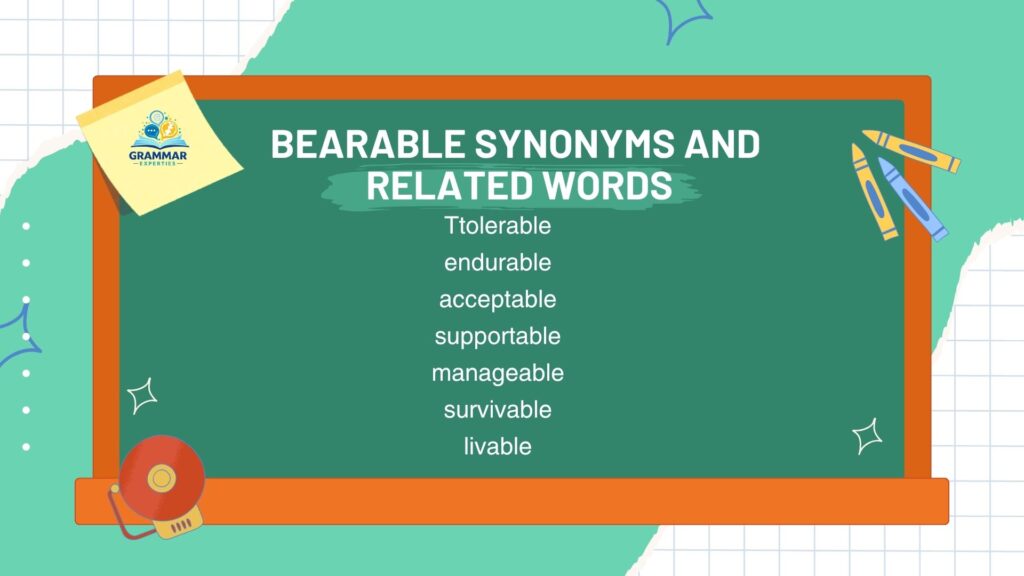
If you want to expand your vocabulary, several words have similar meanings.
Common Synonyms
Depending on context, you can use:
- tolerable
- endurable
- acceptable
- supportable
- manageable
- survivable
- livable
However, these aren’t always perfect replacements.
For example:
The pain was bearable.
could become:
The pain was tolerable.
But manageable may emphasize the ability to handle a situation rather than simply tolerate it.
Merriam-Webster lists endurable and tolerable among the close synonyms of bearable.
Bearable vs Tolerable
These words are often interchangeable.
Bearable usually emphasizes the ability to endure something unpleasant.
Tolerable can also mean acceptable or reasonably good, depending on context. Cambridge and Oxford both show this broader range for tolerable.
For example:
- The pain was bearable.
- The pain was tolerable.
Both work.
But:
- His performance was tolerable.
can mean his performance was acceptable, even though that isn’t necessarily the same sense as bearable.
Frequently Asked Questions
Q1:Is bearable or bareable correct?
Bearable is the correct standard spelling. It means capable of being endured or tolerated. Bareable is generally a misspelling and should be avoided in standard English.
Q:2bareable a real English word?
Bareable is not the standard spelling of the adjective meaning “able to be endured.” If that’s the meaning you want, use bearable.
Q3:What does bearable mean in simple words?
Bearable means something is difficult, unpleasant, or uncomfortable, but you can still tolerate or endure it.
For example:
The heat is hot, but it’s bearable.
Q4:Why do people spell bearable as bareable?
The main reason is pronunciation. Bear and bare are homophones, so they sound alike. Writers may therefore choose bare when trying to spell bearable.
Q5:What is the opposite of bearable?
The common opposite is unbearable.
If something is unbearable, it is too painful, unpleasant, difficult, or annoying to tolerate. Oxford lists unbearable as the opposite of bearable.
Q6:Is bearable used in British and American English?
Yes. Bearable is standard in both British and American English. The pronunciation may vary slightly by accent, but the spelling remains the same.
Q7:What is an easy trick to remember bearable?
Think:
If you can BEAR it, it’s BEARABLE.
The word comes from the verb bear, meaning to endure or tolerate.
Q8:Can I use bareable in formal writing?
It’s best not to. In formal writing, academic work, professional communication, and published content, use bearable when you mean “able to be endured.”
Mini Quiz: Bearable vs Bareable
- Which spelling is correct?
A) Bareable
B) Bearable
✅ Answer: B) Bearable - The pain was difficult but still ____.
A) bearable
B) bareable
✅ Answer: A) bearable - What does “bearable” mean?
A) Uncovered
B) Able to be endured
C) Very expensive
✅ Answer: B) Able to be endured - Complete the sentence: “Can you ____ the noise?”
A) bear
B) bare
✅ Answer: A) bear - Which word means “uncovered”?
A) Bear
B) Bare
C) Bearable
✅ Answer: B) Bare - Choose the correct sentence:
A) The heat was bareable.
B) The heat was bearable.
✅ Answer: B - Bearable is formed from which root word?
A) Bear
B) Bare
C) Bore
✅ Answer: A) Bear - What is the opposite of “bearable”?
A) Unbearable
B) Bare
C) Unbareable
✅ Answer: A) Unbearable - Which sentence uses “bearable” correctly?
A) The workload is bearable.
B) The workload is bareable.
✅ Answer: A - True or False: “Bareable” is the standard spelling for something that can be tolerated.
✅ Answer: False - Which phrase is correct?
A) Bearable pain
B) Bareable pain
✅ Answer: A) Bearable pain - If you can “bear” something, it is…
A) Bearable
B) Bareable
C) Bare
✅ Answer: A) Bearable - Why do people confuse bearable and bareable?
A) They have the same pronunciation.
B) They have the same meaning.
C) They are both verbs.
✅ Answer: A - Which word is a synonym of “bearable”?
A) Tolerable
B) Exposed
C) Empty
✅ Answer: A) Tolerable - Spot the mistake: “The long wait was bareable.”
A) Long
B) Wait
C) Bareable
✅ Answer: C — It should be “bearable.” - Choose the correct spelling:
A) Unbearable
B) Unbareable
✅ Answer: A) Unbearable - Which word belongs with “bearable”?
A) Endurable
B) Uncovered
C) Exposed
✅ Answer: A) Endurable - The cold weather became ____ after the sun came out.
A) bearable
B) bareable
✅ Answer: A) bearable - True or False: Bear and bare are homophones.
✅ Answer: True - Which word should you use in formal writing?
A) Bearable
B) Bareable
✅ Answer: A) Bearable - Pick the correct sentence:
A) Her support made the situation more bearable.
B) Her support made the situation more bareable.
✅ Answer: A - Which word means “able to be tolerated”?
A) Bearable
B) Bare
C) Bearing
✅ Answer: A) Bearable - Fill in the blank: “The noise was annoying but ____.”
A) bearable
B) bareable
C) bare
✅ Answer: A) bearable - Quick spelling challenge: Which one would you publish?
A) This pain is bearable.
B) This pain is bareable.
🎯 Answer: A - 🏆 Final Challenge: What’s the golden rule?
A) If you can bare it, it’s bareable.
B) If you can bear it, it’s bearable.
C) If you can bore it, it’s bearable.
✅ Answer: B — If you can bear it, it’s bearable!
Final Verdict: Bearable vs Bareable
When comparing bearable vs bareable, the answer is clear: bearable is the correct spelling.
The word comes from the verb bear, which can mean to endure or tolerate something. Add -able, and you get bearable, meaning something that can be endured or dealt with.
Bareable is a common spelling mistake caused largely by the fact that bear and bare sound alike. Although bare is a real English word, it doesn’t provide the correct root for this adjective.
So the next time you’re unsure, remember one simple rule:
If you can bear it, it’s bearable.
Whether you’re writing an email, school assignment, article, report, or everyday message, choosing bearable will keep your spelling accurate and your writing clear.
For more clear explanations of confusing English words and spelling mistakes, keep exploring our grammar guides and strengthen your vocabulary one word at a time.
Explore more easy grammar lessons and improve your English with Grammar Expertise
References
Merriam-Webster: Bearable
Oxford Learner’s Dictionaries: Bearable

Maimoona Mughal is an English grammar enthusiast dedicated to simplifying confusing words, grammar rules, and vocabulary through clear, accurate, and learner-friendly content that helps readers write and communicate with confidence.