Have you ever heard someone say “minute” and wondered whether it should actually be spelled “minoot”? You’re not alone. The pronunciation of minute can make its spelling surprisingly confusing, especially when the word means “extremely small.”
So, is it minoot or minute?
The correct spelling is minute. Minoot is not the standard English spelling. It is usually a phonetic attempt to spell the way the adjective minute sounds when it means “extremely small.”
The interesting part is that minute has more than one pronunciation and meaning. When it refers to a unit of time, it is pronounced differently from when it means something very small.
This guide explains the difference between minoot and minute, including the correct spelling, meanings, pronunciation, examples, word history, common mistakes, and an easy way to remember the correct form.
Minoot or Minute: Which Spelling Is Correct?
The correct spelling is minute.
Minoot is not the standard spelling of the English word. If you are writing an email, essay, article, school assignment, report, or professional document, use minute.
The confusion comes from pronunciation. The word minute can be pronounced in two distinct ways depending on its meaning. Cambridge gives the noun and verb pronunciation as /ˈmɪn.ɪt/, while the adjective meaning “extremely small” is pronounced /maɪˈnjuːt/ in British English and /maɪˈnuːt/ in American English.
Quick Answer
| Spelling | Correct? | Meaning |
|---|---|---|
| minute | Yes | A unit of time, a very short period, or extremely small |
| minoot | No | Nonstandard phonetic spelling |
For example:
- Correct: Please wait one minute.
- Incorrect: Please wait one minoot.
- Correct: The scientist observed a minute change.
- Incorrect: The scientist observed a minoot change.
The spelling remains minute in both sentences.
Why Do People Write “Minoot”?
The word minoot usually appears because people try to spell a word according to the way they hear it.
This is called a phonetic spelling or phonetic misspelling. English has many words whose pronunciation doesn’t perfectly match their written form. Minute is an especially interesting example because the same spelling has two substantially different pronunciations.
When someone hears the adjective minute meaning “extremely small,” they may hear something close to “my-noot.” Without seeing the written word, they might reasonably guess that it should be spelled minoot.
However, English spelling does not work entirely by sound. Therefore, the correct written form is still minute.
What Does Minute Mean?
The word minute has several meanings. Its meaning depends on its grammatical role and context.
As a noun, minute commonly refers to one of the 60 parts of an hour. It can also refer informally to a short period of time.
As an adjective, minute means extremely small, tiny, or sometimes very detailed.
Minute as a Unit of Time
When minute means a unit of time, it refers to 60 seconds.
Examples:
- The meeting will begin in five minutes.
- I waited for ten minutes.
- Please give me one minute.
- The train arrived three minutes late.
- She finished the task in twenty minutes.
Cambridge defines a minute as one of the 60 parts into which an hour is divided, with each part consisting of 60 seconds.
Oxford gives the same core definition and also shows common expressions such as in minutes, for minutes, and within minutes.
Minute as a Very Short Period
Minute can also mean a short period rather than precisely 60 seconds.
For example:
Wait a minute. I need to find my keys.
Here, the speaker may not mean exactly 60 seconds. The word simply means “a short time.”
Other examples include:
- I’ll be there in a minute.
- Can you wait a minute?
- Give me a minute to think.
- She’ll return in a minute.
This informal meaning is common in everyday conversation.
Minute Meaning Extremely Small
The adjective minute has a completely different meaning: extremely small or tiny.
For example:
The scientist noticed a minute difference between the two samples.
Here, minute does not refer to time. It means the difference was very small.
More examples:
- The microscope revealed minute particles.
- There was a minute crack in the glass.
- The doctor detected a minute change.
- The machine contains several minute components.
- Even a minute error can affect the result.
This is the pronunciation that often leads people to write minoot.
How Do You Pronounce Minute?
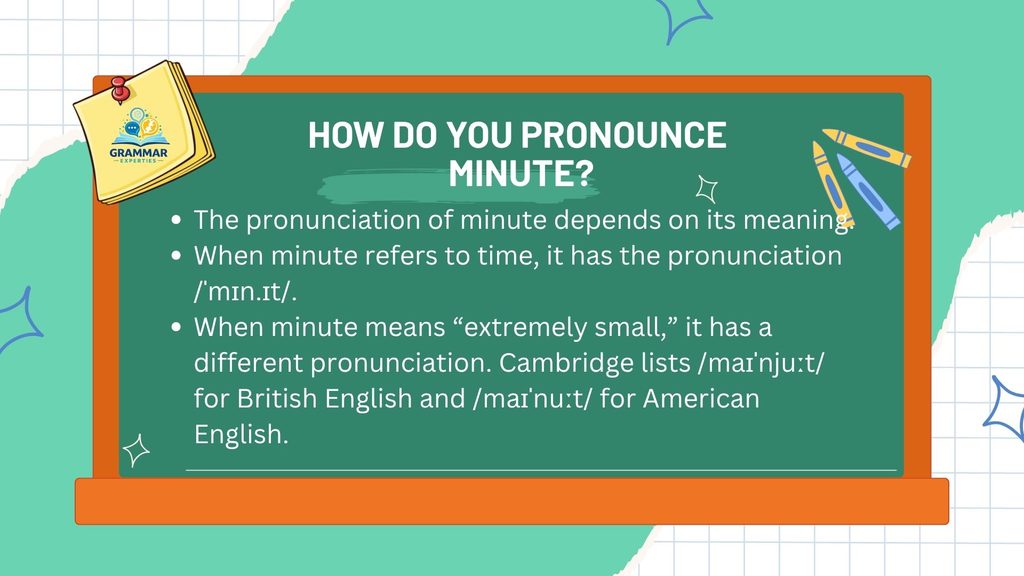
The pronunciation of minute depends on its meaning.
When minute refers to time, it has the pronunciation /ˈmɪn.ɪt/.
When minute means “extremely small,” it has a different pronunciation. Cambridge lists /maɪˈnjuːt/ for British English and /maɪˈnuːt/ for American English.
Minute Pronunciation for Time
When talking about time:
minute → /ˈmɪn.ɪt/
Examples:
- one minute
- ten minutes
- wait a minute
- five minutes ago
The stress falls on the first syllable.
Minute Pronunciation for “Extremely Small”
When minute means “extremely small”:
minute → /maɪˈnuːt/ in American English
The pronunciation changes significantly.
Examples:
- a minute amount
- a minute detail
- a minute difference
- a minute particle
The stress falls on the second syllable.
Why Are the Pronunciations Different?
English has many words whose spelling stays the same while pronunciation and meaning change according to context. Minute is one of the clearest examples.
You don’t need to change the spelling when the meaning changes.
Think of it this way:
Different meaning → different pronunciation → same spelling
That is why writing minoot is unnecessary.
Minute vs Minoot: Examples in Sentences
Seeing the two forms side by side makes the difference much easier to understand.
Examples With Minute
Here are examples where minute refers to time:
- Please wait one minute.
- The class starts in ten minutes.
- I called her a few minutes ago.
- The presentation lasted thirty minutes.
- He arrived one minute before the deadline.
Now consider examples where minute means extremely small:
- The scientist found a minute difference in the samples.
- The camera captured a minute detail.
- A minute crack appeared in the surface.
- The machine contains several minute components.
- The researchers detected a minute amount of contamination.
In every example, the spelling is minute.
Incorrect “Minoot” Examples
These sentences contain the nonstandard spelling:
- Please give me a minoot.
- The difference was minoot.
- It took one minoot to finish.
- She noticed a minoot change.
They should be written:
- Please give me a minute.
- The difference was minute.
- It took one minute to finish.
- She noticed a minute change.
The important point is that the pronunciation may change, but the spelling does not.
Why “Minoot” Is a Common Spelling Mistake
The minoot vs minute confusion is mainly caused by the unusual relationship between spelling and pronunciation.
English learners often expect words to be spelled exactly as they sound. That expectation works reasonably well with some words, but English contains many historical spellings that don’t follow a simple sound-to-letter system.
The Sound Creates the Confusion
Imagine hearing:
The scientist discovered a minute difference.
If you already know minute as a time word, you may be surprised by the pronunciation. The adjective sounds quite different.
A person unfamiliar with the written form might therefore assume that the word is spelled minoot.
However, dictionaries consistently give minute as the standard spelling for both meanings.
English Has Many Similar Problems
This isn’t unique to minute.
English includes many words where pronunciation can surprise learners:
- colonel
- queue
- island
- though
- through
- enough
- yacht
The lesson is simple: don’t automatically create a new spelling based on pronunciation.
When you’re unsure, check the dictionary spelling.
A Simple Comparison: Minute vs Minoot
| Feature | Minute | Minoot |
|---|---|---|
| Standard English spelling | Yes | No |
| Refers to 60 seconds | Yes | No |
| Means extremely small | Yes | No |
| Used in formal writing | Yes | No |
| Listed as the standard spelling in major dictionaries | Yes | No |
| Often caused by phonetic spelling | No | Yes |
This comparison shows why minute is the only appropriate spelling in standard English.
The Word History Behind Minute
The spelling minute has a long history.
Merriam-Webster traces the word to Middle English, through Middle French and Late Latin minuta, related to Latin minutus, meaning “small” or “lessened.” Merriam-Webster records the first known use of minute as a noun in the 14th century.
Oxford also connects the word with Latin minutus, meaning “made small.” Its explanation shows how the time-related sense developed from the idea of a small or first division of an hour.
From “Small” to a Unit of Time
The history becomes easier to understand when you think about measurement.
A minute is a small division of an hour. An hour can be divided into 60 minutes, and each minute can be divided into 60 seconds.
The word’s history therefore helps explain why the meanings became associated with ideas of smallness and division.
Why the Spelling Stayed the Same
Over time, the word developed different senses and pronunciations, but the spelling remained minute.
This is one reason modern readers can find it confusing.
The spelling isn’t a modern attempt to represent today’s pronunciation. It reflects the word’s historical development.
Real-Life Example: Why Someone Might Write “Minoot”
Consider a student named Sara who is preparing a science report.
During class, her teacher says:
“The experiment showed a minute difference between the two samples.”
Sara understands the meaning but has never seen the word written in this context. She knows minute as a measurement of time, so she is surprised by the pronunciation. When she types her report later, she writes:
“The experiment showed a minoot difference between the two samples.”
Her teacher corrects the spelling to:
“The experiment showed a minute difference between the two samples.”
Sara isn’t making a random mistake. She is spelling the word based on what she heard.
This is a useful example of why pronunciation and spelling shouldn’t always be treated as the same thing. In English, a word can sound different from what you expect while still retaining a traditional spelling.
Sara can avoid the mistake by remembering that minute has two common pronunciations but one standard spelling. When it refers to 60 seconds, the pronunciation is the familiar time-related form. When it means extremely small, the pronunciation changes, but the spelling remains minute.
The same situation can happen with language learners, children, writers, and even fluent speakers who encounter the adjective less frequently. Once you recognize the two meanings, however, the confusion becomes much easier to handle.
Minute in 2025–2026: What Current Dictionaries Confirm
Current dictionary references continue to support minute as the standard spelling.
Merriam-Webster’s current dictionary entry distinguishes the noun minute, meaning a 60th part of an hour, from the adjective minute, meaning something very small. Its page was updated in December 2025.
Cambridge’s current pronunciation information also distinguishes the two readings. The noun and verb use /ˈmɪn.ɪt/, while the adjective meaning “extremely small” uses /maɪˈnjuːt/ in British English and /maɪˈnuːt/ in American English.
Oxford’s current learner dictionary likewise records minute as the standard spelling for the time-related noun and explains its historical development.
What the Data Tells Us
There is an important distinction between dictionary evidence and search-volume data.
Search engines may receive queries such as “minoot meaning,” “minoot or minute,” or “how do you spell minoot.” However, search-query volume changes over time and should not be presented as an exact number unless a current, verifiable dataset is available.
The stronger evidence for the spelling question is therefore dictionary documentation:
- Merriam-Webster: recognizes minute in its time and smallness-related senses.
- Cambridge: documents the distinct pronunciations of minute.
- Oxford: documents the noun, verb, pronunciation, and historical development of minute.
Therefore, there is no reason to treat minoot as an alternative standard spelling in 2026.
How to Remember the Correct Spelling
A simple memory trick can help.
Remember:
One spelling, two pronunciations: minute.
Whether you’re talking about time or something extremely small, write:
minute
Never change the spelling to minoot.
Memory Trick for Time
Think:
One minute = 60 seconds.
Examples:
- one minute
- five minutes
- ten minutes
- a few minutes
Memory Trick for Something Tiny
When minute means extremely small, remember that the spelling still contains the familiar letters:
m-i-n-u-t-e
Don’t try to spell the sound.
This is particularly useful when writing essays, reports, articles, and academic work.
Common Mistakes With Minute
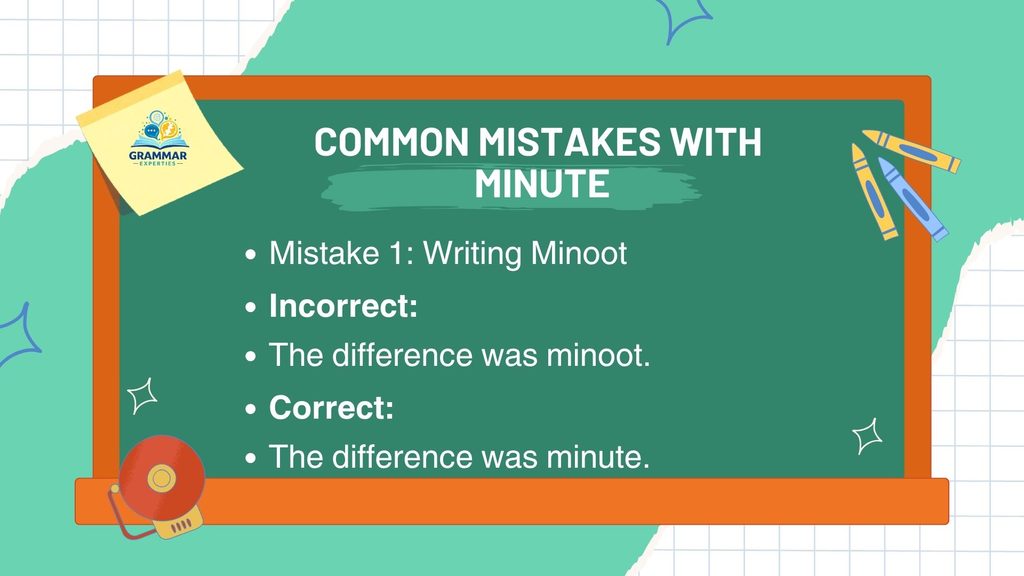
Mistake 1: Writing Minoot
Incorrect:
The difference was minoot.
Correct:
The difference was minute.
Mistake 2: Assuming Different Pronunciation Means Different Spelling
The word can have different pronunciations depending on meaning, but that doesn’t mean the spelling changes.
Correct:
I’ll be there in a minute.
Correct:
The scientist observed a minute change.
Mistake 3: Confusing Minute With Minuet
Minuet is a different word.
A minuet is a type of dance and musical composition.
For example:
The orchestra performed a classical minuet.
It should not be confused with minute.
Mistake 4: Using Minoot in Formal Writing
Even if readers understand what you mean, minoot should not be used as the standard spelling in formal English.
Use minute in:
- School assignments
- Business emails
- Academic writing
- Blog posts
- Reports
- Professional documents
- Applications
Minute as a Noun, Adjective, and Verb
Understanding the grammar of minute can make the spelling easier.
Minute as a Noun
As a noun, minute can mean a unit of time.
The meeting lasted an hour and twenty minutes.
It can also mean a short period:
I’ll be ready in a minute.
The plural is minutes.
Minute as an Adjective
As an adjective, minute means extremely small or very detailed.
The engineer examined every minute detail.
Here, the word has the unusual pronunciation associated with the adjective.
Minute as a Verb
Minute can also be used as a verb meaning to record something in the official minutes of a meeting.
For example:
The secretary minuted the decision.
Oxford lists the verb minute with the pronunciation /ˈmɪnɪt/ and defines it as recording something said at a meeting in the official record.
This gives the word another grammatical function while retaining the same spelling.
Quick Checklist: Should You Write “Minoot”?
Use this checklist whenever you’re unsure:
- Are you referring to 60 seconds? → minute
- Are you referring to a short period? → minute
- Are you describing something extremely small? → minute
- Are you describing very small details? → minute
- Are you recording something in meeting minutes? → minute/minuted
- Are you writing the word based on how “my-noot” sounds? → Still minute
- Are you considering minoot in formal English? → Don’t use it.
The answer is remarkably consistent: write minute.
Mini Quiz:Minoot or Minute
1. Which spelling is correct?
A. Minoot
B. Minute
C. Minut
D. Minuite
Answer: B. Minute
2. Which sentence is correct?
A. Wait one minoot.
B. Wait one minute.
C. Wait one minuet.
D. Wait one minit.
Answer: B. Wait one minute.
3. What does “minute” mean when used as a unit of time?
A. 10 seconds
B. 30 seconds
C. 60 seconds
D. 100 seconds
Answer: C. 60 seconds
4. Is “minoot” the standard English spelling?
A. Yes
B. No
C. Only in American English
D. Only in British English
Answer: B. No
5. Which word means “extremely small”?
A. Minoot
B. Minute
C. Minuet
D. Minuted
Answer: B. Minute
6. Choose the correct sentence.
A. The scientist noticed a minoot difference.
B. The scientist noticed a minute difference.
C. The scientist noticed a minuet difference.
D. The scientist noticed a minut difference.
Answer: B. The scientist noticed a minute difference.
7. Which word can mean “a short period of time”?
A. Minute
B. Minoot
C. Minuet
D. Minut
Answer: A. Minute
8. What is the correct spelling in this sentence?
“I’ll be back in a ___.”
A. minoot
B. minuet
C. minute
D. minut
Answer: C. minute
9. What does “minute” mean in “a minute detail”?
A. A period of 60 seconds
B. Extremely small or precise
C. A musical instrument
D. A meeting
Answer: B. Extremely small or precise
10. Which spelling should you use in formal writing?
A. Minoot
B. Minuit
C. Minute
D. Minut
Answer: C. Minute
11. Why do some people spell “minute” as “minoot”?
A. Because it is the British spelling
B. Because it is an official alternative
C. Because they spell it according to how it sounds
D. Because dictionaries recommend it
Answer: C. Because they spell it according to how it sounds
12. Which sentence uses “minute” correctly?
A. The machine has a minute crack.
B. The machine has a minoot crack.
C. The machine has a minuet crack.
D. The machine has a minut crack.
Answer: A. The machine has a minute crack.
13. Which word is related to a type of dance?
A. Minute
B. Minoot
C. Minuet
D. Minut
Answer: C. Minuet
14. How many seconds are in one minute?
A. 50
B. 60
C. 70
D. 100
Answer: B. 60
15. Which sentence is correctly spelled?
A. She waited five minoots.
B. She waited five minutes.
C. She waited five minuets.
D. She waited five minuts.
Answer: B. She waited five minutes.
16. Which word has the meaning “extremely small”?
A. Minute
B. Minoot
C. Minuet
D. Minutes
Answer: A. Minute
17. What is wrong with this sentence?
“The difference was minoot.”
A. Nothing
B. “Minoot” should be “minute”
C. “Difference” should be “diffrence”
D. “Was” should be “were”
Answer: B. “Minoot” should be “minute”
18. Choose the correct sentence.
A. Give me a minoot to think.
B. Give me a minute to think.
C. Give me a minuet to think.
D. Give me a minut to think.
Answer: B. Give me a minute to think.
19. Which statement is true?
A. Minute has only one meaning.
B. Minoot is the official spelling of minute.
C. Minute can have different meanings and pronunciations.
D. Minuet means 60 seconds.
Answer: C. Minute can have different meanings and pronunciations.
20. Which word should complete the sentence?
“The doctor detected a ___ change in the patient’s condition.”
A. minoot
B. minute
C. minuet
D. minut
Answer: B. minute
21. Which sentence uses “minute” as a time-related noun?
A. There was a minute crack.
B. She waited for ten minutes.
C. He noticed a minute detail.
D. The machine contains minute parts.
Answer: B. She waited for ten minutes.
22. Which sentence uses “minute” as an adjective?
A. Wait a minute.
B. Five minutes passed.
C. The researcher found a minute particle.
D. I’ll return in a minute.
Answer: C. The researcher found a minute particle.
23. What is the best way to remember the spelling?
A. Spell the word exactly as it sounds
B. Always write “minoot”
C. Remember that both meanings use “minute”
D. Use “minuet” instead
Answer: C. Remember that both meanings use “minute”
24. Which sentence is incorrect?
A. Please wait a minute.
B. The difference was minute.
C. The meeting lasted twenty minutes.
D. The difference was minoot.
Answer: D. The difference was minoot.
25. Complete the sentence:
“Although the pronunciation can change, the standard spelling is always ___.”
A. minoot
B. minuet
C. minute
D. minut
Answer: C. minute
Quick Score Guide
- 23–25: Excellent! You completely understand minute vs. minoot.
- 20–22: Very good! Just review a few details.
- 15–19: Good effort! Review the meanings and spelling.
- 10–14: Keep practicing the difference.
- Below 10: Re-read the guide and try the quiz again.
Remember: The correct standard spelling is minute, not minoot.
Frequently Asked Questions
Q1:Is “minoot” a correct English word?
No. Minoot is not the standard spelling of the English word. It is generally a phonetic misspelling based on the pronunciation of minute when the word means “extremely small.”
Q2:Is it minoot or minute?
The correct spelling is minute. Use minute whether you mean a unit of time or something extremely small.
Q3:How do you spell “minoot” correctly?
If you mean the English word pronounced like the adjective meaning “extremely small,” the correct spelling is minute, not minoot.
Q4:Why is minute pronounced differently?
Minute has different meanings and corresponding pronunciations. As a noun referring to time, it is pronounced /ˈmɪn.ɪt/. As an adjective meaning extremely small, it is pronounced /maɪˈnuːt/ in American English and /maɪˈnjuːt/ in British English.
Q5:Does minute mean “very small”?
Yes. As an adjective, minute can mean extremely small, tiny, or very detailed.
For example:
The researcher observed a minute change in the sample.
Q6:Is “minute” a noun or adjective?
It can be both.
As a noun, it can mean a unit of time:
Wait one minute.
As an adjective, it can mean extremely small:
There was a minute difference.
It can also function as a verb, particularly in the context of recording meeting proceedings.
Q7:What is the difference between minute and minuet?
Minute can refer to time or something extremely small, while minuet refers to a type of dance or musical composition.
They are different words and should not be used interchangeably.
Q8:Can I use “minoot” in informal writing?
You may encounter minoot as an intentional phonetic spelling, joke, username, or representation of speech. However, it is not the standard spelling you should use when writing normal English. In standard writing, use minute.
Final Answer: Minoot or Minute?
So, minoot or minute—which spelling is correct?
The answer is minute.
Minoot is a phonetic misspelling that usually develops because people hear the adjective minute pronounced differently from the familiar time-related word.
The spelling doesn’t change.
Use minute for:
- 60 seconds
- A short period
- Something extremely small
- A very small detail
- Meeting records
- The verb related to recording proceedings
The key lesson is simple: minute has multiple meanings and pronunciations, but its standard spelling remains minute.
If you’ve ever written “minoot,” don’t worry. The confusion is understandable because English spelling and pronunciation don’t always line up neatly. Now that you know the rule, you can confidently use minute in your essays, emails, articles, assignments, and everyday writing.
Explore more easy grammar lessons and improve your English with Grammar Expertise
References
Cambridge Dictionary — Pronunciation

Maimoona Mughal is an English grammar enthusiast dedicated to simplifying confusing words, grammar rules, and vocabulary through clear, accurate, and learner-friendly content that helps readers write and communicate with confidence.