If you have ever wondered whether 13rd or 13th is the correct way to write the number thirteen in its ordinal form, you are not alone. The confusion is understandable because 3rd is correct, so it may seem logical that 13rd should also be correct.
However, English has a special rule for numbers ending in 11, 12, and 13.
The correct form is 13th, not 13rd.
13th = thirteenth
13rd = incorrect
In this guide, you’ll learn why 13th is correct, where the -rd confusion comes from, how ordinal-number suffixes work, and how to avoid similar mistakes with numbers such as 11th, 12th, 21st, 22nd, and 23rd.
Quick Answer: Is It 13rd or 13th?
The correct spelling is 13th.
13th is the standard abbreviated form of thirteenth, the ordinal number for 13.
Correct: My birthday is on the 13th of June.
Incorrect: My birthday is on the 13rd of June.
The reason is simple: although 3rd uses the suffix -rd, 13 belongs to the special 11–13 group, and these numbers all use -th.
- 11th = eleventh
- 12th = twelfth
- 13th = thirteenth
- 14th = fourteenth
- 15th = fifteenth
Official style guidance confirms that ordinal numerals use suffixes such as -st, -nd, -rd, and -th, with 13th being the correct form for thirteen.
13rd vs 13th: Why Is 13th Correct?
The easiest way to understand 13rd vs 13th is to learn the ordinal-number rule rather than looking only at the final digit.
The Basic Ordinal Suffix Rule
In English, ordinal numbers commonly use four suffixes:
| Ending | Example | Ordinal |
|---|---|---|
| -st | 1 | 1st |
| -nd | 2 | 2nd |
| -rd | 3 | 3rd |
| -th | 4 | 4th |
This creates a pattern that works for many numbers:
- 21st = twenty-first
- 22nd = twenty-second
- 23rd = twenty-third
- 24th = twenty-fourth
At first glance, this might make 13rd appear reasonable.
But there is an important exception.
The 11th, 12th, and 13th Exception
Numbers ending in 11, 12, and 13 always use -th.
Therefore:
- 11 → 11th
- 12 → 12th
- 13 → 13th
This is why 13rd is not a standard English ordinal form.
The same principle applies to larger numbers ending in these combinations:
- 111th
- 112th
- 113th
- 211th
- 212th
- 213th
The Australian Government Style Manual explicitly gives -st, -nd, -rd, and -th as ordinal suffixes and uses examples such as 11th and 22nd.
Why 23rd Is Different From 13th
Compare these two numbers:
13 → thirteenth → 13th
23 → twenty-third → 23rd
The difference is that 13 is part of the special 11–13 group, while 23 is not.
So:
13th is correct.
23rd is correct.
This is one of the most useful distinctions to remember when learning ordinal numbers.
What Does 13th Mean?
13th is an ordinal number. It indicates position, order, sequence, or rank.
The word form is thirteenth.
For example:
- She finished in 13th place.
- Today is the 13th day of the month.
- He lives on the 13th floor.
- This is my 13th attempt.
- Their anniversary is on the 13th.
An ordinal number answers a question such as “Which one?” or “What position?”
For example:
Cardinal: I have 13 books.
Here, 13 tells us how many books there are.
Ordinal: The 13th book is missing.
Here, 13th tells us which book is being discussed.
Ordinal numbers therefore describe position rather than simple quantity.
13th in a Sentence
Here are several natural examples:
- The meeting is scheduled for the 13th.
- She won 13th place in the competition.
- This is the 13th chapter of the book.
- He celebrated his 13th birthday.
- The package arrived on the 13th day.
- Their team finished 13th in the rankings.
Why Do People Write 13rd?
The mistake 13rd usually comes from applying the ordinary final-digit pattern too literally.
A learner may see:
- 1st
- 2nd
- 3rd
and assume:
- 11st
- 12nd
- 13rd
But English does not work that way for 11, 12, and 13.
The correct forms are:
- 11th
- 12th
- 13th
The same pattern is found in larger numbers:
- 111th
- 112th
- 113th
The mistake is therefore understandable, but 13rd is not the accepted ordinal abbreviation for thirteenth.
A Simple Memory Trick
Remember this:
11, 12, 13 → all use TH.
You can memorize the group as:
11th → 12th → 13th
After that, the ordinary final-digit pattern becomes easier to apply.
For example:
- 21st
- 22nd
- 23rd
- 24th
So whenever you see a number ending in 11, 12, or 13, stop and use -th.
13th vs 13rd Examples
Seeing the forms in context makes the difference easier to remember.
Correct Examples With 13th
Example 1:
She celebrated her 13th birthday with her family.
Example 2:
The competition will begin on the 13th of September.
Example 3:
He finished 13th in the race.
Example 4:
This is the 13th chapter in the novel.
Example 5:
The company opened its 13th store last year.
Example 6:
Our final examination is on the 13th.
Incorrect Examples With 13rd
These forms should be avoided:
13rd birthday13rd chapter13rd position13rd anniversary13rd floor
Replace each one with 13th:
- 13th birthday
- 13th chapter
- 13th position
- 13th anniversary
- 13th floor
13th, 23rd, and 33rd: The Difference Explained
One of the best ways to remember the rule is to compare 13th, 23rd, and 33rd.
| Number | Correct Form | Word Form |
|---|---|---|
| 3 | 3rd | third |
| 13 | 13th | thirteenth |
| 23 | 23rd | twenty-third |
| 33 | 33rd | thirty-third |
| 43 | 43rd | forty-third |
| 53 | 53rd | fifty-third |
| 63 | 63rd | sixty-third |
| 73 | 73rd | seventy-third |
| 83 | 83rd | eighty-third |
| 93 | 93rd | ninety-third |
| 103 | 103rd | one hundred third |
| 113 | 113th | one hundred thirteenth |
Notice the important difference:
13th is special because the number ends in 13.
But 23rd, 33rd, 43rd, and similar numbers do not belong to the 11–13 exception.
The Last Two Digits Matter
For numbers ending in 11, 12, or 13, look at the last two digits, not just the final digit.
For example:
- 111 → 111th
- 112 → 112th
- 113 → 113th
But:
- 121 → 121st
- 122 → 122nd
- 123 → 123rd
This makes the rule much easier to apply.
Case Study: Why 13rd Can Look Correct at First
Imagine a student writing an invitation for a birthday party.
The student wants to write:
“You are invited to Sarah’s 13th birthday party.”
They remember that 3rd means “third.” They also know that numbers ending in 3 often use -rd. While typing quickly, they write:
“Sarah’s 13rd birthday party.”
At first, the form may look logical because 3rd is familiar. However, the student has overlooked the special rule for the numbers 11, 12, and 13.
When the number is written in words, the difference becomes obvious:
13 = thirteen
Its ordinal form is:
thirteen → thirteenth
Therefore, the abbreviation is:
13 + th = 13th
Now compare it with 23:
23 = twenty-three
Its ordinal form is:
twenty-third
Therefore:
23 + rd = 23rd
This example shows why relying only on the last digit can cause mistakes. The more reliable approach is to check whether the number ends in 11, 12, or 13 first. If it does, use -th.
This distinction is particularly useful in birthdays, invitations, school assignments, certificates, rankings, addresses, event announcements, and other everyday writing.
2025–2026 Usage and Rule Evidence
There is no widely recognized 2025–2026 statistical dataset that measures how many English writers mistakenly type “13rd” instead of “13th.” It would therefore be misleading to invent a percentage or claim that a particular share of writers makes this error.
However, current 2025–2026 English-learning and style guidance continues to document the same ordinal-number rule.
A current government style resource states that ordinal numerals use suffixes including -st, -nd, -rd, and -th, while examples include 11th and 22nd.
Current English-learning guidance also explicitly identifies 13th = thirteenth and explains that 11th, 12th, and 13th form the special teen exception.
A 2026 guide likewise explains the distinction between 13th and 23rd, reinforcing the same rule for contemporary English usage.
So the evidence available for 2025–2026 supports a clear grammatical conclusion: 13th is the standard ordinal abbreviation for thirteenth, while 13rd is an incorrect form in standard English.
A Quick Step-by-Step Method for Choosing the Correct Suffix
If you frequently confuse ordinal numbers, use this simple process.
Step 1: Check the Last Two Digits
First ask whether the number ends in:
- 11
- 12
- 13
If yes, use -th.
Examples:
- 11th
- 12th
- 13th
- 111th
- 112th
- 113th
Step 2: If Not, Check the Last Digit
If the number does not end in 11, 12, or 13:
- ending in 1 → -st
- ending in 2 → -nd
- ending in 3 → -rd
- everything else → -th
Examples:
- 21st
- 22nd
- 23rd
- 24th
- 31st
- 32nd
- 33rd
- 34th
Step 3: Read the Number as a Word
If you are still unsure, say the number in your head.
For example:
13 → thirteen → thirteenth → 13th
23 → twenty-three → twenty-third → 23rd
This method is especially useful for learners of English.
Common Mistakes With Ordinal Numbers
The 13rd vs 13th mistake is part of a larger group of ordinal-number errors.
Mistake 1: Writing 13rd
Incorrect: The event is on the 13rd.
Correct: The event is on the 13th.
Mistake 2: Writing 12nd
Incorrect: Her birthday is on the 12nd.
Correct: Her birthday is on the 12th.
Mistake 3: Writing 11st
Incorrect: He finished 11st.
Correct: He finished 11th.
Mistake 4: Writing 23th
This goes in the opposite direction.
Incorrect: She came 23th.
Correct: She came 23rd.
The number 23 is not part of the 11–13 exception.
Mistake 5: Writing 21th
Incorrect: The 21th anniversary
Correct: The 21st anniversary
Mistake 6: Applying the Rule Only to the Last Digit
This is the biggest trap.
You cannot simply say:
“The number ends in 3, so it must use -rd.”
You must first check for 13.
The same applies to 11 and 12.
13th in Dates: Is the Suffix Always Necessary?
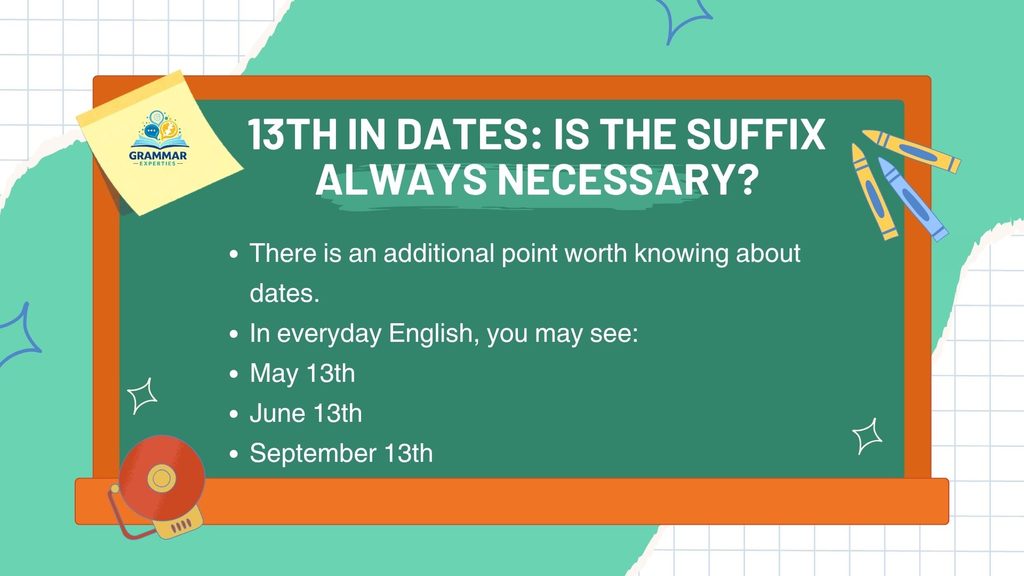
There is an additional point worth knowing about dates.
In everyday English, you may see:
- May 13th
- June 13th
- September 13th
The form 13th is grammatically recognizable as an ordinal.
However, style guides can recommend different conventions for writing dates. For example, the Australian Government Style Manual recommends writing dates with numerals without ordinal suffixes, such as 12 February 2020, rather than 12th February 2020.
Therefore, the best date format can depend on the style guide you are following.
For example:
Formal style:
13 September 2026
Informal style:
September 13th
But if you are specifically choosing between 13rd and 13th, the correct ordinal form is unquestionably:
13th
13th vs Thirteenth: Which Should You Use?
Both 13th and thirteenth are correct. The choice depends on the context.
Use 13th
Use 13th when a numerical style is appropriate:
- 13th place
- 13th floor
- 13th anniversary
- 13th edition
- 13th birthday
Use Thirteenth
Spell out thirteenth when the style or context calls for words:
- She finished thirteenth.
- This was his thirteenth attempt.
- The thirteenth chapter contains the answer.
Some style guides recommend spelling out lower ordinal numbers, while others use numerals from a particular threshold. The Australian Government Style Manual, for example, recommends words through ninth and numerals from 10th onward.
The important point is that 13rd is not an alternative spelling of thirteenth.
13rd vs 13th: Easy Comparison Checklist
Use this checklist whenever you are unsure.
| Question | Answer |
|---|---|
| Is 13 an ordinal number? | Yes |
| What is the word form? | Thirteenth |
| Is 13rd correct? | No |
| Is 13th correct? | Yes |
| What suffix does 13 use? | -th |
| Are 11 and 12 also exceptions? | Yes |
| Is 23rd correct? | Yes |
| Is 33rd correct? | Yes |
| Does 13 follow the ordinary “ending in 3” rule? | No |
| What is the easiest memory trick? | 11th, 12th, 13th |
Mini Quiz:13rd vs 13th
1. Which form is correct for the ordinal number thirteen?
A) 13rd
B) 13th
C) 13st
D) 13nd
Answer: B) 13th
2. Which sentence is correct?
A) She celebrated her 13rd birthday.
B) She celebrated her 13th birthday.
C) She celebrated her 13st birthday.
D) She celebrated her 13nd birthday.
Answer: B) She celebrated her 13th birthday.
3. True or False: The correct ordinal abbreviation for 13 is 13th.
Answer: True
4. Which group contains only correctly written ordinal numbers?
A) 11th, 12th, 13th
B) 11st, 12nd, 13rd
C) 11rd, 12th, 13st
D) 11th, 12nd, 13rd
Answer: A) 11th, 12th, 13th
5. What is the word form of 13th?
A) thirteen
B) thirtieth
C) thirteenth
D) thirdteen
Answer: C) thirteenth
6. Which number correctly uses the -rd suffix?
A) 13rd
B) 23rd
C) 113rd
D) 213rd
Answer: B) 23rd
7. True or False: 113th is the correct ordinal form of 113.
Answer: True
8. Which is the correct ordinal form of 23?
A) 23st
B) 23nd
C) 23rd
D) 23th
Answer: C) 23rd
9. Which sentence is correctly written?
A) He finished in 13rd place.
B) He finished in 13th place.
C) He finished in 13st place.
D) He finished in 13nd place.
Answer: B) He finished in 13th place.
10. Which forms are correctly written?
A) 11th
B) 12th
C) 13th
D) 13rd
Answers: A, B, and C
11. Complete the sentence: “This is my ___ attempt.”
A) 13rd
B) 13th
C) 13nd
D) 13st
Answer: B) 13th
12. Why is 13th correct instead of 13rd?
A) 13 belongs to the 11–13 exception.
B) All numbers ending in 3 use -th.
C) 13 has no ordinal form.
D) 13 must always be written as a word.
Answer: A) 13 belongs to the 11–13 exception.
13. Which form correctly completes “the ___ chapter”?
A) 13rd
B) 13th
C) 13nd
D) 13st
Answer: B) 13th
14. Which pair is correct?
A) 13th and 23rd
B) 13rd and 23th
C) 13th and 23th
D) 13rd and 23rd
Answer: A) 13th and 23rd
15. Which is correct when an ordinal suffix is used with the date?
A) September 13rd
B) September 13th
C) September 13st
D) September 13nd
Answer: B) September 13th
16. Which number should use -th because its last two digits are 13?
A) 121st
B) 122nd
C) 123rd
D) 113th
Answer: D) 113th
17. Which sentence contains the correct form?
A) The building has a 13th floor.
B) The building has a 13rd floor.
C) The building has a 13nd floor.
D) The building has a 13st floor.
Answer: A) The building has a 13th floor.
18. What is the safest way to choose an ordinal suffix?
A) Always look only at the final digit.
B) Check 11, 12, and 13 before using the final-digit pattern.
C) Always use -th.
D) Always use -rd when a number ends in 3.
Answer: B) Check 11, 12, and 13 before using the final-digit pattern.
19. Which examples correctly use 13th?
A) 13th birthday
B) 13th anniversary
C) 13th chapter
D) 13rd position
Answers: A, B, and C
20. What is the correct ordinal form of 33?
A) 33rd
B) 33th
C) 33nd
D) 33st
Answer: A) 33rd
21. Which is the correct spelling of the ordinal word for 13?
A) thirteen
B) thirteenth
C) threeteenth
D) thirdteenth
Answer: B) thirteenth
22. Correct this sentence: “Today is the 13rd.”
A) Today is the 13st.
B) Today is the 13nd.
C) Today is the 13th.
D) Today is the 13rd.
Answer: C) Today is the 13th.
23. Which sequence is completely correct?
A) 21st, 22nd, 23rd, 24th
B) 21th, 22th, 23th, 24th
C) 21st, 22nd, 23th, 24rd
D) 21nd, 22rd, 23st, 24th
Answer: A) 21st, 22nd, 23rd, 24th
24. Which statements about 13th are correct?
A) It represents thirteenth.
B) It can describe position in a sequence.
C) It is the standard ordinal form of 13.
D) It is another standard form of 13rd.
Answers: A, B, and C
25. What is the easiest rule to remember for 13rd vs 13th?
A) 13rd is correct because 3 uses -rd.
B) 13th is correct because 11, 12, and 13 use -th.
C) Both 13rd and 13th are equally standard.
D) 13 has no ordinal abbreviation.
Answer: B) 13th is correct because 11, 12, and 13 use -th.
Frequently Asked Questions About 13rd vs 13th
Q1:Is 13rd grammatically correct?
No. 13rd is not the standard English ordinal form. The correct abbreviation is 13th, which represents thirteenth.
Q2:Why is 13th correct instead of 13rd?
Because 13 belongs to the special 11–13 group. The numbers 11, 12, and 13 all use the -th suffix.
Q3:Is it 13rd or 13th birthday?
The correct expression is 13th birthday.
For example:
She is celebrating her 13th birthday this weekend.
Q4:Is 13th the same as thirteenth?
Yes. 13th is the abbreviated numerical form of thirteenth.
Q5:Why is 23rd correct but 13th wrong?
Because 13 ends in the special teen sequence 13, which uses -th. 23 ends in 23 and therefore follows the regular final-digit rule, giving 23rd.
Q6:Is 113th or 113rd correct?
113th is correct.
Although 113 ends in 3, its last two digits are 13, so it follows the 13 exception.
Q7:Is 213rd or 213th correct?
213th is correct.
Again, the last two digits are 13, so the number takes -th.
Q8:How can I remember 13th easily?
Remember the three-number sequence:
11th → 12th → 13th
All three use -th.
Then remember the contrasting sequence:
21st → 22nd → 23rd
These use -st, -nd, and -rd.
Conclusion: 13rd vs 13th
When choosing between 13rd vs 13th, always choose 13th.
13th is the correct ordinal abbreviation for thirteenth, while 13rd is an incorrect form in standard English.
The key rule is easy to remember:
11th, 12th, and 13th always use -th.
Do not let the final digit fool you. Although 3rd and 23rd are correct, 13th is different because 13 belongs to the special 11–13 exception.
So whether you are writing about a 13th birthday, 13th anniversary, 13th chapter, 13th place, or the 13th day, the correct form is always 13th.
Explore more easy grammar lessons and improve your English with Grammar Expertise
References
Australian Government Style Manual – Ordinal Numbers
Cambridge Dictionary – Thirteenth

Maimoona Mughal is an English grammar enthusiast dedicated to simplifying confusing words, grammar rules, and vocabulary through clear, accurate, and learner-friendly content that helps readers write and communicate with confidence.