The correct spelling is retailer
Retailer is the standard modern English noun for a person or business that sells goods directly to the public.
Oxford Learner’s Dictionaries defines a retailer as a person or business that sells goods to the public.
Examples include:
- a clothing retailer
- an online retailer
- a grocery retailer
- a furniture retailer
- a major electronics retailer
For example:
The retailer introduced a new collection for the holiday season.
Here, retailer is correct because the word refers to a business selling products to customers.
Why retailor causes confusion
The spelling retailor looks logical at first because English often forms nouns by adding -or or -er to a verb.
However, English spelling does not always follow a predictable pattern.
The noun comes from retail, and the established modern noun is retailer, not retailor. Dictionary sources support retailer as the standard term for someone or a business selling goods to consumers.
Quick answer
| Word | Standard retail meaning? | Correct modern choice? |
|---|---|---|
| Retailer | A person or business selling goods to consumers | Yes |
| Retailor | Historical/obsolete spelling in this sense; also a separate verb in some dictionaries | Generally no for the retail-business meaning |
If you are writing about shopping or a retail business, choose retailer.
What Does Retailer Mean?
Retailer definition
A retailer is a person or business that sells goods directly to consumers, usually for personal use.
For example, a supermarket is a retailer because it sells food and household products directly to shoppers.
An online store can also be a retailer. The business does not need to operate a physical shop to qualify as a retailer.
Retailer vs. wholesaler
One useful way to understand the word is to compare a retailer with a wholesaler.
A retailer generally sells products to the final consumer. A wholesaler, on the other hand, generally sells goods in larger quantities to businesses or other organizations.
For example:
- A manufacturer produces 10,000 shirts.
- A wholesaler purchases 5,000 shirts.
- A retailer purchases some of those shirts from the wholesaler.
- Customers purchase individual shirts from the retailer.
This distinction helps explain why retailer is such a common term in business English.
Examples of retailers
Retailers can operate in many industries, including:
- clothing
- groceries
- electronics
- furniture
- cosmetics
- books
- sporting goods
- automobiles
- home improvement
- online shopping
So the word retailer applies to much more than traditional stores.
Retailer in Sentences: Correct Examples
Everyday examples
Seeing the word in context makes the spelling easier to remember.
Here are several correct examples:
- The retailer offers free delivery on large orders.
- The clothing retailer launched a new collection.
- We compared prices from several online retailers.
- The electronics retailer extended its return policy.
- That supermarket is one of the largest food retailers in the region.
- The retailer announced a discount for loyal customers.
- Many retailers now combine physical stores with online shopping.
Notice that every example uses retailer, not retailor.
Incorrect and corrected examples
| Incorrect | Correct |
|---|---|
| The retailor opened a new store. | The retailer opened a new store. |
| We contacted the retailor about the order. | We contacted the retailer about the order. |
| The online retailor offers discounts. | The online retailer offers discounts. |
| Several retailors attended the trade event. | Several retailers attended the trade event. |
A simple memory trick
Think of:
Retail + er = retailer
The word retail remains intact, and -er identifies the person or business performing the activity.
You can remember it with this sentence:
A retailer retails products.
That connection makes the spelling easier to recall.
Retailor vs Retailer: Why the Difference Matters
Spelling matters in professional writing
A single letter may seem insignificant, but spelling can affect how professional your writing looks.
If you are writing a business report, product description, resume, website page, email, or article, using retailer shows that you know the established term.
For example:
We contacted three major retailers about product distribution.
This sounds natural and standard.
Writing:
We contacted three major retailors about product distribution.
can distract readers because retailor is not the normal modern noun for a retail business.
Search engines and website content
Correct terminology also matters when creating online content.
Businesses use terms such as retailer, retail store, online retailer, retail sales, and retail industry because these are established expressions used by dictionaries, government agencies, businesses, and consumers.
That does not mean a single misspelled word automatically determines search performance. However, using conventional terminology makes content clearer for readers and reduces unnecessary spelling errors.
For an SEO article, product page, category page, or business description, retailer is therefore the natural choice.
Business communication example
Imagine that you are preparing an email for a company:
We are looking for a reliable retailer to distribute our products.
This clearly communicates that you want a business that sells products to customers.
Using retailor could create confusion, especially for international readers or English learners.
A Real-World Retail Example
How the word retailer appears in modern business
Consider an online clothing company that sells directly to customers.
The company purchases clothing from manufacturers, lists those products on its website, processes customer orders, and ships products to individual shoppers. In this situation, the company functions as a retailer.
The same principle applies to a physical supermarket. The supermarket may purchase products from manufacturers and distributors before selling those products directly to consumers.
This distinction is still important in 2026 because retail increasingly combines physical and digital channels. The U.S. Census Bureau reported that retail e-commerce sales reached an estimated $340.2 billion in the second quarter of 2026, representing 17.1% of total retail sales for that quarter.
The example shows why the word retailer remains useful across different types of commerce. Whether a company sells through a website, mobile app, physical store, or several channels, it can still be described as a retailer when it sells goods directly to consumers.
The spelling does not change simply because the business operates online. An online clothing business is an online retailer, not normally an online retailor.
Retail Industry Statistics: 2025–2026
The importance of the word retailer becomes clearer when you look at the scale of the industry.
According to the U.S. Bureau of Labor Statistics, the retail trade sector accounted for approximately 12.2% of nonfarm business employment, or 16.1 million jobs, in 2025.
The Census Bureau reported that U.S. retail e-commerce sales totaled an estimated $1.2337 trillion in 2025, an increase of 5.4% from 2024. E-commerce represented 16.4% of total retail sales in 2025.
More recent 2026 data show continued online retail activity. In the second quarter of 2026, estimated U.S. e-commerce sales increased 12.2% from the second quarter of 2025, while total retail sales increased 6.7% over the same period.
The BLS also reported that retail trade labor productivity increased 2.9% in 2025, while retail output grew 2.5%.
These figures are U.S. data, so they should not be treated as measurements of global retail activity. Still, they demonstrate the widespread use and continuing relevance of the term retailer in modern business and commerce.
Common Mistakes With Retailer
Mistake 1: Writing retailor
The most common error is replacing -er with -or:
❌ The retailor sells household products.
Correct it to:
✅ The retailer sells household products.
Mistake 2: Confusing retailer with retail
Retail and retailer are related but do not mean exactly the same thing.
- Retail can describe the activity or industry.
- Retailer refers to the person or business performing the selling.
For example:
Retail is an important part of the economy.
But:
The retailer opened another location.
Mistake 3: Assuming retailor is always meaningless
There is a useful exception.
Some dictionary sources record retailor as an obsolete spelling of retailer. In addition, Collins records retailor as a verb meaning to alter or restyle something, particularly clothing.
Therefore, saying that retailor can never appear in English would be too broad.
The practical rule is simpler:
For a person or business that sells goods to consumers, use retailer.
Retailor or Retailer: Comparison Checklist
Use this quick checklist whenever you are unsure.
| Question | Answer |
|---|---|
| Are you referring to a business that sells products? | Use retailer |
| Are you referring to a person who sells goods to consumers? | Use retailer |
| Are you writing about online shopping? | Use online retailer |
| Are you describing the retail industry? | Use retail |
| Are you using retailor as the modern noun for a seller? | Usually replace it with retailer |
| Did you find retailor in an older text? | It may be an obsolete spelling |
| Are you using retailor as a verb meaning to tailor again? | The word can have that separate meaning |
The easiest rule
When your sentence means “a person or company that sells goods to consumers,” write:
retailer
Not:
retailor
How to Remember the Correct Spelling
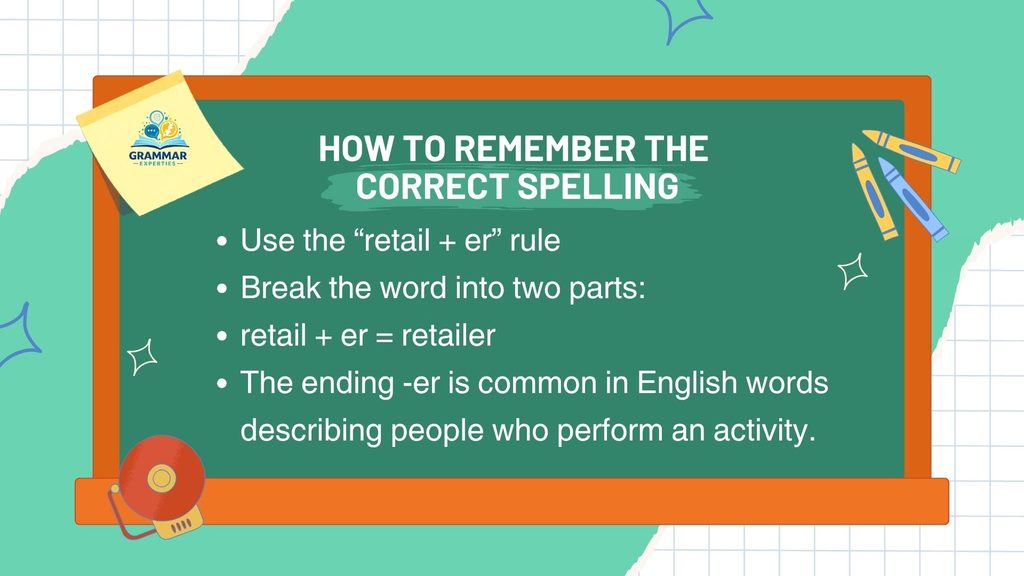
Use the “retail + er” rule
Break the word into two parts:
retail + er = retailer
The ending -er is common in English words describing people who perform an activity.
Compare:
- teach → teacher
- farm → farmer
- drive → driver
- sell → seller
- retail → retailer
This pattern makes retailer easier to remember.
Associate retailer with customer
A retailer is directly connected with the customer.
Think:
Retailer → Retail → Customer
That mental association can help you avoid the incorrect retailor spelling when writing quickly.
Mini Quiz: Retailor or Retailer
- Which spelling is correct for a person or business that sells goods directly to consumers?
A. Retailor
B. Retailer
C. Retaler
D. Retailar
Answer: B. Retailer
- What does “retailer” mean?
A. A manufacturer
B. A business that sells goods to consumers
C. A shipping company
D. A wholesaler
Answer: B. A business that sells goods to consumers
- Which sentence is correct?
A. The retailor opened a new store.
B. The retailer opened a new store.
C. The retaler opened a new store.
D. The retailar opened a new store.
Answer: B. The retailer opened a new store.
- Is “retailor” the standard modern spelling for a retail seller?
A. Yes
B. No
Answer: B. No
- How can you easily remember the spelling of “retailer”?
A. Retail + er
B. Retail + or
C. Retail + ar
D. Retail + ur
Answer: A. Retail + er
- Which word refers to the business activity of selling goods to consumers?
A. Retailer
B. Retail
C. Retailor
D. Retaler
Answer: B. Retail
- Which phrase is correctly spelled?
A. Online retailor
B. Online retaler
C. Online retailer
D. Online retailar
Answer: C. Online retailer
- Which of the following can be a retailer?
A. Supermarket
B. Clothing store
C. Online shop
D. All of the above
Answer: D. All of the above
- What is the plural form of “retailer”?
A. Retailors
B. Retailers
C. Retalers
D. Retailars
Answer: B. Retailers
- Which sentence uses “retailers” correctly?
A. Several retailors offered discounts.
B. Several retailers offered discounts.
C. Several retalers offered discounts.
D. Several retailars offered discounts.
Answer: B. Several retailers offered discounts.
- What is an online retailer?
A. A website or business that sells products online
B. A factory that manufactures products
C. A warehouse only
D. A delivery company only
Answer: A. A website or business that sells products online
- What is the usual difference between a retailer and a wholesaler?
A. Retailers generally sell to final consumers.
B. Retailers manufacture all products themselves.
C. Wholesalers only sell to individual customers.
D. There is no difference.
Answer: A. Retailers generally sell to final consumers.
- Which spelling should you use in a professional business report?
A. Retailor
B. Retailer
C. Retaler
D. Retailar
Answer: B. Retailer
- Complete the sentence: “The clothing _____ launched a new collection.”
A. retailor
B. retailer
C. retaler
D. retailar
Answer: B. retailer
- Which sentence is grammatically and orthographically correct?
A. We contacted the retailor about the order.
B. We contacted the retailer about the order.
C. We contacted the retaler about the order.
D. We contacted the retailar about the order.
Answer: B. We contacted the retailer about the order.
- Why can “retailor” be confusing?
A. It looks like a possible noun formed from “retail.”
B. It is always the preferred spelling.
C. It is the plural of retailer.
D. It means wholesaler.
Answer: A. It looks like a possible noun formed from “retail.”
- Can “retailor” appear in English with a meaning different from the standard noun “retailer”?
A. Yes
B. No
Answer: A. Yes
- In some dictionary sources, “retailor” can be used as what?
A. A verb related to tailoring or altering something again
B. The plural of retailer
C. A synonym for wholesaler
D. A type of retail store
Answer: A. A verb related to tailoring or altering something again
- Which sentence correctly uses “retail”?
A. The company operates in the retail industry.
B. The company operates in the retailer industry.
C. The company operates in the retailor industry.
D. The company operates in the retaler industry.
Answer: A. The company operates in the retail industry.
- Complete the sentence: “Many _____ now sell products through websites and physical stores.”
A. retailors
B. retailers
C. retalers
D. retailars
Answer: B. retailers
- Which spelling is correct?
A. Retailor
B. Retailer
C. Retalier
D. Retailar
Answer: B. Retailer
- Which of these is an example of a retailer?
A. A supermarket selling groceries to shoppers
B. A factory producing furniture
C. A delivery truck
D. A warehouse storing products
Answer: A. A supermarket selling groceries to shoppers
- What is the easiest way to break down the spelling of “retailer”?
A. Retail + er
B. Retail + or
C. Ret + ailer
D. Retail + ar
Answer: A. Retail + er
- Which sentence is correct?
A. The electronics retailor announced a sale.
B. The electronics retailer announced a sale.
C. The electronics retaler announced a sale.
D. The electronics retailar announced a sale.
Answer: B. The electronics retailer announced a sale.
- What is the main takeaway about “retailor or retailer”?
A. Retailor is always preferred.
B. Retailer is the standard spelling for a retail seller.
C. Both spellings are equally standard for a retail seller.
D. Retailer is used only for online businesses.
Answer: B. Retailer
FAQs About Retailor or Retailer
Q1:Is “retailer” the correct spelling?
Yes. Retailer is the standard modern spelling for a person or business that sells goods directly to consumers.
Q2:Is “retailor” a word?
Yes, but it has limited and different uses. Historical sources record retailor as an obsolete spelling of retailer, while some dictionaries also use it as a verb meaning to tailor or alter something again.
Q3:Is “retailor” the correct spelling for a shop owner?
Generally, no. If you mean a person or business that sells goods to consumers, retailer is the standard choice.
Q4:What is the meaning of retailer?
A retailer is a person or business that sells goods to the public or final consumers.
Q5:What is the difference between retail and retailer?
Retail refers to the activity or industry of selling goods to consumers. A retailer is the person or business that carries out that activity.
Q6:Is an online store a retailer?
Yes. A business can be an online retailer if it sells products directly to consumers through a website or other digital channel.
Q7:How do you spell retailer?
The correct spelling is:
R-E-T-A-I-L-E-R
A useful memory aid is retail + er.
Q8:What is the plural of retailer?
The plural is retailers.
For example:
Several retailers are offering discounts this week.
Conclusion
When choosing between retailor or retailer, use retailer when you mean a person or business that sells goods directly to consumers.
Retailer is the standard modern spelling used in dictionaries and business English. Retailor may appear in historical usage or in the separate verb sense of altering something again, but it is not the normal spelling for a retail seller.
The easiest way to remember the correct form is:
Retail + er = retailer
So, whether you are writing a blog post, business email, product description, resume, or website page, choose retailer when referring to a retail business or seller.
Explore more easy grammar lessons and improve your English with Grammar Expertise
References

Maimoona Mughal is an English grammar enthusiast dedicated to simplifying confusing words, grammar rules, and vocabulary through clear, accurate, and learner-friendly content that helps readers write and communicate with confidence.