Introduction
Have you ever written familiarise and wondered whether it should be familiarize instead? Or perhaps you’ve seen both spellings and assumed that one must be a spelling mistake.
The good news is that both familiarise and familiarize are correct. The main difference is regional spelling. Familiarise is commonly used in British English, while familiarize is the standard form in American English. Cambridge identifies familiarize as a US form and notes that the UK commonly uses the -ise spelling.
Both words have the same basic meaning: to make someone familiar with something or to become familiar with something yourself.
For example:
British English: You should familiarise yourself with the new rules.
American English: You should familiarize yourself with the new rules.
The meaning does not change. Only the spelling changes.
In this guide, you’ll learn the difference between familiarise vs familiarize, their meanings, pronunciation, grammar, sentence examples, British and American usage, common mistakes, and practical rules for choosing the right spelling.
Familiarise vs Familiarize: What Is the Difference?
Familiarise vs Familiarize at a glance
The simplest answer is this:
| Word | Common English variety | Meaning | Correct? |
|---|---|---|---|
| Familiarise | British English | To become or make familiar with something | Yes |
| Familiarize | American English | To become or make familiar with something | Yes |
There is no important difference in meaning between the two forms.
The difference is primarily a matter of spelling convention. British English frequently uses -ise in words such as familiarise, organise, recognise, and realise. American English generally uses -ize in these words: familiarize, organize, recognize, and realize. The British Council gives these -ise/-ize differences as a common distinction between British and American English.
Is familiarise or familiarize correct?
Both are correct.
Choose familiarise when you’re following British English spelling conventions.
Choose familiarize when you’re following American English conventions.
For example:
- British: The staff must familiarise themselves with the procedure.
- American: The staff must familiarize themselves with the procedure.
Neither sentence is grammatically wrong.
Why do both spellings exist?
English has developed different spelling conventions in different regions.
British English and American English share the same core vocabulary, grammar, and pronunciation patterns, but some spellings differ. Examples include:
- colour / color
- favourite / favorite
- organise / organize
- recognise / recognize
- familiarise / familiarize
The British Council specifically identifies -ise in British English and -ize in American English as a common spelling distinction.
Therefore, seeing familiarise in a British publication and familiarize in an American publication is completely normal.
What Does Familiarise and Familiarize Mean?
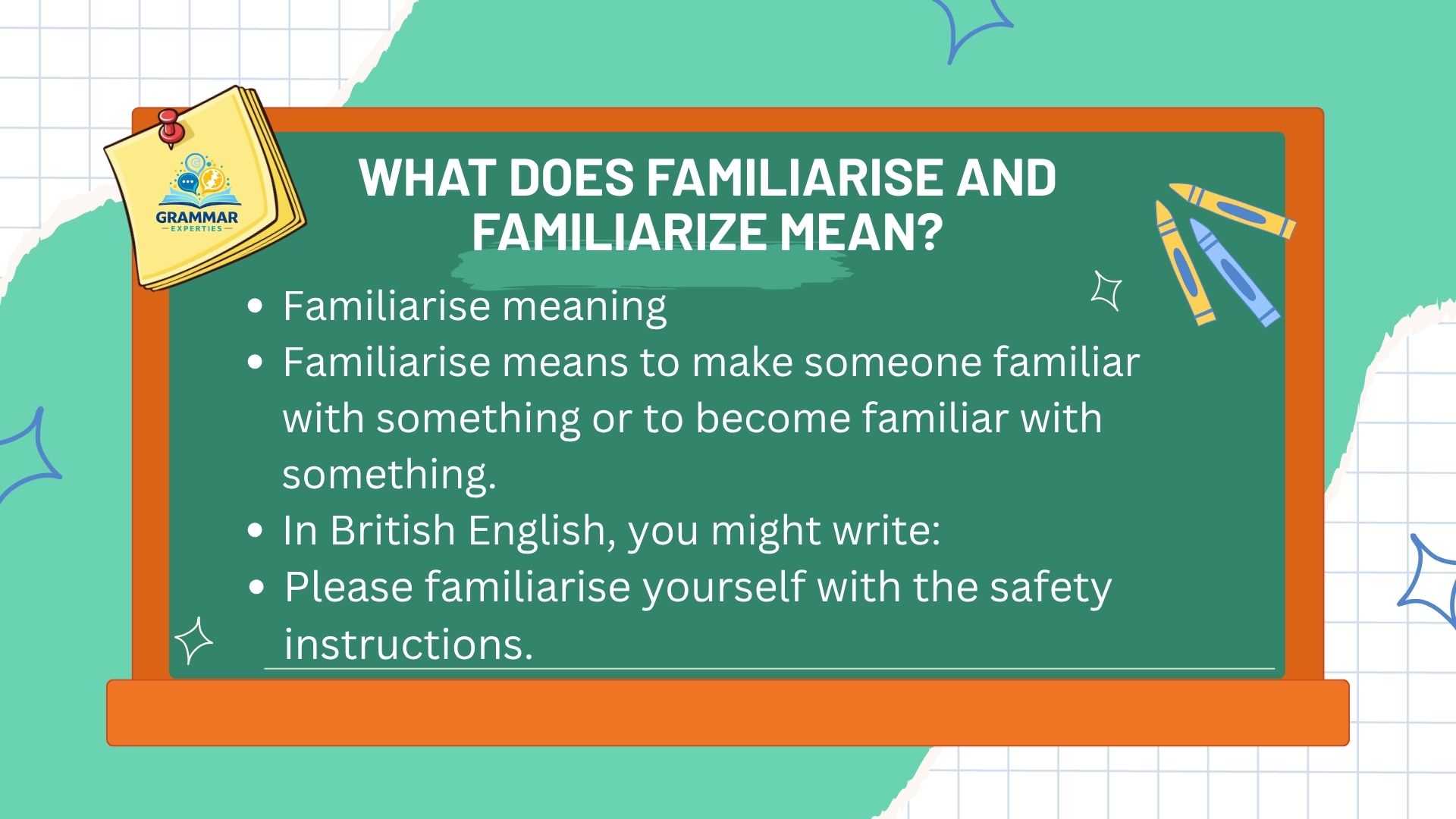
Familiarise meaning
Familiarise means to make someone familiar with something or to become familiar with something.
In British English, you might write:
Please familiarise yourself with the safety instructions.
This means:
Please learn about and become familiar with the safety instructions.
Familiarize meaning
Familiarize has the same meaning and is the usual American spelling.
For example:
Please familiarize yourself with the safety instructions.
Cambridge defines familiarize as learning about something and gives examples involving people becoming familiar with software, tasks, rules, and other subjects.
The Cambridge Learner’s Dictionary also identifies familiarise as the UK form.
The common phrase “familiarise/familiarize yourself with”
One of the most common structures is:
familiarise yourself with something
or
familiarize yourself with something
This means to learn about something so that you understand or know it better.
Examples:
You should familiarise yourself with the company’s policies.
You should familiarize yourself with the company’s policies.
Students should familiarise themselves with the examination rules.
Students should familiarize themselves with the examination rules.
Cambridge lists familiarize yourself with something as a phrasal verb and notes that the UK usually uses familiarise yourself with something.
Familiarise vs Familiarize in British and American English
Familiarise in British English
Familiarise is commonly associated with British English.
You may encounter it in:
- UK newspapers
- British educational materials
- UK government documents
- British academic writing
- British business communication
- Publications following British spelling
Examples:
Please familiarise yourself with the application process.
Employees must familiarise themselves with the updated policy.
The teacher asked students to familiarise themselves with the reading list.
Familiarize in American English
Familiarize is the standard American spelling.
It is commonly used in:
- American newspapers
- US academic writing
- American business communication
- US websites
- American educational resources
Examples:
Please familiarize yourself with the application process.
Employees must familiarize themselves with the updated policy.
The teacher asked students to familiarize themselves with the reading list.
The Cambridge Dictionary uses familiarize in its US entry and identifies the UK spelling as familiarise.
A useful spelling pattern
The same regional pattern appears in several other verbs:
| British English | American English |
|---|---|
| familiarise | familiarize |
| organise | organize |
| recognise | recognize |
| realise | realize |
| apologise | apologize |
| specialise | specialize |
| modernise | modernize |
This pattern is useful when editing an article, essay, website, or business document.
However, don’t assume that every word ending in -ise must automatically become -ize in American English. English spelling contains exceptions and words with different histories, so individual words should be checked when you’re uncertain.
How to Use Familiarise and Familiarize in Sentences
Familiarise vs Familiarize sentence examples
Here are examples showing that the two forms work in exactly the same grammatical contexts:
British English:
The manager asked the new employees to familiarise themselves with the software.
American English:
The manager asked the new employees to familiarize themselves with the software.
More examples:
You should familiarise yourself with the instructions before starting.
You should familiarize yourself with the instructions before starting.
The students familiarised themselves with the examination format.
The students familiarized themselves with the examination format.
She is familiarising herself with the new system.
She is familiarizing herself with the new system.
The difference is spelling rather than meaning.
Familiarise/familiarize with a person
The verb can also be used when introducing someone to a person, subject, process, or environment.
For example:
The guide familiarised the visitors with the local customs.
American spelling:
The guide familiarized the visitors with the local customs.
The basic structure is:
familiarise/familiarize + someone + with + something
or:
familiarise/familiarize + yourself + with + something
Common grammatical patterns
You can use the verb in several forms:
- familiarise/familiarize yourself with
- familiarised/familiarized
- familiarising/familiarizing
- familiarises/familiarizes
Examples:
She familiarised herself with the new software.
She familiarized herself with the new software.
They are familiarising themselves with the new procedure.
They are familiarizing themselves with the new procedure.
The trainer familiarises new employees with the system.
The trainer familiarizes new employees with the system.
Familiarise vs Familiarize: Common Mistakes to Avoid
Mistake 1: Treating one spelling as universally correct
A common mistake is assuming that familiarise is wrong because an American dictionary or website uses familiarize.
The opposite mistake is also possible.
If you’re writing in British English, familiarise is a normal spelling. If you’re writing in American English, familiarize is the expected form.
The key is consistency.
Mistake 2: Mixing spelling systems
Suppose an article uses:
The company will organise the event and familiarize employees with the new system.
The sentence isn’t difficult to understand, but it mixes British -ise and American -ize conventions.
If you’re following British English, you could write:
The company will organise the event and familiarise employees with the new system.
If you’re following American English:
The company will organize the event and familiarize employees with the new system.
This creates a more consistent writing style.
Mistake 3: Confusing familiar with familiarize
These words are related but have different grammatical functions.
Familiar is an adjective:
I am familiar with the software.
Familiarize/familiarise is a verb:
I need to familiarize myself with the software.
Compare:
| Word | Part of speech | Example |
|---|---|---|
| familiar | Adjective | She is familiar with the process. |
| familiarize | Verb | She familiarized herself with the process. |
| familiarise | Verb | She familiarised herself with the process. |
| familiarity | Noun | Her familiarity with the process was helpful. |
Cambridge defines familiarity as a good knowledge of something or the condition of knowing something well.
A Practical Guide to Choosing the Right Spelling
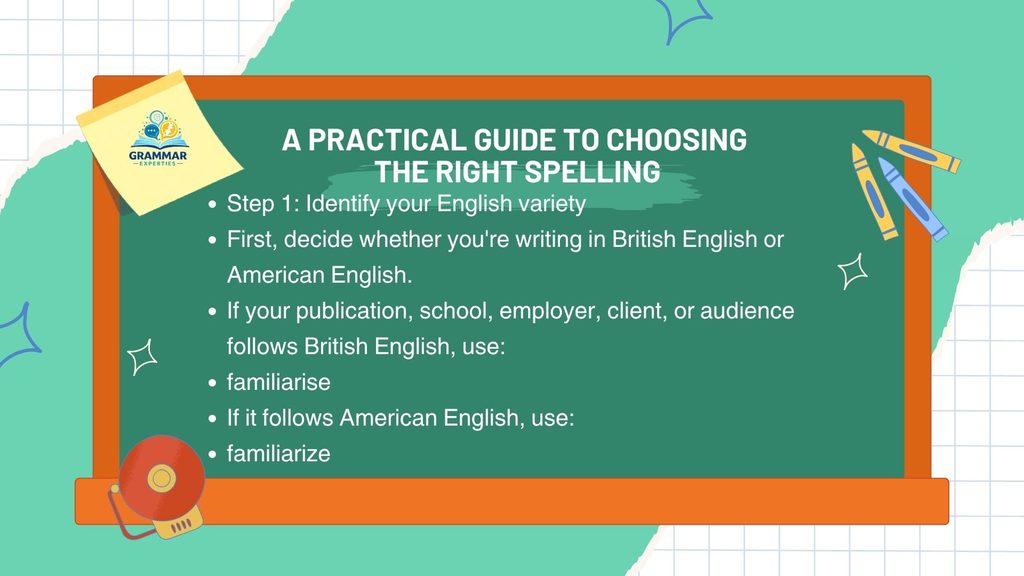
Step 1: Identify your English variety
First, decide whether you’re writing in British English or American English.
If your publication, school, employer, client, or audience follows British English, use:
familiarise
If it follows American English, use:
familiarize
Step 2: Check your style guide
Professional publications often have their own style rules.
For example, a company may require American spelling even if some members of its international team normally use British spelling.
Follow the style guide when one exists.
Step 3: Keep the entire document consistent
Don’t switch between familiarise and familiarize randomly.
Choose one convention and use it throughout the document.
Step 4: Consider your audience
If you’re writing for readers in the United Kingdom, familiarise may look more natural.
For readers in the United States, familiarize is generally the expected form.
For an international audience, either spelling can work, provided you use it consistently.
Quick decision checklist
Use this checklist before publishing:
- Is my audience primarily British English users?
- Is my audience primarily American English users?
- Does my organization have a style guide?
- Am I using -ise and -ize consistently?
- Have I used the correct grammatical form?
- Does the sentence require familiarise/familiarize yourself with?
If you’ve answered these questions, choosing the spelling should be straightforward.
Real-Life Example: Editing a Workplace Training Document
Imagine a UK-based company preparing a training manual for new employees. The document says:
“Before beginning your first shift, please familiarize yourself with our health and safety procedures.”
The sentence is grammatically correct, and American readers would find the spelling completely normal. However, the company uses British English throughout its documents. Elsewhere in the manual, it writes organise, recognise, and authorise.
An editor reviewing the document notices the inconsistency and changes the sentence to:
“Before beginning your first shift, please familiarise yourself with our health and safety procedures.”
Nothing about the meaning has changed. The employee still needs to learn the health and safety procedures. The only change is the spelling convention.
Now imagine the same training document is being prepared for an American company. In that case, familiarize would fit naturally alongside organize, recognize, and authorize.
This example demonstrates an important principle in English writing: correctness can sometimes depend on the variety of English you’re using. British and American English have different conventions, and neither variety needs to be treated as an error simply because it differs from the other.
For editors, teachers, students, and professional writers, the practical lesson is simple: identify the intended variety of English, follow the relevant spelling convention, and remain consistent.
What Does Recent Language Data Tell Us?
English spelling continues to vary by region
There isn’t a single global spelling system for English. British and American English remain established varieties with differences in spelling, grammar, vocabulary, and usage.
The British Council’s Language Trends England 2025 report surveyed teachers in more than 1,000 primary, secondary, and independent schools in England. The report highlights the continuing importance of English-language education and multilingual learning environments.
The report also found that 90.7% of surveyed schools reported having learners for whom English is an additional language, demonstrating the range of language backgrounds present in English education in England.
These figures do not measure how often familiarise or familiarize appears. Instead, they provide recent context for why learners and writers encounter multiple English varieties and spelling conventions.
Why this matters for writers
Digital communication means readers from different English-speaking regions regularly encounter one another’s spelling conventions.
A writer in Britain may see:
familiarise
while an American reader may expect:
familiarize
Both can communicate the same meaning.
Therefore, modern writers should understand regional English differences rather than treating every variation as a spelling error.
Familiarise vs Familiarize: Which Should You Use?
Use familiarise when writing British English
Choose familiarise if your writing follows British spelling conventions.
Example:
Please familiarise yourself with the company’s policies before your first day.
This is appropriate for a British English context.
Use familiarize when writing American English
Choose familiarize when using American spelling.
Example:
Please familiarize yourself with the company’s policies before your first day.
This is appropriate for an American English context.
What about international English?
If your audience is international, the most important thing is usually consistency.
For example, if your website consistently uses British spellings such as:
- colour
- centre
- organise
- recognise
then familiarise will fit that style.
If your website consistently uses American forms such as:
- color
- center
- organize
- recognize
then familiarize is the natural choice.
Mini Quiz: Familiarise vs Familiarize
1. Which spelling is commonly used in British English?
A) Familiarize
B) Familiarise
C) Familiarizee
D) Familarise
Answer: B) Familiarise
2. Which spelling is commonly used in American English?
A) Familiarise
B) Familarize
C) Familiarize
D) Familiarized
Answer: C) Familiarize
3. Do familiarise and familiarize have essentially the same meaning?
A) Yes
B) No
Answer: A) Yes
4. Choose the correct British English sentence.
A) Please familiarize yourself with the rules.
B) Please familiarise yourself with the rules.
C) Please familiarity yourself with the rules.
D) Please familarise yourself with the rules.
Answer: B) Please familiarise yourself with the rules.
5. Choose the correct American English sentence.
A) Please familiarise yourself with the policy.
B) Please familiarize yourself with the policy.
C) Please familiarity yourself with the policy.
D) Please familarize yourself with the policy.
Answer: B) Please familiarize yourself with the policy.
6. What is the main difference between “familiarise” and “familiarize”?
A) Their meanings
B) Their pronunciation
C) Their regional spelling conventions
D) Their grammatical category
Answer: C) Their regional spelling conventions
7. Which form would generally fit a British English article?
A) Familiarize
B) Familiarise
C) Familiarized
D) Familiarity
Answer: B) Familiarise
8. Which form would generally fit an American English article?
A) Familiarise
B) Familiarize
C) Familiarising
D) Familiarity
Answer: B) Familiarize
9. Fill in the blank with the British spelling:
“Students should ______ themselves with the new guidelines.”
A) familiarize
B) familiarise
C) familiarity
D) familiar
Answer: B) familiarise
10. Fill in the blank with the American spelling:
“Employees should ______ themselves with the safety procedures.”
A) familiarise
B) familiarize
C) familiarity
D) familiar
Answer: B) familiarize
11. Which sentence uses the verb correctly?
A) She familiarise herself with the software yesterday.
B) She familiarized herself with the software.
C) She familiarity herself with the software.
D) She familiar herself with the software.
Answer: B) She familiarized herself with the software.
12. What does “familiarize yourself with something” generally mean?
A) To forget something
B) To become acquainted with something
C) To remove something
D) To change something
Answer: B) To become acquainted with something
13. Which sentence uses the British spelling consistently?
A) They will organize and familiarize the staff.
B) They will organise and familiarise the staff.
C) They will organize and familiarise the staff.
D) They will organise and familiarize the staff.
Answer: B) They will organise and familiarise the staff.
14. Which sentence uses the American spelling consistently?
A) They will organise and familiarise the staff.
B) They will organize and familiarize the staff.
C) They will organise and familiarize the staff.
D) They will organize and familiarise the staff.
Answer: B) They will organize and familiarize the staff.
15. True or False: “Familiarise” is an incorrect spelling in all forms of English.
Answer: False
“Familiarise” is a standard spelling commonly used in British English.
16. True or False: “Familiarize” is commonly used in American English.
Answer: True
“Familiarize” is the standard American spelling.
17. Which spelling pattern is associated with many British English verbs?
A) -ize only
B) -ise in many words
C) -ies
D) -ous
Answer: B) -ise in many words
18. Which sentence contains the American spelling?
A) The teacher asked students to familiarise themselves with the textbook.
B) The teacher asked students to familiarize themselves with the textbook.
C) The teacher asked students for familiarisation with the textbook.
D) The teacher asked students to familiar themselves with the textbook.
Answer: B) The teacher asked students to familiarize themselves with the textbook.
19. Which sentence contains the British spelling?
A) The manager asked employees to familiarize themselves with the system.
B) The manager asked employees to familiarise themselves with the system.
C) The manager asked employees for familiarize with the system.
D) The manager asked employees to familiar the system.
Answer: B) The manager asked employees to familiarise themselves with the system.
20. If your entire document follows American English, which spelling should you normally use?
A) Familiarise
B) Familiarize
C) Both randomly
D) Neither
Answer: B) Familiarize
21. If your entire document follows British English, which spelling should you normally use?
A) Familiarize
B) Familiarise
C) Familiarized only
D) Familiar
Answer: B) Familiarise
22. Which sentence is grammatically correct?
A) Please familiarize yourself with the instructions.
B) Please familiarize you with the instructions.
C) Please familiarity yourself with the instructions.
D) Please familiar yourself with the instructions.
Answer: A) Please familiarize yourself with the instructions.
23. What should a writer primarily consider when choosing between “familiarise” and “familiarize”?
A) The word’s length
B) The intended variety of English
C) The number of syllables
D) The font being used
Answer: B) The intended variety of English
24. Which statement is correct?
A) Familiarise and familiarize are completely different verbs.
B) Familiarise is always wrong.
C) Familiarize is always wrong.
D) Both are accepted spellings, with regional preferences differing.
Answer: D) Both are accepted spellings, with regional preferences differing.
25. Which is the best conclusion about “Familiarise vs Familiarize”?
A) Only familiarize is correct.
B) Only familiarise is correct.
C) Both are correct, but usage depends mainly on the English variety being followed.
D) Neither spelling is standard.
Answer: C) Both are correct, but usage depends mainly on the English variety being followed.
Familiarise vs Familiarize FAQs
Q1:Is “familiarise” correct English?
Yes. Familiarise is a standard British English spelling of the verb. It has the same meaning as the American spelling familiarize. Cambridge specifically notes the UK -ise form.
Q2:Is “familiarize” correct English?
Yes. Familiarize is the standard American spelling and is also recognized in major English dictionaries. Cambridge’s US entry defines the word as a verb meaning to learn about something.
Q3:Is familiarise British or American?
Familiarise is primarily associated with British English.
American English generally uses familiarize.
Q4:Is familiarize British or American?
Familiarize is primarily associated with American English, while British English commonly uses familiarise.
Q5:Do familiarise and familiarize have different meanings?
No. They have essentially the same meaning. The difference is mainly regional spelling.
For example:
Familiarise yourself with the rules.
and
Familiarize yourself with the rules.
Both mean that you should learn about and become comfortable with the rules.
Q6:How do you use familiarize in a sentence?
You can use it with yourself with when telling someone to become familiar with something:
Please familiarize yourself with the new policy.
Cambridge gives the same general grammatical construction, noting that British English commonly uses familiarise yourself with.
Q7:How do you use familiarise in a sentence?
Use familiarise in the same grammatical way, particularly when following British English spelling:
Please familiarise yourself with the new policy.
Q8:Which spelling should I use in academic writing?
Use the spelling convention required by your institution, instructor, publisher, or style guide.
If you’re writing in British English, use familiarise. If you’re following American English, use familiarize.
The important point is to remain consistent throughout your paper or document.
Conclusion
When comparing familiarise vs familiarize, there isn’t one spelling that is universally correct and the other universally wrong.
Familiarise is the common British English spelling, while familiarize is the common American English spelling. Both mean to make someone familiar with something or to become familiar with something.
The most important rule is to match the spelling to your chosen variety of English and remain consistent.
Remember:
British English → familiarise
American English → familiarize
So, if you’re writing for a British audience, choose familiarise. If you’re writing for an American audience, choose familiarize.
Explore more easy grammar lessons and improve your English with Grammar Expertise
References

Maimoona Mughal is an English grammar enthusiast dedicated to simplifying confusing words, grammar rules, and vocabulary through clear, accurate, and learner-friendly content that helps readers write and communicate with confidence.