Have you ever wondered whether to write todays or today’s in an email, school assignment, blog post, or social media caption? Although these forms look almost identical, the apostrophe makes a difference in how the word functions.
The correct choice depends on what you want to express. Today’s is the standard form when you mean something happening today or something associated with today. Todays, without an apostrophe, is generally incorrect in ordinary English writing when used with this meaning.
In this complete grammar guide, you’ll learn the difference between todays and today’s, understand the apostrophe rule, explore real-life examples, and discover how to avoid this common punctuation mistake.
Todays or Today’s: Which Spelling Is Correct?
Why Is Today’s the Correct Form?
Today’s is the standard spelling when you want to describe something associated with the present day. The apostrophe and s indicate a relationship with today, as in today’s news, today’s weather, or today’s schedule.
For example:
- Correct: Today’s lesson was interesting.
- Correct: I checked today’s weather forecast.
- Correct: Today’s meeting starts at noon.
- Incorrect for the intended meaning: Todays meeting starts at noon.
The apostrophe helps readers understand the grammatical relationship between today and the noun that follows it.
Is Todays Ever Correct?
In ordinary modern English, todays without an apostrophe is not the standard spelling for the possessive expression meaning “of today.”
However, it could appear in a specialized context, such as a brand name, username, or deliberately stylized title. Such uses do not make it the correct standard form in regular prose.
If you are writing an essay, business email, article, or formal document, use today’s when referring to something associated with the current day.
Quick Comparison: Todays vs. Today’s
| Word or phrase | Correct usage | Example |
|---|---|---|
| Today | The present day | Today is Friday. |
| Today’s | Associated with today | Today’s class was helpful. |
| Todays | Generally incorrect for the intended meaning | Write “today’s events,” not “todays events.” |
The easiest rule to remember is simple: when you mean something connected with today, write today’s.
What Does Today’s Mean in English Grammar?
Today’s as a Possessive Expression
The apostrophe in today’s can show a relationship similar to possession. It does not necessarily mean that today physically owns something. Instead, it connects the day to an event, activity, condition, or piece of information.
Consider these examples:
- Today’s newspaper contains an important announcement.
- Today’s assignment is due by 5 p.m.
- Today’s temperature is higher than yesterday’s.
- Today’s discussion focused on writing skills.
In each example, today’s means “of today” or “associated with today.”
This use is common in both formal and informal English. You will find it in newspapers, school notices, work emails, calendars, advertisements, and everyday conversations.
Today’s in Time Expressions
The word today’s often appears before nouns that describe events, plans, information, or activities.
Examples include:
- Today’s schedule
- Today’s appointment
- Today’s lesson
- Today’s announcement
- Today’s special offer
- Today’s deadline
These expressions refer to something connected with the current day.
For instance, if a manager writes, “Please review today’s report,” the message refers to the report associated with the current day.
Today’s in Everyday Writing
You can use today’s naturally in almost any type of writing.
In an email:
“Please find today’s meeting notes attached.”
In a school assignment:
“Today’s lesson helped me understand apostrophe usage.”
In a blog post:
“Today’s guide explains the difference between commonly confused words.”
In a social media caption:
“Today’s little achievement deserves a celebration!”
In all these examples, the apostrophe is necessary because today’s connects the present day with another noun or idea.
Why Does Today’s Need an Apostrophe?
The Basic Apostrophe Rule
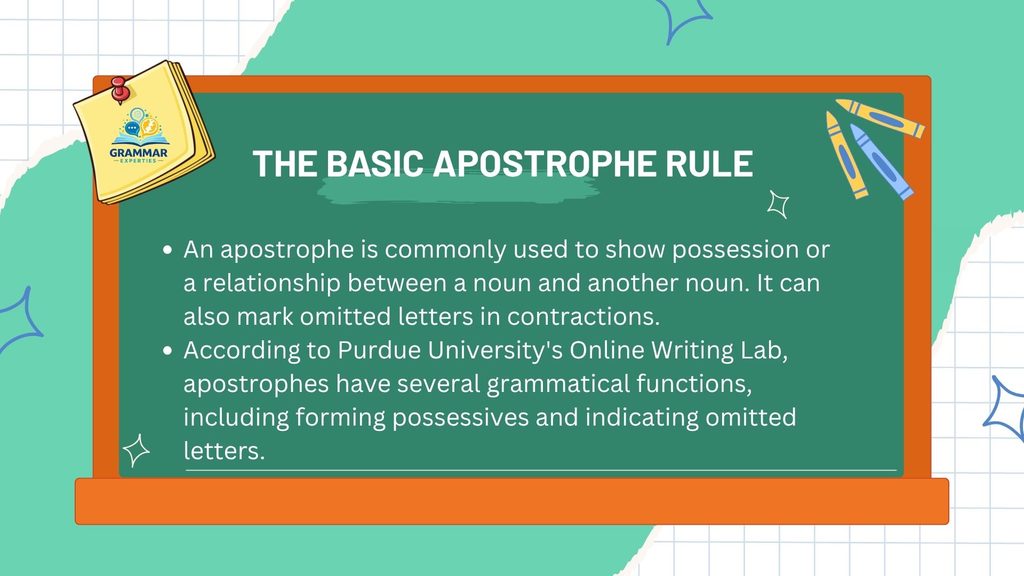
An apostrophe is commonly used to show possession or a relationship between a noun and another noun. It can also mark omitted letters in contractions.
According to Purdue University’s Online Writing Lab, apostrophes have several grammatical functions, including forming possessives and indicating omitted letters.
For a singular noun, the usual possessive pattern is to add ’s.
Examples:
- The student’s book
- The teacher’s desk
- The company’s website
- Today’s lesson
Although today is a time expression rather than a person or physical object, English uses the possessive form today’s to describe something associated with the day.
How to Remember the Difference
A useful method is to replace today’s with “of today.”
For example:
- Today’s news = the news of today.
- Today’s weather = the weather of today.
- Today’s meeting = the meeting scheduled for today.
If the sentence makes sense with this replacement, today’s is likely the form you need.
Compare these sentences:
Correct: Today’s event begins at 10 a.m.
Incorrect: Todays event begins at 10 a.m.
The first sentence correctly identifies the event associated with today. The second omits the apostrophe required for the intended meaning.
Why Apostrophe Mistakes Matter
A missing apostrophe may not prevent readers from understanding your message, but it can make your writing appear less polished.
In professional communication, academic work, and published content, punctuation helps establish clarity and consistency. Correct apostrophe use also makes it easier for readers to distinguish possessive forms from ordinary plurals.
The goal is not to add apostrophes everywhere. It is to use them where standard grammar requires them.
Todays or Today’s in Real-Life Situations
Example 1: Workplace Communication
Imagine that a project manager sends a message to a team:
“Please review todays project updates before the meeting.”
The intended meaning is clear, but the sentence contains a punctuation mistake.
The corrected version is:
“Please review today’s project updates before the meeting.”
Here, today’s describes the project updates associated with the current day.
Example 2: School and Academic Writing
A student writes:
“Todays assignment is about English punctuation.”
A teacher may correct the sentence to:
“Today’s assignment is about English punctuation.”
The apostrophe is necessary because the assignment is associated with today.
This is a useful example for students learning English grammar because it demonstrates how a small punctuation mark can change the correctness of a sentence.
Example 3: Blogging and Digital Publishing
Suppose a blogger writes the following headline:
“Todays Best Writing Tips for Beginners”
The polished version is:
“Today’s Best Writing Tips for Beginners”
The second version follows standard English punctuation. It also looks more professional in a blog title, newsletter subject line, or article heading.
Case Study: Correcting a Common Mistake in a Work Email
Consider a hypothetical workplace scenario involving an employee who regularly prepares daily updates for a team. The employee writes emails such as “Todays schedule has changed” and “Please check todays announcements.” The team members understand the messages, so the employee initially assumes that the spelling does not matter.
Later, a colleague reviewing the team’s written communications notices that the apostrophe is missing. The colleague explains that the standard forms are “today’s schedule” and “today’s announcements.” The employee checks the relevant sentences and corrects both examples.
The employee then adopts a simple proofreading habit: whenever a sentence contains today followed by a noun, the employee checks whether the intended expression is “of today” or “associated with today.” If it is, the employee uses today’s.
Over time, this small change makes the team’s emails, daily reports, and meeting notes more consistent. It also encourages the employee to review other common apostrophe mistakes, including its versus it’s and students versus students’.
This hypothetical example illustrates a practical lesson: grammar improvements do not always require complicated rules. A short checklist and a clear understanding of the apostrophe can prevent repeated mistakes. The same technique works for students, bloggers, editors, and anyone who writes regularly.
Common Mistakes and How to Avoid Them
Mistake 1: Leaving Out the Apostrophe
Incorrect: Todays weather is beautiful.
Correct: Today’s weather is beautiful.
Why? The sentence refers to the weather associated with today, so the possessive form is needed.
Mistake 2: Adding an Apostrophe to Every Word Ending in S
Incorrect: The students’ book is on the desk. (If you mean one student’s book.)
Correct: The student’s book is on the desk.
However, students’ book can be correct if the book belongs to multiple students. The correct form depends on the intended meaning.
Similarly, do not assume that every word ending in s needs an apostrophe. Ordinary plurals generally do not use one.
Mistake 3: Confusing Today With Today’s
These forms serve different grammatical purposes.
- Today: Today is a beautiful day.
- Today’s: Today’s weather is beautiful.
Use today when referring directly to the day. Use today’s when describing something connected with it.
Mistake 4: Using Todays in Headlines
Headlines often omit punctuation by mistake, especially when written quickly for websites or social media.
Incorrect: Todays Top Grammar Tips
Correct: Today’s Top Grammar Tips
Before publishing a heading, check that the apostrophe is present wherever the possessive expression is required.
A Simple Checklist for Choosing the Correct Form
Use this checklist when proofreading:
- Are you referring directly to the current day? Use today.
- Are you describing something associated with the current day? Use today’s.
- Are you writing todays to mean “of today”? Add the apostrophe.
- Are you following a special brand or title spelling? Check the official styling before changing it.
- Are you proofreading a published article or professional email? Review apostrophes consistently.
What Do Grammar Sources and Recent Data Tell Us?
Established Grammar Guidance
Purdue OWL explains that apostrophes form possessives and mark certain contractions. Its guidance supports the standard pattern used in expressions such as today’s lesson and today’s schedule.
Google Search Central also recommends creating helpful, reliable, people-first content rather than writing primarily to manipulate search rankings. Its guidance emphasizes accuracy, originality, and useful information for readers.
What About 2025–2026 Statistics?
There is no verified, authoritative 2025–2026 statistic available here that establishes how often people misspell today’s as todays. Therefore, it would be misleading to invent a percentage or claim that a particular number of writers make this mistake.
For this grammar question, the most reliable evidence is the established punctuation rule rather than an unsupported statistic.
If you want to investigate actual usage trends, you can compare dated text collections or search-term data. However, the frequency of a spelling in online content does not automatically establish whether that spelling is grammatically correct.
The important takeaway remains straightforward: today’s is the standard form when describing something associated with the present day.
Mini Quiz:Todays or Today’s
1. Which spelling correctly completes the sentence?
“_____ weather is sunny.”
A) Todays B) Today’s C) Todays’ D) Today
Answer: B) Today’s
Explanation: Today’s correctly describes the weather associated with the current day.
2. Which sentence is correct?
A) Todays meeting starts at noon. B) Today’s meeting starts at noon. C) Today meeting starts at noon. D) Todays’ meeting starts at noon.
Answer: B) Today’s meeting starts at noon.
Explanation: The apostrophe is needed to show the relationship between today and the meeting.
3. Which word refers directly to the current day?
A) Today B) Today’s C) Todays D) Todays’
Answer: A) Today
Explanation: Today refers directly to the present day.
4. Choose the correct phrase for a work email.
A) Todays report B) Today report C) Today’s report D) Todays’ report
Answer: C) Today’s report
Explanation: Today’s report means the report associated with today.
5. True or False: “Today’s lesson begins at nine” is correctly punctuated.
Answer: True
Explanation: Today’s correctly describes the lesson associated with the current day.
6. Which sentence correctly uses “today” without an apostrophe?
A) Today is my birthday. B) Today birthday is special. C) Todays is my birthday. D) Today’s is my birthday.
Answer: A) Today is my birthday.
Explanation: Today names the current day and does not need an apostrophe in this sentence.
7. Fill in the blank: “Please check _____ announcements.”
A) todays B) today’s C) today D) todays’
Answer: B) today’s
Explanation: Today’s correctly describes announcements associated with today.
8. Which phrase is correctly written?
A) Today’s schedule B) Today’s weather C) Todays meeting D) Today’s assignment
Answer: A, B, and D
Explanation: Today’s requires an apostrophe when it describes something associated with the current day.
9. Which sentence is correct for a school assignment?
A) Todays assignment is difficult. B) Today assignment is difficult. C) Today’s assignment is difficult. D) Todays’ assignment is difficult.
Answer: C) Today’s assignment is difficult.
Explanation: The apostrophe makes today’s the correct possessive form.
10. True or False: The sentence “Today is a busy day” needs an apostrophe in “Today.”
Answer: False
Explanation: Today is correctly written without an apostrophe when referring directly to the current day.
11. Which phrase means “the news of today”?
A) Todays news B) Today’s news C) Today news D) Todays’ news
Answer: B) Today’s news
Explanation: Today’s news means news associated with the current day.
12. Which punctuation mark is missing from “Todays plans have changed”?
A) Comma B) Colon C) Apostrophe D) Semicolon
Answer: C) Apostrophe
Explanation: The correct phrase is “Today’s plans have changed.”
13. Choose the correct headline.
A) Todays Top Writing Tips B) Today Top Writing Tips C) Today’s Top Writing Tips D) Todays’ Top Writing Tips
Answer: C) Today’s Top Writing Tips
Explanation: Today’s correctly describes the writing tips associated with today.
14. Which sentence uses “today” correctly?
A) Today’s is Monday. B) Today is Monday. C) Todays is Monday. D) Todays’ is Monday.
Answer: B) Today is Monday.
Explanation: Today correctly identifies the current day.
15. Which sentences correctly use “today’s”?
A) Today’s class was helpful. B) I read today’s newspaper. C) Today’s is sunny. D) Today’s deadline is approaching.
Answer: A, B, and D
Explanation: Today’s correctly modifies nouns such as class, newspaper, and deadline. In option C, the correct sentence is “Today is sunny.”
16. Fill in the blank: “I wrote a summary of _____ events.”
A) todays B) today’s C) today D) todays’
Answer: B) today’s
Explanation: Today’s events are events associated with the current day.
17. What does “today’s meeting” mean?
A) A meeting held every day B) A meeting associated with today C) A meeting held yesterday D) A meeting with no scheduled date
Answer: B) A meeting associated with today
Explanation: Today’s meeting refers to the meeting connected with the current day.
18. Which sentence is correct for a daily newsletter?
A) Todays edition includes updates. B) Today edition includes updates. C) Today’s edition includes updates. D) Todays’ edition includes updates.
Answer: C) Today’s edition includes updates.
Explanation: Today’s correctly describes the edition associated with today.
19. True or False: “Todays weather is cold” is correctly punctuated when referring to the current day’s weather.
Answer: False
Explanation: The correct sentence is “Today’s weather is cold.”
20. Which expression is correctly written?
A) Today’s special offer B) Todays special offer C) Todays’ special offer D) Today special offer
Answer: A) Today’s special offer
Explanation: Today’s correctly describes an offer associated with the current day.
21. Which sentence contains a spelling or punctuation mistake?
A) Today is sunny. B) Today’s class starts early. C) Todays homework is ready. D) Today’s news is interesting.
Answer: C) Todays homework is ready.
Explanation: The correct form is “Today’s homework is ready.”
22. Complete the sentence: “I have already finished _____ work.”
A) todays B) today’s C) today D) todays’
Answer: B) today’s
Explanation: Today’s work means work associated with the current day.
23. Which sentence is correct?
A) Today’s menu includes pasta. B) Todays menu includes pasta. C) Today menu includes pasta. D) Todays’ menu includes pasta.
Answer: A) Today’s menu includes pasta.
Explanation: The apostrophe is required in the standard expression “today’s menu.”
24. What is the main purpose of the apostrophe in “today’s schedule”?
A) To make today plural B) To show a relationship with today C) To turn today into a verb D) To indicate past tense
Answer: B) To show a relationship with today
Explanation: The apostrophe helps form the possessive expression meaning the schedule associated with today.
25. Choose the correct sentence.
A) Todays deadline is tomorrow. B) Today deadline is tomorrow. C) Today’s deadline is tomorrow. D) Todays’ deadline is tomorrow.
Answer: C) Today’s deadline is tomorrow.
Explanation: Today’s is the standard form when describing a deadline associated with the current day.
Frequently Asked Questions
Q1: Is It Todays or Today’s?
Today’s is correct when you mean something associated with the current day. For example, write “today’s meeting,” not “todays meeting.”
Q2: Is Todays Ever Grammatically Correct?
Todays is generally incorrect in standard English when intended to mean “of today.” It may appear in a proper name or stylized title, but that does not make it the standard grammatical form.
Q3: Why Does Today’s Have an Apostrophe?
The apostrophe forms a possessive expression that connects today with another noun. For example, “today’s news” means the news associated with today.
Q4: Should I Write Today’s Meeting or Todays Meeting?
Write today’s meeting. The apostrophe is needed because the meeting is associated with the current day.
Q5: Is Today’s Singular or Plural?
Today’s is the possessive form of today, which refers to a single day in this context. The apostrophe does not make the word plural.
Q6: Can I Use Today’s at the Beginning of a Sentence?
Yes. For example: “Today’s lesson covers punctuation.” The word can begin a sentence or headline without any special grammatical restriction.
Q7: What Is the Difference Between Today and Today’s?
Today refers to the current day, as in “Today is Monday.” Today’s describes something connected with that day, as in “Today’s meeting is on Monday.”
Q8: How Can I Remember Whether to Use Todays or Today’s?
Try replacing the phrase with “of today.” If you mean “the schedule of today,” write “today’s schedule.” This quick test helps you identify when the apostrophe is necessary.
Conclusion: Todays or Today’s – Which One Should You Use?
When choosing between todays or today’s, remember that today’s is the standard form for describing something associated with the current day. The apostrophe is an essential part of this expression.
Use today when referring directly to the present day, as in “Today is sunny.” Use today’s when describing something connected with it, as in “Today’s weather is sunny.” Avoid todays when you intend this possessive meaning.
Although the difference looks small, correct punctuation makes your writing clearer and more professional. By applying this simple rule, you can avoid a common grammar mistake in emails, assignments, blog posts, and everyday communication.
Explore more easy grammar lessons and improve your English with Grammar Expertise
References
https://dictionary.cambridge.org/us/grammar/british-grammar/apostrophe
https://dictionary.cambridge.org/grammar/british-grammar/nowadays-these-days-or-today

Maimoona Mughal is an English grammar enthusiast dedicated to simplifying confusing words, grammar rules, and vocabulary through clear, accurate, and learner-friendly content that helps readers write and communicate with confidence.