Have you ever confused bellow and below when writing a sentence? These two words look similar, but they have completely different meanings. Choosing the wrong one can change your sentence and make your writing unclear.
The correct word depends on what you want to express. Bellow means to shout loudly or produce a deep, loud sound, while below means at a lower position, level, or amount.
In this guide, you’ll learn the difference between bellow and below, understand their meanings and grammatical functions, explore practical sentence examples, and discover simple ways to avoid this common English word-choice mistake.
What Is the Difference Between Bellow and Below?
The main difference between bellow and below is their meaning and usage. Bellow usually describes a loud, deep sound or the act of shouting. Below describes a lower position, level, or measurement.
Although the words differ by only one letter, you cannot use them interchangeably.
What Does Bellow Mean?
Bellow is a verb that means to shout loudly, often in an angry, forceful, or powerful voice. It can also describe the deep, loud sound made by an animal.
Examples:
- The angry man began to bellow at the workers.
- The coach bellowed instructions across the field.
- The bull let out a loud bellow.
- “Get out of my way!” he bellowed.
In these examples, bellow describes a loud voice or sound. It often suggests more volume and force than an ordinary shout.
Bellow can also function as a noun when it refers to a loud, deep cry or roar.
What Does Below Mean?
Below is a preposition or adverb that indicates a lower position, level, or amount in relation to something else.
Examples:
- The temperature dropped below zero.
- The village lies below the mountain.
- Please write your name below the heading.
- Her score was below average.
In each example, below describes a position, measurement, or level that is lower than a reference point.
Bellow vs. Below: Quick Comparison
| Feature | Bellow | Below |
|---|---|---|
| Main meaning | To shout loudly or make a deep sound | At a lower position or level |
| Grammatical function | Verb or noun | Preposition or adverb |
| Example | The man began to bellow. | The village lies below the hill. |
| Related words | Shout, roar, yell | Under, beneath, lower |
| Common context | Loud voices and animal sounds | Positions, measurements, and levels |
Quick rule: Use bellow when describing a loud sound or shout. Use below when describing something at a lower position or level.
When Should You Use Bellow?
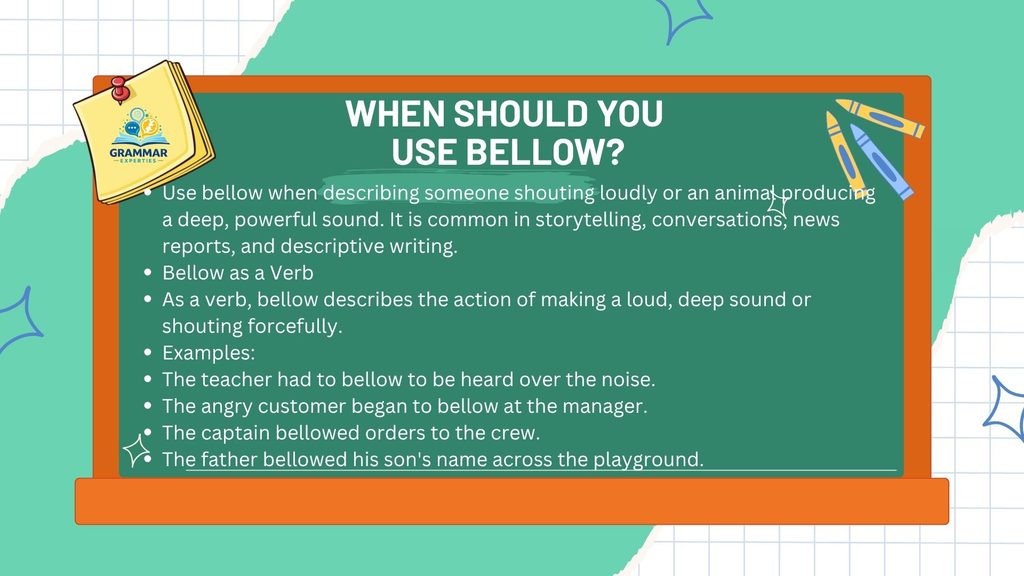
Use bellow when describing someone shouting loudly or an animal producing a deep, powerful sound. It is common in storytelling, conversations, news reports, and descriptive writing.
Bellow as a Verb
As a verb, bellow describes the action of making a loud, deep sound or shouting forcefully.
Examples:
- The teacher had to bellow to be heard over the noise.
- The angry customer began to bellow at the manager.
- The captain bellowed orders to the crew.
- The father bellowed his son’s name across the playground.
Bellow often conveys emotion. Depending on the context, it may suggest anger, urgency, excitement, or an effort to be heard over a loud environment.
For example:
“The coach bellowed instructions during the final minutes of the game.”
This sentence tells readers that the coach spoke loudly and forcefully rather than speaking in a normal voice.
Bellow as a Noun
Bellow can also function as a noun, referring to a loud, deep cry or roar.
Examples:
- A bellow of anger came from the next room.
- The bull gave a powerful bellow.
- His sudden bellow startled everyone.
- A loud bellow echoed through the forest.
In these sentences, bellow names the sound itself rather than the action of making it.
Synonyms and Related Words for Bellow
Several words have meanings similar to bellow, although their exact usage depends on context.
- Shout: To speak loudly, often to attract attention.
- Yell: To call out or speak in a loud voice.
- Roar: To make a deep, powerful sound, often associated with animals.
- Holler: To shout or call loudly, especially in informal speech.
- Scream: To make a very loud, high-pitched sound.
For example, “The man shouted across the street” is a neutral description. “The man bellowed across the street” suggests a louder, deeper, or more forceful voice.
When Should You Use Below?
Use below when describing a lower position, a smaller amount, or a level that does not reach a particular point. It is common in everyday English, academic writing, instructions, and professional communication.
Below for Physical Positions
Below can describe the location of one object in relation to another.
Examples:
- The keys are on the shelf below the mirror.
- A small village sits below the hill.
- The picture hangs below the clock.
- The apartment below ours is vacant.
Below does not necessarily mean that two objects touch. It simply indicates a lower position relative to a reference point.
For example, a village may be below a mountain even if there is a considerable distance between them.
Below for Numbers and Measurements
Below is frequently used when discussing temperatures, scores, prices, and other measurable values.
Examples:
- The temperature fell below freezing.
- Her score was below 80 percent.
- The price dropped below $100.
- The employee’s performance was below expectations.
In these examples, below means less than a specified amount or standard.
It is especially useful in reports and formal writing because it communicates comparisons clearly.
Below in Instructions and Written Content
Writers often use below to direct readers to information appearing farther down a document or webpage.
Examples:
- Read the instructions below.
- The examples below explain the rule.
- Please see the table below for further details.
- The information below outlines the main requirements.
For example, a blogger might write, “You can find the complete list of references below.”
Here, below guides the reader to another part of the page rather than describing a physical object.
Bellow or Below: Common Mistakes and Real-Life Examples
Confusing bellow and below is easy because their spellings differ by only one letter. However, their meanings are distinct. Understanding the context is the simplest way to select the correct word.
Common Mistakes to Avoid
| Incorrect sentence | Correct sentence | Explanation |
|---|---|---|
| The teacher began to below at the students. | The teacher began to bellow at the students. | Bellow means to shout loudly. |
| The temperature fell bellow zero. | The temperature fell below zero. | Below describes a lower measurement. |
| The bull gave a loud below. | The bull gave a loud bellow. | Bellow can be a noun describing a deep sound. |
| Please write your answer bellow the question. | Please write your answer below the question. | Below indicates a lower position on the page. |
| The manager bellowed the instructions bellow the heading. | The manager bellowed the instructions below the heading. | Bellow describes how the manager spoke; below describes position. |
These examples demonstrate why you must consider meaning instead of relying only on spelling.
A Real-Life Example: Correcting a Short Story
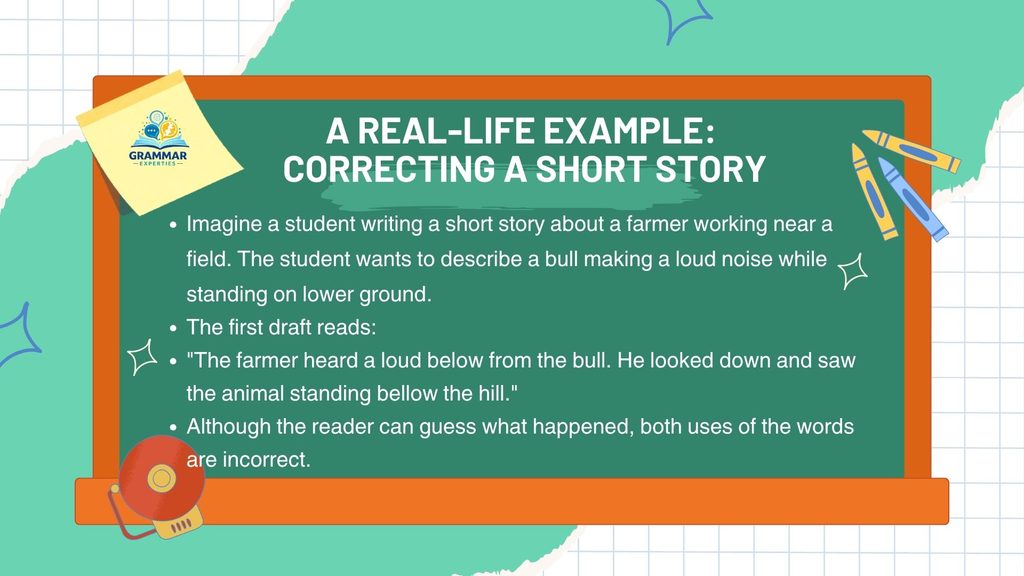
Imagine a student writing a short story about a farmer working near a field. The student wants to describe a bull making a loud noise while standing on lower ground.
The first draft reads:
“The farmer heard a loud below from the bull. He looked down and saw the animal standing bellow the hill.”
Although the reader can guess what happened, both uses of the words are incorrect.
The student revises the passage:
“The farmer heard a loud bellow from the bull. He looked down and saw the animal standing below the hill.”
The revised version communicates the scene clearly. Bellow describes the deep, loud sound made by the bull, while below identifies the animal’s position relative to the hill.
This example highlights an important writing principle: similar-looking words can have very different meanings. When editing a story, school assignment, blog post, or professional email, check whether each word expresses the intended action, sound, position, or measurement.
A useful proofreading technique is to replace the questionable word with a simple definition. If you mean “shout loudly,” choose bellow. If you mean “at a lower level,” choose below. This small check can help you catch word-choice mistakes before publishing or submitting your writing.
A Simple Checklist for Choosing the Correct Word
Follow these steps whenever you are unsure whether to use bellow or below.
- Identify the meaning. Are you describing a loud sound or a lower position?
- Check the sentence. Does the word describe an action, a sound, or a location?
- Try a replacement. If shout or roar fits, bellow may be appropriate. If lower than or underneath fits, below may be correct.
- Read the sentence again. Make sure the meaning remains clear and natural.
Examples:
- The man began to bellow angrily.
- The temperature dropped below freezing.
- The bull let out a loud bellow.
- The village lies below the mountain.
English Usage Facts and Reliable References for 2025–2026
Understanding established definitions is more useful than assuming one spelling is always correct. Bellow and below are both standard English words, but each has a different purpose.
What Do Dictionaries Say?
Established dictionaries distinguish bellow from below by meaning and grammatical use.
Bellow is associated with loud shouting and deep sounds, including the cries of animals. Below is associated with lower positions, levels, and amounts.
These distinctions are useful for students, English learners, editors, and anyone who wants to improve their written communication.
Are There Statistics Showing Which Word Is More Correct?
There is no meaningful universal percentage that determines whether bellow or below is more correct. Both are valid words, and the appropriate choice depends on the sentence.
A search-frequency comparison would not establish grammatical correctness. Even if one word appeared more often in online searches, that would not make it a suitable substitute for the other.
No specific 2025–2026 statistic is needed to establish their difference. Their definitions, grammatical functions, and contextual examples provide the relevant guidance.
Mini Quiz:Bellow or Below
1. Which word means to shout loudly?
A. Below B. Bellow C. Belowe D. Belllow
Answer: B. Bellow
2. Which word means at a lower position?
A. Bellow B. Below C. Bellows D. Belowe
Answer: B. Below
3. Fill in the blank: The angry man began to _____ at the workers.
A. below B. bellow C. beloe D. belows
Answer: B. bellow
4. Fill in the blank: The temperature dropped _____ zero.
A. bellow B. below C. bellows D. bellowed
Answer: B. below
5. Which sentence uses bellow correctly?
A. The village lies bellow the hill. B. The coach began to bellow instructions. C. Write your name bellow the heading. D. The temperature fell bellow freezing.
Answer: B. The coach began to bellow instructions.
6. Which sentence uses below correctly?
A. The man belowed at the crowd. B. The bull gave a loud below. C. The picture hangs below the clock. D. She began to below angrily.
Answer: C. The picture hangs below the clock.
7. What is the past tense of bellow?
A. Below B. Bellowed C. Belled D. Belowed
Answer: B. Bellowed
8. Fill in the blank: The bull let out a loud _____.
A. below B. bellow C. belows D. belowed
Answer: B. bellow
9. Which word fits this sentence? “Please write your answer _____ the question.”
A. bellow B. below C. bellowed D. bellowing
Answer: B. below
10. Bellow is commonly associated with which action?
A. Moving downward B. Shouting loudly C. Writing carefully D. Walking slowly
Answer: B. Shouting loudly
11. Fill in the blank: The manager _____ orders across the noisy factory.
A. belowed B. bellowed C. belows D. belowing
Answer: B. bellowed
12. Which word belongs in this sentence? “Her test score was _____ average.”
A. bellow B. below C. bellowing D. bellowed
Answer: B. below
13. Which word can be used as a noun referring to a loud, deep cry?
A. Below B. Bellow C. Beneath D. Under
Answer: B. Bellow
14. Choose the correctly spelled sentence.
A. The farmer heard a loud below. B. The farmer heard a loud bellow. C. The farmer heard a loud beloe. D. The farmer heard a loud belllow.
Answer: B. The farmer heard a loud bellow.
15. Fill in the blank: The apartment _____ ours is vacant.
A. bellow B. below C. bellowed D. bellows
Answer: B. below
16. Which word is appropriate when someone shouts angrily?
A. Below B. Bellow C. Beneath D. Under
Answer: B. Bellow
17. Fill in the blank: The price fell _____ $20.
A. bellow B. below C. bellowing D. bellowed
Answer: B. below
18. Which sentence contains a spelling mistake?
A. The captain bellowed an order. B. The village is below the mountain. C. The temperature fell bellow zero. D. The bull gave a loud bellow.
Answer: C. The temperature fell bellow zero.
19. What does below mean in “Read the instructions below”?
A. Read them loudly. B. Read the instructions farther down the page. C. Read them angrily. D. Read them twice.
Answer: B. Read the instructions farther down the page.
20. Which word completes the sentence? “The teacher had to _____ to be heard over the noise.”
A. below B. bellow C. beneath D. under
Answer: B. bellow
21. True or false: Bellow and below have exactly the same meaning.
Answer: False. Bellow refers to a loud shout or sound, while below refers to a lower position or level.
22. True or false: Below can describe a temperature lower than zero.
Answer: True. For example, “The temperature fell below zero.”
23. Fill in the blanks: The bull began to _____, and the farmer stood on the path _____ the hill.
A. below, bellow B. bellow, below C. bellow, bellow D. below, below
Answer: B. bellow, below
24. Which sentence uses both words correctly?
A. The man stood bellow the hill and began to below. B. The man stood below the hill and began to bellow. C. The man stood bellow the hill and began to bellow. D. The man stood below the hill and began to below.
Answer: B. The man stood below the hill and began to bellow.
25. Complete the rule: Use _____ for a loud shout and _____ for a lower position.
A. below, bellow B. bellow, below C. below, below D. bellow, bellow
Answer: B. bellow, below
Frequently Asked Questions
Q1: Is bellow or below correct?
Both are correct English words, but they have different meanings. Bellow means to shout loudly or make a deep sound, while below refers to a lower position, level, or amount.
Q2: What does bellow mean?
Bellow means to shout loudly or produce a deep, powerful sound. For example, “The coach began to bellow instructions across the field.”
Q3: What does below mean?
Below means at a lower position or level than something else. It can also mean less than a specified amount, as in “The temperature dropped below zero.”
Q4: Can bellow and below be used in the same sentence?
Yes. For example, “The farmer heard a bull bellow from the field below the hill.” Bellow describes the sound, while below describes the location.
Q5: Is bellow a verb or a noun?
Bellow can be both a verb and a noun. As a verb, it means to shout loudly. As a noun, it refers to a loud, deep cry or roar.
Q6: Is below a preposition or an adverb?
Below can function as a preposition or an adverb. In “The cat is below the window,” it is a preposition. In “Please look below,” it functions as an adverb.
Q7: Why do people confuse bellow and below?
People often confuse these words because they have similar spellings and differ by only one letter. Remembering their meanings helps prevent mistakes: bellow relates to loud sounds, while below relates to lower positions or levels.
Q8: How can I remember the difference between bellow and below?
Use this simple memory aid: Bellow means a loud shout; below means a lower position. If your sentence describes someone shouting, choose bellow. If it describes something lower than a reference point, choose below.
Conclusion
The difference between bellow or below comes down to meaning and context. Bellow means to shout loudly or make a deep, powerful sound. Below means at a lower position, level, or amount.
Both spellings are correct, but they are not interchangeable. Use bellow when describing a loud voice or animal sound, and use below when discussing positions, measurements, or information farther down a page.
To improve your English writing, pay attention to word meanings, read example sentences, and consult reliable dictionaries whenever you are uncertain.
Explore more easy grammar lessons and improve your English with Grammar Expertise
References
https://dictionary.cambridge.org/dictionary/english/bellow https://dictionary.cambridge.org/dictionary/english/below

Maimoona Mughal is an English grammar enthusiast dedicated to simplifying confusing words, grammar rules, and vocabulary through clear, accurate, and learner-friendly content that helps readers write and communicate with confidence.