Have you ever typed “ocassion” and wondered whether it looks right? You’re not alone. Occasion or ocassion is a common spelling question because the word contains repeated letters and its pronunciation doesn’t make every letter obvious.
The correct spelling is occasion. The spelling ocassion is incorrect in standard English.
If you’re writing an email, school assignment, article, invitation, business document, or social media post, use occasion. In this guide, you’ll learn the meaning of occasion, how to pronounce it, why ocassion is incorrect, and how to use the correct word naturally in sentences.
The Quick Answer: Occasion or Ocassion?
Occasion is the correct spelling.
Ocassion is a misspelling and should not be used in standard English.
The correct word contains two c’s and one s:
O-C-C-A-S-I-O-N → occasion
A useful way to remember it is:
oc + casion = occasion
Not:
oc + assion = ocassion
The correct spelling is confirmed by major English dictionaries. Cambridge defines occasion as a particular time when something happens, a special or formal event, or an opportunity or reason for something to happen.
Correct vs. Incorrect Spelling
| Spelling | Correct? | Example |
|---|---|---|
| occasion | ✅ Yes | It was a memorable occasion. |
| ocassion | ❌ No | Incorrect spelling |
| Occasion | ✅ Yes, when capitalized | Occasion can be used at the beginning of a sentence. |
| OCCASION | ✅ Yes | Used when all-caps formatting is appropriate. |
So, if you’re asking “occasion or ocassion?”, the answer is simple: occasion.
What Does Occasion Mean?
The word occasion is a noun with several related meanings. Its exact meaning depends on how it appears in a sentence.
Cambridge Dictionary lists occasion as referring to a particular time when something happens, a special or formal event, or an opportunity or reason for something to happen.
Occasion Meaning: A Special Event
One common meaning of occasion is a special event, celebration, or important moment.
For example:
- A wedding is a special occasion.
- Her graduation was a memorable occasion.
- We bought new clothes for the occasion.
- His birthday was a joyful occasion.
In this sense, occasion can refer to birthdays, weddings, anniversaries, graduations, ceremonies, festivals, and other meaningful events.
Occasion Meaning: A Particular Time
Occasion can also mean a specific time when something happened.
Examples:
- I met him on several occasions.
- She has helped me on more than one occasion.
- On that occasion, everyone stayed calm.
- We had discussed the issue on a previous occasion.
Here, occasion doesn’t necessarily mean a celebration. It simply refers to a particular instance or time.
Occasion Meaning: An Opportunity or Reason
The word can also describe an opportunity or reason for doing something.
For example:
- The meeting gave us an occasion to discuss the problem.
- He had no occasion to complain.
- The award ceremony was an occasion for the team to celebrate.
This use is somewhat more formal, but you’ll still encounter it in professional and literary English.
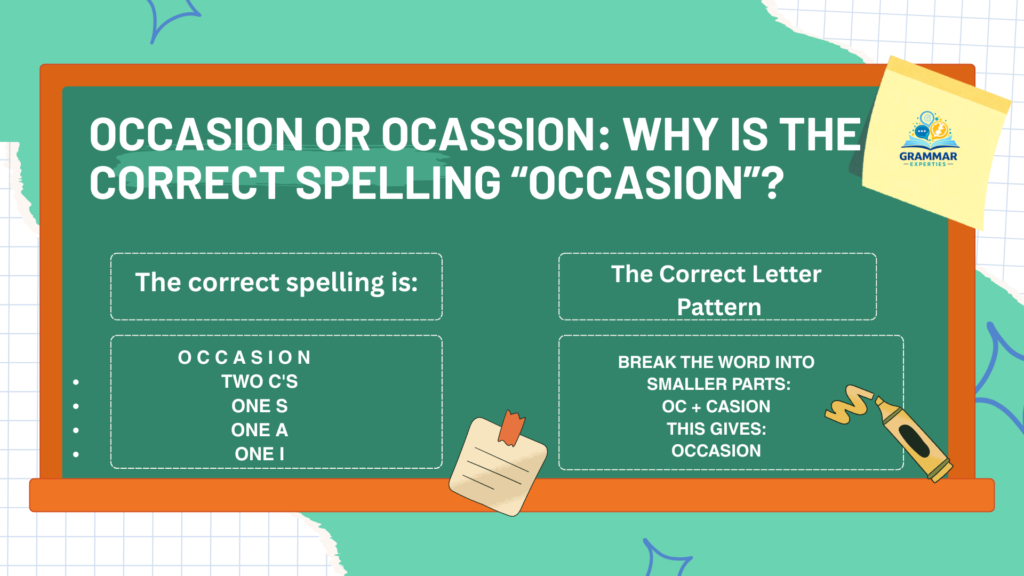
Occasion or Ocassion: Why Is the Correct Spelling “Occasion”?
The biggest spelling challenge is deciding where the repeated letters belong.
The correct spelling is:
O C C A S I O N
Notice that there are:
- Two c’s
- One s
- One a
- One i
The incorrect spelling ocassion changes the letter pattern and uses an extra s instead of the second c.
The Correct Letter Pattern
Break the word into smaller parts:
oc + casion
This gives:
OCCASION
A common mistake is to remember the pronunciation rather than the spelling. Because the word sounds approximately like “uh-KAY-zhun,” the letters in the middle aren’t always obvious when you’re writing quickly.
Is “Ocassion” a Word?
No. Ocassion is not the standard spelling of the English word.
If you see ocassion in an essay, email, article, résumé, invitation, or other formal writing, it should normally be corrected to occasion.
For example:
❌ We are celebrating this special ocassion.
✅ We are celebrating this special occasion.
The difference is only one letter, but spelling accuracy matters in professional and academic communication.
Why Do People Spell Occasion as Ocassion?
The error usually happens because English spelling doesn’t always match pronunciation perfectly.
When people hear occasion, they may focus on the “shun” sound at the end and remember the middle incorrectly. Typing quickly can also cause repeated letters to be misplaced.
Another reason is visual familiarity. If someone has repeatedly seen the misspelling ocassion, it may begin to look correct even though dictionaries use occasion.
The solution isn’t to memorize a complicated rule. Instead, memorize the letter sequence:
CC before AS → occasion
How to Pronounce Occasion
Correct spelling becomes much easier to remember when you connect it with pronunciation.
Occasion is commonly pronounced approximately:
uh-KAY-zhun
Cambridge gives the pronunciation as /əˈkeɪ.ʒən/ in both British and American English.
Pronunciation Breakdown
You can think of the word as three sound groups:
uh + KAY + zhun
The spelling, however, remains:
occasion
Not:
ocassion
Occasion vs. Occasionally
Another useful word from the same family is occasionally.
Correct:
- occasion
- occasional
- occasionally
Incorrect:
- ocassion
- ocassional
- ocassionally
Cambridge defines occasionally as meaning “sometimes but not often.”
For example:
I occasionally visit my old school.
This connection can help reinforce the correct spelling of the word family.
How to Use Occasion Correctly in a Sentence
Understanding the meaning is only half the job. You also need to know how occasion behaves in real sentences.
“Special Occasion”
One of the most common phrases is special occasion.
Examples:
- This dress is perfect for a special occasion.
- We usually eat out on special occasions.
- Her wedding was a truly special occasion.
- He bought a watch for the special occasion.
The phrase commonly refers to something important, memorable, formal, or worth celebrating.
“On Occasion”
On occasion is an important expression that means sometimes or from time to time.
Examples:
- I eat dessert on occasion.
- He still visits his hometown on occasion.
- We disagree on occasion, but we usually work well together.
Cambridge specifically defines on occasion as meaning “sometimes, but not often.”
A useful point to remember is that on occasion doesn’t necessarily refer to a celebration.
For example:
I drink coffee on occasion.
This means:
I drink coffee sometimes.
“On the Occasion Of”
The phrase on the occasion of is generally more formal.
Examples:
- We congratulate you on the occasion of your graduation.
- The speech was delivered on the occasion of the company’s anniversary.
- They organized a ceremony on the occasion of the school’s 50th anniversary.
This phrase is particularly common in formal announcements, speeches, invitations, and ceremonial writing.
“Rise to the Occasion”
Rise to the occasion is an idiomatic expression meaning to successfully deal with a difficult or important situation.
Example:
When the team needed a leader, Maria rose to the occasion.
It means Maria responded effectively when her skills or leadership were needed.
Occasion Examples in Everyday English
Here are practical examples showing the different ways you can use occasion.
Examples About Events
- The wedding was a beautiful occasion.
- Her graduation was an unforgettable occasion.
- We dressed formally for the occasion.
- It was a joyful occasion for the entire family.
- His retirement was a special occasion.
Examples About Particular Times
- I have spoken to her on several occasions.
- On one occasion, we arrived late.
- He helped me on more than one occasion.
- I remember meeting him on that occasion.
- She had visited the museum on previous occasions.
Examples Meaning Sometimes
- I eat fast food on occasion.
- He makes mistakes on occasion.
- We go hiking on occasion.
- She calls her old friends on occasion.
- They disagree on occasion, but they remain close.
Examples in Formal Writing
- We are pleased to welcome you on this important occasion.
- The ceremony marks an important occasion in the organization’s history.
- He delivered a speech on the occasion of the anniversary.
- The event provided an occasion to recognize outstanding employees.
- The award was presented on the occasion of her retirement.
Common Mistakes With Occasion
Spelling mistakes aren’t the only issue. Writers sometimes use occasion incorrectly because they aren’t sure which expression fits the intended meaning.
Mistake 1: Writing “Ocassion”
❌ This is a very special ocassion.
✅ This is a very special occasion.
Remember: CC, not SS.
Mistake 2: Confusing Occasion With Opportunity
Although occasion and opportunity can overlap in some contexts, they aren’t always interchangeable.
Occasion can mean a particular time or event.
Opportunity usually means a favorable situation or possibility for doing something.
Compare:
The wedding was a memorable occasion.
Here, opportunity wouldn’t work.
Now consider:
The internship gave me an opportunity to gain experience.
In this sentence, occasion would sound unnatural.
Cambridge defines opportunity as a situation that makes it possible to do something or the possibility of doing something.
Mistake 3: Confusing Occasion With Occurrence
Occurrence refers to something that happens.
Occasion can refer to a particular time or event.
For example:
The accident was a serious occurrence.
But:
We met on several occasions.
These words can appear in related contexts, but their meanings aren’t identical.
Occasion vs. Ocassion: Quick Comparison
| Feature | Occasion | Ocassion |
| Correct spelling | ✅ Yes | ❌ No |
| Standard English | Yes | No |
| Dictionary entry | Yes | No as the standard spelling |
| Meaning | Event, particular time, opportunity/reason | — |
| Example | It was a special occasion. | Incorrect |
| Use in formal writing | Recommended | Avoid |
The safest rule is simple:
Always write “occasion,” not “ocassion.”
A Simple Trick to Remember the Spelling
If you frequently forget whether the word has cc or ss, use this memory trick:
Think: “Two C’s for the Occasion”
Remember:
Occasion = CC + ASION
The first part is:
OCC
Then:
ASION
Put them together:
OCC + ASION = OCCASION
You can also connect it with the related forms:
- occasion
- occasional
- occasionally
All three begin with occa-.
A Five-Second Spelling Check
Before submitting an essay, email, article, or document, look at the middle of the word.
Ask:
Does it say “CC” or “SS”?
If you wrote SS, change it.
Correct:
OCCASION
Incorrect:
OCASSION
This tiny check can prevent one of the most common spelling errors involving this word.
Real-Life Example: Correcting “Ocassion” in Professional Writing
Imagine that a student is preparing an invitation for a university award ceremony. She writes:
“We are delighted to invite you to this special ocassion celebrating our graduating students.”
At first glance, the sentence looks perfectly understandable. The meaning is clear, the grammar is mostly correct, and the invitation sounds professional. However, ocassion is misspelled.
The corrected sentence is:
“We are delighted to invite you to this special occasion celebrating our graduating students.”
Why does this small correction matter?
In casual texting, readers may understand the intended word immediately. In a formal invitation, however, spelling contributes to the overall impression of professionalism and attention to detail. A spelling error in a headline, invitation, résumé, academic assignment, or business document can distract the reader from the message.
The student can also make the error less likely in the future by remembering the word as OCC + ASION. Instead of trying to reproduce the word entirely from memory, she can recall that it contains two c’s before the a.
This is a useful strategy for many spelling questions: don’t just memorize the whole word mechanically. Identify the specific letter sequence that causes the mistake and create a short memory cue for it.
2025–2026 Data & Evidence Snapshot
There isn’t a reliable public 2025–2026 statistic showing exactly what percentage of English writers spell occasion as ocassion. It would be misleading to invent a search-volume percentage or error rate without a verifiable dataset.
However, several useful evidence points can be established.
First, current Cambridge Dictionary resources continue to list occasion as the standard English word and provide its meanings, pronunciation, grammatical information, and examples.
Second, Cambridge’s current learner resources classify occasion at B1/B2 levels depending on the specific dictionary entry, showing that the word is part of established English vocabulary rather than a rare or obsolete expression.
Third, Google’s current Search Central guidance, updated in December 2025, emphasizes helpful, reliable, original, people-first content rather than content produced primarily to manipulate search rankings. Google also specifically recommends avoiding easily verifiable factual errors and ensuring that content demonstrates appropriate expertise and trustworthiness.
For a spelling guide like this, the most trustworthy evidence therefore comes from established dictionaries and authoritative language references rather than unsupported claims about search volume.
When Should You Use “Occasion”?
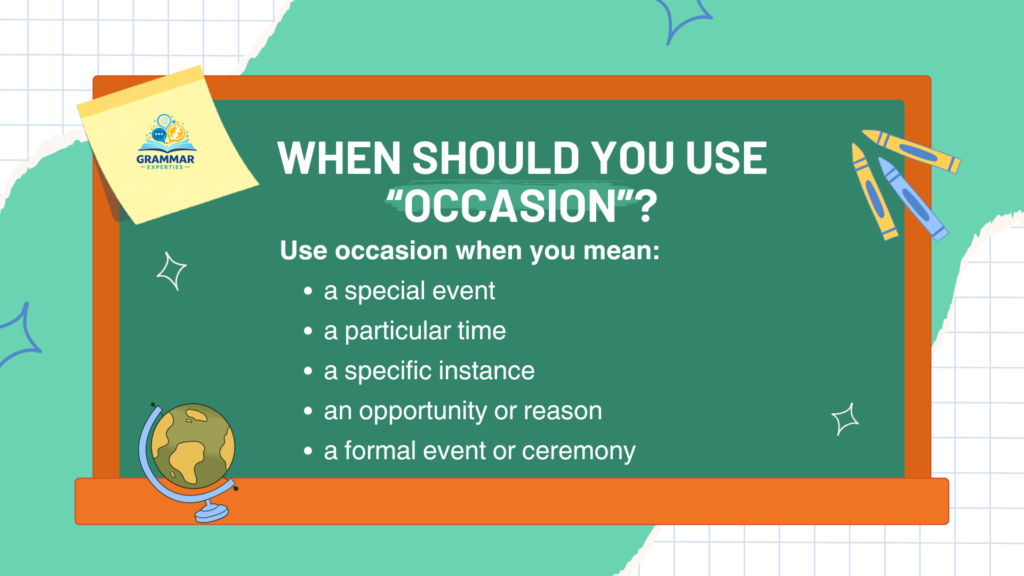
Use occasion when you mean:
- a special event
- a particular time
- a specific instance
- an opportunity or reason
- a formal event or ceremony
For example:
The anniversary was an important occasion.
I have seen her on several occasions.
We usually travel abroad on special occasions.
He used the occasion to thank his colleagues.
She occasionally visits her grandparents.
When Should You Not Use “Occasion”?
Don’t use occasion simply because another word sounds similar in meaning.
For example, if you mean a favorable possibility, opportunity may be the better choice:
The course gave me an opportunity to improve my writing.
If you mean something that happens, occurrence may be more appropriate:
The unusual occurrence surprised the researchers.
And if you mean a specific event, occasion may be ideal:
The ceremony was a memorable occasion.
Choosing the right word depends on the meaning you want to communicate, not just the similarity between words.
Occasion Word Family
Learning related forms can make spelling easier.
Occasion
Noun: a particular time, event, or opportunity.
It was a memorable occasion.
Occasional
Adjective: happening sometimes but not regularly.
We have occasional meetings on Fridays.
Occasionally
Adverb: sometimes, but not often.
I occasionally work late.
Notice the shared spelling:
OCCASION → OCCASIONAL → OCCASIONALLY
The cc remains in each form.
Checklist: How to Avoid the “Ocassion” Mistake
Use this quick checklist whenever you’re unsure about the spelling.
- Does the word begin with occa-?
- Did you use two c’s?
- Did you avoid writing ss in the middle?
- Does the sentence mean an event, particular time, or related idea?
- Have you checked the surrounding sentence for meaning?
- Are related words such as occasional and occasionally spelled correctly?
If you can answer these questions, you’re unlikely to make the occasion vs. ocassion mistake.
Mini Quiz: Occasion or Ocassion
1. Which spelling is correct?
A) Ocassion
B) Occasion
C) Occassion
D) Ocasian
Answer: B) Occasion
2. What is the biggest spelling clue in “occasion”?
A) One C
B) Two C’s
C) Two S’s
D) Two A’s
Answer: B) Two C’s
3. Which sentence is correct?
A) It was a special ocassion.
B) It was a special occassion.
C) It was a special occasion.
D) It was a special ocasian.
Answer: C) It was a special occasion.
4. What does “occasion” commonly mean?
A) A special event
B) A spelling error
C) A pronunciation
D) A grammar rule
Answer: A) A special event
5. Fill in the blank: “Her wedding was a memorable ____.”
A) ocassion
B) occasion
C) occassion
D) ocasian
Answer: B) occasion
6. Which phrase means “sometimes”?
A) In occasion
B) At occasion
C) On occasion
D) By occasion
Answer: C) On occasion
7. What does “on occasion” mean?
A) Always
B) Never
C) Sometimes
D) Immediately
Answer: C) Sometimes
8. Which word is spelled correctly?
A) Ocassional
B) Occasional
C) Occassional
D) Ocasional
Answer: B) Occasional
9. Which spelling is correct?
A) Ocassionally
B) Occassionally
C) Occasionally
D) Ocasionaly
Answer: C) Occasionally
10. What does “occasionally” mean?
A) Every day
B) Sometimes, but not often
C) Never
D) Continuously
Answer: B) Sometimes, but not often
11. Complete the sentence: “I have met her on several ____.”
A) occasion
B) occasions
C) ocassions
D) occassion
Answer: B) occasions
12. Which is the correct plural of “occasion”?
A) Ocassions
B) Occassions
C) Occasions
D) Ocasion
Answer: C) Occasions
13. How is “occasion” approximately pronounced?
A) OH-kass-on
B) Uh-KAY-zhun
C) OH-see-an
D) ACK-shun
Answer: B) Uh-KAY-zhun
14. Which sentence uses “occasion” to mean a particular time?
A) It was a special occasion.
B) I met him on several occasions.
C) She occasionally visits us.
D) This is an occasional problem.
Answer: B) I met him on several occasions.
15. Which phrase is commonly used for weddings, birthdays, and anniversaries?
A) Special occasion
B) Special opportunity
C) Special occurrence
D) Special occasioning
Answer: A) Special occasion
16. Complete the phrase: “On the ____ of her graduation…”
A) ocassion
B) occasion
C) occassion
D) ocasian
Answer: B) occasion
17. What does “rise to the occasion” mean?
A) Attend a party
B) Handle a situation successfully
C) Arrive late
D) Celebrate a birthday
Answer: B) Handle a situation successfully
18. Which sentence is grammatically and spelling-wise correct?
A) She occasionally visits her grandmother.
B) She ocassionally visits her grandmother.
C) She occassionally visits her grandmother.
D) She ocasionaly visits her grandmother.
Answer: A) She occasionally visits her grandmother.
19. Which word refers more directly to a favorable chance or possibility?
A) Occasion
B) Opportunity
C) Occasional
D) Occasionally
Answer: B) Opportunity
20. Find the spelling mistake: “We bought new clothes for the ocassion.”
A) Bought
B) New
C) Clothes
D) Ocassion
Answer: D) Ocassion
21. Which word is an adjective?
A) Occasion
B) Occasionally
C) Occasional
D) Occasions
Answer: C) Occasional
22. Which word is an adverb?
A) Occasion
B) Occasional
C) Occasionally
D) Occasions
Answer: C) Occasionally
23. Which sentence is best for a formal invitation?
A) Join us on this special ocassion.
B) Join us on this special occasion.
C) Join us on this special occassion.
D) Join us on this special ocasian.
Answer: B) Join us on this special occasion.
24. What is the easiest way to remember the spelling of “occasion”?
A) Remember two S’s
B) Remember two C’s
C) Remove the C’s
D) Add another A
Answer: B) Remember two C’s
25. Final Challenge! Which statement is TRUE?
A) Ocassion is the American spelling.
B) Occasion and ocassion are both correct.
C) Occasion is the correct standard spelling.
D) Ocassion is preferred in formal writing.
Answer: C) Occasion is the correct standard spelling.
Frequently Asked Questions
Q1:Is “occasion” or “ocassion” correct?
Occasion is correct. Ocassion is an incorrect spelling. The standard spelling contains two c’s: O-C-C-A-S-I-O-N.
Q2:Is “ocassion” a real English word?
No. Ocassion is a common misspelling of occasion. Use occasion in standard English writing.
Q3:What is the meaning of occasion?
Occasion can mean a particular time when something happens, a special or formal event, or an opportunity or reason for something to happen.
Q4:How do you spell occasion?
Spell it:
O-C-C-A-S-I-O-N
The easiest part to remember is CC in the middle.
Q5:How do you pronounce occasion?
Occasion is pronounced approximately uh-KAY-zhun. Cambridge gives the pronunciation /əˈkeɪ.ʒən/.
Q6:What is the plural of occasion?
The plural is occasions.
Example:
We met on several occasions.
Q7:What does “on occasion” mean?
On occasion means sometimes or from time to time.
Example:
I eat dessert on occasion.
Cambridge gives the same meaning for this expression.
Q8:What is the difference between occasion and opportunity?
Occasion can mean an event, particular time, or reason for something. Opportunity usually refers to a situation or possibility that allows you to do something.
Final Verdict: Occasion or Ocassion?
If you’re wondering “occasion or ocassion?”, remember one simple rule:
Occasion is correct. Ocassion is incorrect.
The correct spelling is:
OCCASION
It contains two c’s and one s.
Use occasion when talking about a special event, a particular time, an instance, or in some contexts an opportunity or reason. You’ll also see it in common expressions such as special occasion, on occasion, on the occasion of, and rise to the occasion.
Once you remember “two C’s in occasion,” this spelling becomes much easier to get right.
If you’re working on your English spelling and frequently encounter confusing words like this one, keep checking the exact spelling, meaning, pronunciation, and real-world usage rather than relying only on how a word sounds.
For more practical spelling and grammar guides, explore our other confusing-word articles and keep improving your English one word at a time.
Explore more easy grammar lessons and improve your English with Grammar Expertise
References:
1.Cambridge Dictionary — Occasion

Maimoona Mughal is an English grammar enthusiast dedicated to simplifying confusing words, grammar rules, and vocabulary through clear, accurate, and learner-friendly content that helps readers write and communicate with confidence.