Have you ever typed “connecter” and wondered whether it should actually be “connector”? You’re not alone. This spelling can be confusing because both forms look like they could logically come from the verb connect.
The correct spelling in standard modern English is connector. The word connector is a noun used for something that connects two things, such as an electrical component, cable, pipe, device, or even two ideas or groups of people. Cambridge Dictionary lists connector as the standard English noun and gives examples involving electrical equipment, cables, computers, and pipes.
Connecter is sometimes encountered, but it isn’t the standard spelling you should normally choose in edited English.
In this guide, you’ll learn the difference between connector and connecter, what connector means, why the spelling can be confusing, how to use it correctly, and which form is safest for formal writing.
Connector or Connecter: Which One Is Correct?
The short answer is simple:
Connector is the standard and preferred spelling.
Connecter may appear occasionally, but connector is overwhelmingly the safer choice in standard English, especially in professional, academic, technical, and online writing.
Connector is the standard spelling
A connector is something that connects one thing to another.
For example:
- I need a new connector for my charger.
- The cable has a damaged connector.
- This connector joins two sections of pipe.
- The computer has several USB connectors.
- She acted as a connector between the two teams.
Cambridge Dictionary defines connector as a device or part that allows electrical equipment to connect, and it also uses the word for objects that join pipes or similar components.
Is connecter a word?
You may occasionally see connecter in English, particularly in older, specialized, or informal contexts. However, if you’re deciding which spelling to use in normal modern writing, connector is the better choice.
This distinction matters because English does not always form nouns from verbs in exactly the same way.
For example:
- connect → connector
- inspect → inspector
- direct → director
- protect → protector
- collect → collector
So although connecter might look logical, connector is the established spelling used in standard English.
Quick answer
| Word | Standard modern usage | Meaning |
|---|---|---|
| Connector | Yes | Something that connects |
| Connecter | Uncommon/nonstandard in ordinary usage | A person or thing that connects |
| Connect | Yes | To join or link |
| Connection | Yes | A link or relationship |
If you’re writing an email, article, essay, product description, manual, or report, choose connector.
What Does Connector Mean?
The noun connector comes from the verb connect, meaning to join, link, or bring things together.
A connector can be physical or conceptual.
Physical connector
The most common meaning refers to a physical object that joins two things.
For example:
The USB connector fits into the port.
Here, the connector is a physical component that makes a connection possible.
Other examples include:
- electrical connector
- cable connector
- USB connector
- pipe connector
- hose connector
- audio connector
- network connector
- fiber-optic connector
Cambridge’s examples specifically include electrical connectors, computer connectors, cable ends, and connectors used with pipes and hoses.
A person can also be a connector
The word can also describe someone who brings people together.
For example:
Maria is a natural connector who introduces people with similar interests.
In this sense, a connector is a person who creates relationships or helps different groups communicate.
This usage is especially common in business, networking, leadership, and social contexts.
Connector in language and writing
Connector can also refer to a word or expression that links ideas.
For example:
However, therefore, meanwhile, and in addition can function as connectors between ideas.
In language learning, terms such as linking words, transition words, connecting words, and discourse connectors are often used to describe expressions that help organize ideas.
For example:
I wanted to go outside. However, it was raining.
The word however connects the two ideas by showing contrast.
Why Is Connector Spelled With “-or”?
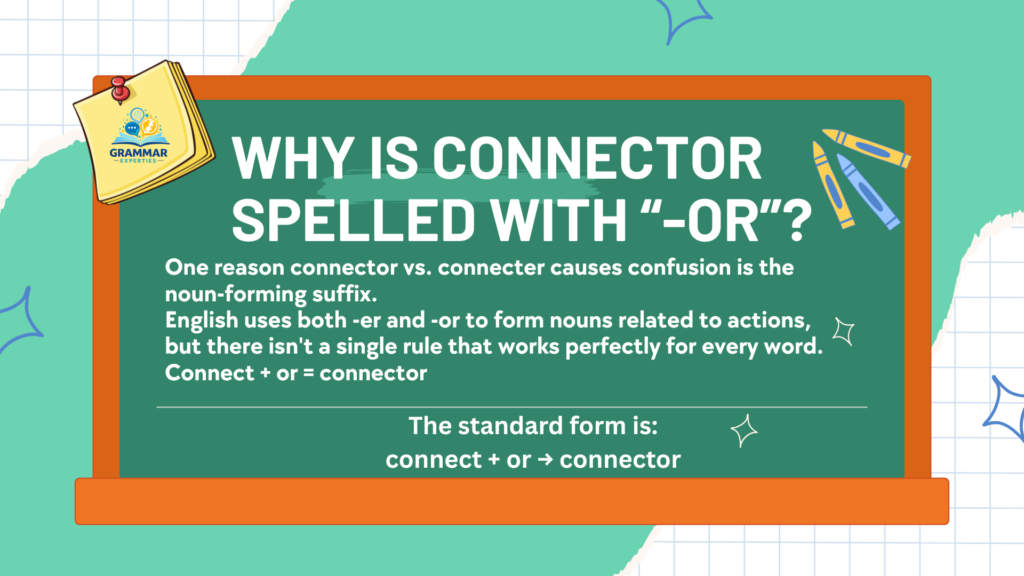
One reason connector vs. connecter causes confusion is the noun-forming suffix.
English uses both -er and -or to form nouns related to actions, but there isn’t a single rule that works perfectly for every word.
Connect + or = connector
The standard form is:
connect + or → connector
The word follows a familiar pattern found in words such as:
- act → actor
- inspect → inspector
- operate → operator
- translate → translator
- educate → educator
- create → creator
- protect → protector
This doesn’t mean every verb ending in a particular pattern must use -or. English spelling has developed through different historical influences, so individual words often need to be learned as established vocabulary.
Why “connecter” looks reasonable
The confusion makes sense.
English commonly forms agent nouns with -er:
- teach → teacher
- drive → driver
- write → writer
- run → runner
- work → worker
Because connect describes an action, someone may naturally assume that connecter should follow the same pattern.
However, standard English has established connector as the usual noun.
Therefore, the fact that connecter looks grammatically possible doesn’t make it the preferred spelling.
Connector vs. Connecter: Examples in Real Sentences
Seeing both spellings side by side makes the difference much easier to remember.
Correct examples with connector
Here are natural examples of connector:
- The technician replaced the damaged connector.
- Make sure the cable connector is firmly attached.
- This adapter includes a USB-C connector.
- We need a pipe connector to join these sections.
- The new device uses a different connector.
- She is a strong connector who brings professionals together.
- Use a transition word as a connector between these ideas.
- The optical connector must remain clean.
- The monitor connector was loose.
- The two teams needed a connector to improve communication.
Examples where connecter should be replaced
If you’re writing standard English, these sentences are better with connector:
Less preferred:
I bought a new connecter for my laptop.
Preferred:
I bought a new connector for my laptop.
Less preferred:
The connecter joins the two cables.
Preferred:
The connector joins the two cables.
Less preferred:
She is an excellent connecter of people.
Preferred:
She is an excellent connector of people.
The practical rule is easy: when you mean something or someone that connects, use connector.
Connector Meaning in Different Contexts
The meaning of connector changes slightly depending on the context, but the central idea remains the same: something that creates a connection.
Technology and electronics
In technology, a connector is a component that allows electrical or electronic devices to connect.
Examples include:
- USB connector
- HDMI connector
- audio connector
- power connector
- Ethernet connector
- electrical connector
Example:
The laptop has a USB-C connector for charging and data transfer.
This is one of the most common modern uses of the word.
Plumbing and construction
A connector can join pipes, tubes, hoses, or other physical components.
For example:
The plumber used a connector to join the two pipes.
Cambridge Dictionary includes this physical meaning and gives examples involving water pipes, taps, hoses, and similar equipment.
Business and networking
In business, a connector can be a person who introduces people and creates professional relationships.
Example:
As a successful industry connector, she knows people across several companies.
Here, connector isn’t referring to a physical object. Instead, it describes someone who links people or opportunities.
Writing and communication
In writing, a connector can link sentences, clauses, or ideas.
Examples include:
- however
- therefore
- furthermore
- meanwhile
- because
- although
- in addition
- for example
For instance:
The product is affordable. However, it isn’t available locally.
Here, however acts as a connecting expression because it creates a relationship between the two statements.
A Simple Case Study: Choosing Connector in Professional Writing
Imagine you’re preparing a product manual for a new electronic device.
The manual contains this sentence:
“Insert the cable into the connecter until it clicks.”
At first glance, connecter may not seem like a serious problem. The reader can probably understand what the sentence means. However, technical documentation depends heavily on consistency and standard terminology.
A professional editor reviewing the manual would normally change the sentence to:
“Insert the cable into the connector until it clicks.”
Why?
Because connector is the established standard noun for the component that joins the cable to another device or port. Major English dictionary references use connector for this meaning.
Now imagine that the same manual uses connecter in 15 different places. The problem becomes more noticeable. Readers may start wondering whether connecter is a special technical term rather than simply an unusual spelling.
The same principle applies to a website article, academic assignment, business proposal, or résumé. Even when a reader understands a misspelled or uncommon form, using the established spelling makes your writing clearer and more professional.
This example also demonstrates an important editing principle: don’t choose a spelling merely because it seems logical. Check how established dictionaries and professional sources use the word.
2025–2026 Usage and Evidence Snapshot
There is an important distinction between verified language evidence and made-up search statistics.
As of 2026, major dictionary references continue to recognize connector as the standard English noun. Cambridge Dictionary provides current definitions and examples for connector, covering electrical equipment, computers, cables, pipes, and hoses.
A useful evidence snapshot is:
- 1 standard spelling: connector
- 2 major physical meanings documented by Cambridge: electrical/electronic connection and pipe/tube connection
- Multiple established contexts: technology, plumbing, networking, and language
- 2025–2026 editorial guidance: Google continues to recommend useful, reliable, people-first content and emphasizes accuracy and clear sourcing.
There isn’t a reliable public 2025–2026 universal percentage showing how often connector versus connecter is typed across every search engine, book, website, and country. Therefore, it would be misleading to invent a percentage.
The stronger evidence for a spelling question is dictionary usage and established written English. Based on that evidence, connector is the clear standard choice.
Connector vs. Connecter: Quick Comparison
| Feature | Connector | Connecter |
| Standard spelling | Yes | Generally no |
| Common in modern English | Yes | Rare |
| Technical writing | Preferred | Avoid |
| Formal writing | Preferred | Avoid |
| Meaning | Something that connects | A possible agent noun, but uncommon |
| Dictionary-standard choice | Connector | Not the usual choice |
| Best choice for SEO content | Connector | Avoid as the main spelling |
The easiest rule to remember
If you’re unsure, use:
Connect → Connector
Not:
Connect → Connecter
That one memory trick will solve most spelling questions involving this word.
Common Mistakes With Connector
Knowing the correct spelling is only part of using the word well.
Mistake 1: Writing connecter
This is the most obvious mistake.
Incorrect or non-preferred:
The connecter is broken.
Correct:
The connector is broken.
Mistake 2: Confusing connector with connection
These words are related but don’t mean exactly the same thing.
A connection is the link or relationship itself.
A connector is something that creates or enables that connection.
Compare:
The internet connection is unstable.
versus:
The cable connector is damaged.
The first describes the link. The second describes the component.
Mistake 3: Confusing connector with adapter
An adapter and a connector can be related, but they’re not always identical.
A connector generally provides the physical or electrical interface between components.
An adapter usually allows components with different interfaces, sizes, standards, or functions to work together.
For example:
I need an adapter to connect this old device to my new computer.
The adapter may contain one or more connectors, but the two terms aren’t automatically interchangeable.
Mistake 4: Assuming every connector is electronic
A connector doesn’t have to involve electricity.
For example:
The plumber installed a pipe connector.
The term can refer to physical components that join pipes, tubes, hoses, and other objects.
How to Remember the Correct Spelling
If connector and connecter keep getting mixed up, use one of these memory techniques.
Think of “or”
Remember:
Connect + OR = CONNECTOR
The final part of the word contains -or.
Connect → Connector
This is a simple visual trick that can make the spelling easier to remember.
Connect it to other “-or” words
You can also group it with familiar words:
- connect → connector
- inspect → inspector
- protect → protector
- direct → director
- operate → operator
This doesn’t create a universal spelling rule, but it helps you remember the established form.
Use the word in context
Instead of memorizing the spelling alone, remember a familiar phrase:
USB connector
cable connector
electrical connector
pipe connector
Once you become familiar with these phrases, connector starts to look natural and connecter begins to look unusual.
Frequently Asked Questions
Q1:Is connector or connecter correct?
Connector is the standard spelling in modern English. Use connector when referring to something that connects electrical equipment, cables, pipes, people, ideas, or other things.
Q2:Is connecter a real word?
Connecter may be encountered occasionally, but it isn’t the standard spelling you should normally use in contemporary formal English. Connector is the safer and established choice.
Q3:What is the plural of connector?
The plural is connectors.
Connecter may be encountered occasionally, but it isn’t the standard spelling you should normally use in contemporary formal English. Connector is the safer and established choice.
Example:
The computer has several different connectors.
Q4:What does connector mean?
A connector is something that joins or links two or more things. It can refer to a physical component, such as a cable connector, or figuratively to a person who brings people together.
Q5:Is connector a noun or a verb?
Connector is a noun.
The related verb is connect.
Example:
Connect the cable to the device.
The cable has a secure connector.
Q6:What is another word for connector?
Depending on context, alternatives can include link, joiner, coupling, adapter, plug, interface, bridge, or intermediary. However, these words aren’t always exact synonyms, so choose according to the specific meaning.
Q7:Is “connector” used in writing and grammar?
Yes. In language and writing, connector can describe words or expressions that connect ideas, sentences, or clauses. Terms such as linking words, transition words, and connecting expressions are also commonly used.
Q8:How do you pronounce connector?
Connector is generally pronounced approximately as kuh-NEK-ter. Cambridge gives UK and US pronunciations for the word.
Mini Quiz: Connecter or Connector
- Quick Check: Which spelling is correct in standard English?
A) Connecter
B) Connector
C) Connecttor
D) Connectar
Answer: B) Connector - Spot the Correct Word:
“I need a new ___ for my laptop cable.”
A) connecter
B) connector
C) connectar
D) connectur
Answer: B) connector - Meaning Match: What does connector generally mean?
A) Something that separates things
B) Something that connects things
C) Something that repairs things
D) Something that measures things
Answer: B) Something that connects things - Grammar Challenge: What part of speech is connector?
A) Verb
B) Adjective
C) Noun
D) Adverb
Answer: C) Noun - Fill the Gap:
“The technician replaced the damaged ___.”
A) connecter
B) connector
Answer: B) connector - Tech Test: Which phrase is correctly spelled?
A) USB connecter
B) USB connector
C) USB connectar
D) USB connecter
Answer: B) USB connector - Memory Trick: Which word should you remember after “connect”?
A) Connecter
B) Connector
C) Connectist
D) Connectingor
Answer: B) Connector - True or False: Connector can refer to a person who brings people together.
A) True
B) False
Answer: A) True - Choose the Better Sentence:
A) She is a natural connecter.
B) She is a natural connector.
C) She is a natural connectar.
D) She is a natural connectator.
Answer: B) She is a natural connector. - Word Family Challenge: Which word is related to connector?
A) Connect
B) Disconnectingness
C) Connectful
D) Connectation
Answer: A) Connect - Which One Doesn’t Belong?
A) Cable connector
B) Pipe connector
C) USB connector
D) Cable connecter
Answer: D) Cable connecter - Writing Wizard: Which word can connect ideas in writing?
A) However
B) Laptop
C) Keyboard
D) Connector cable
Answer: A) However - Context Clue:
“The plumber used a ___ to join the two pipes.”
A) connector
B) connecter
C) connection
D) connecting
Answer: A) connector - Connector vs. Connection: Which sentence uses connection correctly?
A) The cable connection is unstable.
B) The cable connection is broken connector.
C) The connection joins the pipes physically.
D) She is a connection who introduces people.
Answer: A) The cable connection is unstable. - Spelling Trap: Which ending does the standard word connector use?
A) -er
B) -or
C) -ar
D) -ur
Answer: B) -or - Professional Writing Test: Which sentence is best for a technical manual?
A) Insert the cable into the connecter.
B) Insert the cable into the connector.
C) Insert the cable into the connectar.
D) Insert the cable into the connectur.
Answer: B) Insert the cable into the connector. - Plural Power: What is the plural of connector?
A) Connectories
B) Connector’s
C) Connectors
D) Connectorses
Answer: C) Connectors - Synonym Search: Which word can sometimes describe something similar to a connector?
A) Link
B) Divider
C) Opponent
D) Separator
Answer: A) Link - Context Challenge:
“Maria introduces professionals from different industries. She is a great ___.”
A) connection
B) connector
C) connecter
D) connectoring
Answer: B) connector - Which Is Standard?
A) Connector is the preferred modern spelling.
B) Connecter is always the preferred spelling.
C) Both spellings are equally common.
D) Neither word exists.
Answer: A) Connector is the preferred modern spelling. - Don’t Get Tricked! Which sentence is correct?
A) The connecter is loose.
B) The connector is loose.
C) The connectar is loose.
D) The connecter is loose.
Answer: B) The connector is loose. - Grammar Connection: Which term can also describe words that link ideas?
A) Connectors
B) Nouns only
C) Articles
D) Pronouns only
Answer: A) Connectors - Pick the Pair: Which pair is spelled correctly?
A) Connect → Connecter
B) Connect → Connector
C) Connect → Connectar
D) Connect → Connectour
Answer: B) Connect → Connector - Final Spelling Sprint: Complete the phrase:
Connect + ___ = ?
A) -er
B) -or
C) -ar
D) -ur
Answer: B) -or - The Ultimate Challenge: You’re writing a formal article. Which word should you choose?
A) Connecter
B) Connector
C) Both equally
D) Neither
Answer: B) Connector
Final Verdict: Connector or Connecter?
So, connector or connecter which is correct?
The answer is connector.
Although connecter may occasionally appear, connector is the established spelling in standard modern English and is the form you should choose in professional, academic, technical, and everyday writing.
Remember the simple pattern:
Connect → Connector
Use connector when talking about a device that joins components, a part that links pipes or cables, a person who brings people together, or an expression that connects ideas.
When in doubt, don’t rely only on what looks logical. Check established dictionaries and reputable usage sources. Cambridge Dictionary consistently presents connector as the standard noun, while current Google Search guidance also emphasizes accurate, reliable, people-first content rather than content created simply to manipulate rankings.
Now that you know the difference, you can confidently use “connector” in your writing without second-guessing the spelling.
Explore more easy grammar lessons and improve your English with Grammar Expertise
References:
1.Cambridge Dictionary — Connector

Maimoona Mughal is an English grammar enthusiast dedicated to simplifying confusing words, grammar rules, and vocabulary through clear, accurate, and learner-friendly content that helps readers write and communicate with confidence.