Have you ever typed “ballon” when you meant “balloon”? You’re not alone. The two spellings look almost identical, and the missing o is an easy mistake to make.
So, ballon or balloon which spelling is correct? For the ordinary English word referring to an inflatable object, balloon is the correct spelling. It has two consecutive o’s: B-A-L-L-O-O-N.
However, ballon isn’t simply a meaningless spelling error. It exists as a specialized English word in contexts such as ballet, and dictionaries also record ballon as a type of large, rounded brandy glass. That distinction makes the topic more interesting than it first appears.
In this guide, you’ll learn exactly when to use balloon, what ballon means, how to pronounce both words, common mistakes, useful examples, and a simple trick to remember the correct spelling.
Ballon or Balloon: Which Spelling Is Correct?
For everyday English, balloon is the correct spelling when you mean an inflatable object filled with air or gas.
Balloon is the standard spelling
The word balloon is a noun that commonly refers to a thin bag made from rubber or another material that can be inflated. Balloons are often used as decorations, toys, or for scientific and medical purposes. Cambridge Dictionary also lists balloon as a verb meaning to increase rapidly or become larger.
Examples:
- We bought colorful balloons for the birthday party.
- The child released a balloon into the air.
- The company’s expenses began to balloon unexpectedly.
- A hot-air balloon flew over the valley.
The important spelling detail is the double o:
B-A-L-L-O-O-N
Is “ballon” wrong?
It depends on what you mean.
If you’re talking about a party decoration, inflatable toy, hot-air balloon, or something that rapidly increases, ballon is not the standard spelling. You should write balloon.
However, ballon is a legitimate word in specialized contexts. Cambridge Dictionary defines it as a large, round glass typically used for drinking brandy. It is also used as a ballet term referring to the lightness or buoyancy of a dancer’s movement.
So:
| Word | Correct? | Main meaning |
|---|---|---|
| balloon | Yes | Inflatable object; also a verb meaning to increase rapidly |
| ballon | Yes, but specialized | Ballet term or large rounded drinking glass |
| ballon for an inflatable party object | No | Use balloon instead |
Quick answer: If you mean the object you blow up at a party, spell it balloon.
What Does “Balloon” Mean?
The word balloon has several meanings, which makes it useful in everyday English, formal writing, and specialized contexts.
Balloon as a noun
As a noun, a balloon is generally an inflatable object that becomes larger when filled with air or gas.
For example:
The children played with balloons in the garden.
The word can also describe a much larger object designed to rise into the air. A hot-air balloon, for example, carries people in a basket beneath the inflated envelope. Oxford traces the English word to French ballon or Italian ballone, meaning a large ball.
Other common expressions include:
- helium balloon
- weather balloon
- hot-air balloon
- balloon animal
- balloon ride
- balloon decoration
- speech balloon
Balloon as a verb
Balloon can also function as a verb.
When something balloons, it increases rapidly in size, amount, cost, or importance. Cambridge gives this meaning as “to quickly increase in size, weight, or importance.”
Examples:
- The project’s budget ballooned after several delays.
- Online orders ballooned during the holiday season.
- The rumor ballooned into a major controversy.
- Medical costs can balloon unexpectedly.
Notice that the meaning has moved beyond physical balloons. The verb uses the image of something expanding quickly.
Balloon in figurative expressions
English frequently uses balloon figuratively.
For example:
The company’s expenses ballooned within a year.
Here, nobody is inflating an actual rubber object. The sentence means that expenses increased rapidly.
Another familiar expression is:
My suggestion went down like a lead balloon.
This means the suggestion was received very badly or was unsuccessful. Oxford lists this as an informal idiom.
What Does “Ballon” Mean?
The spelling ballon does exist, but its meanings are much narrower than those of balloon.
Ballon as a ballet term
In ballet, ballon refers to the quality of lightness or buoyancy that makes a dancer appear to float or remain suspended during a jump.
Merriam-Webster records ballon as a noun meaning the lightness of movement that can make a ballet dancer’s jump appear to last longer. Its first known use in this sense dates to 1828.
Example:
The dancer demonstrated remarkable ballon during the performance.
This is not a spelling mistake. In a ballet discussion, ballon can be exactly the word you need.
Ballon as a type of glass
Cambridge Dictionary also records ballon as a noun for a large, rounded glass, usually used for drinking brandy.
Example:
He ordered a brandy in a large ballon.
Again, the spelling is intentional.
Therefore, it’s important not to say that ballon is always wrong. The better rule is:
Use “balloon” for the common inflatable object and related meanings; use “ballon” only when the specialized meaning calls for it.
How to Spell Balloon Correctly
If you frequently forget whether balloon has one or two o’s, a simple spelling trick can help.
Remember the two O’s
The correct spelling is:
B A L L O O N
Think of the two O’s as two round balloons sitting next to each other:
BALL + OO + N = BALLOON
This visual association makes the spelling easier to remember.
Don’t confuse “ballon” with “balloon”
A common mistake is writing:
❌ We bought ten ballons.
The correct version is:
✅ We bought ten balloons.
The plural is formed by adding -s to balloon:
balloon → balloons
The double o remains.
Other forms include:
- balloon
- balloons
- ballooned
- ballooning
Oxford lists ballooned as the past tense and ballooning as the -ing form.
A quick spelling test
Ask yourself:
“Am I talking about something that can be inflated?”
If the answer is yes, you almost certainly need:
BALLOON
For example:
- a birthday balloon
- a helium balloon
- a weather balloon
- a hot-air balloon
If you’re discussing ballet technique, however, ballon may be the specialized term.
Balloon vs. Ballon: Examples and Usage
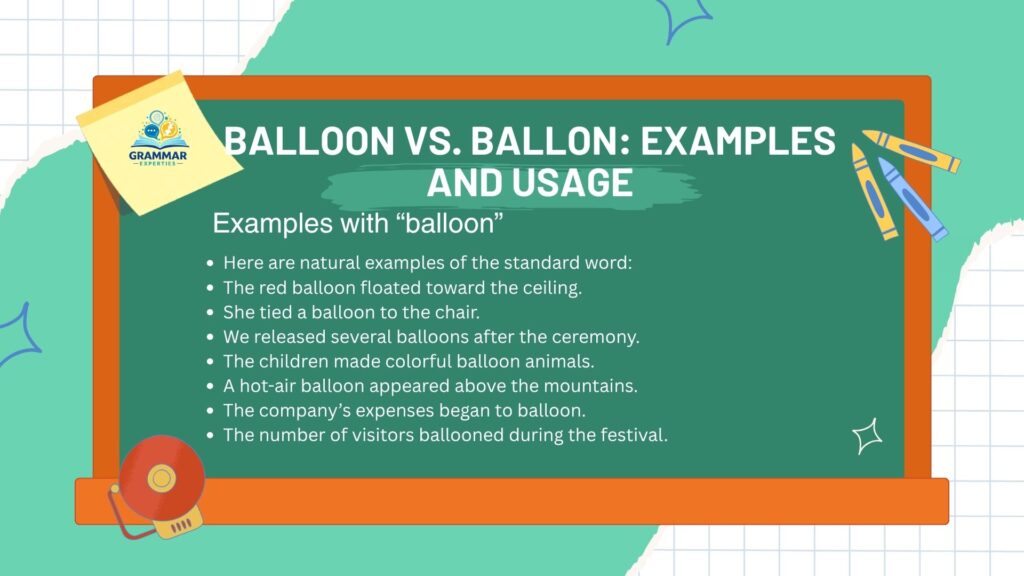
Seeing the two words in context is one of the easiest ways to understand the difference.
Examples with “balloon”
Here are natural examples of the standard word:
- The red balloon floated toward the ceiling.
- She tied a balloon to the chair.
- We released several balloons after the ceremony.
- The children made colorful balloon animals.
- A hot-air balloon appeared above the mountains.
- The company’s expenses began to balloon.
- The number of visitors ballooned during the festival.
Examples with “ballon”
Here are examples where the specialized spelling is appropriate:
- The dancer displayed excellent ballon during her jumps.
- His ballet technique helped create a strong sense of ballon.
- The waiter served the brandy in a large ballon glass.
These examples show why context matters.
Common sentences corrected
Incorrect for the inflatable object:
❌ She bought a red ballon for the party.
Correct:
✅ She bought a red balloon for the party.
Incorrect:
❌ The children released ten ballons.
Correct:
✅ The children released ten balloons.
Correct specialized use:
✅ The ballet dancer had impressive ballon.
The last sentence is different because it uses the specialized ballet term.
A Simple Balloon vs. Ballon Comparison Guide
Understanding the difference becomes much easier when you compare the words directly.
Side-by-side comparison
| Feature | Balloon | Ballon |
|---|---|---|
| Standard everyday English | Yes | No |
| Inflatable party object | Yes | No |
| Hot-air flying object | Yes | No |
| Verb meaning “increase rapidly” | Yes | No |
| Ballet terminology | No | Yes |
| Rounded brandy glass | No | Yes |
| Common spelling mistake | Frequently misspelled as “ballon” | Sometimes used incorrectly instead of “balloon” |
Which word should you choose?
Use this simple guide:
- Party decoration? → balloon
- Helium-filled object? → balloon
- Hot-air flying object? → balloon
- Something increasing rapidly? → balloon
- Ballet quality of lightness? → ballon
- Specialized rounded brandy glass? → ballon
This distinction prevents most spelling errors.
Why Do People Spell Balloon as “Ballon”?
The spelling mistake is understandable because the pronunciation doesn’t clearly reveal the second o.
Pronunciation doesn’t show the spelling
Both Cambridge and Oxford give balloon the pronunciation approximately /bəˈluːn/.
When you hear the word, you hear something like:
buh-LOON
You don’t hear two separate “o” sounds. As a result, someone may naturally spell it ballon.
English has many words where pronunciation doesn’t provide enough information to reconstruct the spelling perfectly.
The double-o pattern helps
The safest approach is visual memory:
balloon = two o’s
You can picture the two o’s as two inflated balloons:
BALL OO N
That small memory trick can make the correct spelling much easier to recall.
Real-life example: a student correcting “ballon”
Imagine a student writing a school assignment about a science experiment involving a weather balloon.
The student writes:
“The ballon rose high into the atmosphere.”
At first glance, the sentence looks perfectly understandable. However, in standard English, the spelling should be:
“The balloon rose high into the atmosphere.”
The student isn’t confused about the object or the meaning. The mistake is purely orthographic—the word has been written with one o instead of two.
Now imagine the same student encounters a ballet article containing the sentence:
“The dancer’s ballon was remarkable.”
Here, correcting ballon to balloon would actually create a different word and change the meaning. In ballet terminology, ballon is a legitimate specialized noun.
This example highlights an important lesson in English spelling: context matters. A word that looks like a misspelling may occasionally be a real word with a specialized meaning. For ordinary writing about inflatable objects, though, balloon is the form you should use.
Balloon Spelling and Usage Data: What the Current Evidence Shows
What current dictionary evidence tells us
As of 2026, major English dictionaries continue to recognize balloon as the standard word for the inflatable object and related meanings. Cambridge describes balloon as both a noun and a verb, while Oxford documents its noun and verb uses and its historical origin.
There is also a useful historical distinction. Merriam-Webster gives 1783 as the first known use of balloon as a noun, while its entry for the specialized ballet word ballon gives 1828 as its first known use in that sense.
That means the two spellings are not simply “correct versus nonexistent.” They developed into different English words and uses.
A useful 2025–2026 dictionary check
Current editions and pages provide several concrete reference points:
- 2026: Oxford’s online entry continues to list balloon as a noun and verb, with forms such as balloons, ballooned, and ballooning.
- 2026: Merriam-Webster continues to list balloon and gives 1783 as its first known use.
- 2026: Merriam-Webster lists ballon as a specialized ballet noun and gives 1828 as its first known use.
- 2026: Cambridge continues to distinguish balloon from the separate dictionary entry ballon.
These dictionary records are more useful for this spelling question than inventing a percentage of “people who misspell balloon.” Reliable public sources do not provide a universal 2025–2026 statistic showing exactly how many writers make this particular spelling error.
Common Mistakes With Balloon and Ballon
Mistake 1: Writing “ballon” for a party decoration
❌ We need more ballons for the birthday.
✅ We need more balloons for the birthday.
Remember the two o’s.
Mistake 2: Removing an “o” in the plural
Some writers remember balloon correctly but accidentally write:
❌ balloons → ballons
The correct plural is:
✅ balloons
The spelling remains balloon before adding -s.
Mistake 3: Assuming “ballon” is never a word
This is the opposite mistake.
In a ballet context, ballon can be correct. Merriam-Webster defines it as a quality of lightness in a dancer’s movement, and Cambridge also recognizes specialized uses.
So don’t automatically “correct” every instance of ballon.
Mistake 4: Confusing pronunciation with spelling
Because balloon is pronounced with a long “oo” sound, some writers may not remember that the written form contains oo.
Pronunciation:
buh-LOON
Spelling:
B-A-L-L-O-O-N
The sound can help you recognize the word, but visual memory is more useful for spelling it.
Mini Quiz: Ballon or Balloon
- 🎈 The Spelling Showdown: Which spelling is correct for the inflatable party object?
A) Ballon
B) Balloon
C) Baloon
D) Ballun
Answer: B) Balloon - Double-O Challenge: What makes the spelling of “balloon” easy to remember?
A) Double L
B) Double A
C) Double O
D) Double N
Answer: C) Double O - Party Time: Choose the correct sentence.
A) She bought five ballons.
B) She bought five ballon.
C) She bought five balloons.
D) She bought five baloons.
Answer: C) She bought five balloons. - Fill the Gap: The children released a red ______ into the sky.
A) ballon
B) balloon
C) baloon
D) ballun
Answer: B) balloon - Meaning Match: What does “balloon” usually refer to?
A) A type of shoe
B) An inflatable object
C) A musical instrument
D) A kitchen tool
Answer: B) An inflatable object - Tricky Twin: Which word can be a specialized ballet term?
A) Balloon
B) Ballon
C) Baloon
D) Balluun
Answer: B) Ballon - Grammar Twist: Which sentence uses “balloon” as a verb?
A) The balloon is blue.
B) She held a balloon.
C) Costs began to balloon.
D) The balloon popped.
Answer: C) Costs began to balloon. - Plural Power: What is the correct plural of “balloon”?
A) Ballons
B) Balloen
C) Balloons
D) Balloones
Answer: C) Balloons - Spelling Detective: Which sentence contains the spelling mistake?
A) The balloon floated away.
B) We decorated the room with balloons.
C) He released a ballon.
D) The hot-air balloon was beautiful.
Answer: C) He released a ballon. - Sky High: Which phrase is correctly spelled?
A) Hot-air ballon
B) Hot-air baloon
C) Hot-air balloon
D) Hot-air ballun
Answer: C) Hot-air balloon - Two O’s or Not Two O’s? Complete the word: B A L L _ _ N
A) AA
B) EE
C) OO
D) UU
Answer: C) OO - Context Clue: Which word belongs in this sentence? “The dancer showed impressive ______ during her jumps.”
A) balloon
B) ballon
C) baloon
D) ballun
Answer: B) ballon - Spot the Correct One: Which spelling is standard English for an inflatable object?
A) Ballun
B) Baloon
C) Ballon
D) Balloon
Answer: D) Balloon - Vocabulary Voyage: What can “balloon” mean as a verb?
A) To disappear suddenly
B) To increase rapidly
C) To move silently
D) To become smaller
Answer: B) To increase rapidly - Sentence Saver: Which sentence is correctly written?
A) The company’s costs began to ballon.
B) The company’s costs began to baloon.
C) The company’s costs began to balloon.
D) The company’s costs began to ballun.
Answer: C) The company’s costs began to balloon. - Ballet Brain-Teaser: In ballet terminology, what can “ballon” describe?
A) A dancer’s lightness or buoyancy
B) A dancer’s costume
C) A ballet stage
D) A musical instrument
Answer: A) A dancer’s lightness or buoyancy - Quick Correction: Correct this sentence: “We need more ballons for the party.”
A) We need more ballon for the party.
B) We need more balloons for the party.
C) We need more baloons for the party.
D) We need more balluns for the party.
Answer: B) We need more balloons for the party. - Pronunciation Puzzle: Which word is pronounced approximately “buh-LOON”?
A) Ballon
B) Balloon
C) Balun
D) Ballun
Answer: B) Balloon - Meaning Matters: Which sentence uses “balloon” in a figurative sense?
A) The balloon popped.
B) She held a yellow balloon.
C) The balloon floated upward.
D) The project’s costs ballooned.
Answer: D) The project’s costs ballooned. - Grammar Grab: Which form is the correct past tense of “balloon”?
A) Balloned
B) Ballooned
C) Balloond
D) Balluned
Answer: B) Ballooned - Choose Your Balloon: Which sentence is correct?
A) A weather ballon was launched.
B) A weather baloon was launched.
C) A weather balloon was launched.
D) A weather ballun was launched.
Answer: C) A weather balloon was launched. - The Specialist: Which spelling may be correct when discussing a ballet dancer’s lightness in jumping?
A) Balloon
B) Ballon
C) Baloon
D) Ballun
Answer: B) Ballon - Memory Master: Which memory trick best helps you spell “balloon”?
A) Remember the double A
B) Remember the double E
C) Remember the double O
D) Remember the double N
Answer: C) Remember the double O - Final Spelling Battle: Which option contains the correctly spelled words?
A) Balloon, balloons, ballooned
B) Ballon, ballons, balloned
C) Baloon, baloons, balooned
D) Ballun, balluns, balluned
Answer: A) Balloon, balloons, ballooned - 🏆 The Ultimate Challenge: Complete the sentence correctly: “The number of visitors began to ______ rapidly.”
A) ballon
B) baloon
C) balloon
D) ballun
Answer: C) balloon
Frequently Asked Questions About Ballon vs. Balloon
Q1:Is “ballon” a correct spelling?
Yes, ballon is a real English word in specialized contexts. It can refer to a ballet term describing a dancer’s lightness or buoyancy, and Cambridge also lists it as a type of large rounded drinking glass.
Q2:Is “balloon” the correct spelling for an inflatable object?
Yes. Balloon is the standard spelling for an inflatable object filled with air or gas.
For example:
She carried a red balloon.
Q3:How do you spell balloon correctly?
Spell it:
B-A-L-L-O-O-N
The easiest trick is to remember the two o’s in the middle:
BALL + OO + N
Q4:What is the plural of balloon?
The plural is balloons.
Example:
The room was decorated with colorful balloons.
The double o stays in the plural.
Q5:What is the difference between ballon and balloon?
Balloon is the standard everyday word for an inflatable object and can also be a verb meaning to increase rapidly. Ballon is a specialized word used in contexts such as ballet and, in dictionary usage, a type of rounded drinking glass.
Q6:Is “ballon” a common spelling mistake?
Yes, ballon can occur as a misspelling of balloon, especially because the second o is not obvious from pronunciation. However, ballon is also a legitimate specialized word, so context determines whether it is an error.
Q7:Is balloon a noun or a verb?
It can be both.
As a noun:
The balloon floated away.
As a verb:
Costs began to balloon.
Cambridge and Oxford both document these uses.
Q8:Does British English spell it “ballon”?
No. The ordinary word is balloon in both British and American English. Cambridge gives the same basic spelling and pronunciation for both varieties.
Final Verdict: Ballon or Balloon?
If you’re asking about the colorful object you inflate for a birthday party, the answer is simple: balloon is the correct spelling.
Remember:
Balloon = inflatable object, rapid increase, hot-air balloon, helium balloon
Ballon = specialized word, especially in ballet or certain dictionary-defined contexts
The best spelling trick is to remember the two o’s:
BALL + OO + N = BALLOON
So the next time you’re writing about a party decoration, weather balloon, helium balloon, or something that suddenly increases, choose balloon.
If you’re interested in improving your English spelling and avoiding confusing-word mistakes, keep exploring practical grammar and spelling guides that explain not only which word is correct, but also why.
Explore more easy grammar lessons and improve your English with Grammar Expertise
References

Maimoona Mughal is an English grammar enthusiast dedicated to simplifying confusing words, grammar rules, and vocabulary through clear, accurate, and learner-friendly content that helps readers write and communicate with confidence.