
Introduction
Have you ever typed contractor and suddenly wondered, “Wait is it contractor or contracter?” You’re not alone. The two forms look almost identical, and the ending can easily cause confusion.
The answer is simple: contractor is the correct spelling. Contracter is a common misspelling and should generally be avoided in standard English.
The correct word, contractor, is a noun for a person or business that agrees to perform work or provide services under a contract. It can describe someone working in construction, IT, consulting, engineering, design, or many other fields.
In this guide, you’ll learn the difference between contractor or contracter, what contractor means, why the spelling uses -or, how to use it in sentences, and how to remember the correct form.
Contractor or Contracter: Which Spelling Is Correct?
If you’re choosing between the two spellings, there’s no need to hesitate: contractor is correct.
Contracter is not the standard spelling of the noun. In ordinary English writing, use contractor when referring to a person or company that performs work under an agreement.
Merriam-Webster defines a contractor as someone who contracts to perform work or provide supplies. Its examples also show contractor being used in construction and other professional contexts.
Contractor Is the Correct Word
The correct spelling is:
Contractor ✅
The word contains -or near the end:
contract + or = contractor
For example:
- We hired a contractor to remodel the kitchen.
- The contractor submitted a project proposal.
- She works as an independent contractor.
- The government awarded the project to a construction contractor.
Contracter Is a Misspelling
The incorrect form is:
Contracter ❌
You may see contracter online, but seeing a spelling repeatedly doesn’t make it standard English.
For example:
❌ We hired a contracter to repair the roof.
✅ We hired a contractor to repair the roof.
❌ The contracter submitted the estimate yesterday.
✅ The contractor submitted the estimate yesterday.
Quick Answer
| Word | Correct? | Meaning |
|---|---|---|
| Contractor | ✅ Yes | A person or company performing work under a contract |
| Contracter | ❌ No | Common misspelling of contractor |
Easy rule: When you mean someone who works under a contract, spell it contractor.
What Does Contractor Mean?
The noun contractor refers to a person or business that agrees to perform work, provide services, or supply something under a contract.
The word isn’t limited to construction. Although you may commonly hear contractor when discussing builders and renovation projects, the term also appears in technology, consulting, government work, engineering, and other industries.
Contractor Definition in Simple English
In simple terms:
A contractor is a person or company hired to complete specific work under an agreement.
For example, imagine that you want to renovate your kitchen. You hire a professional to manage the work. That person may be your contractor.
Likewise, a company might hire an IT professional for a six-month project. That professional may work as an independent contractor rather than as a regular employee.
Common Types of Contractors
Here are some common expressions:
General contractor: A person or company responsible for managing a construction project, often coordinating subcontractors.
Independent contractor: A self-employed person who provides services independently rather than working as a traditional employee.
Subcontractor: A person or business hired by another contractor to perform part of a larger contract.
Government contractor: A company or individual that provides goods or services to a government organization.
For example:
The general contractor hired an electrician to handle the wiring.
In this sentence, the electrician may be a subcontractor working under the larger project.
Contractor vs. Contract
These two words are related, but they don’t mean the same thing.
A contract is an agreement.
A contractor is a person or business that performs work under that agreement.
For example:
The company signed a contract with the contractor.
Here, contract refers to the agreement, while contractor refers to the party doing the work.
Why Is Contractor Spelled With “-or”?
One reason people write contracter is that English frequently forms nouns with -er.
Think about:
- teach → teacher
- write → writer
- drive → driver
- build → builder
It’s understandable, therefore, to assume that contract should become contracter. However, English doesn’t always follow one simple suffix rule.
Contractor Uses the “-or” Ending
The standard noun is contractor, not contracter.
The -or ending appears in many English words that entered the language through Latin and French patterns, including words such as:
- actor
- editor
- creator
- director
- operator
- instructor
- contractor
This doesn’t mean every word referring to a person must end in -or. English has many exceptions. The important point is that contractor is the established standard form.
A Simple Memory Trick
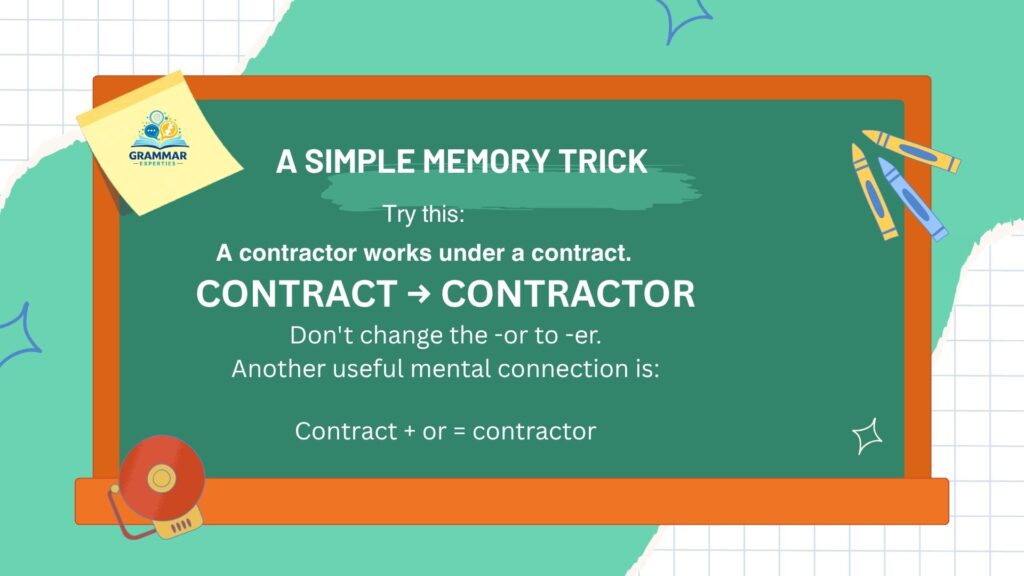
Try this:
A contractor works under a contract.
Both contract and contractor begin with the same base:
CONTRACT → CONTRACTOR
Don’t change the -or to -er.
Another useful mental connection is:
Contract + or = contractor
That simple association can help you remember the spelling when you’re writing quickly.
Contractor or Contracter in Grammar
From a grammatical perspective, contractor is a countable noun.
You can use singular and plural forms:
- one contractor
- two contractors
- several contractors
- the contractor
- a contractor
Examples:
We hired a contractor.
The company works with several contractors.
The plural is formed normally by adding -s:
contractor → contractors
How to Use Contractor Correctly in a Sentence
Knowing the spelling is only half the job. You also need to know how the word works in real sentences.
Because contractor is a noun, it usually refers to the person or company performing the contracted work.
Everyday Examples
Here are natural examples:
- We hired a contractor to paint the house.
- The contractor gave us a detailed estimate.
- Our contractor finished the renovation ahead of schedule.
- She works as an independent contractor.
- The company is looking for an experienced IT contractor.
- The government selected a contractor for the project.
- The contractor provided the necessary materials.
- We need to speak with the building contractor.
- The project manager contacted the contractor yesterday.
- Several contractors submitted bids.
Contractor in Professional Writing
The word is especially common in business and professional communication.
For example:
Please send the revised proposal to the contractor before Friday.
Or:
The contractor is responsible for completing the installation according to the agreed specifications.
In a resume, you might write:
Independent Contractor — Web Development
Designed and maintained websites for small businesses.
Contractor in Construction
Construction is one of the most familiar contexts for contractor.
For example:
We hired a licensed contractor to renovate our bathroom.
Other common phrases include:
- building contractor
- electrical contractor
- roofing contractor
- plumbing contractor
- general contractor
- construction contractor
- residential contractor
The U.S. Bureau of Labor Statistics also tracks specialty trade contractors as a major part of the construction industry. Its current industry data show more than 5.2 million employees in specialty trade contractors in May 2026.
Contractor vs Contracter: Comparison Table
| Feature | Contractor | Contracter |
| Spelling | ✅ Correct | ❌ Incorrect |
| Standard English | Yes | No |
| Part of speech | Noun | Not standard |
| Meaning | Person or company performing contracted work | No standard meaning |
| Professional writing | Appropriate | Avoid |
| Business documents | Appropriate | Avoid |
| Construction context | Common | Incorrect |
| Plural | Contractors | Not applicable |
The distinction is straightforward: contractor is the established English word, while contracter is a misspelling.
Real-Life Case Study: Choosing the Correct Word in a Business Email
Imagine a small business owner is renovating a new office. She needs to contact the person managing the renovation, so she writes an email:
“Hello, we would like to confirm when the contracter will begin the work.”
The meaning is understandable, but the spelling immediately creates a problem. The professional form should be:
“Hello, we would like to confirm when the contractor will begin the work.”
Now imagine that the same misspelling appears repeatedly in the project proposal, invoices, email correspondence, and internal documents. Each individual mistake may seem minor, but repeated errors can make business communication look careless.
The better approach is to establish the correct spelling at the beginning: contractor.
This matters even more in professional documents because words such as contractor, contract, subcontractor, and client can appear many times. A simple spelling check before sending a proposal or agreement can prevent the same error from appearing throughout an entire document.
The lesson is useful beyond construction. An IT freelancer, marketing consultant, designer, engineer, or other independent professional may also be a contractor. Whenever the person is performing work under a contractual arrangement, contractor is the standard spelling.
2025–2026 Usage and Data: Why the Word Still Matters
The spelling question is linguistic, but the word contractor remains highly relevant in modern professional life.
The U.S. Bureau of Labor Statistics reported 8.3 million construction jobs in the United States at the end of 2025, with specialty trade contractors accounting for roughly 5.25 million jobs.
BLS’s current 2026 specialty-trade-contractor data also list more than 5.26 million employees for May 2026, including workers in occupations such as electricians, plumbers, construction laborers, and carpenters.
Construction activity remains substantial as well. The U.S. Census Bureau continues to publish monthly construction-spending data covering private and public construction, including residential and nonresidential projects. Its May 2026 data provide a current measure of construction activity in the United States.
These figures don’t measure the spelling contractor versus contracter. Instead, they provide useful context: contractor is a widely relevant professional term, especially in construction and skilled trades.
For search behavior, Google explains that Google Trends uses a sample of actual Google searches and normalizes results on a 0–100 scale. Therefore, Trends scores should be treated as relative search interest, not as exact numbers of searches. Google also specifically notes that Trends can be used to compare different spellings of the same term.
That distinction is important when researching spelling questions. A search trend can reveal that people are uncertain about a word, but dictionary evidence not search popularity determines the standard spelling.
Common Mistakes With Contractor
Even after learning the correct spelling, people can make other mistakes with the word.
Mistake 1: Writing Contracter
❌ The contracter will arrive tomorrow.
✅ The contractor will arrive tomorrow.
Remember: contractor ends in -or.
Mistake 2: Confusing Contractor With Contract
❌ We signed a contractor yesterday.
✅ We signed a contract yesterday.
A contract is an agreement.
A contractor is the person or company performing work under an agreement.
Mistake 3: Assuming Contractor Only Means a Builder
A contractor doesn’t necessarily work in construction.
For example:
The company hired an independent software contractor.
Here, the contractor works in technology rather than construction.
Mistake 4: Using Contractor as a Verb
In standard modern English, contractor is normally used as a noun.
For example:
The contractor completed the project.
Don’t confuse it with contract, which can function as a noun or verb depending on context.
How to Remember the Correct Spelling
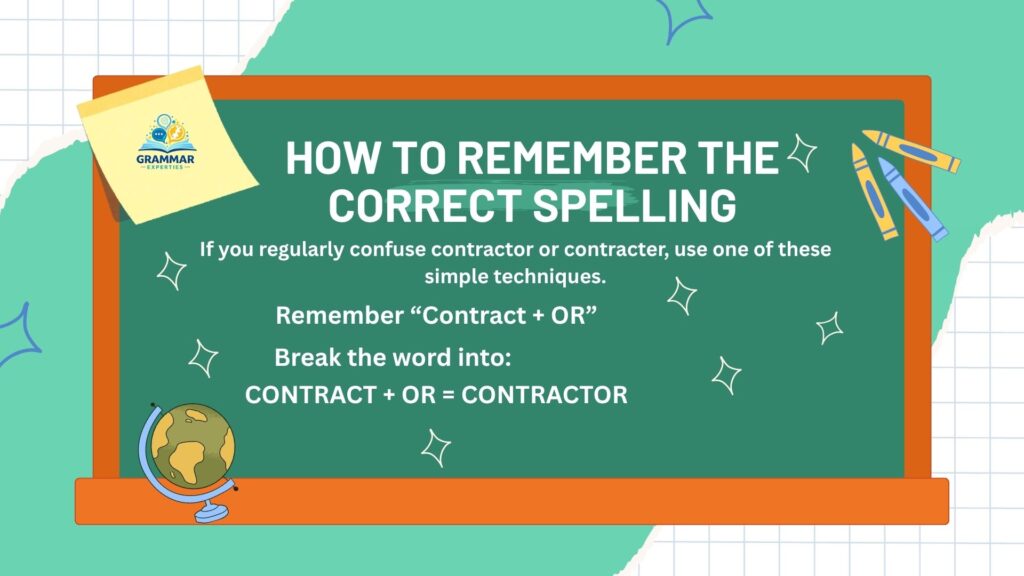
If you regularly confuse contractor or contracter, use one of these simple techniques.
Remember “Contract + OR”
Break the word into:
CONTRACT + OR = CONTRACTOR
The person or company is the one connected to the contract, so keep the or ending.
Connect It With Similar Words
Think of:
- actor
- creator
- director
- operator
- contractor
You don’t need to memorize a complicated grammar rule. Just remember that the standard word is contractor.
Check Before Sending Professional Documents
If you’re writing a:
- resume
- cover letter
- proposal
- business email
- contract
- job advertisement
- website
- invoice
take a moment to check the spelling.
A spelling checker can help, but understanding the correct word yourself is even better.
Mini Quiz: Contractor or Contracter
1. Which spelling is correct?
A. Contracter
B. Contractor
C. Contractir
D. Contractar
Answer: B. Contractor
2. Complete the sentence: “We hired a _____ to renovate the kitchen.”
A. Contracter
B. Contractar
C. Contractor
D. Contractir
Answer: C. Contractor
3. What does a contractor typically do?
A. Writes dictionaries
B. Performs work under a contract
C. Creates grammar rules
D. Signs every document
Answer: B. Performs work under a contract
4. Which word is the common misspelling?
A. Contractor
B. Contractors
C. Contracter
D. Contractual
Answer: C. Contracter
5. What is the easiest way to remember “contractor”?
A. Contract + er
B. Contract + or
C. Contact + er
D. Contract + ar
Answer: B. Contract + or
6. Which sentence is correct?
A. The contracter finished the job.
B. The contractor finished the job.
C. The contractir finished the job.
D. The contractar finished the job.
Answer: B. The contractor finished the job.
7. What is the plural of “contractor”?
A. Contracters
B. Contractor’s
C. Contractors
D. Contractorses
Answer: C. Contractors
8. Which word refers to an agreement?
A. Contractor
B. Contract
C. Contracter
D. Contracting
Answer: B. Contract
9. Which sentence uses “contractor” correctly?
A. We signed a contractor yesterday.
B. The contractor repaired the roof.
C. The contractor is a document.
D. She contractor the agreement.
Answer: B. The contractor repaired the roof.
10. Which type of contractor commonly manages a construction project?
A. General contractor
B. Grammar contractor
C. Sentence contractor
D. Document contractor
Answer: A. General contractor
11. Spot the spelling mistake:
A. The contractor submitted a proposal.
B. Several contractors attended the meeting.
C. The contracter called this morning.
D. Our contractor completed the work.
Answer: C. Contracter
12. What part of speech is “contractor”?
A. Noun
B. Verb
C. Adverb
D. Preposition
Answer: A. Noun
13. Which sentence has the correct plural?
A. Three contracter submitted bids.
B. Three contractor submitted bids.
C. Three contractors submitted bids.
D. Three contractars submitted bids.
Answer: C. Three contractors submitted bids.
14. Is “contractor” used only in construction?
A. Yes
B. No
C. Only in the US
D. Only in business
Answer: B. No
15. Which professional could be an independent contractor?
A. A freelance web developer
B. A dictionary
C. A contract document
D. A building
Answer: A. A freelance web developer
16. Choose the correct sentence:
A. We contacted the contracter.
B. We contacted the contractor.
C. We contacted the contractir.
D. We contacted the contractar.
Answer: B. We contacted the contractor.
17. What does “independent contractor” generally describe?
A. A self-employed professional providing services independently
B. A company policy
C. A signed agreement
D. A government document
Answer: A. A self-employed professional providing services independently
18. What is a subcontractor?
A. Someone hired to perform part of a larger project
B. A person who writes contracts
C. A type of contract
D. A project invoice
Answer: A. Someone hired to perform part of a larger project
19. Which spelling belongs in a formal business email?
A. Contracter
B. Contractar
C. Contractor
D. Contractir
Answer: C. Contractor
20. Which statement is TRUE?
A. Contracter is the preferred spelling.
B. Contractor is the standard spelling.
C. Both spellings are equally standard.
D. Contractor is only used as a verb.
Answer: B. Contractor is the standard spelling.
21. Fill in the blank: “The company hired an IT _____ for six months.”
A. Contracter
B. Contractor
C. Contractar
D. Contractir
Answer: B. Contractor
22. Which pair correctly shows the relationship?
A. Contract = person; contractor = agreement
B. Contract = agreement; contractor = person or company
C. Contract = employee; contractor = salary
D. Contract = project; contractor = invoice
Answer: B. Contract = agreement; contractor = person or company
23. Why might people accidentally write “contracter”?
A. They may assume the word follows the common “-er” pattern.
B. It is the official British spelling.
C. It is the plural form.
D. It is an abbreviation.
Answer: A. They may assume the word follows the common “-er” pattern.
24. Which sentence is completely correct?
A. The contracter gave us an estimate.
B. The contractor gave us an estimate.
C. The contractar gave us an estimate.
D. The contractir gave us an estimate.
Answer: B. The contractor gave us an estimate.
25. Final Challenge: Complete the memory rule!
Contract + _____ = Contractor
A. er
B. ar
C. ir
D. or
Answer: D. or
Frequently Asked Questions
Q1:Is contractor or contracter correct?
Contractor is correct. Contracter is a common misspelling and isn’t the standard form used in professional English.
Q2:Is “contracter” a real word?
In standard English, contracter is not the accepted spelling for a person or business that performs work under a contract. Use contractor instead.
Q3:What does contractor mean?
A contractor is a person or company that agrees to perform work, provide services, or supply materials under a contract.
Q4:How do you spell contractor correctly?
Spell it C-O-N-T-R-A-C-T-O-R: contractor.
A useful memory aid is:
contract + or = contractor
Q5:Why do people spell contractor as contracter?
The mistake probably comes from English’s frequent use of the -er ending for people who perform an action, such as teacher, writer, and builder. However, the established word is contractor, with -or.
Q6:Is contractor used in British and American English?
Yes. Contractor is standard in both British and American English. The spelling does not normally change between these varieties.
Q7:What is the difference between a contractor and a subcontractor?
A contractor may be responsible for a whole project or particular contractual work. A subcontractor is generally hired by another contractor to perform part of that work.
Merriam-Webster defines a subcontractor as an individual or business that contracts to perform part or all of another party’s contract.
Q8:What is the plural of contractor?
The plural is contractors.
Example:
The company interviewed three contractors for the project.
Quick Reference Checklist
Before using the word, remember:
- Contractor is the correct spelling.
- Contracter is a misspelling.
- Contractor is a noun.
- It can refer to a person or company.
- It can be used in construction, IT, consulting, government, and other industries.
- The plural is contractors.
- A contract is an agreement; a contractor performs work under an agreement.
- Use contractor in formal and professional writing.
Conclusion
So, contractor or contracter Which spelling is correct? The answer is clear: contractor is the correct spelling.
A contractor is a person or business that performs work or provides services under a contract. The word is widely used in construction, technology, consulting, government work, freelancing, and many other professional settings.
Contracter is simply a common spelling mistake. When you’re writing an email, resume, proposal, business document, or article, choose contractor.
The easiest way to remember it is:
Contract + or = contractor.
Save that simple rule, and you’ll be much less likely to make the mistake again.
If you’re building stronger English vocabulary, keep checking confusing word pairs like this one. Learning the correct spelling, meaning, and real-world usage together is one of the best ways to make your writing clearer and more professional.
Explore more easy grammar lessons and improve your English with Grammar Expertise
References

Maimoona Mughal is an English grammar enthusiast dedicated to simplifying confusing words, grammar rules, and vocabulary through clear, accurate, and learner-friendly content that helps readers write and communicate with confidence.
To the http://grammarexpertise.com/fekal0911 Admin