Have you ever typed “layed” and wondered if it should actually be “laid”? You’re not alone. The words look almost identical, and English has plenty of verbs that form the past tense by adding -ed, so “layed” can seem perfectly logical.
However, laid is the correct standard spelling when it is the past tense or past participle of lay. “Layed” is not the standard modern form. The confusion becomes even greater because lay, lie, laid, and lain are closely related but have different grammatical jobs.
The good news is that the rule is easier than it first appears. In this guide, you’ll learn layed vs. laid, what each form means, when to use laid, how lay differs from lie, and how to avoid common mistakes in everyday writing.
Layed or Laid: Which Spelling Is Correct?
The quick answer
Laid is correct. “Layed” is incorrect in standard modern English.
The word laid is both the simple past tense and past participle of the verb lay, which means to put, place, or set something somewhere.
For example:
- Correct: She laid the book on the desk.
- Incorrect: She layed the book on the desk.
- Correct: We laid the foundation yesterday.
- Incorrect: We layed the foundation yesterday.
- Correct: The hen laid three eggs.
- Incorrect: The hen layed three eggs.
Cambridge Dictionary identifies laid as the past simple and past participle of lay, while Oxford gives the same verb forms.
Why does “layed” look correct?
The mistake makes sense if you think about regular English verbs.
For example:
- play → played
- walk → walked
- clean → cleaned
- call → called
So it’s tempting to assume:
- lay → layed
But lay is an irregular verb. Its past form doesn’t follow the simple “add -ed” pattern.
Instead:
lay → laid → laid
This is similar to other irregular patterns such as:
- say → said
- pay → paid
- make → made
- teach → taught
Therefore, when you need the past tense of lay, use laid, not “layed.”
What does “laid” mean?
Laid generally describes something that was put, placed, positioned, spread, or set somewhere.
Examples include:
- She laid the keys on the counter.
- He laid the baby gently in the crib.
- They laid the tiles across the floor.
- The workers laid the pipes underground.
- We laid the documents on the table.
The important clue is that lay normally takes an object.
You lay something.
That object might be a book, blanket, phone, baby, foundation, carpet, tablecloth, or plan.
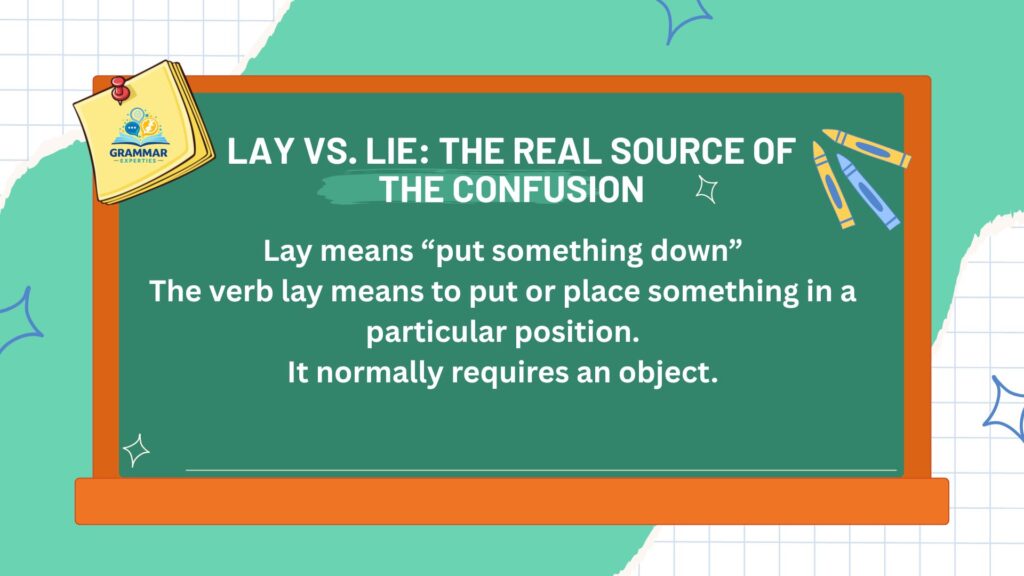
Lay vs. Lie: The Real Source of the Confusion
Lay means “put something down”
The verb lay means to put or place something in a particular position.
It normally requires an object.
Present:
I lay the phone on the table.
Past:
I laid the phone on the table.
Past participle:
I have laid the phone on the table.
Notice the object phone in each example.
Cambridge explains that lay takes an object, while lie, when it means to recline or be in a horizontal position, does not.
Lie means “rest or be in a horizontal position”
This is where many writers get confused.
When lie means to rest or be in a horizontal position, its forms are:
lie → lay → lain
Examples:
- I lie on the sofa every evening.
- Yesterday, I lay on the sofa for an hour.
- I have lain here since morning.
So if someone is talking about themselves resting on a bed, the correct sentence is:
I lay in bed all morning.
Not:
I layed in bed all morning.
And not:
I laid in bed all morning.
The last sentence is common in informal speech, but it doesn’t follow the standard grammar rule when lay is being used to mean “recline.” Cambridge specifically notes this distinction.
The easiest way to remember the four forms
Use this table:
| Meaning | Present | Past | Past Participle |
|---|---|---|---|
| Put/place something | lay | laid | laid |
| Recline/rest | lie | lay | lain |
| Tell something untrue | lie | lied | lied |
Think of it this way:
You lay something down, but you lie down yourself.
For example:
- I laid the blanket on the bed.
- I lay on the bed.
- I have lain on the bed for an hour.
This one distinction eliminates most layed or laid mistakes.
How to Use Laid Correctly in a Sentence
Laid as the simple past tense
Use laid when the action of putting or placing something happened in the past.
Examples:
Sarah laid her phone beside the laptop.
The chef laid the ingredients on the counter.
We laid the papers across the desk.
He laid the foundation for the project.
The gardener laid fresh soil around the plants.
In each sentence, something is being placed or positioned.
Laid as a past participle
Laid is also the past participle of lay. It commonly appears with helping verbs such as has, have, or had, and in passive constructions.
Examples:
She has laid the book on the shelf.
They had laid the groundwork before the meeting.
The workers have laid the new pipeline.
The carpet had been laid before the furniture arrived.
Oxford lists laid as both the past simple and past participle of lay.
Common phrases containing “laid”
You’ll often see laid in familiar expressions:
- laid out
- laid down
- laid off
- laid the foundation
- laid the groundwork
- laid to rest
- laid a plan
- laid the table
- laid an egg
Examples:
She laid out the documents for everyone.
The company laid off several employees.
The team laid the groundwork for future success.
The farmer said the hen had laid an egg.
In each case, laid is the standard spelling.
Common “Layed or Laid” Mistakes You Should Avoid
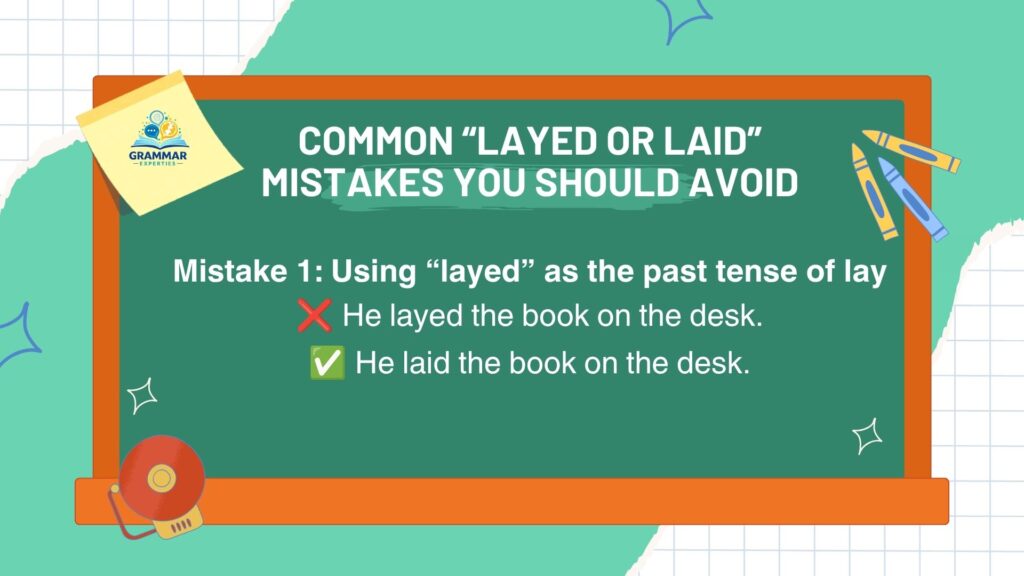
Mistake 1: Using “layed” as the past tense of lay
❌ He layed the book on the desk.
✅ He laid the book on the desk.
The verb lay changes to laid, not “layed.”
The CDC’s 2025 Clear Writing guidance explicitly states that “layed” is not a word and distinguishes it from laid, the past form and past participle of lay.
Mistake 2: Using “laid” when you mean “lay”
Consider:
❌ I laid on the couch yesterday.
If you mean that you rested on the couch, the standard form is:
✅ I lay on the couch yesterday.
Why?
Because the verb is lie, meaning to recline:
lie → lay → lain
You aren’t placing an object. You are describing your own position.
Mistake 3: Saying “I have laid down” when you mean “I have lain down”
Compare:
I laid the baby down.
Here, baby is the object, so laid is correct.
But:
I have lain down.
Here, you are describing your own reclining position, so lain is correct.
This distinction may feel strange at first, but repeated examples make it much easier.
Mistake 4: Writing “did laid”
After did, use the base form of the verb.
❌ Did you laid the book there?
✅ Did you lay the book there?
The same rule applies to negatives:
❌ She didn’t laid the papers on the table.
✅ She didn’t lay the papers on the table.
Why? Because did already carries the past tense.
A Simple Step-by-Step Guide to Choosing Lay, Laid, Lie, or Lain
Step 1: Ask what the verb means
Does it mean put or place something?
If yes, you’re dealing with lay.
Does it mean rest or recline?
If yes, you’re dealing with lie.
Step 2: Look for an object
If there is an object receiving the action, lay is usually the right verb.
She laid the book on the table.
“The book” is the object.
If there is no object and the person or animal is simply resting, lie is usually appropriate.
The dog lay on the floor.
Step 3: Check the tense
For lay meaning “put”:
- Present: lay
- Past: laid
- Past participle: laid
- -ing form: laying
For lie meaning “recline”:
- Present: lie
- Past: lay
- Past participle: lain
- -ing form: lying
Step 4: Never automatically add “-ed”
This is the trap behind layed.
Don’t assume every English verb forms its past tense by adding -ed.
Instead, remember:
lay → laid
Quick decision checklist
- Does the verb mean “put/place”? → Use lay/laid.
- Is the action in the past? → Use laid.
- Does the verb mean “recline/rest”? → Use lie/lay/lain.
- Is someone simply resting? → Don’t use layed.
- Does the sentence contain “did”? → Use lay, not laid.
- Does the sentence contain “have,” “has,” or “had” and mean “recline”? → Consider lain.
- Are you tempted to write “layed”? → Stop and check whether laid is required.
Layed or Laid: A 2025–2026 Data and Usage Snapshot
What current reference sources show
The most useful “data” for a spelling question like this comes from current dictionaries and language-reference sources rather than a single numerical survey.
A 2025 CDC writing guide explicitly presents the four-way comparison of lie, lay, laid, and lain and identifies “layed” as not a word.
Oxford’s current dictionary entry gives the conjugation of lay as:
lay → laid → laid → laying.
Cambridge likewise lists laid as both the past simple and past participle of lay.
A useful numerical snapshot
You can reduce the core rule to three numbers:
3 — the principal forms you need to remember for lay:
lay → laid → laid
2 — the major meanings that cause the confusion:
lay = put/place and lie = recline
1 — the spelling to eliminate from standard modern writing:
layed
This isn’t a claim about search volume or the number of people making the mistake. It’s a practical grammar snapshot based on current reference sources. For additional confirmation, QuillBot’s guide, published in 2025 and revised later that year, also identifies layed as a misspelling and laid as the standard form.
A Real-Life Example: How One Small Verb Change Fixes an Entire Sentence
Imagine you’re writing an email about preparing a conference room.
You type:
“Yesterday, I layed all the documents on the conference table.”
At first glance, the sentence looks reasonable. You’re describing something you placed on a table, and “layed” seems like a natural past tense.
But there is a simple grammatical test: What was placed?
The answer is the documents. Because “documents” is the object receiving the action, the verb is lay, meaning “put or place.” Its past tense is laid.
So the corrected sentence becomes:
“Yesterday, I laid all the documents on the conference table.”
Now imagine a different sentence:
“After the meeting, I layed on the sofa.”
Here, you’re not placing something anywhere. You’re describing your own position. The correct base verb is lie, whose past tense is lay.
Therefore:
“After the meeting, I lay on the sofa.”
This example shows why simply memorizing “laid is correct” isn’t enough. You also need to understand what the verb means. If you’re placing an object, use lay/laid. If you’re reclining, use lie/lay/lain. Once you identify the meaning, the correct form becomes much easier to choose.
Mini Quiz: Layed or Laid
- Which sentence is correct?
A) She layed the book down.
B) She laid the book down.
Answer: B - Complete the sentence:
“He ___ the keys on the table yesterday.”
A) layed
B) laid
Answer: B - Spot the spelling mistake:
“The farmer said the hen layed three eggs.”
Which word should replace “layed”?
Answer: Laid - Choose the correct form:
“We have ___ the foundation for the new building.”
A) layed
B) laid
Answer: B - Which word is NOT standard modern English?
A) Laid
B) Lay
C) Layed
D) Laying
Answer: C - Grammar challenge:
“She ___ the blanket on the bed before dinner.”
A) laid
B) layed
Answer: A - Pick the correct sentence:
A) They layed the carpet yesterday.
B) They laid the carpet yesterday.
Answer: B - Fill in the blank:
“The teacher ___ the papers on the desk.”
A) laid
B) layed
Answer: A - True or False:
“Layed” is the correct past tense of “lay.”
Answer: False - Which sentence uses “laid” correctly?
A) I laid on the sofa all afternoon.
B) I laid the phone beside my laptop.
Answer: B - Choose the correct verb:
“Yesterday, I ___ on the couch for two hours.”
A) lay
B) laid
C) layed
Answer: A - Complete the pattern:
Lay → ___ → ___
A) layed → layed
B) laid → laid
C) lied → lied
Answer: B - Which sentence is grammatically correct?
A) She has layed the documents on the desk.
B) She has laid the documents on the desk.
Answer: B - Quick grammar trap:
“Did you ___ the book there?”
A) laid
B) lay
C) layed
Answer: B - Choose the correct sentence:
A) He didn’t laid the papers on the table.
B) He didn’t lay the papers on the table.
Answer: B - Which verb means “to put or place something”?
A) Lie
B) Lay
C) Lain
D) Lied
Answer: B - Which form belongs to the verb “lie” meaning “to recline”?
A) lie → lay → lain
B) lie → laid → laid
C) lie → layed → layed
Answer: A - Complete the sentence:
“The workers have ___ the new pipes underground.”
A) layed
B) laid
Answer: B - Which sentence contains the correct past tense of “lay”?
A) She layed the table.
B) She laid the table.
C) She lain the table.
Answer: B - Find the correct phrase:
A) layed out the documents
B) laid out the documents
C) lain out the documents
Answer: B - Grammar detective:
“I ___ the package near the door yesterday.”
Which word belongs in the blank?
A) lay
B) laid
C) lain
Answer: B - Which sentence is correct?
A) The cat layed on the floor.
B) The cat lay on the floor.
Answer: B - Choose the correct past participle:
“They had ___ the groundwork before the project began.”
A) layed
B) laid
C) lay
Answer: B - One-word challenge:
What is the correct past form of lay?
A) Layen
B) Layed
C) Laid
D) Lain
Answer: C - Final boss question:
Which sentence is completely correct?
A) She layed the book down and walked away.
B) She laid the book down and walked away.
C) She lain the book down and walked away.
D) She lied the book down and walked away.
Answer: B
Frequently Asked Questions About Layed and Laid
Q1:Is “layed” a correct English word?
No. “Layed” is not the standard modern English form of the past tense of lay. The correct form is laid. Current Cambridge, Oxford, and CDC guidance all support laid as the standard form.
Q2:Is it “laid” or “layed”?
It is laid.
For example:
She laid the book on the table.
Not:
She layed the book on the table.
Q3:What is the past tense of “lay”?
The past tense of lay is laid.
The past participle is also laid.
So:
Present: lay
Past: laid
Past participle: laid
Q4:Is “I laid down” grammatically correct?
It depends on what you mean.
If you mean you placed something down, “laid” may be correct:
I laid the blanket down.
If you mean you reclined or rested, standard English uses:
I lay down.
For the perfect form:
I have lain down.
Cambridge specifically distinguishes these uses.
Q5:Is “I layed in bed” correct?
No.
If you mean that you rested in bed in the past, write:
I lay in bed.
The verb is lie, whose past tense is lay.
Q6:Is “laid” the past tense of “lie”?
Not when lie means “recline.”
The forms are:
lie → lay → lain
So:
I lie down every afternoon.
Yesterday, I lay down early.
I have lain down for a while.
However, lie meaning “tell an untruth” has a different pattern:
lie → lied → lied
Q7:Is “layed out” or “laid out” correct?
Laid out is correct.
For example:
She laid out the documents before the meeting.
“Layed out” is not the standard spelling. QuillBot’s 2025 guide also identifies laid out as the correct form.
Conclusion: Remember “Lay → Laid,” Not “Lay → Layed”
So, layed or laid which is correct?
The answer is simple: laid is the correct standard form. Layed should not be used in ordinary modern English.
Remember the main pattern:
Lay → laid → laid
But don’t stop there. The bigger source of confusion is the relationship between lay and lie:
- Lay = put or place something.
- Laid = past tense and past participle of lay.
- Lie = recline or rest.
- Lay = past tense of lie.
- Lain = past participle of lie.
- Layed = not the standard modern form.
When you’re unsure, ask yourself one question:
“Am I putting something somewhere, or am I resting somewhere?”
If you’re putting something somewhere, think lay → laid. If you’re resting, think lie → lay → lain.
Master that distinction, and you’ll avoid one of English’s most persistent verb-form mistakes.
For more clear, practical guides on confusing words, spelling, and grammar, keep exploring our grammar resources and strengthen your writing one rule at a time.
Explore more easy grammar lessons and improve your English with Grammar Expertise
References

Maimoona Mughal is an English grammar enthusiast dedicated to simplifying confusing words, grammar rules, and vocabulary through clear, accurate, and learner-friendly content that helps readers write and communicate with confidence.