Have you ever typed stoped and wondered whether it should have two p’s? You’re not alone. The difference between stopped or stoped is a small spelling detail, but it can make a big difference in clear, professional English.
The correct spelling is stopped with two p’s. Stoped is incorrect when you’re using the past tense or past participle of the verb stop.
Why does English double the final p? The answer comes from a common spelling pattern involving short, one-syllable verbs. Once you understand this rule, words such as stopped, planned, dropped, and hopped become much easier to spell.
This guide explains the stopped vs. stoped difference, the double-consonant rule, meanings, sentence examples, common mistakes, British and American usage, and practical ways to remember the correct spelling.
Stopped or Stoped: Which Is Correct?
The answer is straightforward:
| Spelling | Correct? | Explanation |
|---|---|---|
| stopped | ✅ Yes | Correct past tense and past participle of stop |
| stoped | ❌ No | Incorrect spelling in standard English |
Why “Stopped” Is Correct
The base verb is stop.
When you form its past tense by adding -ed, the final consonant p is doubled:
stop → stopped
The same doubling happens when you add -ing:
stop → stopping
Therefore, these forms are correct:
- I stop at the traffic light.
- I stopped at the traffic light.
- I am stopping at the traffic light.
- She stops at the traffic light.
The form stoped doesn’t follow the standard spelling pattern.
What Does “Stopped” Mean?
Stopped is the past tense and past participle of stop. It can mean that someone or something:
- came to a halt,
- ended an action,
- prevented something from continuing,
- paused an activity, or
- ceased doing something.
For example:
The car stopped suddenly.
Here, stopped means the car came to a halt.
Another example:
She stopped talking.
Here, stopped means she ended the action of talking.
Why Is Stopped Spelled With Two P’s?
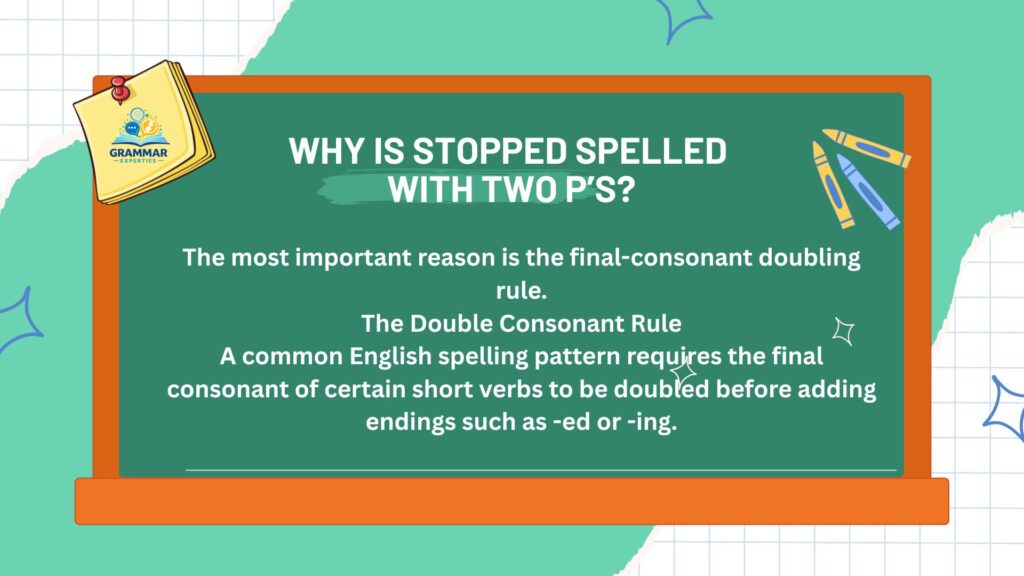
The most important reason is the final-consonant doubling rule.
The Double Consonant Rule
A common English spelling pattern requires the final consonant of certain short verbs to be doubled before adding endings such as -ed or -ing.
The verb stop is a one-syllable verb ending in a short vowel sound followed by one consonant:
st + o + p
The final p is therefore doubled:
stop + ed → stopped
and:
stop + ing → stopping
This spelling convention is documented in English usage references. Michael Swan’s Practical English Usage, for example, specifically gives stop → stopped as an example of final-consonant doubling.
More Examples of the Same Pattern
Once you understand stop → stopped, you can recognize the pattern in many other verbs:
| Base Verb | Past Tense | -ing Form |
| stop | stopped | stopping |
| plan | planned | planning |
| drop | dropped | dropping |
| shop | shopped | shopping |
| hop | hopped | hopping |
| clap | clapped | clapping |
| rob | robbed | robbing |
So if you know that shop becomes shopped, it becomes easier to remember that stop becomes stopped.
Why Doesn’t English Simply Add “-ed”?
It may seem logical to write:
stop + ed = stoped
However, English spelling doesn’t always work by simply attaching an ending to the base word.
The doubling rule helps preserve the expected short-vowel pronunciation and follows established English orthographic conventions.
This is why:
- stop → stopped
- hop → hopped
- plan → planned
rather than:
- stop → stoped
- hop → hoped
- plan → planed
Notice something interesting: hoped and planed are actually different words with different pronunciations and meanings. That’s one reason spelling patterns matter.
How to Use “Stopped” Correctly in a Sentence
Knowing the spelling is only half the job. You also need to know how stopped works in sentences.
Stopped as a Simple Past Verb
Use stopped to describe an action that happened in the past.
Examples:
- The bus stopped outside the school.
- She stopped the car near the entrance.
- The rain stopped before sunset.
- We stopped for lunch.
- He stopped working at six o’clock.
In each example, the action happened in the past.
Stopped as a Past Participle
Stopped can also be used as a past participle with helping verbs.
Examples:
- The machine has stopped working.
- The rain had stopped by morning.
- The car was stopped by the police.
- Production has stopped temporarily.
So stopped isn’t limited to simple past sentences.
Stopped + -ing
When stop is followed by an -ing form, it usually means that the activity itself has ended.
For example:
She stopped smoking.
This means she no longer smokes.
Similarly:
They stopped arguing.
This means the argument ended.
The British Council explains that stop + -ing means an action is no longer happening.
Stopped to Do Something vs. Stopped Doing Something
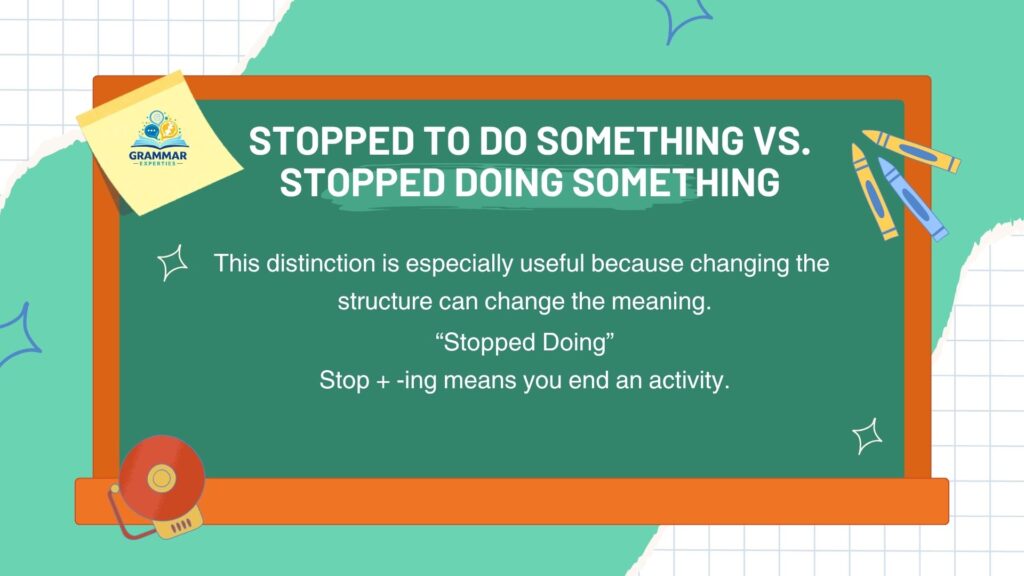
This distinction is especially useful because changing the structure can change the meaning.
“Stopped Doing”
Stop + -ing means you end an activity.
Example:
I stopped watching television.
Meaning: I no longer continued watching television.
Another example:
She stopped eating sweets.
Meaning: She ended or discontinued the habit of eating sweets.
“Stopped to Do”
Stop + to + verb means you pause one activity in order to do another.
Example:
I stopped to buy some water.
This means I was doing something else, paused, and bought water.
Compare:
He stopped talking.
He ended the talking.
But:
He stopped to talk.
He paused another activity so he could talk.
This difference is important in formal writing, exams, and English-language learning. The British Council provides the same distinction in its explanation of verbs followed by -ing or to + infinitive.
Stopped or Stoped: Common Examples
One of the easiest ways to remember the difference is to see the incorrect and correct forms side by side.
Everyday Examples
❌ I stoped the car at the corner.
✅ I stopped the car at the corner.
❌ The rain stoped suddenly.
✅ The rain stopped suddenly.
❌ She stoped talking.
✅ She stopped talking.
❌ They stoped playing after sunset.
✅ They stopped playing after sunset.
Professional Writing Examples
The correct spelling matters in emails, reports, applications, assignments, and business communication.
❌ The project was stoped because of budget problems.
✅ The project was stopped because of budget problems.
❌ Production stoped temporarily.
✅ Production stopped temporarily.
❌ The meeting stoped at noon.
✅ The meeting stopped at noon.
A single missing letter may not change the intended meaning, but repeated spelling mistakes can make writing look less polished.
British English vs. American English: Is There a Difference?
There is no spelling difference between British and American English for this word.
Both varieties use:
stopped
Not:
stoped
Some English verbs do have different British and American spellings. For example, travelled is common in British English, while traveled is standard in American English.
However, stop → stopped remains the same in both varieties.
So whether you’re writing for a British, American, Australian, Canadian, or international audience, stopped is the safe standard form.
Which Form Should Students Use?
Students should always use stopped in:
- school assignments,
- university papers,
- exams,
- English tests,
- essays,
- applications,
- emails, and
- professional documents.
Writing stoped instead can be marked as a spelling error.
What About “Stoping”?
The same rule applies to the -ing form.
❌ stoping
✅ stopping
The final p is doubled before -ing:
stop → stopping
Remembering these two forms together can help:
stopped — stopping
If you can remember one, the other becomes much easier.
A Simple Way to Remember Stopped
English spelling rules can feel complicated, but you don’t need to memorize a long grammar lesson every time you write stopped.
Use the “Stop Sign” Trick
Think of a physical stop sign.
When you see a stop sign, remember:
STOP = P
When the action moves into the past:
STOP + ED = STOPPED
The p gets doubled.
You can also pair the two forms:
STOP → STOPPED → STOPPING
Say them aloud when practicing. Repetition makes the pattern easier to recognize automatically.
Learn Similar Words Together
Instead of memorizing stopped by itself, learn a small family of similar words:
- stop → stopped
- hop → hopped
- shop → shopped
- drop → dropped
- plan → planned
- clap → clapped
This helps you understand the spelling pattern rather than relying on memorization alone.
A Quick Checklist for Spelling Stopped Correctly
Use this checklist whenever you’re unsure.
- Is the base verb stop?
- Are you talking about a past action?
- Are you forming the past participle?
- Are you adding -ed?
- Did you double the final p?
- Does your sentence contain stopped, not stoped?
If the answer is yes, your spelling is correct.
2025–2026 Spelling and Usage Data: What Does the Research Show?
There isn’t a reliable public 2025–2026 statistic that gives an exact worldwide count of people who type stoped instead of stopped. Claims that provide a precise percentage for this specific typo without identifying a verifiable corpus should be treated cautiously.
However, recent research does show that spelling errors remain a significant issue for English learners.
A 2025 study of English spelling errors among Korean college students analyzed 1,260 words produced by 18 learners and identified 246 spelling errors. The researchers found that vowel and consonant errors were prominent categories, highlighting the difficulty learners can have with English sound-to-spelling relationships.
Another 2025 study published in Reading and Writing examined spelling challenges among English-as-a-foreign-language learners and reported recurring difficulties involving English orthographic conventions. The study specifically notes that learners can struggle with spelling conventions such as consonant patterns.
Research involving Pakistani ESL learners also illustrates why these rules matter. A 2025 corpus-based study analyzed 130 middle-school students’ essays and found substantial spelling and grammar errors across different school settings. Its results support targeted instruction in spelling and grammar rather than simply relying on exposure.
The takeaway is simple: stopped is an individual spelling question, but it reflects a broader challenge in English—understanding when letters change, double, or disappear when suffixes are added.
Real-Life Case Study: Why One Letter Can Matter
Imagine a student named Ayesha preparing an English assignment.
She knows that the past tense of most regular verbs is often formed by adding -ed. She writes sentences such as:
The teacher asked a question.
The students walked into the classroom.
The bus stoped outside the school.
The first two sentences follow a straightforward pattern. Ayesha then assumes that stop works exactly the same way: stop + ed = stoped.
Her teacher marks the third sentence as incorrect.
At first, the correction seems arbitrary. Why should stop be different?
The teacher explains the final-consonant doubling rule and compares the word with familiar examples:
stop → stopped
plan → planned
drop → dropped
shop → shopped
Ayesha then notices the pattern. These short verbs have a short vowel sound followed by a single final consonant. Before certain vowel-initial suffixes, the final consonant is doubled.
She practices the pattern in several sentences:
The bus stopped at the station.
We stopped for lunch.
The rain stopped suddenly.
He stopped talking.
After practicing the word family, she no longer has to guess whether stoped looks right. The double p becomes automatic.
This example shows why learning the rule is more useful than simply memorizing one spelling. Once you understand the pattern, you can apply it to many other verbs.
Stopped vs. Stoped: Quick Comparison
| Feature | Stopped | Stoped |
| Correct spelling | ✅ Yes | ❌ No |
| Base verb | Stop | Stop |
| Past tense | Yes | No |
| Past participle | Yes | No |
| Standard English | Yes | No |
| Double consonant | Yes, pp | No |
| Example | She stopped working. | She stoped working. ❌ |
The key difference is simply the extra p.
Common Mistakes to Avoid
Mistake 1: Writing “Stoped”
❌ The car stoped suddenly.
✅ The car stopped suddenly.
This is the most common spelling error associated with the word.
Mistake 2: Writing “Stoping”
❌ The bus is stoping here.
✅ The bus is stopping here.
The final p is doubled before -ing, too.
Mistake 3: Confusing “Stopped to” and “Stopped -ing”
Compare:
She stopped talking.
She ended the activity.
She stopped to talk.
She paused another activity in order to talk.
The spelling remains stopped in both cases, but the grammar changes the meaning.
Mistake 4: Assuming British English Uses “Stoped”
It doesn’t.
Both British and American English use stopped.
Why Correct Spelling Matters
At first glance, the difference between stopped and stoped may seem tiny. After all, most readers can understand what you mean.
However, accurate spelling matters for several reasons.
It Improves Credibility
Spelling mistakes can distract readers from your message. In professional writing, careful spelling suggests attention to detail.
It Helps Readers Trust Your Content
Readers expect websites, reports, educational materials, and business documents to use standard English.
It Matters in Education
Students are often assessed on spelling, grammar, and written accuracy. Understanding the doubling rule can help prevent similar mistakes beyond this one word.
It Builds Better English Skills
Learning why stop becomes stopped gives you a reusable spelling principle. You aren’t just memorizing one word; you’re learning how English word formation works.
Frequently Asked Questions
Q1:Is “stopped” or “stoped” correct?
Stopped is correct. Stoped is an incorrect spelling when forming the past tense or past participle of stop.
Q2:Why does “stopped” have two p’s?
The final p is doubled because stop is a short one-syllable verb that follows the final-consonant doubling pattern before -ed and -ing.
Q3:What is the past tense of “stop”?
The past tense of stop is stopped.
Example:
The train stopped at the station.
Q4:Is “stoped” ever correct?
For ordinary English use, stoped is not the correct past tense or past participle of stop. Use stopped.
Q5:Is “stopping” spelled with one p or two?
It is spelled with two p’s:
stopping
Not:
stoping
Q6:Do British and American English spell “stopped” differently?
No. Both British and American English use stopped.
Q7:What is the difference between “stopped doing” and “stopped to do”?
Stopped doing means an activity ended.
She stopped reading.
Stopped to do means someone paused one activity in order to perform another.
She stopped to read the sign.
Q8:What is an easy way to remember “stopped”?
Remember the word pair:
stop → stopped
When -ed is added, double the final p. You can also connect it with similar forms such as drop → dropped and plan → planned.
Mini Quiz: Stopped or Stoped
- Quick Spelling Check:
Which spelling is correct?
A) Stoped
B) Stopped
C) Stopted
D) Stoppped
Answer: B) Stopped - Complete the Sentence:
The bus ______ at the red light.
A) stoped
B) stopped
C) stoppt
D) stupped
Answer: B) stopped - Double-P Challenge:
Which word correctly uses the past-tense form of “stop”?
A) Stoped
B) Stopped
C) Stoppped
D) Stopt
Answer: B) Stopped - Spot the Mistake:
Which sentence contains a spelling error?
A) The rain stopped.
B) She stopped laughing.
C) The car stoped suddenly.
D) We stopped for lunch.
Answer: C) The car stoped suddenly. - Grammar Detective:
What is the correct past tense of “stop”?
A) Stoped
B) Stopped
C) Stoping
D) Stopt
Answer: B) Stopped - Pick the Winner:
The teacher ______ the lesson at noon.
A) stoped
B) stopped
C) stoppt
D) stoppped
Answer: B) stopped - One Letter Matters:
What letter is doubled in “stopped”?
A) S
B) T
C) O
D) P
Answer: D) P - Past-Tense Puzzle:
Which transformation is correct?
A) stop → stoped
B) stop → stopped
C) stop → stopted
D) stop → stoppt
Answer: B) stop → stopped - Find the Correct Sentence:
A) The music stoped suddenly.
B) The music stopped suddenly.
C) The music stoppped suddenly.
D) The music stopt suddenly.
Answer: B) The music stopped suddenly. - -ING Challenge:
Which spelling is correct?
A) Stoping
B) Stopping
C) Stoppping
D) Stoppinng
Answer: B) Stopping - Meaning Match:
In “The train stopped,” what does “stopped” mean?
A) Started moving
B) Came to a halt
C) Moved faster
D) Changed direction
Answer: B) Came to a halt - Choose the Correct Form:
Yesterday, we ______ playing at 6 p.m.
A) stoped
B) stopped
C) stop
D) stopping
Answer: B) stopped - Rule Master:
Why does “stop” become “stopped”?
A) The vowel disappears
B) The final consonant is doubled
C) The word loses its first letter
D) The ending changes to “-ted”
Answer: B) The final consonant is doubled - Which One Doesn’t Belong?
Which spelling is incorrect?
A) Hopped
B) Dropped
C) Stopped
D) Stoped
Answer: D) Stoped - Sentence Repair:
Fix this sentence: “The rain stoped before sunset.”
A) The rain stopped before sunset.
B) The rain stoped before sunset.
C) The rain stoppt before sunset.
D) The rain stopping before sunset.
Answer: A) The rain stopped before sunset. - Meaning Matters:
What does “She stopped smoking” mean?
A) She began smoking
B) She continued smoking
C) She ended the activity
D) She smoked faster
Answer: C) She ended the activity - Grammar Twist:
Which sentence means someone paused one activity in order to do another?
A) He stopped talking.
B) He stopped to talk.
C) He stopped talked.
D) He stoped talking.
Answer: B) He stopped to talk. - British vs. American:
Which spelling is standard in both British and American English?
A) Stoped
B) Stopped
C) Stoppt
D) Stoppped
Answer: B) Stopped - Word Family Challenge:
Which group contains correctly spelled forms?
A) Stop, stoped, stoping
B) Stop, stopped, stopping
C) Stop, stopted, stoping
D) Stop, stoppped, stoping
Answer: B) Stop, stopped, stopping - Fast Fix:
Choose the correct word: “The machine has ______ working.”
A) stoped
B) stopped
C) stop
D) stopping
Answer: B) stopped - Double-Consonant Detective:
Which word follows a similar doubling pattern to “stopped”?
A) Hoped
B) Hopped
C) Helped
D) Heated
Answer: B) Hopped - Complete the Pair:
STOP → STOPPED
HOP → ______
A) Hoped
B) Hopt
C) Hopped
D) Hoppped
Answer: C) Hopped - Professional Writing Test:
Which sentence is suitable for formal writing?
A) Production stoped temporarily.
B) Production stopped temporarily.
C) Production stopeded temporarily.
D) Production stoppt temporarily.
Answer: B) Production stopped temporarily. - Final Boss Question:
Which statement is TRUE?
A) “Stoped” is the standard past tense of stop.
B) “Stopped” has only one p.
C) “Stopped” is the correct past tense and past participle of stop.
D) “Stoped” is preferred in British English.
Answer: C) “Stopped” is the correct past tense and past participle of stop. - Memory Master:
Which formula helps you remember the correct spelling?
A) STOP → STOPED → STOPING
B) STOP → STOPPED → STOPPING
C) STOP → STOPPT → STOPING
D) STOP → STOPPED → STOPING
Answer: B) STOP → STOPPED → STOPPING
Final Verdict: Stopped or Stoped?
The answer is clear: stopped is the correct spelling.
Stoped is not the standard past tense or past participle of stop. The reason stopped has two p’s is the English final-consonant doubling pattern used when forming words such as stopped and stopping.
So whenever you’re writing a sentence such as:
The bus stopped at the station.
or:
She stopped talking.
use the double p.
The easiest formula to remember is:
STOP → STOPPED → STOPPING
Once you understand that pattern, the stopped or stoped confusion becomes much easier to avoid.
For more practical English spelling and grammar guides, keep exploring related confusing-word topics and build your vocabulary one clear rule at a time.
Explore more easy grammar lessons and improve your English with Grammar Expertise
References

Maimoona Mughal is an English grammar enthusiast dedicated to simplifying confusing words, grammar rules, and vocabulary through clear, accurate, and learner-friendly content that helps readers write and communicate with confidence.