Have you ever typed “tieing” and wondered whether it actually looks right? You’re not alone. The spelling can be confusing because the base verb is tie, so adding -ing seems as though it should produce tieing. However, standard English uses a different spelling pattern.
The correct spelling is tying, not tieing, when you mean the present participle or gerund of tie. Cambridge Dictionary lists tying as the present participle of tie, and Oxford also gives tying as the standard -ing form.
The reason is a special spelling rule for verbs ending in -ie: before adding -ing, the -ie changes to -y.
So:
tie → tying
Not:
tie → tieing
In this guide, you’ll learn exactly why tying is correct, when to use it, why tieing causes confusion, and how to remember the rule permanently.
Quick Answer: Is It Tying or Tieing?
Tying is the standard spelling.
Tieing is not the normal modern spelling used for the present participle or gerund of tie.
The spelling changes because verbs ending in -ie generally change -ie to -y before -ing is added.
| Base verb | Correct -ing form |
|---|---|
| tie | tying |
| die | dying |
| lie | lying |
| vie | vying |
For example:
- She is tying her shoes. ✅
- She is tieing her shoes. ❌
- He is tying the rope to the post. ✅
- He is tieing the rope to the post. ❌
Cambridge and Oxford both list tying as the present participle of tie.
What Does Tying Mean?
The Meaning of Tying
Tying is the present participle and gerund form of the verb tie.
The verb tie can mean to fasten, connect, secure, or attach something using string, rope, ribbon, or another material. It can also mean connecting ideas or having the same score in a competition.
For example:
- She is tying her shoelaces.
- He is tying a ribbon around the package.
- They are tying the boat to the dock.
- The two teams are tying at 2–2.
Cambridge defines tie in several related ways, including fastening something, connecting things, and finishing with the same score in a competition.
Tying as a Present Participle
A present participle is commonly used with forms of be to create continuous tenses.
Examples:
- I am tying my shoes.
- She is tying the package.
- They are tying the ropes.
- We were tying the balloons.
- He has been tying knots all morning.
In these examples, tying describes an action that is happening or was happening over a period of time.
Tying as a Gerund
The same -ing form can function as a noun. In that situation, it is called a gerund.
For example:
Tying knots takes practice.
Here, tying is the name of an activity rather than simply an action being performed by a subject.
Another example is:
Tying your shoes is an important everyday skill.
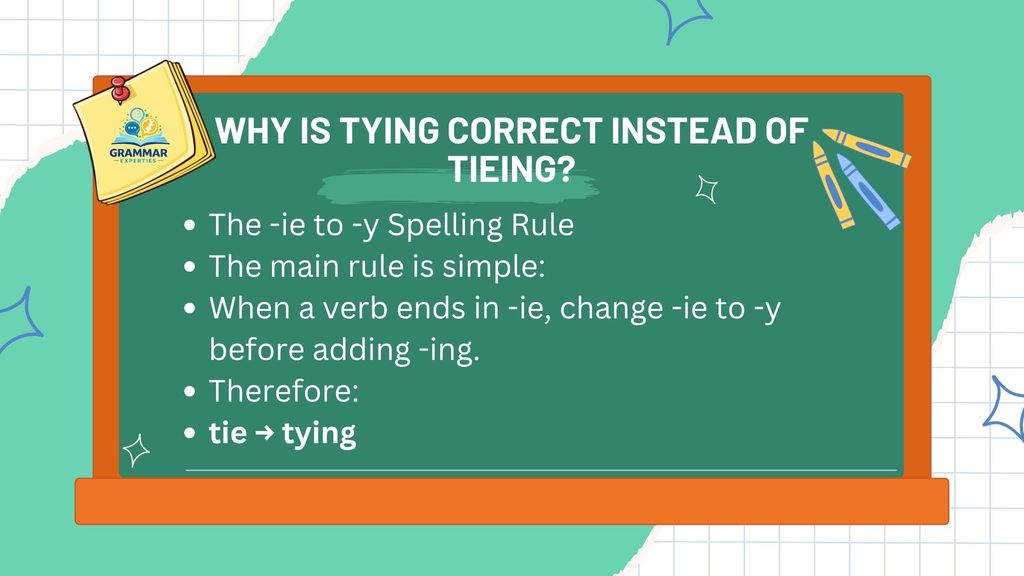
Why Is Tying Correct Instead of Tieing?
The -ie to -y Spelling Rule
The main rule is simple:
When a verb ends in -ie, change -ie to -y before adding -ing.
Therefore:
tie → tying
The same pattern appears in several other English verbs:
- die → dying
- lie → lying
- vie → vying
- untie → untying
The Language Portal of Canada explains the rule directly: verbs ending in -ie change ie to y before -ing, giving examples such as die → dying, lie → lying, tie → tying, and vie → vying.
Why “Tieing” Looks Logical
The confusion is understandable.
Many verbs simply take -ing:
- play → playing
- read → reading
- jump → jumping
- work → working
- wash → washing
So a learner may naturally think:
tie + ing = tieing
But English spelling does not always work by simply attaching letters. Some verbs have spelling changes when suffixes are added.
For tie, the transformation is:
tie → remove -ie → add -ying → tying
It is therefore better to memorize the pattern rather than treating tieing as a simple combination of tie + ing.
Similar Words That Follow the Same Pattern
Learning similar words makes the rule easier to remember.
| Verb | Correct -ing Form |
|---|---|
| tie | tying |
| untie | untying |
| die | dying |
| lie | lying |
| vie | vying |
Notice the common feature: each base verb ends in -ie.
Tying vs Tieing: What’s the Difference?
Tying Is the Standard Choice
When you need the -ing form of tie, use tying.
Examples:
She is tying her hair.
He is tying the package.
They are tying the boat to the dock.
I am tying my shoelaces.
Oxford lists tying as the -ing form of tie, while Cambridge likewise identifies tying as its present participle.
What About Tieing?
There is an important dictionary nuance.
It would be too broad to claim that the sequence tieing has never appeared or cannot be found anywhere. Merriam-Webster’s current entry for tie records tying or tieing in its verb forms, and its entries for phrases such as tie in and tie off also record tieing alongside tying.
However, tying is the form you should normally choose in modern standard English, especially in schoolwork, professional writing, websites, articles, and everyday communication.
So if you’re deciding which spelling to use:
Choose “tying.”
Quick Comparison
| Feature | Tying | Tieing |
|---|---|---|
| Standard modern choice | ✅ Yes | Generally no |
| Present participle of tie | ✅ Yes | Variant recorded by some dictionaries |
| Common in current English | ✅ Yes | Much less common |
| Recommended for formal writing | ✅ Yes | Avoid |
| Example | She is tying her shoes. | She is tieing her shoes. |
This distinction matters because a dictionary can record a variant without that variant being the best choice for everyday modern writing.
How to Use Tying Correctly
Tying Shoes
One of the most common uses is talking about shoelaces.
Correct:
The child is tying his shoes.
I learned how to tie my shoes when I was young.
She is tying her shoelaces before the race.
Notice that the base verb is tie, but the continuous form is tying.
Tying Something With a Rope or String
Tying can describe fastening or securing something.
Examples:
He is tying the box with string.
She is tying the rope to the tree.
We were tying the balloons together.
They spent an hour tying the packages.
These uses reflect the core meaning of tie: to fasten or hold things together.
Tying Ideas Together
Tying can also have a figurative meaning.
For example:
The writer is tying the two ideas together.
The report is tying the results to the original research.
Here, tying means connecting or relating things rather than physically fastening them.
Oxford includes this broader meaning of tie, describing it as connecting or linking someone or something closely with something else.
Tying in Sports
Tying can also relate to equal scores.
For example:
The team is tying the game in the final minute.
The two players are tying for first place.
The goal gave the team a chance of tying the score.
Cambridge includes tie as a verb meaning to finish with the same score or number of points as another competitor.
Tying or Tieing: Real-Life Case Study
A Common Writing Mistake
Imagine a student writing an English assignment about daily routines.
The student wants to write:
“Every morning, I am tieing my shoelaces before leaving for school.”
At first glance, tieing seems reasonable. The student knows the base verb is tie and remembers that many verbs form the present participle by adding -ing.
However, the standard spelling is:
“Every morning, I am tying my shoelaces before leaving for school.”
The difference is only one letter, but it reflects an important English spelling pattern.
The student then encounters another sentence:
“My brother is lieing on the sofa.”
That looks wrong for the same reason. The correct form is:
“My brother is lying on the sofa.”
Now the pattern becomes easier to recognize:
- tie → tying
- lie → lying
- die → dying
- vie → vying
This is a useful learning strategy because instead of memorizing tying as an isolated spelling, the student remembers a word family.
The lesson also applies to professional writing. Imagine a content writer preparing an article that says, “The company is tieing its new strategy to customer feedback.” A spelling checker or editor may flag the word, and readers may notice the unusual form. Replacing it with tying makes the sentence conform to the standard spelling used by major learner dictionaries.
The practical takeaway is simple: when you need the -ing form of tie, write tying. If you remember the -ie → y pattern, you can also handle related words such as lying, dying, and vying with much greater confidence.
What Current Dictionary Evidence Says in 2026
2025–2026 Reference Check
Rather than relying on outdated spelling lists, it is useful to check current major dictionaries.
As of the current 2026 dictionary entries:
- Cambridge Dictionary lists tying as the present participle of tie.
- Oxford Advanced Learner’s Dictionary gives tying as the -ing form of tie.
- Merriam-Webster records tying and also notes tieing as a variant in its entry for tie.
- The Language Portal of Canada explains the spelling rule as changing ie to y before adding -ing.
This gives us an important distinction: tying is clearly the standard form presented by major modern learner dictionaries, while Merriam-Webster also records tieing as a variant.
Therefore, the safest recommendation for modern general writing in 2026 is:
Use “tying.”
Why Dictionary Evidence Matters
Spelling questions can become misleading when an article simply labels one form “wrong” without checking authoritative references.
English contains many historical, regional, and variant spellings. A dictionary may record a form because it exists in real usage, even when another form is much more widely preferred.
For tying, the evidence is especially useful because it explains why you may occasionally encounter tieing while still being advised to write tying.
A Simple Step-by-Step Guide to Remember Tying
Step 1: Find the Base Verb
Start with:
tie
Step 2: Check the Ending
Does the verb end in -ie?
Yes.
Step 3: Apply the Spelling Change
Change:
ie → y
So:
tie → ty
Step 4: Add -ing
Now add -ing:
ty + ing = tying
Step 5: Check Your Sentence
For example:
She is tying her hair.
Correct.
She is tieing her hair.
Not the standard modern choice.
The Memory Trick
Remember:
IE becomes Y before ING.
Then think of the three easiest examples:
tie → tying
lie → lying
die → dying
If you remember those three, you’ll rarely have trouble with this spelling rule.
Common Mistakes With Tying
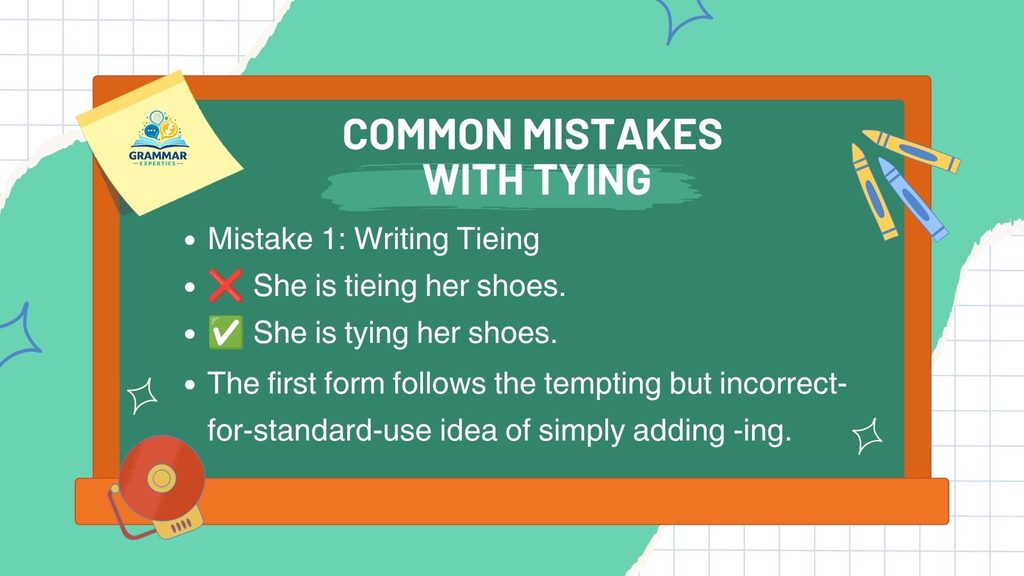
Mistake 1: Writing Tieing
❌ She is tieing her shoes.
✅ She is tying her shoes.
The first form follows the tempting but incorrect-for-standard-use idea of simply adding -ing.
Mistake 2: Writing Tyeing
❌ He is tyeing the rope.
✅ He is tying the rope.
The spelling tye is not the normal base verb. The correct base form is tie.
Mistake 3: Confusing Tying With Tied
Tying and tied are different forms.
- Present participle: tying
- Past tense: tied
- Past participle: tied
Examples:
She is tying the ribbon.
She tied the ribbon yesterday.
The ribbon was tied securely.
Mistake 4: Forgetting the Same Rule in Related Words
Once you learn tie → tying, remember the related pattern:
- lie → lying
- die → dying
- vie → vying
- untie → untying
This makes the rule more useful than simply memorizing one word.
Tying Examples in Everyday English
Here are several natural examples:
- She is tying her shoes.
- He is tying a knot in the rope.
- They are tying the boxes together.
- I am tying a ribbon around the gift.
- The sailor is tying the boat to the dock.
- She was tying her hair back.
- We are tying the balloons to the chairs.
- He is tying the two pieces of string together.
- The writer is tying the evidence to the main argument.
- The team is tying the score near the end of the game.
These examples demonstrate the different meanings of tying, from physical fastening to figurative connection and competition.
Mini Quiz:Tying or Tieing
- Which spelling is correct?
A) Tieing
B) Tying
C) Tyeing
D) Tiying
Answer: B) Tying - Choose the correct sentence:
A) She is tieing her shoes.
B) She is tying her shoes.
C) She is tyeing her shoes.
D) She is tiying her shoes.
Answer: B) She is tying her shoes. - What is the -ing form of “tie”?
A) Tieing
B) Tying
C) Tyeing
D) Tieding
Answer: B) Tying - Which spelling rule applies to “tie”?
A) Double the final e
B) Change -ie to -y before -ing
C) Remove the first letter
D) Add -ing without any change
Answer: B) Change -ie to -y before -ing - Complete the sentence: “He is ___ a knot.”
A) tieing
B) tying
C) tyeing
D) tied
Answer: B) tying - Which word follows the same pattern as “tie → tying”?
A) play → playing
B) lie → lying
C) work → working
D) jump → jumping
Answer: B) lie → lying - True or False: “Tying” is the standard spelling of the -ing form of “tie.”
Answer: True - Which sentence is correct?
A) They are tieing the rope.
B) They are tying the rope.
C) They are tyeing the rope.
D) They are tieding the rope.
Answer: B) They are tying the rope. - What happens to “ie” in “tie” before adding “-ing”?
A) It becomes y
B) It becomes ee
C) It is doubled
D) It remains unchanged
Answer: A) It becomes y - Choose the correct form:
“She is ___ a ribbon around the gift.”
A) tieing
B) tying
C) tyeing
D) tie
Answer: B) tying - Which is NOT the standard spelling?
A) Tying
B) Lying
C) Dying
D) Tieing
Answer: D) Tieing - Complete the sentence: “I am ___ my shoelaces.”
A) tieing
B) tying
C) tyeing
D) tied
Answer: B) tying - What is the base verb of “tying”?
A) tied
B) tie
C) tying
D) tye
Answer: B) tie - True or False: “Tieing” is the spelling normally recommended for formal modern English.
Answer: False - Which sentence is correctly spelled?
A) He was tieing the package.
B) He was tying the package.
C) He was tyeing the package.
D) He was tiying the package.
Answer: B) He was tying the package. - Which is the correct -ing form of “untie”?
A) Untieing
B) Untying
C) Untyeing
D) Untiying
Answer: B) Untying - Which word is correctly spelled?
A) Tying
B) Tieying
C) Tyeing
D) Tieing
Answer: A) Tying - In which sentence does “tying” refer to connecting ideas?
A) She is tying her shoes.
B) He is tying a rope.
C) The writer is tying the evidence to the argument.
D) She is tying a ribbon.
Answer: C) The writer is tying the evidence to the argument. - Choose the correct sequence:
A) Tie → tied → tied → tying
B) Tie → tieing → tied → tying
C) Tie → tye → tied → tieing
D) Tie → tying → tieing → tied
Answer: A) Tie → tied → tied → tying - Which sentence contains the correct spelling?
A) Tying your shoes takes practice.
B) Tieing your shoes takes practice.
C) Tyeing your shoes takes practice.
D) Tiying your shoes takes practice.
Answer: A) Tying your shoes takes practice. - Which pair is correct?
A) Die → dieing
B) Lie → lieing
C) Tie → tying
D) Vie → vieing
Answer: C) Tie → tying - Complete the sentence: “The sailor is ___ the boat to the dock.”
A) tieing
B) tying
C) tyeing
D) tieding
Answer: B) tying - Which spelling should you normally use in an article or school assignment?
A) Tieing
B) Tyeing
C) Tiying
D) Tying
Answer: D) Tying - What does “tying” mean in “She is tying the package”?
A) Opening the package
B) Fastening the package
C) Removing the package
D) Measuring the package
Answer: B) Fastening the package - What is the easiest rule to remember?
A) Change -ie to -y before -ing
B) Change -ie to -ee before -ing
C) Keep -ie and add -ing
D) Remove the entire ending before -ing
Answer: A) Change -ie to -y before -ing
ChatGPT can make mistakes. Check important info.
Frequently Asked Questions About Tying or Tieing
Q1:Is “tying” or “tieing” correct?
Tying is the standard modern spelling you should normally use. Cambridge and Oxford list tying as the present participle of tie. Merriam-Webster also records tieing as a variant, but tying is the safer and more widely preferred choice for general writing.
Q2:Why is tying spelled with a y?
The spelling follows the rule for verbs ending in -ie. Before adding -ing, the -ie changes to -y:
tie → tying
The same pattern occurs in:
lie → lying
die → dying
vie → vying
The Language Portal of Canada explicitly gives this spelling rule and includes tie → tying as an example.
Q3:Is “tieing” a real word?
Tieing is recorded as a variant by Merriam-Webster, so it would be inaccurate to claim that the form has never existed. However, tying is the standard form shown by Cambridge and Oxford and is the recommended choice for most modern English writing.
Q4:What is the present participle of tie?
The present participle of tie is tying.
For example:
She is tying her shoes.
Cambridge and Oxford both list tying as the present participle or -ing form of tie.
Q5:Is “tying” a gerund?
Yes. Tying can function as a gerund when it acts like a noun.
For example:
Tying your shoes takes practice.
Here, tying your shoes functions as the subject of the sentence.
Q6:Is it “tying the knot” or “tieing the knot”?
The standard spelling is:
tying the knot
For example:
They are tying the knot next month.
The phrase means getting married.
Q7:What is the past tense of tie?
The past tense and past participle are tied.
Examples:
She tied her shoes.
He has tied the package securely.
So the basic forms are:
tie → tied → tied → tying
Q8:How can I remember the spelling of tying?
Use this simple rule:
Words ending in -ie usually change -ie to -y before -ing.
Remember:
tie → tying
Then connect it with:
lie → lying
die → dying
This makes the spelling much easier to remember.
Tying or Tieing: Final Verdict
If you’re wondering “tying or tieing—which spelling is correct?”, the answer for normal modern English writing is tying.
The key rule is:
-ie → -y + -ing
Therefore:
tie → tying
Use tying when talking about fastening something, connecting things, forming a knot, linking ideas, or reaching an equal score.
Although tieing is recorded as a variant by Merriam-Webster, major learner dictionaries such as Cambridge and Oxford give tying as the present participle or -ing form.
The easiest way to remember it is to group it with other -ie verbs:
tie → tying
lie → lying
die → dying
vie → vying
So the next time you hesitate between tying and tieing, choose tying with confidence.
Explore more easy grammar lessons and improve your English with Grammar Expertise.
References
Cambridge Dictionary — Tie
Oxford Learner’s Dictionaries — Tie

Maimoona Mughal is an English grammar enthusiast dedicated to simplifying confusing words, grammar rules, and vocabulary through clear, accurate, and learner-friendly content that helps readers write and communicate with confidence.