Introduction
Have you ever typed “disgard” and then wondered whether you had spelled it correctly? If so, you’re dealing with a very common spelling confusion.
When comparing discard vs disgard, there is a clear winner: discard is the correct spelling. Disgard is a misspelling and should not be used as the standard English word.
The correct word, discard, means to throw something away, get rid of something, or reject something you no longer want or need. Cambridge Dictionary also gives discard the meaning of getting rid of something because it is no longer wanted or needed.
In this guide, you’ll learn exactly why discard is correct, what it means, how to use it in sentences, how it differs from disregard, and an easy trick that will help you remember the spelling permanently.
Discard vs Disgard: Which Spelling Is Correct?
The answer is straightforward:
Discard = Correct ✅
Disgard = Incorrect ❌
Discard is the standard English spelling. Disgard is not the correct spelling of this word.
Is “Disgard” a Word?
In standard modern English, disgard should be treated as a misspelling rather than an alternative spelling of discard.
For example:
- ❌ Please disgard the old documents.
- ✅ Please discard the old documents.
The correct spelling is:
D-I-S-C-A-R-D
Why Is Discard Correct?
The spelling becomes easier to remember when you break the word into two parts:
DIS + CARD = DISCARD
The word contains card, which is also connected to one of its meanings in card games.
For example:
The player decided to discard a card.
Cambridge recognizes discard as both a verb meaning to get rid of something and a term used when getting rid of a card during a card game.
Quick Answer
If you’re wondering “Should I write discard or disgard?”, always choose:
Discard.
What Does Discard Mean?
Discard means to throw away, remove, reject, or get rid of something because you no longer want, need, or accept it.
It can describe physical objects as well as ideas, plans, information, and other abstract things.
Discard as a Verb
The most common use of discard is as a verb.
For example:
Please discard the empty bottle.
Here, discard means throw away.
Another example:
The company decided to discard its outdated policy.
Here, the word means abandon or reject.
Cambridge provides examples showing discard being used for physical objects as well as broader situations where something is removed or rejected.
Common Discard Examples
Here are some natural examples:
- Please discard the damaged packaging.
- She discarded her old shoes.
- We should discard these outdated files.
- The chef discarded the spoiled ingredients.
- The team discarded its original strategy.
- He discarded the idea after considering the evidence.
- Please discard any duplicate copies.
- The player discarded one card.
- The editor discarded the unnecessary paragraph.
- They decided to discard the broken equipment.
Discard as a Noun
Although the verb is more common, discard can also be a noun.
For example:
The player placed the card in the discard pile.
In card games, a discard can refer to a card that has been thrown away or the act of getting rid of it. Cambridge lists this noun usage as well.
Why Do People Confuse Discard and Disgard?
The discard vs disgard confusion is easy to understand. The two forms look extremely similar, and English spelling does not always make pronunciation-to-spelling relationships obvious.
The Missing “C” Problem
The most common mistake is simply leaving out the c.
People may remember the sound and type:
disgard
instead of:
discard
However, the correct spelling contains card:
dis + card = discard
This makes the letter c easier to remember.
Discard vs Disregard
Another reason for confusion may be the word disregard.
Both discard and disregard are correct English words, but their meanings are different.
Discard means to get rid of something:
She discarded the old documents.
Disregard means to ignore something or pay no attention to it:
He disregarded the warning.
Therefore:
| Word | Meaning |
|---|---|
| Discard | Get rid of, throw away, or reject |
| Disregard | Ignore or pay no attention to |
Neither word should be shortened to disgard.
Common Incorrect Spellings
When proofreading, watch for these forms:
| Spelling | Correct? |
|---|---|
| Discard | ✅ |
| Discards | ✅ |
| Discarded | ✅ |
| Discarding | ✅ |
| Disgard | ❌ |
| Disgardd | ❌ |
| Discared | ❌ |
The standard base form is discard.
How to Use Discard Correctly
Knowing the definition is helpful, but seeing the word in different contexts makes correct usage much easier.
Discard vs Throw Away
Throw away and discard can have similar meanings.
Please throw away the empty box.
Please discard the empty box.
Both sentences are correct.
However, discard can sound more formal and is common in written instructions, technical writing, business communication, and academic contexts.
Discard vs Reject
Discard and reject sometimes overlap, particularly when discussing ideas or proposals.
The committee rejected the proposal.
This emphasizes that the proposal was not accepted.
The committee discarded the proposal.
This emphasizes that the proposal was abandoned or removed from consideration.
The exact difference depends on context.
Discard vs Dispose Of
Another related phrase is dispose of.
Please dispose of the waste properly.
Please discard the waste properly.
Both can be correct, although dispose of is often used in formal instructions about handling or removing materials.
A Simple Memory Trick for Discard vs Disgard
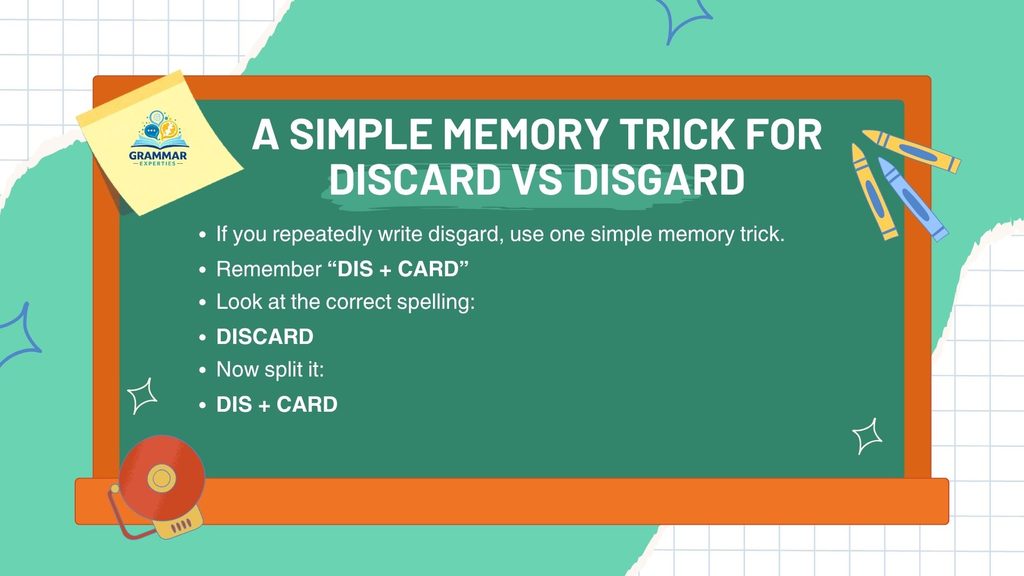
If you repeatedly write disgard, use one simple memory trick.
Remember “DIS + CARD”
Look at the correct spelling:
DISCARD
Now split it:
DIS + CARD
That gives you the correct spelling immediately.
Think about a card game:
You don’t “disgard” a card. You discard a card.
This association makes the spelling much easier to remember.
Remember the Letter C
When you’re unsure, ask yourself:
Does this word contain “card”?
Yes.
Therefore:
DIS + CARD = DISCARD
Not:
DIS + GARD
Memorize One Sentence
You can also memorize a simple example:
Please discard the old papers.
Once you become familiar with the correct spelling in a complete sentence, you’re less likely to reproduce the misspelling.
Real-Life Case Study: A Small Spelling Error in Professional Writing
Imagine a student named Daniel preparing a university research report. While writing his conclusion, he types:
“The researcher decided to disgard the results that were inconsistent with the final analysis.”
The meaning is understandable, but disgard is not the standard spelling. During proofreading, Daniel checks the word in a reputable dictionary and discovers that the correct form is discard.
He changes the sentence to:
“The researcher decided to discard the results that were inconsistent with the final analysis.”
The correction may look small, but it improves the quality and professionalism of the report.
Daniel then notices something else. Discard doesn’t only apply to physical objects. It can also be used with results, ideas, theories, plans, assumptions, strategies, and information. That makes the word much more versatile than he initially realized.
He also encounters the word disregard elsewhere in his report:
“The researcher disregarded the warning.”
At first, Daniel thinks disregard might be another form of discard. However, he learns that the two words have different meanings. To discard something is to get rid of or reject it, while to disregard something is to ignore it.
This example shows why checking a single uncertain spelling can improve more than spelling accuracy. It can also help you understand vocabulary, word relationships, and precise meaning.
For students, bloggers, editors, and professional writers, the lesson is simple: when a spelling looks uncertain, verify it before publishing. A single letter can change the quality of an otherwise well-written piece.
Discard in 2025–2026: What the Current Evidence Shows
For a spelling question such as discard vs disgard, dictionary evidence is more useful than simply counting how often each form appears online.
Current authoritative dictionary entries continue to recognize discard as the standard English word. Cambridge lists discard as a verb meaning to throw something away or get rid of it because it is no longer wanted or needed.
Google Trends can provide useful information about search behavior, but it should not be treated as a dictionary or spelling authority. Google explains that Trends uses aggregated and normalized samples of Google searches rather than publishing absolute search-volume counts.
Google also explains that exact search terms can be analyzed separately, including different spellings and misspellings.
What This Means for Spelling Research
There is an important distinction between search popularity and language correctness.
A misspelled word may appear in searches because people are unsure how to spell it. That doesn’t make the spelling correct.
Therefore, for discard vs disgard, the practical evidence is:
- Discard is the recognized standard word.
- Disgard is a spelling error.
- Dictionary definitions support discard.
- Search data can reveal confusion but cannot by itself establish correct spelling.
Google also notes that very low-volume search terms may not generate meaningful Trends results, which is another reason not to treat missing or limited Trends data as proof that a word is or isn’t correct.
Discard vs Disgard: Quick Comparison
| Feature | Discard | Disgard |
|---|---|---|
| Standard English spelling | ✅ Yes | ❌ No |
| Means “throw away” | ✅ Yes | ❌ No |
| Can refer to rejecting an idea | ✅ Yes | ❌ No |
| Used in card games | ✅ Yes | ❌ No |
| Recommended in formal writing | ✅ Yes | ❌ No |
| Contains “card” | ✅ Yes | ❌ No |
Five-Second Spelling Checklist
When you’re uncertain, follow these steps:
- Identify the meaning. Do you mean “throw away” or “get rid of”?
- Think of the word “card.”
- Add dis- before it.
- Write discard.
- Proofread the sentence once.
For example:
❌ We should disgard these files.
becomes:
✅ We should discard these files.
Mini Quiz:Discard vs Disgard
1. Which spelling is correct?
A. Disgard
B. Discard
C. Discared
D. Discaard
Answer: B. Discard
2. What does discard mean?
A. To keep something
B. To throw away or get rid of something
C. To repair something
D. To copy something
Answer: B. To throw away or get rid of something
3. Choose the correct sentence:
A. Please disgard the old receipt.
B. Please discard the old receipt.
C. Please discart the old receipt.
D. Please discarde the old receipt.
Answer: B. Please discard the old receipt.
4. True or False: Disgard is the standard English spelling.
Answer: False
5. Which word should you use in formal writing?
A. Disgard
B. Discard
C. Disgaurd
D. Discarrd
Answer: B. Discard
6. Complete the sentence:
“Please ______ any damaged forms.”
A. disgard
B. discard
C. discared
D. discart
Answer: B. discard
7. Which is a synonym of discard?
A. Keep
B. Preserve
C. Throw away
D. Collect
Answer: C. Throw away
8. What is the past tense of discard?
A. Discarded
B. Discarding
C. Discardt
D. Discarded
Answer: A. Discarded
9. Which sentence uses discarded correctly?
A. She discarded the broken shoes.
B. She disgard the broken shoes.
C. She discardded the broken shoes.
D. She disguarded the broken shoes.
Answer: A. She discarded the broken shoes.
10. Which spelling is a common mistake?
A. Discard
B. Discarded
C. Disgard
D. Discarding
Answer: C. Disgard
11. What is the easiest way to remember discard?
A. Think of “card” in the word
B. Think of “guard”
C. Think of “garden”
D. Think of “dark”
Answer: A. Think of “card” in the word
12. Choose the correct phrase:
A. Disgard the rubbish
B. Discard the rubbish
C. Disgaurd the rubbish
D. Discaurd the rubbish
Answer: B. Discard the rubbish
13. What does discard mean when talking about an unwanted idea?
A. Accept it
B. Improve it
C. Reject or abandon it
D. Memorize it
Answer: C. Reject or abandon it
14. Fill in the blank:
“The editor decided to ______ the unnecessary paragraph.”
A. disgard
B. discard
C. disguarde
D. discaard
Answer: B. discard
15. Which word is spelled correctly?
A. Discarding
B. Disgarding
C. Discaarding
D. Discardingg
Answer: A. Discarding
16. True or False: Discard can be used for both physical objects and ideas.
Answer: True
17. Which sentence is correct?
A. He decided to discard the outdated plan.
B. He decided to disgard the outdated plan.
C. He decided to disguarde the outdated plan.
D. He decided to discarde the outdated plan.
Answer: A. He decided to discard the outdated plan.
18. Which word is related to discard in a card game?
A. Card
B. Guard
C. Garden
D. Grade
Answer: A. Card
19. What is the opposite of discard?
A. Throw away
B. Reject
C. Keep
D. Remove
Answer: C. Keep
20. Which sentence contains the spelling error?
A. I discarded the empty box.
B. We should discard these old files.
C. She decided to disgard the letter.
D. They are discarding unused items.
Answer: C. She decided to disgard the letter.
21. Choose the correct form:
“The company is ______ outdated equipment.”
A. disgard
B. discard
C. discarding
D. discarded
Answer: C. discarding
22. Which word means to ignore rather than throw away?
A. Discard
B. Disregard
C. Discarding
D. Discarded
Answer: B. Disregard
23. Which sentence correctly uses disregard?
A. Please disregard my previous message.
B. Please discard my previous message because it means ignore.
C. Please disgard my previous message.
D. Please disgaurd my previous message.
Answer: A. Please disregard my previous message.
24. Select the correctly spelled sentence:
A. You can disgard the damaged document.
B. You can disguarde the damaged document.
C. You can discard the damaged document.
D. You can discaard the damaged document.
Answer: C. You can discard the damaged document.
25. Final Challenge: Which statement is correct?
A. Disgard is an alternative spelling of discard.
B. Discard is the correct standard spelling; disgard is a misspelling.
C. Both spellings are equally correct.
D. Discard is only used in American English.
Answer: B. Discard is the correct standard spelling; disgard is a misspelling.
ChatGPT can make mistakes. Check important info.
Frequently Asked Questions About Discard vs Disgard
Q1:Is “disgard” a correct spelling?
No. Disgard is not the standard spelling. The correct spelling is discard.
Q2:Is it discard or disgard?
It is discard.
✅ Please discard the old papers.
❌ Please disgard the old papers.
Q3:What does discard mean?
Discard means to throw something away, get rid of it, reject it, or abandon it because it is unwanted or no longer useful.
Q4:How do you spell discard?
The correct spelling is:
D-I-S-C-A-R-D
Remember:
DIS + CARD = DISCARD
Q5:What is the difference between discard and disregard?
Discard means to get rid of something.
Disregard means to ignore something or pay no attention to it.
For example:
Discard the broken item.
Disregard the previous instruction.
Q6:Can you discard an idea?
Yes. You can discard an idea, plan, theory, assumption, strategy, proposal, or option.
For example:
The team decided to discard its original plan.
Q7:Is “discarded” correct?
Yes. Discarded is the past tense and past participle of discard. Cambridge lists discarded as the past form of the verb.
Q8:What are synonyms for discard?
Depending on the context, synonyms include throw away, get rid of, dispose of, reject, abandon, remove, eliminate, and drop.
Final Verdict: Discard vs Disgard
When it comes to discard vs disgard, the answer is clear: discard is the correct spelling.
Disgard is a misspelling and should be avoided in academic, professional, formal, and everyday writing.
The easiest way to remember the correct spelling is:
DIS + CARD = DISCARD
Use discard when you mean to throw something away, remove it, reject it, or abandon it. The word can describe physical objects, ideas, plans, information, and playing cards.
So, the next time you hesitate between discard and disgard, remember the C in CARD.
Choose “discard” every time.
Explore more easy grammar lessons and improve your English with Grammar Expertise
References

Maimoona Mughal is an English grammar enthusiast dedicated to simplifying confusing words, grammar rules, and vocabulary through clear, accurate, and learner-friendly content that helps readers write and communicate with confidence.