Have you ever heard someone describe themselves as agnostic and wondered what that actually means? The word often appears in conversations about religion, spirituality, philosophy, and personal beliefs. However, many people confuse it with atheism or assume that every agnostic person rejects religion.
Understanding the agnostic meaning is easier than you might think. In simple terms, an agnostic person believes that the existence of God or a higher power is unknown or may be impossible to know with certainty.
The word can also describe someone who remains undecided about a particular subject. In this guide, you will learn the definition of agnostic, its origin, different types, real-life examples, and how to use it correctly in everyday English.
What Does Agnostic Mean? Definition and Explanation
The word agnostic describes someone who believes that the existence of God, a higher power, or certain ultimate truths are unknown or unknowable.
In everyday language, an agnostic person does not claim to have definite knowledge about whether God exists. Instead, they may believe that humans cannot prove or disprove such questions with complete certainty.
According to the Cambridge Dictionary, an agnostic is someone who does not know, or believes it is impossible to know, whether a god exists.
Simple definition: An agnostic is a person who is uncertain about the existence of God or believes that this question cannot be answered with absolute certainty.
For example:
- Sarah describes herself as agnostic because she is unsure whether God exists.
- My friend has agnostic beliefs and prefers to question religious ideas.
- He takes an agnostic position on questions that cannot be scientifically proven.
Agnostic Meaning in Simple Words
In simple words, agnostic means not claiming to know whether something is true, especially when discussing God’s existence.
Imagine someone asks you, “Do you believe in God?”
An agnostic person might answer:
“I don’t know whether God exists, and I don’t think anyone can prove the answer with complete certainty.”
This response explains the basic idea of agnosticism.
However, being agnostic does not automatically mean someone is against religion. Some agnostic people attend religious services, pray, or believe in a higher power. Others do not follow any religious tradition.
Is Agnostic a Noun or an Adjective?
The word agnostic can function as both a noun and an adjective.
As a noun: It describes a person who holds agnostic beliefs.
- My brother is an agnostic.
- Several agnostics attended the discussion.
As an adjective: It describes a belief, attitude, or position based on uncertainty.
- She has an agnostic outlook on religion.
- His approach to spirituality is agnostic.
Both uses are grammatically correct.
What Is the Meaning of Agnosticism?
Agnosticism is the philosophical position associated with the belief that the existence of God or certain ultimate realities is unknown or unknowable.
The distinction is simple:
- Agnostic: A person or something characterized by agnostic beliefs.
- Agnosticism: The belief or philosophical position itself.
For example:
“His agnosticism influences how he approaches religious discussions.”
Here, the noun agnosticism describes his philosophical position.
Origin and History of the Word Agnostic
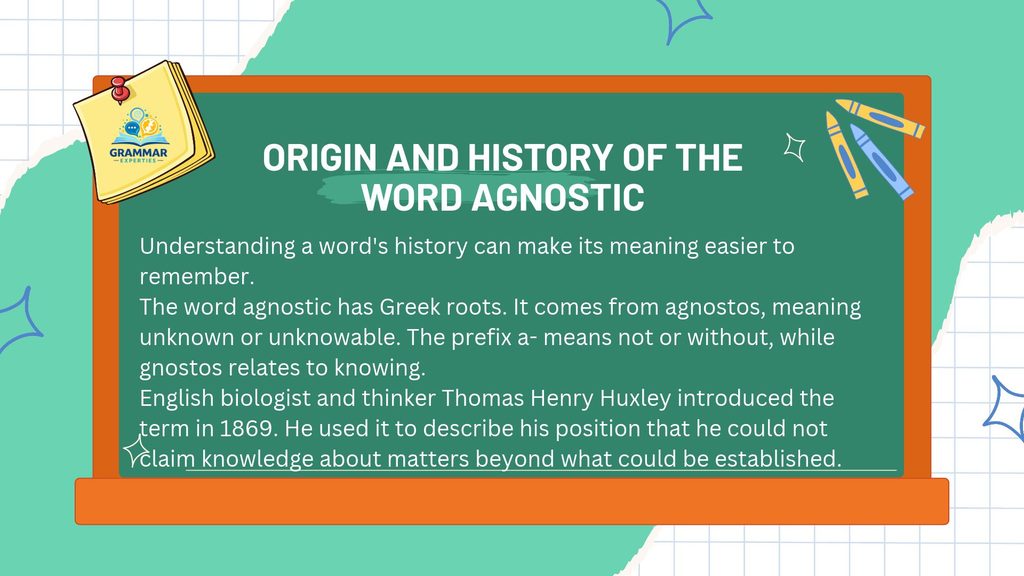
Understanding a word’s history can make its meaning easier to remember.
The word agnostic has Greek roots. It comes from agnostos, meaning unknown or unknowable. The prefix a- means not or without, while gnostos relates to knowing.
English biologist and thinker Thomas Henry Huxley introduced the term in 1869. He used it to describe his position that he could not claim knowledge about matters beyond what could be established.
According to the Online Etymology Dictionary, the word entered English around 1870.
Who Coined the Term Agnostic?
Thomas Henry Huxley is credited with creating the term.
He wanted a word that expressed his position toward religious and philosophical claims. Rather than claiming certainty about matters that could not be established, he emphasized the limits of human knowledge.
His approach helped establish agnostic as an important term in discussions about religion, science, and philosophy.
How the Meaning Developed Over Time
Initially, the word was strongly connected to religious and philosophical questions.
Over time, however, people began using it more broadly.
Today, agnostic can describe uncertainty about different subjects, including politics, science, technology, and personal opinions.
For example:
- I am agnostic about the proposed changes.
- The company remains agnostic about which software platform to choose.
- She is agnostic on the question of whether the new policy will succeed.
In these sentences, the word communicates an open or undecided position rather than a specific religious belief.
Agnostic vs. Atheist: What Is the Difference?
One of the most common misunderstandings about the agnostic meaning is the belief that agnostic and atheist mean exactly the same thing.
Although the words are related to discussions about God, they describe different ideas.
An agnostic position concerns knowledge: whether someone knows or believes that the existence of God can be established.
An atheist position concerns belief: someone who does not believe in the existence of God or gods.
Here is a simple comparison:
| Feature | Agnostic | Atheist |
|---|---|---|
| Main idea | Uncertainty about knowledge | Lack of belief in God |
| Focus | What can be known | What is believed |
| Religious identity | May vary | Generally non-theistic |
| Belief in God | May be uncertain | Does not believe in God |
| Certainty | May consider the answer unknowable | Does not require certainty that God cannot exist |
Can Someone Be Both Agnostic and Atheist?
Yes! A person can be both agnostic and atheist.
These terms are not necessarily opposites because they describe different aspects of someone’s position.
An agnostic atheist does not believe in God but also does not claim to know with absolute certainty that no God exists.
For example:
“I don’t currently believe in God, but I cannot say with certainty that no higher power exists.”
This statement represents an agnostic atheist position.
Similarly, an agnostic theist believes in God but does not claim to know with absolute certainty that God exists.
Agnostic vs. Theist
A theist believes in the existence of God or gods.
An agnostic, in the traditional sense, focuses on whether the existence of God can be known.
Consider these examples:
- Theist: “I believe God exists.”
- Agnostic: “I don’t know whether God exists.”
- Atheist: “I don’t believe in God.”
These descriptions are simplified explanations. In real life, people’s beliefs can be more complicated.
Agnostic vs. Religious
Being agnostic does not always mean being completely nonreligious.
Some people follow religious traditions while acknowledging that they cannot know every spiritual truth with certainty.
For example, someone might participate in Christian practices while describing their knowledge of God’s existence as uncertain.
Therefore, religious practice, personal belief, and philosophical certainty are not always the same thing.
Types of Agnosticism and Their Examples
Agnosticism is not limited to one specific viewpoint. People may approach questions about knowledge and belief in different ways.
Understanding these variations helps explain why two agnostic people might have different opinions.
Strong Agnosticism
Strong agnosticism, sometimes called hard agnosticism, is the position that humans cannot know whether God exists.
People who hold this view believe that the existence of a higher power is beyond the limits of human knowledge.
Example:
“I believe humans cannot discover with certainty whether a supernatural being exists.”
This statement reflects strong agnosticism.
Weak Agnosticism
Weak agnosticism, also known as soft agnosticism, describes someone who does not currently know whether God exists but remains open to discovering an answer.
Unlike strong agnosticism, this position does not necessarily claim that the answer is permanently unknowable.
Example:
“I haven’t found enough evidence to decide whether God exists, but I am open to learning more.”
This is an example of weak agnosticism.
Agnostic Theism
Agnostic theism combines belief in God with uncertainty about whether God’s existence can be known.
An agnostic theist believes in a higher power but does not claim to possess absolute proof.
Example:
“I believe there is a God, although I cannot prove that belief scientifically.”
Agnostic Atheism
Agnostic atheism combines a lack of belief in God with uncertainty about whether God’s existence can be disproven.
Someone with this position does not believe in God but also acknowledges the limits of human knowledge.
Example:
“I don’t believe in a higher power, but I cannot claim to know everything about the universe.”
These categories show that agnosticism is more flexible than many people assume.
How to Use Agnostic in a Sentence: Examples and Everyday Usage
Knowing the definition is important, but learning how to use the word naturally is equally useful.
The word agnostic commonly appears in discussions about religion, philosophy, science, technology, and personal opinions.
Here are practical examples.
Agnostic in Religious Conversations
These examples describe uncertainty about religious beliefs.
- She considers herself agnostic because she is unsure whether God exists.
- My cousin became agnostic after studying different religious philosophies.
- He respects religious traditions but maintains an agnostic position.
- The discussion included Christian, Muslim, atheist, and agnostic perspectives.
- Being agnostic does not mean someone dislikes religion.
Agnostic in Everyday Conversations
The word can also describe someone who has not formed a definite opinion about something.
- I am agnostic about which candidate will win the election.
- She remains agnostic about the company’s future plans.
- We are agnostic about the best approach until we review the evidence.
- He is relatively agnostic when choosing between different brands.
- The manager remained agnostic about the proposed strategy.
Agnostic in Technology and Business
In professional settings, agnostic often means independent of a particular platform, technology, or system.
For example, a platform-agnostic application can work across different platforms without depending on just one.
Consider these examples:
- The software is platform-agnostic and works on different operating systems.
- Our company uses a technology-agnostic approach.
- The system is hardware-agnostic, allowing it to operate with different devices.
In this context, the word does not describe religious uncertainty. Instead, it means that a particular choice or approach is not tied to one specific technology.
Real-Life Example: Understanding an Agnostic Person
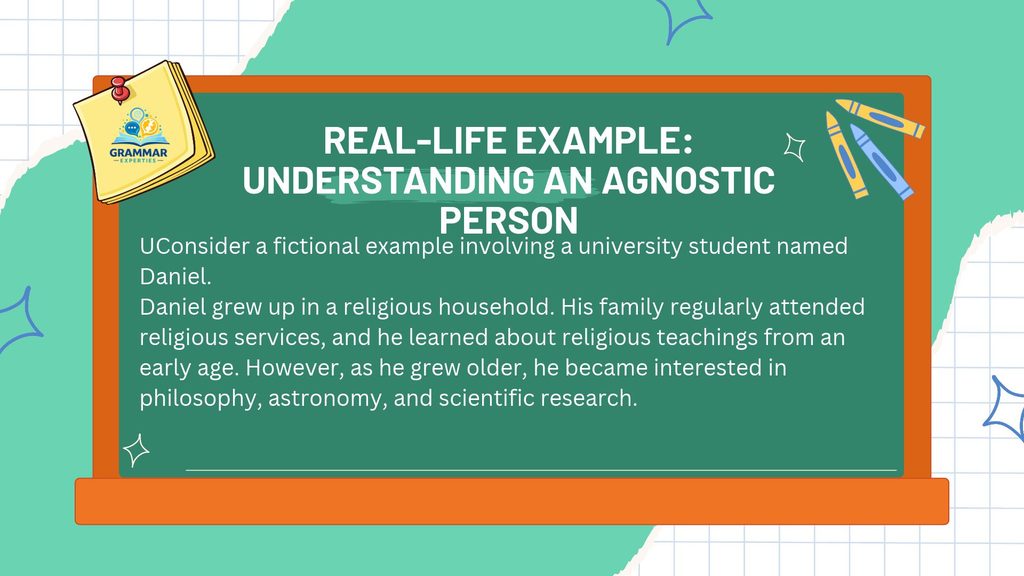
Consider a fictional example involving a university student named Daniel.
Daniel grew up in a religious household. His family regularly attended religious services, and he learned about religious teachings from an early age. However, as he grew older, he became interested in philosophy, astronomy, and scientific research.
During university, Daniel began discussing questions about the universe, human existence, and the possibility of a higher power with his classmates. Some believed strongly in God, while others identified as atheists.
Daniel did not feel comfortable accepting or rejecting every claim without examining it. He believed that some questions about existence were difficult to answer because humans have limited knowledge.
When his classmates asked whether he believed in God, he explained that he was still uncertain. He respected other people’s religious beliefs but did not claim to know whether a higher power existed.
Eventually, Daniel started describing himself as agnostic.
His position did not mean that he hated religion, rejected everyone else’s beliefs, or had stopped thinking about spirituality. It simply reflected his uncertainty about a question he considered difficult to answer.
This example demonstrates an important point: An agnostic person does not necessarily reject religion. The term describes their position regarding knowledge and certainty.
It also shows why understanding the difference between belief and knowledge is essential when discussing agnosticism.
Agnostic Meaning in 2025–2026: Statistics and Modern Usage
Agnosticism remains relevant in modern conversations about religion, personal identity, spirituality, and philosophy.
Recent research also helps explain how people identify themselves in relation to religious beliefs.
According to Pew Research Center’s 2025 Religious Landscape Study, based on its 2023–24 survey of U.S. adults:
| Religious identity | Percentage of U.S. adults |
|---|---|
| Christian | 62% |
| Atheist | 5% |
| Agnostic | 6% |
| Nothing in particular | 19% |
| Other religions | 7% |
The figures are rounded and may not add up to exactly 100%.
The study found that approximately 29% of American adults were religiously unaffiliated. This group included atheists, agnostics, and people who described their religion as nothing in particular.
What Do These Statistics Tell Us?
There are three important observations:
- Agnosticism is a distinct identity: The 6% who identified as agnostic were counted separately from atheists and people who selected nothing in particular.
- Religious identity is diverse: People who do not identify with a religion do not necessarily share identical beliefs.
- Uncertainty does not always mean a lack of spirituality: Pew Research Center’s September 2025 international research found that many religiously unaffiliated adults still hold spiritual beliefs.
It is important to understand that these figures describe religious identification, not a direct measurement of how frequently people use the word agnostic.
The research also focuses on specific surveyed populations, so U.S. percentages should not be treated as worldwide statistics.
Why Is Understanding Agnosticism Important Today?
Modern society includes people with different religious, cultural, and philosophical backgrounds.
Understanding the term helps people:
- Communicate respectfully about religious differences.
- Avoid confusing atheism with agnosticism.
- Understand philosophical discussions about knowledge.
- Use the word correctly in writing and conversation.
- Recognize that personal beliefs can be complex.
As a result, knowing the meaning of agnostic is useful for both English learners and people interested in contemporary discussions about spirituality.
Common Mistakes When Using the Word Agnostic
Although agnostic is not a particularly difficult word, people sometimes misunderstand its meaning or use it incorrectly.
Here are some common mistakes to avoid.
Mistake 1: Thinking Agnostic Means Atheist
Agnosticism and atheism are related but not identical.
Agnosticism concerns knowledge, while atheism concerns belief.
A person may be both agnostic and atheist, but the terms are not interchangeable in every situation.
Mistake 2: Assuming Every Agnostic Person Rejects Religion
Some agnostic people participate in religious activities or believe in a higher power.
The term does not automatically describe someone’s religious practices.
Mistake 3: Using Agnostic Only in Religious Discussions
The word also appears in professional and technical contexts.
For example:
“Our new application is platform-agnostic.”
This means the application is not restricted to one particular platform.
Mistake 4: Confusing Agnostic With Indifferent
An agnostic person may care deeply about questions concerning God, spirituality, and existence.
Being uncertain does not mean being uninterested.
For example:
“She is agnostic about God’s existence but spends considerable time studying religious philosophy.”
This sentence is perfectly understandable.
Quick Checklist: Are You Using Agnostic Correctly?
- Use agnostic to describe uncertainty about knowledge or the existence of God.
- Use agnosticism when referring to the philosophical position.
- Remember that an agnostic person may still believe in God.
- Do not automatically treat agnostic and atheist as synonyms.
- Use the word in broader contexts when describing an undecided or neutral position.
- Use agnostic as either a noun or adjective, depending on the sentence.
Mini Quiz:Agnostic Meaning
1. What does the word agnostic mean?
A. Someone who follows every religion
B. Someone uncertain whether God exists
C. Someone who studies history
D. Someone who rejects science
Answer: B. Someone uncertain whether God exists
2. What is the noun form of agnostic?
A. Agnosticism
B. Agnostically
C. Agnostical
D. Agnosticate
Answer: A. Agnosticism
3. Who introduced the term agnostic?
A. Charles Darwin
B. Isaac Newton
C. Thomas Henry Huxley
D. Albert Einstein
Answer: C. Thomas Henry Huxley
4. In which year did Thomas Henry Huxley introduce the term agnostic?
A. 1850
B. 1869
C. 1885
D. 1900
Answer: B. 1869
5. What is the Greek meaning associated with the word agnostic?
A. Unknown or unknowable
B. Religious or spiritual
C. Wise or intelligent
D. Powerful or strong
Answer: A. Unknown or unknowable
6. Is agnostic a noun or an adjective?
A. Only a noun
B. Only an adjective
C. Both a noun and an adjective
D. Neither
Answer: C. Both a noun and an adjective
7. Which sentence uses agnostic correctly?
A. She is an agnostic about God’s existence.
B. She agnostic the book yesterday.
C. He agnostic quickly.
D. They are agnosticly students.
Answer: A. She is an agnostic about God’s existence.
8. What is the difference between agnostic and atheist?
A. They always mean exactly the same thing.
B. Agnostic concerns knowledge, while atheist concerns belief.
C. Atheist means religious, while agnostic means spiritual.
D. Agnostic means believing in every religion.
Answer: B. Agnostic concerns knowledge, while atheist concerns belief.
9. Can someone be both agnostic and atheist?
A. Yes
B. No
C. Only in certain countries
D. Only in ancient history
Answer: A. Yes
10. What does agnostic theism describe?
A. Believing in God without claiming certain knowledge
B. Rejecting every religious tradition
C. Believing that science is impossible
D. Denying all spiritual questions
Answer: A. Believing in God without claiming certain knowledge
11. What does agnostic atheism describe?
A. Believing in multiple gods
B. Not believing in God while acknowledging uncertainty about knowledge
C. Following a particular religion
D. Claiming complete knowledge of the universe
Answer: B. Not believing in God while acknowledging uncertainty about knowledge
12. What is strong agnosticism?
A. The belief that humans cannot know whether God exists
B. The belief that every religion is correct
C. The belief that science answers everything
D. The belief that God definitely exists
Answer: A. The belief that humans cannot know whether God exists
13. What is weak agnosticism?
A. Refusing to discuss religion
B. Not currently knowing whether God exists but remaining open to an answer
C. Believing that all religions are identical
D. Rejecting every philosophical question
Answer: B. Not currently knowing whether God exists but remaining open to an answer
14. Does being agnostic automatically mean rejecting religion?
A. Yes
B. No
C. Only for students
D. Only for adults
Answer: B. No
15. Which sentence uses agnostic in a technology-related context?
A. She is an agnostic person.
B. The software is platform-agnostic.
C. He studies agnosticism.
D. They discussed religious beliefs.
Answer: B. The software is platform-agnostic.
16. What does platform-agnostic mean?
A. A system that works with only one platform
B. A system that is not restricted to one particular platform
C. A system that cannot use technology
D. A system designed only for religious users
Answer: B. A system that is not restricted to one particular platform.
17. Which word is closest in meaning to agnostic in everyday usage?
A. Certain
B. Undecided
C. Confident
D. Determined
Answer: B. Undecided
18. Choose the grammatically correct sentence.
A. My friend are agnostic.
B. My friend is agnostic.
C. My friend agnostic is.
D. My friend be agnostic.
Answer: B. My friend is agnostic.
19. What does agnosticism primarily concern?
A. Human knowledge and certainty
B. Physical fitness
C. Economic growth
D. Language pronunciation
Answer: A. Human knowledge and certainty
20. Which sentence uses the noun agnosticism correctly?
A. His agnosticism influences his philosophical views.
B. He agnosticism every morning.
C. Her agnosticismly opinion was interesting.
D. They agnosticism the discussion.
Answer: A. His agnosticism influences his philosophical views.
21. Can an agnostic person believe in a higher power?
A. Yes
B. No
C. Never
D. Only in fiction
Answer: A. Yes
22. What does the word theist mean?
A. Someone who believes in God or gods
B. Someone who studies grammar
C. Someone who rejects all knowledge
D. Someone who is always undecided
Answer: A. Someone who believes in God or gods.
23. Which statement about agnosticism is correct?
A. Every agnostic person is an atheist.
B. Every agnostic person rejects religion.
C. Agnosticism can describe different positions about knowledge.
D. Agnosticism is only used in technology.
Answer: C. Agnosticism can describe different positions about knowledge.
24. What is the correct adjective form in this sentence: “She has an _____ outlook on spirituality”?
A. Agnosticism
B. Agnostic
C. Agnostically
D. Agnosticate
Answer: B. Agnostic
25. Which statement best summarizes the meaning of agnostic?
A. A person who knows everything about religion
B. A person who follows every religious belief
C. A person who is uncertain whether God exists or whether this can be known
D. A person who rejects every scientific explanation
Answer: C. A person who is uncertain whether God exists or whether this can be known
Frequently Asked Questions (FAQs) About Agnostic Meaning
Q1: What does agnostic mean in simple words?
Agnostic means someone who does not know whether God exists or believes that the existence of God cannot be known with certainty. It describes uncertainty about knowledge rather than a definite religious belief.
Q2: Is an agnostic person religious?
An agnostic person may or may not be religious. Some participate in religious traditions and believe in a higher power, while others do not follow any religion.
Q3: What is the difference between agnostic and atheist?
An agnostic is uncertain about whether God’s existence can be known. An atheist does not believe in the existence of God or gods. However, someone can identify as both an agnostic and an atheist.
Q4: Can an agnostic believe in God?
Yes. An agnostic person can believe in God while acknowledging that they cannot prove God’s existence with absolute certainty. This position is known as agnostic theism.
Q5: What is the opposite of agnostic?
There is no single universally accepted opposite of agnostic. Depending on the context, a person who claims certain knowledge about God’s existence may hold a gnostic position. In everyday religious discussions, theist and atheist describe different positions about belief rather than direct opposites of agnostic.
Q6: What is agnosticism?
Agnosticism is the philosophical position that the existence of God or certain ultimate realities is unknown or unknowable. It emphasizes the limits of human knowledge and certainty.
Q7: Can someone become agnostic?
Yes. People may describe themselves as agnostic after exploring different religious beliefs, philosophical arguments, and scientific perspectives. Personal beliefs can also change over time.
Q8: How do you use agnostic in a sentence?
Here are two examples:
- “My friend is agnostic because she is unsure whether God exists.”
- “The company takes an agnostic approach to technology and does not depend on one particular platform.”
Both sentences use the word correctly, although they describe different contexts.
Conclusion: Understanding the Agnostic Meaning
Understanding the agnostic meaning helps you recognize how people express uncertainty about religion, spirituality, and knowledge.
An agnostic person does not claim to know whether God exists or may believe that such knowledge is impossible to obtain. However, agnosticism does not automatically mean rejecting religion or believing that God does not exist.
The word can also describe a neutral or undecided position in everyday discussions, business, and technology.
Remember the key difference: Agnosticism concerns knowledge, while atheism concerns belief.
Whether you are learning English, exploring philosophical ideas, or improving your vocabulary, understanding this word can help you communicate more accurately.
Explore more easy grammar lessons and improve your English with Grammar Expertise
References
- Cambridge Dictionary – Agnostic Meaning
- Pew Research Center – Religious Identity in the United States (2025)

Maimoona Mughal is an English grammar enthusiast dedicated to simplifying confusing words, grammar rules, and vocabulary through clear, accurate, and learner-friendly content that helps readers write and communicate with confidence.