Have you ever wondered whether you should write any time or anytime? Both spellings appear in everyday English, emails, articles, text messages, and professional writing. However, choosing the correct form depends on how you use it in a sentence.
The difference between any time vs anytime is mainly grammatical. Anytime is commonly used as an adverb meaning whenever or at any time. Any time can also function as an adverbial expression, but it is required when referring to an amount of time or when it follows a preposition such as at.
For example:
- You can call me anytime.
- You can call me at any time.
- Do you have any time to help me?
All three sentences are correct, but their grammatical structures are different.
In this guide, you’ll learn the meaning of both spellings, their grammar rules, differences, common mistakes, and practical examples. By the end, you’ll know exactly when to write any time and when to use anytime.
What Is the Difference Between Any Time and Anytime?
The main difference between any time and anytime is their grammatical function. Although they can communicate similar ideas, they are not interchangeable in every sentence.
Anytime is generally written as one word when it functions as an adverb meaning whenever or at any time. Any time is written as two words when it functions as a noun phrase referring to an unspecified amount or period of time. It is also used after prepositions such as at.
Consider these examples:
- You can visit us anytime.
- You can visit us at any time.
- I don’t have any time today.
- Anytime you need help, contact me.
The first and fourth examples use anytime naturally as an adverb. The second uses any time after the preposition at. The third uses any time as a noun phrase describing an amount of available time.
Quick Comparison of Any Time vs Anytime
| Feature | Any Time | Anytime |
|---|---|---|
| Spelling | Two words | One word |
| Main grammatical role | Noun phrase; also adverbial phrase | Adverb |
| Meaning | An unspecified time or amount of time | Whenever or at any time |
| Used after “at” | Yes | No |
| Used for an amount of time | Yes | No |
| Example | I don’t have any time. | Call me anytime. |
Both forms are accepted in standard English, but their grammatical roles determine which spelling you should choose.
Is Any Time or Anytime More Correct?
Neither spelling is universally more correct. Both are standard English forms.
However, anytime is particularly common in American English as an adverb. In British English, any time is also widely used in this role, although anytime is accepted too.
For formal writing, using any time can sometimes be the safer choice when you are unsure about the sentence structure. Nevertheless, you should always use two words after a preposition such as at.
When to Use Anytime (One Word)
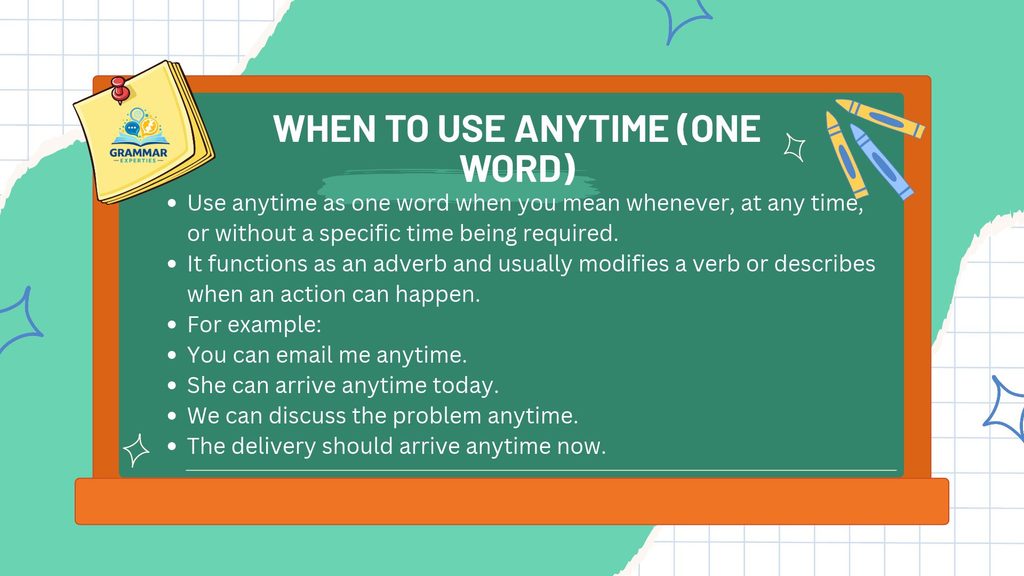
Use anytime as one word when you mean whenever, at any time, or without a specific time being required.
It functions as an adverb and usually modifies a verb or describes when an action can happen.
For example:
- You can email me anytime.
- She can arrive anytime today.
- We can discuss the problem anytime.
- The delivery should arrive anytime now.
In these sentences, anytime indicates that an action can happen without requiring a fixed time.
1. Use Anytime to Mean Whenever
One of the most common uses of anytime is to express whenever something happens or whenever someone wants to do something.
Examples:
- Anytime you need assistance, call our office.
- You can visit my house anytime.
- Anytime she feels tired, she takes a short break.
- I am available anytime you want to talk.
In each example, you can replace anytime with whenever without changing the basic meaning.
For instance:
Original: You can contact me anytime.
Alternative: You can contact me whenever you want.
Both sentences communicate the same idea.
2. Use Anytime in Everyday Conversations
Anytime is especially natural in informal conversations, messages, emails, and friendly communication.
Examples:
- Come over anytime!
- We can meet anytime this weekend.
- Let me know anytime you need something.
- You are welcome to visit anytime.
It makes your message sound friendly and flexible.
However, remember that the one-word form should not be used after the preposition at.
Incorrect: You can call me at anytime.
Correct: You can call me at any time.
3. Use Anytime in Expressions Like Anytime Soon
Another common expression is anytime soon.
It usually appears in negative sentences and questions when discussing whether something will happen in the near future.
Examples:
- I don’t think the weather will improve anytime soon.
- Is the manager coming back anytime soon?
- The company isn’t planning to launch the product anytime soon.
- We don’t expect any major changes anytime soon.
You may also encounter the two-word spelling any time soon. Both forms are used, although style preferences can differ.
4. Use Anytime as a Response to Thank You
Anytime! can also be used as a friendly response when someone thanks you.
For example:
Person A: Thank you for helping me with my assignment.
Person B: Anytime! I’m happy to help.
Here, anytime communicates that you are happy to help again whenever needed.
Other examples include:
- Thanks for your support! — Anytime!
- I appreciate your help. — Anytime!
- Thank you for visiting. — Anytime!
This expression is common in informal English and friendly professional conversations.
When to Use Any Time (Two Words)
Use any time as two separate words when you are talking about an amount of time, using it as a noun phrase, or placing it after a preposition.
This distinction is particularly important because replacing the two-word form with anytime can make a sentence grammatically incorrect.
1. Use Any Time for an Amount of Time
When you are discussing whether someone has enough free time, available time, or time to complete something, use any time.
Examples:
- I don’t have any time to waste.
- Do you have any time this afternoon?
- She doesn’t have any time for unnecessary meetings.
- We need any time we can get.
Notice that time is functioning as a noun in these examples.
Compare:
Correct: Do you have any time to talk?
Incorrect: Do you have anytime to talk?
The first sentence asks whether someone has available time. Therefore, the two-word spelling is necessary.
2. Use Any Time After a Preposition
This is one of the easiest rules to remember.
When any time follows a preposition such as at, write it as two words.
Examples:
- You can contact me at any time.
- The website is accessible at any time of the day.
- She can leave at any time.
- Customers can request assistance at any time.
The word at introduces a prepositional phrase, so any time remains separate.
Incorrect: Please call me at anytime.
Correct: Please call me at any time.
This rule is especially useful when writing formal emails, business documents, and academic assignments.
3. Use Any Time as the Subject of a Sentence
Sometimes, any time functions as the subject of a sentence.
In this situation, it refers to an unspecified period or opportunity.
Examples:
- Any time is a good time to learn something new.
- Any time spent with family is valuable.
- Any time you save can be used for something productive.
- Any time available should be used wisely.
Here, any modifies the noun time. Therefore, the two-word spelling is appropriate.
4. Use Any Time When Referring to a Specific Period
You should also use two words when you are talking about a particular period or amount of time.
Examples:
- We didn’t have any time during the meeting.
- She needs any time available to finish her project.
- I haven’t had any time to relax this week.
- They spent almost any time they could together.
The important point is that time is being treated as a noun rather than an adverb.
Any Time vs Anytime: Important Grammar Rules and Examples
Understanding the grammatical difference makes it easier to choose the correct spelling without memorizing hundreds of sentences.
Here are the most useful rules to follow.
Rule 1: Replace Anytime With Whenever
If you can replace anytime with whenever and the sentence still makes sense, the one-word spelling is generally appropriate.
Examples:
- Call me anytime.
- Call me whenever you want.
Both sentences are correct.
Another example:
- Anytime she visits, she brings a gift.
- Whenever she visits, she brings a gift.
The meaning remains almost identical.
Rule 2: Use Any Time After At
Whenever you use the preposition at immediately before the expression, write any time as two words.
Examples:
| Incorrect | Correct |
|---|---|
| Call me at anytime. | Call me at any time. |
| You can visit at anytime. | You can visit at any time. |
| The service is available at anytime. | The service is available at any time. |
This is a straightforward rule that can prevent many common spelling mistakes.
Rule 3: Use Any Time When Talking About Available Time
When asking whether someone has free time or explaining that someone lacks time, use two words.
Examples:
- Do you have any time for a meeting?
- I don’t have any time to prepare.
- We need any time we can save.
The word time is a noun in these sentences.
Rule 4: Both Forms Can Work as Adverbial Expressions
This is where some confusion occurs.
Both anytime and any time can express the meaning of whenever or at an unspecified time.
Examples:
- You can call me anytime.
- You can call me any time.
Both are acceptable in this adverbial use.
However, when a preposition introduces the expression, or when time refers to an amount, the two-word spelling is necessary.
Rule 5: Consider Your Writing Style and Audience
Although both spellings are accepted, consistency matters.
For example:
- In casual messages, anytime is natural and conversational.
- In formal writing, any time may be preferred by some style guides.
- In sentences containing at, always use any time.
Following these guidelines helps you maintain clear and consistent writing.
Real-Life Examples: Any Time vs Anytime in Everyday English
Understanding grammar rules is useful, but seeing them in realistic situations makes them easier to remember.
Consider the following example involving a student, a teacher, and an assignment.
Case Study: A Student Writing an Email to a Teacher
Imagine a university student named Sarah who needs help with an important research assignment. She wants to email her teacher to ask for guidance and arrange a meeting.
Initially, Sarah writes:
“Dear Professor, I can meet you at anytime this week. I also need anytime to discuss my research project.”
Although her message is understandable, it contains two spelling mistakes.
The first mistake appears in the expression at anytime. Since the word at is a preposition, the correct form is at any time.
The second mistake appears in need anytime. Sarah is talking about the amount of time she needs to discuss her project. Therefore, she should use any time as two words.
A corrected version would be:
“Dear Professor, I can meet you at any time this week. I also need any time you can spare to discuss my research project.”
However, the second sentence could sound more natural with a slight improvement:
“Dear Professor, I would appreciate any time you can spare to discuss my research project.”
Now consider another situation. Sarah’s professor replies:
“You can contact me anytime if you have additional questions.”
This sentence is correct because anytime means whenever. It functions as an adverb and does not follow a preposition.
Through these examples, Sarah learns that the spelling depends on the grammatical function rather than simply the intended meaning.
The lesson: Even when two expressions communicate similar ideas, their grammatical roles can determine whether they should be written together or separately.
This distinction is useful in academic writing, professional emails, online communication, and everyday conversations.
Common Mistakes to Avoid When Using Any Time and Anytime
Even experienced English writers sometimes confuse these expressions. Most mistakes happen because people focus on pronunciation instead of grammatical function.
Here are some common errors and their corrections.
1. Writing Anytime After At
Incorrect: You can reach our support team at anytime.
Correct: You can reach our support team at any time.
Why? The preposition at requires the two-word expression in this construction.
2. Using Anytime to Describe Free Time
Incorrect: Do you have anytime for lunch?
Correct: Do you have any time for lunch?
Why? The sentence asks whether someone has available time. Here, time is a noun.
3. Confusing Anytime With Every Time
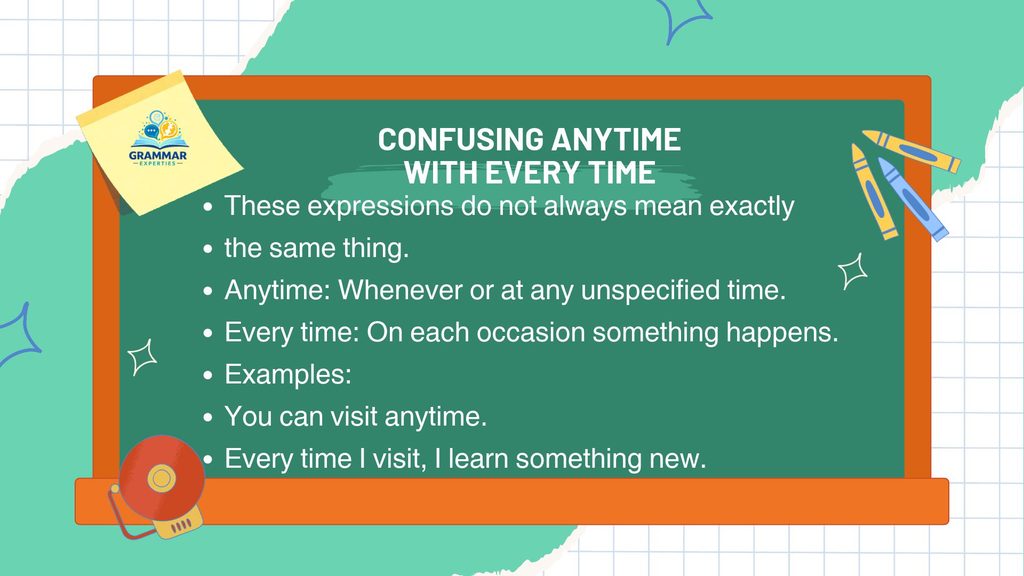
These expressions do not always mean exactly the same thing.
- Anytime: Whenever or at any unspecified time.
- Every time: On each occasion something happens.
Examples:
- You can visit anytime.
- Every time I visit, I learn something new.
The first sentence expresses flexibility. The second refers to repeated occasions.
4. Assuming Anytime Is Always More Modern or Correct
Some writers believe that the one-word spelling is always better because it looks shorter.
However, this is not true.
For example:
Incorrect: I don’t have anytime to finish this work.
Correct: I don’t have any time to finish this work.
Grammar is more important than choosing the shorter spelling.
5. Ignoring the Difference in Formal Writing
In professional communication, small grammatical errors can affect the clarity and presentation of your writing.
For example:
Less appropriate: You may contact us at anytime.
Better: You may contact us at any time.
The corrected version follows standard usage and reads naturally.
2025–2026 Usage Insights: What Do Dictionaries and Language Resources Say?
English spelling and usage continue to evolve. However, there is an important distinction between a word becoming more common and a grammar rule changing.
The difference between any time and anytime remains relevant in modern English writing.
What Current Language Resources Confirm
Several established language resources recognize both forms:
- Cambridge Dictionary: Defines anytime as an adverb meaning at a time that is not specified or does not need to be decided. It also recognizes any time as a British English form.
- Merriam-Webster: Explains that anytime is generally an adverb, while any time can function as a noun phrase or an adverbial expression. It also discusses the importance of prepositions in choosing the correct form.
- Grammarly: Explains that both spellings can work adverbially, but any time is required when referring to an amount of time or following a preposition such as at.
Is There Statistical Data for 2025–2026?
There is no reliable, universally accepted 2025–2026 statistic establishing what percentage of English writers use anytime compared with any time.
It would be misleading to invent a percentage or claim that one spelling has replaced the other.
However, Google Books Ngram Viewer provides a useful way to investigate historical word and phrase frequency in published books. Its July 2024 release notes describe an updated dataset and explain that its graphs represent occurrences in a book corpus rather than real-time internet usage.
This distinction matters because:
- Dictionary definitions establish accepted meanings and usage.
- Published-book corpora help researchers examine historical frequency.
- Search trends measure interest in search terms, not necessarily correct grammatical usage.
- None of these measurements alone proves that one spelling is grammatically superior.
The practical takeaway for 2025–2026: Both forms remain accepted. Choose the spelling according to its grammatical function rather than assuming that one is universally better.
How to Remember the Difference Between Any Time and Anytime
If you still struggle to choose between these expressions, use the following simple checklist.
A Simple Step-by-Step Guide
Step 1: Check whether you are talking about an amount of time.
If you are discussing available, limited, or sufficient time, use any time.
Example: I don’t have any time today.
Step 2: Look for the preposition at.
If the expression follows at, use any time.
Example: You can call me at any time.
Step 3: Try replacing the word with whenever.
If the sentence still makes sense, anytime is generally appropriate.
Example: Visit me anytime.
Replacement: Visit me whenever you want.
Step 4: Check the sentence’s grammatical structure.
If time is acting as a noun, keep the words separate. If the expression functions as an adverb, the one-word form is acceptable.
Step 5: Consider your audience.
For formal writing, you can choose any time in adverbial situations if you prefer a more traditional style. However, do not combine the words when the grammar requires two words.
Easy Memory Trick
Remember these two simple points:
- Anytime = Whenever.
- Any time = An amount of time or a phrase following a preposition.
For example:
- Call me anytime. (Whenever)
- I don’t have any time. (Amount of time)
- Call me at any time. (After a preposition)
If you remember these examples, choosing the correct spelling becomes much easier.
Mini Quiz: Any Time vs. Anytime
1. Choose the correct word:
You can call me ______ you need help.
Answer: Anytime
2. Fill in the blank:
Do you have ______ to talk today?
Answer: Any time
3. Choose the correct sentence:
A. You can visit me any time.
B. You can visit me anytime.
Answer: Both are correct.
4. Fill in the blank:
I don’t have ______ to waste.
Answer: Any time
5. Choose the correct word:
You are welcome to contact us ______.
Answer: Anytime
6. Which phrase means “at any moment”?
A. Any time
B. Anytime
Answer: Anytime
7. Fill in the blank:
Is there ______ available for a quick meeting?
Answer: Any time
8. Choose the correct sentence:
A. I can help you anytime.
B. I can help you anytimes.
Answer: A. I can help you anytime.
9. Fill in the blank:
You can start the course ______ you are ready.
Answer: Anytime
10. Choose the correct word:
I don’t think we have ______ left.
Answer: Any time
11. Which spelling is correct?
A. Any time
B. Anytimes
C. Anytyme
Answer: A. Any time
12. Fill in the blank:
You can leave ______ after the meeting.
Answer: Anytime
13. Choose the correct phrase:
Do you have ______ this weekend?
Answer: Any time
14. True or False:
“Anytime” is usually written as one word when it means “whenever.”
Answer: True
15. Fill in the blank:
I can meet you at ______ that suits you.
Answer: Any time
16. Choose the correct sentence:
A. Anytime I see her, she smiles.
B. Any time I see her, she smiles.
Answer: Both can be correct, but “anytime” is more common in informal usage.
17. Fill in the blank:
Thank you for your help. You can call me ______.
Answer: Anytime
18. Which phrase is generally used before “to”?
A. Any time
B. Anytime
Answer: Any time
19. Correct the mistake:
You can visit us anytimes.
Answer: You can visit us anytime.
20. Fill in the blank:
We don’t have ______ for another discussion.
Answer: Any time
21. Choose the correct word:
Please feel free to ask questions ______.
Answer: Anytime
22. True or False:
“Any time” is always incorrect when used without the word “at.”
Answer: False
23. Fill in the blank:
I would appreciate ______ you can give me.
Answer: Any time
24. Choose the correct sentence:
A. You can access the website anytime.
B. You can access the website anytimes.
Answer: A. You can access the website anytime.
25. Complete the sentence:
If you need advice, you can reach out to me ______.
Answer: Anytime
Frequently Asked Questions (FAQs)
Q1: Is Anytime One Word or Two Words?
Both anytime and any time are correct English forms. Use anytime as an adverb meaning whenever. Use any time when referring to an amount of time or after a preposition such as at.
Q2: Is It Correct to Say at Anytime or at Any Time?
The correct expression is at any time. The word at is a preposition, so the two-word spelling is required.
Example:
- Correct: You can contact me at any time.
- Incorrect: You can contact me at anytime.
Q3: Can I Use Anytime in Formal Writing?
Yes. Anytime is an accepted English adverb. However, some formal writing styles prefer any time. Follow your organization’s style guide and use the spelling that fits the grammatical structure.
Q4: What Does Anytime Mean?
Anytime means whenever or at any unspecified time. It indicates that something can happen without requiring a particular time.
Example: You can visit my office anytime.
Q5:What Does Any Time Mean?
Any time can refer to an unspecified period or amount of time. It can also function as an adverbial phrase meaning at any time.
Examples:
- Do you have any time to help?
- You can call me at any time.
Q6: Is Any Time Soon Correct?
Yes. Both any time soon and anytime soon are accepted expressions.
Example:
- I don’t think the situation will change any time soon.
- I don’t think the situation will change anytime soon.
Both sentences are correct.
Q7: Is Anytime Accepted in British English?
Yes. Although any time has traditionally been common in British English, anytime is also recognized. Cambridge Dictionary identifies any time as a British English alternative.
Q8: What Is the Easiest Way to Remember Any Time vs Anytime?
The easiest way is to remember that anytime means whenever, while any time refers to an amount of time or follows a preposition such as at.
For example:
- Call me anytime.
- I don’t have any time.
- Call me at any time.
Conclusion: Any Time vs Anytime – Which One Should You Use?
Understanding any time vs anytime is easier when you focus on grammar rather than spelling alone.
Both forms are correct, but they serve different grammatical purposes.
Use anytime as an adverb when you mean whenever or at any unspecified time. Use any time when discussing an amount of time, using time as a noun, or placing the expression after a preposition such as at.
Remember these three examples:
- Call me anytime.
- I don’t have any time.
- You can contact me at any time.
These simple rules will help you avoid common spelling mistakes and improve your English writing.
Explore more easy grammar lessons and improve your English with Grammar Expertise
References

Maimoona Mughal is an English grammar enthusiast dedicated to simplifying confusing words, grammar rules, and vocabulary through clear, accurate, and learner-friendly content that helps readers write and communicate with confidence.