Have you ever wondered whether association and organization mean the same thing? The two words are closely related, and in many sentences, they can be used interchangeably. However, there are important differences in emphasis, context, and usage.
An association usually refers to a group of people or organizations connected by a shared interest, profession, purpose, or activity. An organization is a broader term for a structured group formed to achieve a particular purpose.
In simple terms, an association can be an organization, but not every organization is an association.
This guide explains the difference between association vs organization, including their meanings, examples, grammatical usage, common contexts, and practical ways to choose the right word.
Association vs Organization: Quick Answer
What does association mean?
An association is a group of people or organizations that come together because they share a common interest, profession, purpose, or goal.
For example:
- a teachers’ association
- a professional association
- an alumni association
- a homeowners association
- a trade association
The word often emphasizes membership and shared interests.
What does organization mean?
An organization is a structured group of people working together for a specific purpose or goal.
For example:
- a nonprofit organization
- a business organization
- a charitable organization
- an international organization
- a government organization
The word generally emphasizes structure, purpose, administration, or coordinated activity.
The simplest distinction
| Association | Organization |
|---|---|
| Usually connected by shared interests or membership | Broad term for a structured group |
| Often membership-focused | Often structure- or purpose-focused |
| Common in professional and social groups | Used across business, nonprofit, government, and other contexts |
| Can be a type of organization | Includes many types of groups |
| Example: teachers’ association | Example: charitable organization |
The distinction is not absolute. In everyday English, the words can overlap.
What Does Association Mean?
An association is a group of people or organizations that are connected by a common interest, profession, purpose, or activity.
Cambridge Dictionary defines an association, in one of its group-related meanings, as a group of people who work together for a particular purpose. It also gives examples such as professional and national associations.
Association meaning
The most common meaning of association is:
A group of people or organizations joined together because they have a common interest, purpose, or connection.
For example:
The teachers joined a national education association.
Here, the word association highlights the fact that the teachers belong to a group connected with their profession.
Common types of associations
Associations can appear in many areas of life.
Professional associations
Professional associations bring together people working in the same field.
Examples include:
- medical associations
- legal associations
- engineering associations
- teachers’ associations
- accountants’ associations
Their activities may include professional development, networking, advocacy, conferences, publications, and member services.
Community associations
A community association may represent people living in a particular area.
For example:
The neighborhood association organized a community cleanup.
The members have a shared geographical interest.
Alumni associations
An alumni association connects former students of a school, college, or university.
For example:
The university’s alumni association holds an annual dinner.
The shared connection is attending the same educational institution.
Trade associations
A trade association usually represents businesses or professionals within a particular industry.
For example:
The trade association published new industry guidelines.
In this context, association strongly suggests a group formed around a shared professional or commercial interest.
What Does Organization Mean?
An organization is a broader word that refers to a group of people arranged or structured to accomplish a particular purpose.
It can describe businesses, charities, government bodies, nonprofits, clubs, institutions, and many other groups.
Organization meaning
A simple definition is:
An organization is a structured group of people working together toward a particular purpose or goal.
For example:
The organization provides educational resources to students.
The word does not necessarily tell us why the members joined or whether membership is the central feature.
Types of organizations
The term organization has a very broad range of uses.
Business organizations
A company can be described as an organization.
For example:
The organization employs more than 500 people.
Here, the focus is on the company’s structure and operations.
Nonprofit organizations
Charities and other mission-driven groups are commonly called nonprofit organizations.
For example:
The nonprofit organization provides food to families in need.
The word organization works naturally because the group has a defined structure and mission.
Government organizations
Government bodies can also be described as organizations.
For example:
The organization manages public transportation programs.
International organizations
Large bodies working across countries are frequently called organizations.
For example:
Several international organizations participated in the project.
The term is broad enough to describe groups with different structures and purposes.
Association vs Organization: Key Differences
Although association and organization overlap, their typical emphasis is different.
Association focuses on connection and membership
When you use association, the idea of people being connected by something in common is often important.
For example:
She joined the National Writers Association.
The sentence emphasizes membership in a group of people who share a professional or personal interest.
Organization focuses on structure and purpose
When you use organization, the emphasis can be on how a group operates or what it is designed to accomplish.
For example:
The organization launched a literacy program.
The focus is on the group’s activity and mission rather than simply its membership.
Association can be more specific
Organization is a broad umbrella term.
An association is often a more specific type of organized group.
Consider these examples:
- A professional association is an organization.
- A nonprofit association is an organization.
- A business can be an organization.
- A government agency can be an organization.
- A charity can be an organization.
However, calling a large company an association would normally sound unusual unless the company or group is officially named that way.
Association vs Organization in Real-Life Usage
The easiest way to understand the difference is to examine how native speakers commonly use the words.
Professional example
The American Medical Association represents physicians and other medical professionals.
Here, association is appropriate because the group is connected with a profession and has members sharing a professional interest.
Now compare:
The organization released its annual report.
Here, organization works because the focus is on the group’s action rather than its membership structure.
Community example
The neighborhood association held a meeting.
This sounds natural because residents are connected through their community.
Compare:
The community organization provides meals for elderly residents.
Here, organization emphasizes the group’s service and activities.
Business example
The organization has offices in five countries.
This is natural because the sentence focuses on the company’s structure and operations.
Calling it an association would require a different context:
The industry association represents manufacturers across the country.
The first example describes an operational entity. The second describes a membership-based group representing an industry.
When Should You Use Association or Organization?
Use association when membership is important
Choose association when you are talking about a group whose members share an interest, profession, location, background, or goal.
Examples:
I joined a professional association.
The parents’ association organized a fundraiser.
The alumni association contacted former students.
The doctors’ association issued a statement.
The word feels natural because the members have something in common.
Use organization when the group is broad or structured
Choose organization when you are describing a structured group without emphasizing membership.
Examples:
She works for an international organization.
The organization provides free education.
The nonprofit organization received several donations.
The organization employs hundreds of people.
Use the official name when appropriate
Sometimes the choice is not yours because a group has an established name.
For example, if a group officially calls itself an association, changing the name to organization may be inaccurate even if the two words have similar meanings.
Similarly, an entity officially called an organization should normally retain that wording.
Association vs Organization: Comparison Table
| Feature | Association | Organization |
|---|---|---|
| Basic meaning | Group connected by a common interest or purpose | Structured group formed for a purpose |
| Main emphasis | Membership, connection, shared interests | Structure, purpose, activity |
| Scope | Usually narrower | Broader |
| Professional groups | Very common | Also possible |
| Nonprofits | Possible | Very common |
| Businesses | Less common | Very common |
| Government bodies | Less common | Common |
| Community groups | Common | Common |
| Alumni groups | Very common | Possible |
| Industry groups | Very common | Possible |
| Can they overlap? | Yes | Yes |
The important point is that these are not strict opposites. Their meanings overlap, and context determines which word sounds more appropriate.
Association vs Organization: A Real-Life Example
Consider a group of software developers who want to create a professional community.
They establish a formal group called the National Software Developers Association. Members pay annual dues, attend conferences, participate in training programs, and vote on certain matters. The group also publishes resources and represents the interests of software professionals.
Calling it an association makes sense because its membership and shared profession are central to its identity.
Now imagine that the same group creates a separate foundation that receives donations and funds scholarships for computer science students. The foundation has employees, a board, financial procedures, and a specific charitable mission.
People might naturally refer to it as an organization because the emphasis is now on its formal structure and charitable activities.
The two groups may even work together:
The association partnered with a nonprofit organization to provide scholarships.
In this example, both words are correct, but they communicate slightly different ideas.
The association represents a community of members with a shared professional identity. The organization describes a structured body carrying out a particular mission. Neither term automatically means that one group is larger, more formal, or more important than the other.
This illustrates why dictionary definitions alone do not always provide a complete answer. Real-world usage depends heavily on what the group does, how it is structured, how its members relate to it, and what the group calls itself.
Association and Organization in Grammar
Both association and organization are nouns.
Association as a noun
Association can refer to a group:
The association meets every month.
It can also refer to a connection between people or things:
There is a strong association between the two ideas.
Therefore, association has meanings beyond the group-related sense.
Organization as a noun
Organization can refer to a group:
The organization employs several researchers.
It can also describe the arrangement or structure of something:
The organization of the report is clear.
This means organization can refer both to an entity and to the way something is arranged.
Plural forms
The plural forms are straightforward:
- association → associations
- organization → organizations
Examples:
Several professional associations attended the conference.
International organizations supported the initiative.
Association vs Organization: Common Mistakes
Mistake 1: Treating the words as exact synonyms
Although they can overlap, they do not always communicate the same emphasis.
Instead of assuming they are interchangeable, consider whether you are talking about membership or structure and purpose.
Mistake 2: Using association for every group
Not every group is naturally called an association.
For example:
She works for a large international organization.
This is more natural than:
She works for a large international association.
The second sentence is possible in a specific context, but it changes the expected meaning.
Mistake 3: Assuming an association must be nonprofit
An association may be nonprofit, professional, community-based, trade-related, or another type of group. The word itself does not automatically establish a particular legal or tax status.
Legal classification depends on the jurisdiction and the entity’s formal structure.
Mistake 4: Assuming organization always means a company
An organization can be a company, but it can also be a charity, association, government body, educational group, club, or another structured group.
Therefore, organization is much broader than company.
Association vs Organization: 2025–2026 Data and Context
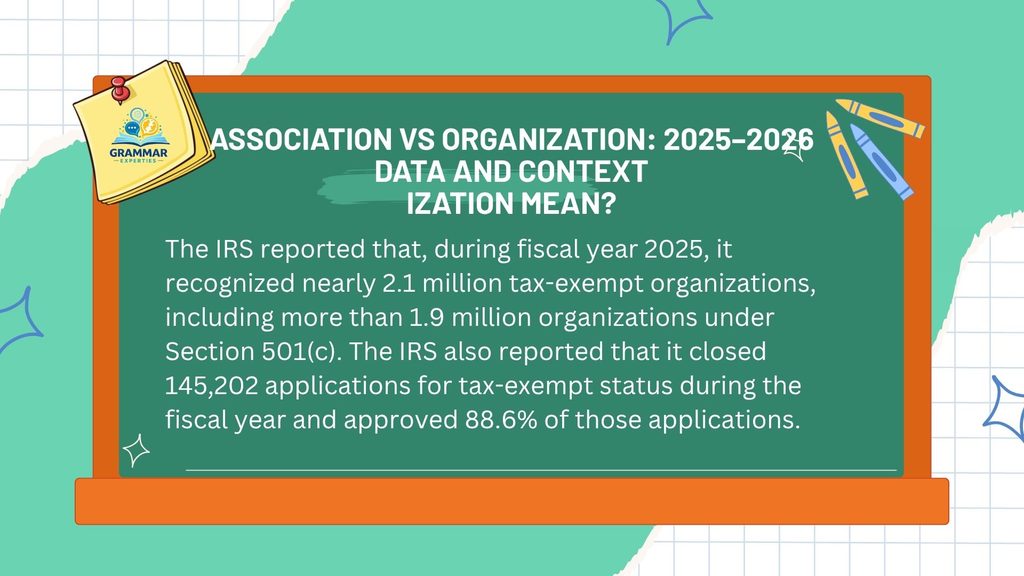
The broad use of the word organization is reflected in official U.S. tax-exempt data.
The IRS reported that, during fiscal year 2025, it recognized nearly 2.1 million tax-exempt organizations, including more than 1.9 million organizations under Section 501(c). The IRS also reported that it closed 145,202 applications for tax-exempt status during the fiscal year and approved 88.6% of those applications.
These figures are useful for understanding the scale and diversity of organized groups, but they should not be interpreted as a count of associations specifically. The IRS categorizes tax-exempt entities according to federal tax classifications, and association is not simply a separate universal category that captures every group using that word.
The IRS’s 2026 materials also show that its exempt-organization datasets cover a wide range of entities, including charitable, religious, social welfare, business league, labor, agricultural, fraternal, and social or recreational organizations.
This demonstrates why organization is such a broad term: it can describe many different kinds of structured entities.
Association vs Organization: Synonyms and Related Words
Understanding related vocabulary can make the distinction easier.
Words related to association
Depending on context, related terms include:
- society
- club
- union
- alliance
- professional body
- membership group
- network
- federation
These words are not always exact synonyms, so context matters.
Words related to organization
Related terms include:
- institution
- company
- nonprofit
- agency
- body
- group
- association
- corporation
- foundation
Again, these terms have their own meanings and should not automatically replace organization.
Association vs society
Society can be especially close to association.
For example:
Historical Society
and
Historical Association
can both describe groups formed around a shared interest.
However, the official name and local usage determine which term is appropriate.
Association vs institution
An institution often suggests an established organization with an important or enduring role in society, education, government, finance, or another field.
For example:
The university is a respected educational institution.
Calling it simply an association would not normally express the same idea.
Association vs Organization Examples
Here are practical examples showing how each word works.
Examples with association
- The teachers’ association organized a professional conference.
- She joined the local business association.
- The alumni association meets every summer.
- Our homeowners association sent an announcement.
- The medical association published new recommendations.
- The sports association organizes competitions for young athletes.
- Several trade associations participated in the discussion.
Examples with organization
- The organization provides free meals to families.
- She works for an international organization.
- The nonprofit organization supports literacy programs.
- The organization opened a new office.
- The charitable organization depends on donations.
- The organization employs more than 200 people.
- Several organizations participated in the project.
Examples where both can work
The association launched a new education program.
The organization launched a new education program.
Both sentences can be grammatically correct. The first highlights the group as an association; the second uses the broader term organization.
How to Choose the Right Word
When you’re unsure whether to use association or organization, ask yourself these questions.
Step 1: Is the group based on shared membership?
If yes, association may be the more natural choice.
The engineers formed an association.
Step 2: Are you emphasizing the group’s operations?
If yes, organization may work better.
The organization operates several educational programs.
Step 3: Is the group a company, charity, agency, or institution?
Organization is usually the broader choice.
Step 4: Does the group have an official name?
Follow the organization’s established name.
Step 5: Could both words work?
If both are grammatically and contextually appropriate, choose the word that communicates your intended emphasis more clearly.
Mini Quiz:Association vs Organization
1. Which word generally describes a group of people who share a common interest?
A. Association B. Arrangement C. Appointment D. Achievement
2. Which word is broader and can describe a business, charity, or institution?
A. Association B. Organization C. Conversation D. Celebration
3. The local teachers’ _____ provides professional networking opportunities.
A. Celebration B. Arrangement C. Association D. Achievement
4. An association can be considered a type of organization.
A. True B. False
5. Which example most clearly describes an association?
A. A furniture manufacturing company B. A club of birdwatchers sharing observations C. A filing system for invoices D. A schedule of office meetings
6. Which statements about associations and organizations are correct?
A. An association may unite people with a shared interest. B. An organization may be a business or charity. C. Every organization must be a professional association. D. Both words always mean exactly the same thing.
7. The nonprofit _____ coordinates disaster relief across the country.
A. Organization B. Appointment C. Conversation D. Celebration
8. The word “organization” can refer to the way tasks or materials are arranged.
A. True B. False
9. Which phrase emphasizes a group of medical professionals?
A. Medical appointment B. Medical arrangement C. Medical association D. Medical achievement
10. What is the main difference between association and organization?
A. Association often emphasizes shared membership, while organization is broader. B. Association always means a company, while organization means a club. C. Association refers only to temporary groups. D. Organization refers only to informal friendships.
11. Good _____ helps our team keep files easy to find.
A. Association B. Organization C. Appointment D. Celebration
12. Which of these could reasonably be called an organization?
A. A charity delivering food to families B. A software company C. A university with departments and staff D. A single notebook with no group or system
13. Which sentence uses “association” correctly?
A. The association held its annual members’ meeting. B. She association her desk every morning. C. The association of the room took two hours. D. He bought an association at the store.
14. A group of engineers forms a body to share research and professional standards. What is the most suitable name?
A. Engineers’ Appointment B. Engineers’ Arrangement C. Engineers’ Association D. Engineers’ Achievement
15. A business can be an organization without being an association.
A. True B. False
16. The neighborhood _____ organized a cleanup for the park.
A. Association B. Appointment C. Achievement D. Arrangement
17. In the sentence “The organization revised its internal policies,” what does “organization” mean?
A. A structured group or institution B. A personal friendship C. A single appointment D. A public celebration
18. Which statement best explains the relationship between the two words?
A. They can overlap, but their meanings are not identical in every context. B. They never describe groups of people. C. They are always interchangeable in formal writing. D. They have identical meanings in every context.
19. The school improved the _____ of its library shelves.
A. Association B. Organization C. Membership D. Partnership
20. A formal body represents members of a particular industry and advocates for their interests. Which term is especially suitable?
A. Celebration B. Appointment C. Association D. Arrangement
21. Which word best completes the sentence? “The international _____ supports educational programs in several countries.”
A. Organization B. Appointment C. Achievement D. Conversation
22. Which phrase refers most clearly to a group of people who share a hobby?
A. A sports association B. A sports appointment C. A sports arrangement D. A sports achievement
23. “Organization” can refer both to a group and to the process of arranging things.
A. True B. False
24. Which sentence uses “organization” to mean a structured group?
A. The organization hired new employees. B. Her organization of the desk was excellent. C. The organization of the books took an hour. D. Good organization makes the files easier to locate.
25. Which sentence best demonstrates the difference between association and organization?
A. The association connects teachers, while the organization manages a nationwide charity program. B. The association ate lunch, while the organization slept. C. The association is always a business, while the organization is always a club. D. The two words have no relationship in mean
Frequently Asked Questions About Association vs Organization
Is an association the same as an organization?
Not exactly. An association is commonly a group of people or organizations connected by a shared interest, profession, purpose, or activity. An organization is a broader term for a structured group formed for a purpose. An association can therefore be a type of organization.
Which is more formal, association or organization?
Neither word is automatically more formal. Formality depends on the context and the specific entity. Association is common in professional, membership, trade, and community contexts, while organization is widely used across business, nonprofit, government, and institutional settings.
Can a nonprofit be called an association?
Yes. A nonprofit can use the word association in its name or description if that accurately reflects its structure and purpose. However, the word itself does not determine whether an entity has nonprofit or tax-exempt status.
Is an organization always a company?
No. An organization can be a company, charity, nonprofit, association, government body, educational institution, club, or another structured group.
Can I use association and organization interchangeably?
Sometimes. In sentences where the focus is simply on a group, either word may work. However, association often highlights shared membership or interests, while organization is broader and can emphasize structure, purpose, or operations.
What is the difference between a professional association and an organization?
A professional association usually brings together members from the same profession or industry. Organization is a broader term and can describe professional associations as well as companies, charities, government bodies, and many other groups.
Is an association a type of organization?
Generally, yes. In ordinary English, an association can be understood as a particular kind of organized group, especially one formed around common interests, membership, or a shared purpose.
Which word should I use in formal writing?
Use the word that best matches the entity and context. If you’re referring to a membership-based professional or community group, association may be more precise. If you’re referring generally to a structured group, organization is usually broader and safer.
Final Takeaway: Association vs Organization
The main difference between association vs organization is one of emphasis and scope.
An association usually describes a group whose members share an interest, profession, purpose, location, or other connection. An organization is a broader term for a structured group working toward a particular purpose.
Remember this simple rule:
Association = shared membership or common interest.
Organization = broader structured group with a purpose.
For example, a teachers’ association brings together people connected by their profession, while an educational organization could refer to almost any structured group involved in education.
The two terms can overlap, so context is important. When writing, don’t worry about finding an absolute rule that separates them. Instead, consider what you want to emphasize: membership and shared interests or structure, purpose, and activity.
Understanding that distinction will help you use association and organization more naturally in professional writing, academic work, business communication, and everyday English.
Explore more easy grammar lessons and improve your English with Grammar Expertise
References
https://dictionary.cambridge.org/dictionary/english/association
https://dictionary.cambridge.org/dictionary/english/organization

Maimoona Mughal is an English grammar enthusiast dedicated to simplifying confusing words, grammar rules, and vocabulary through clear, accurate, and learner-friendly content that helps readers write and communicate with confidence.