Introduction
Attend vs tend can be confusing because the two words look and sound somewhat similar, but they have very different meanings and grammatical uses.
Attend usually means to go to or be present at an event, place, class, meeting, or institution. For example, “I attend the weekly meeting.”
Tend, on the other hand, commonly means to be likely to do something or to take care of someone or something. For example, “I tend to wake up early” or “She tends the garden.”
The distinction becomes especially important with the expressions attend a meeting, attend school, tend to do something, and tend to someone.
In this guide, you’ll learn the exact difference between attend and tend, their meanings, grammar patterns, common mistakes, and plenty of practical examples.
Attend vs Tend: What Is the Difference?
The simplest way to remember the difference is this:
Attend = go to or be present somewhere.
Tend = usually be likely to do something or take care of something.
Cambridge Dictionary defines attend as going to an event or place and also using a place such as a school regularly. It also recognizes other meanings, including giving attention and providing help.
Tend has two major everyday meanings. It can describe something that is likely or usual, as in “People tend to worry,” or it can mean taking care of someone or something, as in “She tends her garden.”
Attend meaning
Attend is a verb that commonly means:
- to go to an event
- to be present at a place
- to regularly go to an institution
- to be present at a meeting, class, lecture, or ceremony
Examples:
I attend a weekly English class.
She attended the conference yesterday.
More than 200 people attended the event.
Do you attend university?
The word can also appear in attend to, which has a different meaning from simply attend.
Tend meaning
Tend commonly means:
- to be likely to do something
- to take care of someone or something
Examples:
I tend to drink coffee in the morning.
Children tend to learn quickly through practice.
He tends the garden every morning.
The nurse tended to the injured man.
So, while attend is strongly associated with presence, tend is associated with tendency or care.
Quick comparison
| Word | Main meaning | Example |
|---|---|---|
| Attend | Go to or be present at something | I attend the meeting. |
| Tend | Be likely to do something | I tend to arrive early. |
| Tend | Take care of something | She tends the garden. |
| Attend to | Deal with or give attention to something | Please attend to the customer. |
| Tend to | Usually be likely to do something | People tend to make mistakes. |
| Tend to someone | Take care of someone | The nurse tended to the patient. |
How to Use “Attend” Correctly
Knowing the basic definition isn’t enough. The grammar pattern after attend is also important.
Attend an event, meeting, or class
When attend means “go to” or “be present at,” it is normally followed directly by the event, place, or activity.
Correct:
I will attend the meeting tomorrow.
She attended the conference last week.
We attend classes every Monday.
He attended the wedding.
A common mistake is adding to after attend when talking about an event.
Incorrect:
I will attend to the meeting.
Correct:
I will attend the meeting.
Cambridge’s grammar guidance specifically notes that when attend means “go to an event or place,” it is not followed by to.
Attend school, college, or university
Attend is also commonly used with educational institutions.
Examples:
She attends school in the morning.
He attended college in California.
My children attend a local school.
I attended university from 2019 to 2023.
Here, attend means to go to an institution regularly.
Attend a meeting vs attend to a meeting
This distinction is worth remembering.
Attend a meeting means go to or participate in the meeting.
I need to attend the meeting at 10 a.m.
Attend to means deal with, give attention to, or take care of something.
I need to attend to the customer’s complaint.
Therefore, these two sentences have different meanings:
She attended the meeting.
She was present at the meeting.
She attended to the problem.
She dealt with the problem.
This is one of the most useful grammar distinctions between attend and attend to.
How to Use “Tend” Correctly
Unlike attend, tend has two important meanings that you should learn separately.
Tend to mean “usually do” or “be likely to”
The most common structure is:
tend + to + base verb
Examples:
I tend to wake up early.
People tend to remember negative experiences.
Children tend to become restless after long lessons.
Prices tend to increase during the holiday season.
She tends to work late.
This structure describes a general habit, pattern, tendency, or likelihood.
Cambridge Dictionary gives examples of tend to meaning to be likely to behave in a particular way or have a particular characteristic.
Tend to someone or something
Tend to can also mean take care of or look after someone or something.
Examples:
The nurse tended to the injured child.
She stayed home to tend to her sick mother.
The farmer tended to the animals.
He carefully tended to the plants.
In this structure, tend to is followed by a noun or pronoun rather than a base verb.
Compare:
I tend to exercise in the morning.
Here, it means “I usually exercise.”
But:
I tend to my garden every morning.
Here, it means “I take care of my garden.”
The words look identical, but the grammatical structures reveal the meaning.
Tend something directly
You can also use tend as a transitive verb when it means to take care of something.
For example:
She tends the garden every morning.
The farmer tends his animals carefully.
He tended the fire throughout the night.
This use is somewhat more formal or literary than everyday expressions such as take care of, but it is completely correct.
Attend vs Tend: Grammar Patterns You Should Know
The fastest way to master these verbs is to memorize their common patterns rather than trying to remember isolated definitions.
Attend + noun
Use:
attend + event/place/institution
Examples:
attend a meeting
attend a class
attend a conference
attend school
attend university
attend a wedding
attend a ceremony
Notice that you normally don’t need to between attend and the event.
Tend + to + verb
Use:
tend + to + base verb
Examples:
tend to forget
tend to worry
tend to arrive late
tend to increase
tend to change
For example:
People tend to forget small details.
This means people are generally likely to forget them.
Tend + noun
When tend means “take care of,” you can use it directly with a noun.
tend the garden
tend the animals
tend the fire
tend the plants
Tend to + person or thing
You can also say:
tend to + noun/pronoun
when you mean “take care of” or “deal with.”
She tended to the patient.
He tended to the plants.
The mechanic tended to the damaged equipment.
The context tells you which meaning is intended.
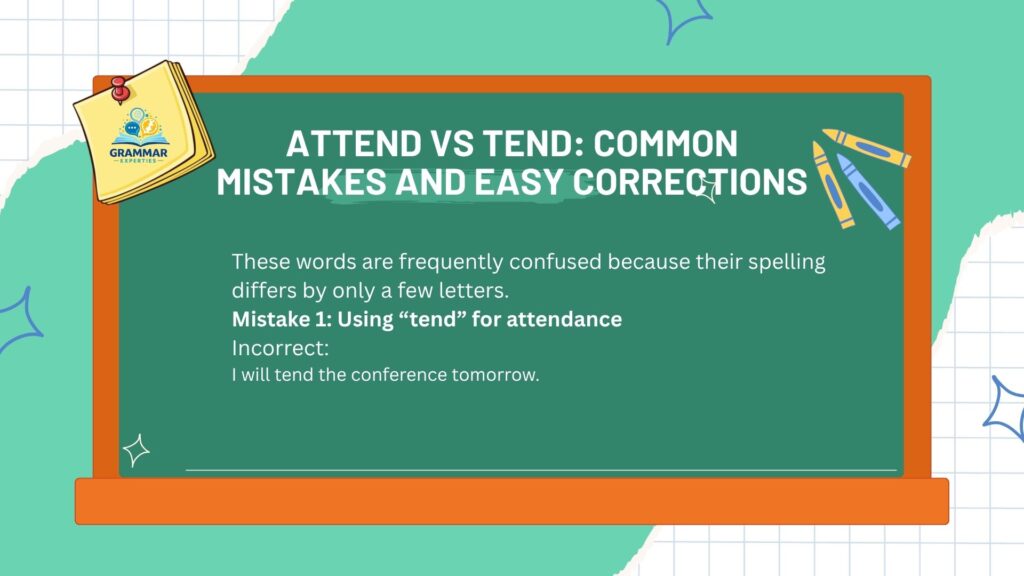
Attend vs Tend: Common Mistakes and Easy Corrections
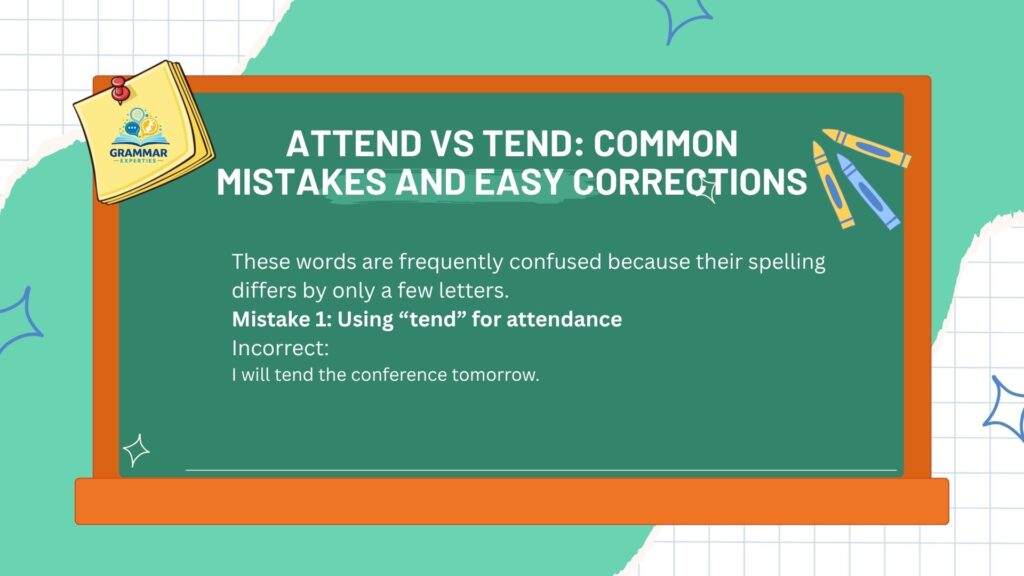
These words are frequently confused because their spelling differs by only a few letters.
Mistake 1: Using “tend” for attendance
Incorrect:
I will tend the conference tomorrow.
Correct:
I will attend the conference tomorrow.
You attend a conference because you go to it.
Mistake 2: Using “attend” for a tendency
Incorrect:
I attend to wake up early.
Correct:
I tend to wake up early.
You use tend to when describing a usual behavior or tendency.
Mistake 3: Adding “to” after attend unnecessarily
Incorrect:
She attended to the lecture.
If you mean she went to the lecture, say:
She attended the lecture.
However, attended to is correct when the meaning is “gave attention to” or “dealt with.”
She attended to the customer’s request.
Mistake 4: Confusing “tend to” meanings
Consider:
I tend to exercise after work.
This means:
I usually exercise after work.
But:
I tend to my plants after work.
This means:
I take care of my plants after work.
The grammatical object changes the meaning.
Mistake 5: Thinking attend and tend are interchangeable
They aren’t.
I attended the seminar.
means I was present at the seminar.
I tended the seminar.
would not normally express that meaning.
Likewise:
People tend to complain.
means people are generally likely to complain.
You cannot replace tend with attend.
A Real-Life Example: Attend or Tend at Work?
Imagine that Sara works in an office and has a busy schedule. On Monday morning, her manager tells her that she must attend a staff meeting at 9 a.m. Sara goes to the meeting and participates in the discussion.
Later that day, a customer contacts the company about a billing problem. Sara’s manager asks her to attend to the customer’s complaint. This doesn’t mean she needs to attend another meeting. It means she needs to deal with the problem and give the customer attention.
At the end of the week, Sara notices that she tends to arrive early whenever she has an important deadline. In this sentence, tends to describes her usual behavior.
She also notices that new employees tend to ask more questions during their first few weeks.
Now we have three different uses:
- Attend a meeting = be present at the meeting.
- Attend to a complaint = deal with the complaint.
- Tend to arrive early = usually arrive early.
This example shows why context matters. The words may look related, but their meanings and grammatical patterns are clearly different. Once you connect each word with its typical structure, choosing between attend and tend becomes much easier.
2026 Usage Snapshot: What Current Dictionaries Show
There isn’t a single reliable 2025–2026 statistic that measures how often everyday English speakers confuse attend and tend. Search-volume estimates also vary by country, language, platform, and date. It would therefore be misleading to invent a percentage or claim that a specific share of English learners makes this mistake.
Instead, a useful 2026 reference snapshot comes from current major English dictionaries:
| Current reference point | Attend | Tend |
|---|---|---|
| Cambridge learner level | B1 | B2 |
| Core meaning | Go to/be present | Be likely to |
| Additional meaning | Give attention/provide help | Take care of |
| Common pattern | attend + noun | tend + to + verb |
| Common phrase | attend a meeting | tend to worry |
| “To” required? | Not for an event | Yes before a verb |
Cambridge currently lists attend as a B1 verb for going to an event or regularly going to a place, while tend is listed as B2 for expressing likelihood or tendency.
Cambridge also separately documents attend to and tend to, confirming that the addition of to changes the grammatical pattern and, in some contexts, the meaning.
So the most useful 2026 takeaway isn’t an unsupported usage percentage. It’s the current grammatical pattern:
Attend → presence
Tend → tendency or care
That distinction remains reliable across standard English usage.
Attend vs Tend: A Simple Step-by-Step Guide
When you’re writing and aren’t sure which word to use, follow these steps.
Step 1: Ask what you mean
Are you talking about going somewhere or being present?
If yes, use attend.
I will attend the conference.
Are you talking about what usually happens or what someone is likely to do?
Use tend.
People tend to arrive early.
Step 2: Look at the word after it
If you have an event or place, attend is usually the right choice:
attend school
attend a meeting
attend a lecture
If you have a base verb, tend to is usually the right pattern:
tend to forget
tend to worry
tend to increase
Step 3: Check whether “take care of” makes sense
If the meaning is “take care of,” tend may be appropriate.
She tended to the injured man.
You could replace it with:
She took care of the injured man.
If “take care of” fits, you’re probably dealing with tend, not attend.
Step 4: Check whether “go to” makes sense
If you can replace the verb with go to or be present at, choose attend.
He attended the seminar.
Equivalent idea:
He went to the seminar.
That simple substitution test can help you make the right choice quickly.
Attend vs Tend Examples
Here are additional examples showing the difference in natural English.
Examples with attend
I attend English classes twice a week.
She attended the business conference yesterday.
Will you attend the wedding?
More than 500 people attended the ceremony.
All students must attend school regularly.
He couldn’t attend the meeting because he was sick.
Examples with tend
I tend to drink tea in the evening.
People tend to become nervous before exams.
Prices tend to rise during periods of high demand.
She tends to speak very quickly.
He tends the garden every weekend.
The nurse tended to the injured patient.
Examples with attend to
Please attend to this matter immediately.
The assistant attended to the customer’s needs.
The nurse attended to the patient.
Remember that attend to does not mean the same thing as simply attend.
Mini Quiz:Attend vs Tend
1. Choose the correct word:
I will _____ the conference tomorrow.
A) tend
B) attend
C) tending
D) tended
Answer: B) attend
2. Choose the correct word:
I _____ to drink coffee in the morning.
A) attend
B) attending
C) tend
D) attended
Answer: C) tend
3. Which sentence is correct?
A) I will tend the meeting.
B) I will attend the meeting.
C) I will tend to attend meeting.
D) I will attending the meeting.
Answer: B) I will attend the meeting.
4. Choose the correct word:
She _____ school every weekday.
A) tends
B) attends
C) tend
D) tending
Answer: B) attends
5. Choose the correct phrase:
People _____ make mistakes when they’re tired.
A) attend to
B) tend to
C) attend
D) tended
Answer: B) tend to
6. Fill in the blank:
The nurse _____ to the patient immediately.
A) attended
B) tended
C) attends
D) Both A and B can be correct depending on intended meaning
Answer: D) Both A and B can be correct depending on intended meaning
7. Which sentence means “I usually wake up early”?
A) I attend to wake up early.
B) I tend to wake up early.
C) I attend waking up early.
D) I tend wake up early.
Answer: B) I tend to wake up early.
8. Choose the correct sentence:
A) She attended the wedding.
B) She tended the wedding.
C) She tend the wedding.
D) She attending the wedding.
Answer: A) She attended the wedding.
9. Which word means “go to or be present at”?
A) Tend
B) Attend
C) Tend to
D) Tended
Answer: B) Attend
10. Choose the correct word:
Children _____ to ask many questions.
A) attend
B) attends
C) tend
D) tended
Answer: C) tend
11. Which sentence uses “tend” to mean “take care of”?
A) I tend to sleep early.
B) She tends the garden.
C) They attend the garden.
D) He attends school.
Answer: B) She tends the garden.
12. Choose the correct phrase:
The receptionist _____ the customer’s request.
A) tended to
B) attended to
C) attended
D) tend
Answer: B) attended to
13. Which sentence is correct?
A) I attended the seminar.
B) I tended the seminar.
C) I attend to the seminar yesterday.
D) I tend seminar yesterday.
Answer: A) I attended the seminar.
14. Choose the correct word:
My brother _____ university in Canada.
A) tends
B) attends
C) tend
D) tending
Answer: B) attends
15. What does “I tend to work late” mean?
A) I attend a workplace late.
B) I usually work late.
C) I take care of my workplace.
D) I go to a meeting late.
Answer: B) I usually work late.
16. Choose the correct sentence:
A) We attended a business conference.
B) We tended a business conference.
C) We tend a business conference yesterday.
D) We attending a business conference.
Answer: A) We attended a business conference.
17. Which sentence uses “attend to” correctly?
A) I attended to the concert.
B) The doctor attended to the patient.
C) I attended to school.
D) She attended to the wedding.
Answer: B) The doctor attended to the patient.
18. Choose the correct word:
Farmers _____ their crops carefully.
A) attend
B) tend
C) tends to
D) attending
Answer: B) tend
19. Which sentence describes a habit?
A) I attended the workshop.
B) She attended school.
C) I tend to read before bed.
D) They attended the conference.
Answer: C) I tend to read before bed.
20. Choose the correct sentence:
A) He tends to worry too much.
B) He attends to worry too much.
C) He tend worry too much.
D) He attending to worry too much.
Answer: A) He tends to worry too much.
21. Which word fits the sentence?
Did you _____ the lecture yesterday?
A) tend
B) attend
C) tends
D) tending
Answer: B) attend
22. Choose the correct phrase:
Employees _____ arrive early on Mondays.
A) attend to
B) tend to
C) attend
D) tend
Answer: B) tend to
23. Which sentence is grammatically correct?
A) She attends the class every Monday.
B) She tends the class every Monday.
C) She attend the class every Monday.
D) She tend to the class every Monday.
Answer: A) She attends the class every Monday.
24. Choose the correct word:
The gardener _____ the flowers every morning.
A) attends
B) tends
C) tend to
D) attending
Answer: B) tends
25. Final Challenge:
Which sentence correctly uses both “attend” and “tend”?
A) I tend to attend evening classes.
B) I attend to tend evening classes.
C) I tend attend evening classes.
D) I attended tend evening classes.
Answer: A) I tend to attend evening classes.
Attend vs Tend: Frequently Asked Questions
What is the main difference between attend and tend?
Attend usually means to go to or be present at an event, place, class, or institution. Tend usually means to be likely to do something or to take care of someone or something.
Is it “attend to a meeting” or “attend a meeting”?
Use attend a meeting when you mean “go to or be present at a meeting.”
I will attend the meeting tomorrow.
Attend to means to deal with or give attention to something.
I need to attend to this issue.
Cambridge specifically distinguishes these patterns.
Is “tend to” grammatically correct?
Yes. Tend to is very common.
When followed by a verb, it means to usually or generally do something:
I tend to work late.
It can also mean “take care of” when followed by a person or thing:
She tended to the patient.
Can “attend” mean “take care of”?
In some formal contexts, attend to can mean to give attention to, deal with, or provide care. However, plain attend usually means being present at an event or place.
Is “tend” the same as “usually”?
Not exactly, but tend to often expresses a similar idea.
I tend to wake up early.
This means that waking up early is a usual or typical behavior for me. It doesn’t necessarily mean I do it every single day.
Which is correct: “I attend to school” or “I attend school”?
Use:
I attend school.
When attend means regularly go to an institution, you normally don’t add to.
What does “tend to” mean in simple English?
Tend to can mean usually do something or be likely to do something.
People tend to make mistakes when they’re tired.
It can also mean take care of someone or something:
She tended to the injured man.
Are attend and tend synonyms?
No. They aren’t normally synonyms.
Attend is associated with being present or going somewhere.
Tend is associated with a tendency or taking care of something.
They may both occur with to, but their meanings and grammatical structures are different.
Conclusion
The difference between attend vs tend becomes easy once you remember their core meanings.
Attend means to go to, be present at, or regularly go to a place:
I attend the weekly meeting.
Tend means to be likely to do something or to take care of someone or something:
I tend to arrive early.
She tends the garden.
Also remember the important difference between attend a meeting and attend to a problem. The first means being present; the second means dealing with something.
A quick memory trick is:
Attend = presence.
Tend = tendency or care.
Once you learn these patterns, you’ll be much less likely to confuse the two verbs in conversations, emails, essays, and professional writing.
Explore more easy grammar lessons and improve your English with Grammar Expertise
References
Cambridge Dictionary: Attend
Cambridge Dictionary: Tend

Maimoona Mughal is an English grammar enthusiast dedicated to simplifying confusing words, grammar rules, and vocabulary through clear, accurate, and learner-friendly content that helps readers write and communicate with confidence.