Have you ever wondered whether to write breath or breathe? These two words look almost identical, sound similar, and are closely connected in meaning. However, using the wrong one can make your sentence grammatically incorrect.
The difference between breath and breathe is simple once you understand their parts of speech. Breath is a noun, while breathe is a verb. One refers to the air you take into your lungs, and the other describes the action of taking air in and letting it out.
For example, you take a deep breath, but you breathe deeply. Both words relate to the same physical process, but they perform different grammatical jobs.
In this guide, you will learn the meaning of each word, their pronunciation, grammar rules, common mistakes, and practical examples. By the end, you will know exactly when to use breath or breathe.
What Is the Difference Between Breath and Breathe?
The main difference between breath and breathe is their grammatical function.
- Breath is a noun that refers to the air taken into or released from your lungs.
- Breathe is a verb that means to take air into your lungs and release it.
Although these words are related, they cannot normally replace each other in a sentence.
Understanding the Word Breath
Breath is a noun. It describes the air moving into and out of your lungs or one complete movement of breathing.
You can use it when talking about inhaling, exhaling, fresh air, or the air coming from someone’s mouth.
Examples:
- Take a deep breath before you speak.
- She held her breath underwater.
- His breath smelled like peppermint.
- I need a moment to catch my breath.
- The cold morning air made my breath visible.
In these sentences, breath identifies something rather than describing an action.
Understanding the Word Breathe
Breathe is a verb. It describes the action of taking air into your lungs and releasing it.
You can use it when discussing normal breathing, relaxation, physical activity, or the movement of air through your body.
Examples:
- Remember to breathe slowly.
- I find it difficult to breathe in this room.
- She breathed deeply before the presentation.
- The baby is breathing normally.
- Try to breathe through your nose.
In these examples, breathe describes an action or process.
Breath vs. Breathe: Quick Comparison
| Feature | Breath | Breathe |
|---|---|---|
| Part of speech | Noun | Verb |
| Meaning | Air taken in or released | To take air in and release it |
| Pronunciation | /breθ/ | /briːð/ |
| Ending sound | Unvoiced TH | Voiced TH |
| Example | Take a deep breath. | Breathe deeply. |
| Word form | Singular or plural noun | Base verb |
The easiest way to remember the difference is this: you take a breath, but you breathe.
How to Pronounce Breath and Breathe Correctly
Pronunciation is another important difference between these words. Although their spelling is similar, their vowel sounds and final consonant sounds are different.
How to Pronounce Breath
The word breath is pronounced /breθ/.
It has a short vowel sound, similar to the vowel in words such as “bed” and “head.”
The final TH sound is unvoiced. This means you produce the sound by placing your tongue near your upper teeth and allowing air to pass through without vibrating your vocal cords.
Try saying:
- Breath
- Death
- Health
- Wealth
These words contain a similar final sound.
How to Pronounce Breathe
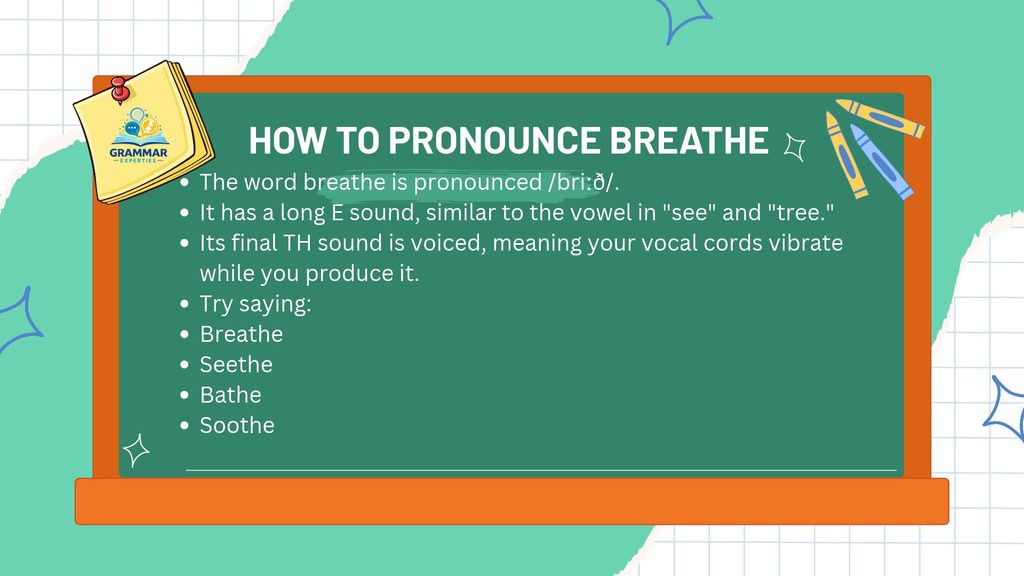
The word breathe is pronounced /briːð/.
It has a long E sound, similar to the vowel in “see” and “tree.”
Its final TH sound is voiced, meaning your vocal cords vibrate while you produce it.
Try saying:
- Breathe
- Seethe
- Bathe
- Soothe
The pronunciation difference becomes easier when you practise both words together:
- Breath: /breθ/
- Breathe: /briːð/
A Simple Pronunciation Trick
Place your hand gently on your throat while saying both words.
When you pronounce breath, the final TH sound does not create vocal cord vibration. When you pronounce breathe, you should feel vibration.
This small exercise can help you distinguish the two sounds and improve your English pronunciation.
Grammar Rules: When Should You Use Breath or Breathe?
Understanding the grammar rules makes it much easier to choose the correct word. The most important rule is to identify whether your sentence needs a noun or a verb.
Rule 1: Use Breath as a Noun
Use breath when referring to air, a single inhalation or exhalation, or the process as a thing.
Examples:
- He took a long breath.
- Her breath was warm.
- I could hear his heavy breath.
- Take one more breath before diving.
- She was out of breath after running.
A useful test is to see whether you can place an article or adjective before the word.
For example:
- A deep breath.
- One breath.
- His breath.
- Fresh breath.
These expressions show how breath functions as a noun.
Rule 2: Use Breathe as a Verb
Use breathe when describing the action of inhaling and exhaling.
Examples:
- Please breathe normally.
- They breathe fresh air every morning.
- He cannot breathe properly.
- The athlete breathed heavily after the race.
- She is learning to breathe more slowly.
You can also change the verb according to the tense.
Examples:
| Verb Form | Example |
|---|---|
| Present | I breathe slowly. |
| Third-person singular | She breathes slowly. |
| Past | He breathed deeply. |
| Present participle | They are breathing normally. |
| Infinitive | I want to breathe fresh air. |
Rule 3: Understand the Relationship Between Breath and Breathe
Breathe is formed from breath, but adding the letter E changes its pronunciation and grammatical function.
Compare these expressions:
- Take a breath.
- Breathe deeply.
- Hold your breath.
- Breathe in slowly.
- Catch your breath.
- Breathe out gently.
Notice how breath appears as a noun, while breathe expresses an action.
Rule 4: Watch Out for Common Verb Mistakes
One common mistake is writing breath when a sentence requires a verb.
Incorrect: I cannot breath properly.
Correct: I cannot breathe properly.
Incorrect: She needs to breath slowly.
Correct: She needs to breathe slowly.
Incorrect: He is trying to breath.
Correct: He is trying to breathe.
Remember that words following “can,” “cannot,” “to,” and “should” generally need the base form of a verb in these constructions.
Therefore, breathe is the correct choice in all three examples.
Common Expressions and Examples Using Breath and Breathe
Both words appear in everyday English. Learning common expressions will help you understand how native speakers use them naturally.
Common Expressions With Breath
1. Take a deep breath
Meaning: To inhale deeply, often to relax.
Example: Take a deep breath before answering the question.
2. Hold your breath
Meaning: To stop breathing temporarily.
Example: The swimmer held her breath underwater.
3. Out of breath
Meaning: Having difficulty breathing after physical activity.
Example: I was out of breath after climbing the stairs.
4. Catch your breath
Meaning: To rest briefly and return to normal breathing.
Example: We stopped walking to catch our breath.
5. A breath of fresh air
Meaning: Something refreshing, new, or pleasant.
Example: Her creative ideas were a breath of fresh air for the team.
Common Expressions With Breathe
1. Breathe in
Meaning: To take air into your lungs.
Example: Breathe in slowly through your nose.
2. Breathe out
Meaning: To release air from your lungs.
Example: Breathe out gently through your mouth.
3. Breathe deeply
Meaning: To take slow, full breaths.
Example: Try to breathe deeply when you feel nervous.
4. Breathe easily
Meaning: To breathe without difficulty or, figuratively, to feel relieved.
Example: After hearing the good news, she could finally breathe easily.
5. Breathe new life into something
Meaning: To make something more exciting, interesting, or successful.
Example: The new manager breathed new life into the project.
Example Sentences Using Both Words
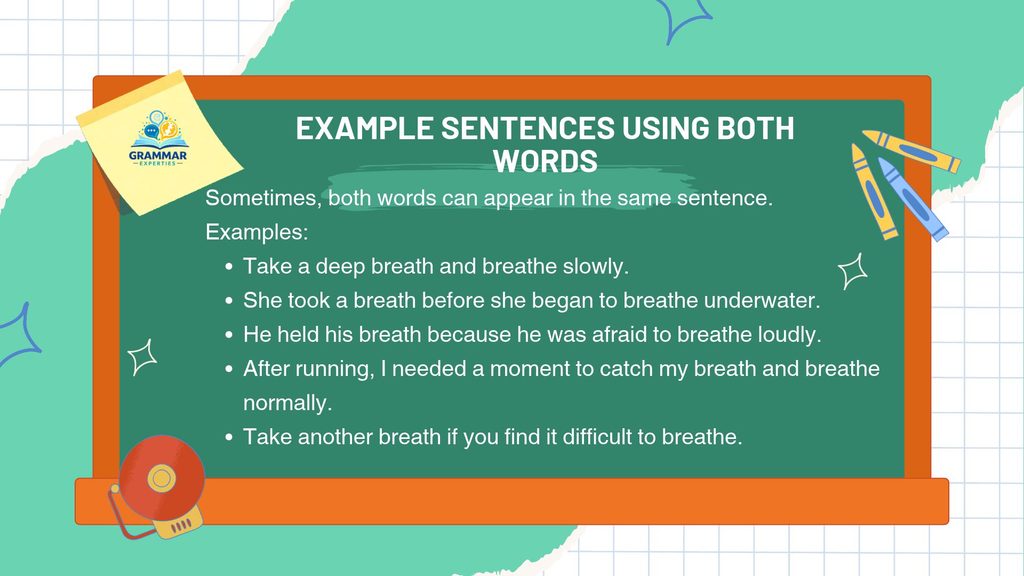
Sometimes, both words can appear in the same sentence.
Examples:
- Take a deep breath and breathe slowly.
- She took a breath before she began to breathe underwater.
- He held his breath because he was afraid to breathe loudly.
- After running, I needed a moment to catch my breath and breathe normally.
- Take another breath if you find it difficult to breathe.
These examples demonstrate how the noun and verb work together without replacing each other.
Real-Life Example: How to Avoid Confusing Breath and Breathe
Imagine a student named Sarah who is preparing for an English-speaking competition at school.
Before going on stage, Sarah feels nervous. Her teacher tells her, “Take a deep breath and breathe slowly.”
Sarah understands the general meaning but becomes confused about the spelling. She wonders why the teacher used breath in the first part and breathe in the second.
To understand the difference, she breaks the sentence into two parts.
First, “Take a deep breath.” Here, breath refers to the air Sarah takes into her lungs. It is a noun because it identifies something she needs to take.
Second, “Breathe slowly.” In this part, breathe describes what Sarah should do. It is a verb because it expresses an action.
Her teacher gives her another example: “You should hold your breath before jumping into the swimming pool, but remember to breathe normally when you come back to the surface.”
Sarah notices that breath is used after “hold your,” while breathe follows “remember to.”
She then practises several sentences:
- I need a deep breath.
- I need to breathe slowly.
- My breath smells fresh.
- I breathe through my nose.
After practising these examples, Sarah no longer treats the words as interchangeable.
This situation shows why understanding parts of speech is more effective than simply memorising spelling differences. When you identify the role of a word in a sentence, choosing the correct spelling becomes much easier. The same approach can help students, bloggers, and English learners avoid similar mistakes in everyday writing.
Breath or Breathe: Common Mistakes to Avoid
Even experienced English learners sometimes confuse these words. The following mistakes are especially common.
Mistake 1: Using Breath Instead of Breathe
Incorrect: I cannot breath in this crowded room.
Correct: I cannot breathe in this crowded room.
Why? The sentence requires a verb describing the action of taking air into the lungs.
Mistake 2: Using Breathe Instead of Breath
Incorrect: Take a deep breathe before speaking.
Correct: Take a deep breath before speaking.
Why? The phrase requires a noun because it refers to one inhalation.
Mistake 3: Confusing Breathes With Breaths
These two forms are different.
- Breathes is a verb.
- Breaths is the plural form of the noun breath.
Examples:
- She breathes slowly during meditation.
- Take three deep breaths before starting.
Mistake 4: Forgetting the Final E
Some writers accidentally leave out the final E when using breathe.
Incorrect: Please breath normally.
Correct: Please breathe normally.
The final E is important because it helps distinguish the verb from the noun.
Mistake 5: Using the Wrong Word After Common Expressions
Memorise these correct combinations:
| Incorrect | Correct |
|---|---|
| Take a deep breathe | Take a deep breath |
| Hold your breathe | Hold your breath |
| Try to breath | Try to breathe |
| Cannot breath | Cannot breathe |
| Out of breathe | Out of breath |
| Catch your breathe | Catch your breath |
| Breathe of fresh air | Breath of fresh air |
Breath and Breathe: Language Data and Usage Insights (2025–2026)
There is an important difference between dictionary evidence and statistical usage data.
Major English dictionaries continue to classify breath as a noun and breathe as a verb. Their definitions and example sentences provide reliable evidence of how these words function in modern English.
However, there is no verified, authoritative 2025–2026 statistic establishing how many English writers confuse these two particular words or what percentage make this mistake. It would be misleading to invent a percentage or present an unsupported figure as research.
Here are three useful language insights:
- Grammar determines the correct spelling: Breath and breathe are not interchangeable because they have different grammatical functions.
- Pronunciation helps identify the difference: Breath has a short vowel and an unvoiced TH sound, whereas breathe has a long E sound and a voiced TH sound.
- Context makes word selection easier: Expressions such as “take a breath,” “hold your breath,” and “breathe deeply” demonstrate the difference in everyday English.
For additional learning, Cambridge Dictionary’s English Grammar Today explains the distinction directly, while Oxford Learner’s Dictionaries provides definitions, pronunciation, and verb forms.
The best way to improve your accuracy is to practise these words in complete sentences rather than memorising their spellings separately.
Mini Quiz:Breath or Breathe
1. Take a deep _____ before speaking.
A. Breath
B. Breathe
Answer: A. Breath
2. Remember to _____ slowly when you feel nervous.
A. Breath
B. Breathe
Answer: B. Breathe
3. She held her _____ underwater.
A. Breath
B. Breathe
Answer: A. Breath
4. It is difficult to _____ in this smoky room.
A. Breath
B. Breathe
Answer: B. Breathe
5. He was out of _____ after running.
A. Breath
B. Breathe
Answer: A. Breath
6. You should _____ through your nose.
A. Breath
B. Breathe
Answer: B. Breathe
7. Take another _____ before diving.
A. Breath
B. Breathe
Answer: A. Breath
8. The baby is learning to _____ normally.
A. Breath
B. Breathe
Answer: B. Breathe
9. I need a moment to catch my _____.
A. Breath
B. Breathe
Answer: A. Breath
10. Please _____ deeply and relax.
A. Breath
B. Breathe
Answer: B. Breathe
11. His _____ smelled like peppermint.
A. Breath
B. Breathe
Answer: A. Breath
12. She could hardly _____ after climbing the stairs.
A. Breath
B. Breathe
Answer: B. Breathe
13. The swimmer took one final _____ before jumping.
A. Breath
B. Breathe
Answer: A. Breath
14. Try to _____ slowly during meditation.
A. Breath
B. Breathe
Answer: B. Breathe
15. I could see my _____ in the cold air.
A. Breath
B. Breathe
Answer: A. Breath
16. Plants need air to _____ and grow.
A. Breath
B. Breathe
Answer: B. Breathe
17. He took a quick _____ before answering.
A. Breath
B. Breathe
Answer: A. Breath
18. The doctor told him to _____ normally.
A. Breath
B. Breathe
Answer: B. Breathe
19. She was completely out of _____ after the race.
A. Breath
B. Breathe
Answer: A. Breath
20. Close your eyes and _____ deeply.
A. Breath
B. Breathe
Answer: B. Breathe
21. The fresh mountain air took my _____ away.
A. Breath
B. Breathe
Answer: A. Breath
22. He struggled to _____ because of the dust.
A. Breath
B. Breathe
Answer: B. Breathe
23. Take three slow _____ before starting the exercise.
A. Breaths
B. Breathes
Answer: A. Breaths
24. She _____ deeply before beginning her speech.
A. Breaths
B. Breathes
Answer: B. Breathes
25. The correct expression is “a _____ of fresh air.”
A. Breath
B. Breathe
Answer: A. Breath
Frequently Asked Questions About Breath or Breathe
Q1: What is the main difference between breath and breathe?
Breath is a noun referring to the air entering or leaving your lungs. Breathe is a verb describing the action of taking air into your lungs and releasing it.
Example: Take a breath and breathe slowly.
Q2: Is it take a breath or take a breathe?
The correct expression is take a breath.
Breath is a noun, and it refers to the air you take into your lungs.
Example: Take a deep breath before speaking.
Q3: Is it breathe or breath deeply?
The correct expression is breathe deeply.
Breathe is a verb because it describes the action of inhaling and exhaling.
Example: Try to breathe deeply when you feel stressed.
Q4: How do you pronounce breath and breathe?
Breath is pronounced /breθ/, with a short vowel and an unvoiced TH sound.
Breathe is pronounced /briːð/, with a long E sound and a voiced TH sound.
Q5: Is breathe a noun or a verb?
Breathe is a verb. It describes the action of moving air into and out of your lungs.
Example: Babies breathe naturally without thinking about it.
Q6: Is breath a noun or a verb?
Breath is a noun. It refers to the air you inhale and exhale or a single amount of air taken into your lungs.
Example: He took a deep breath before diving.
Q7: What is the plural of breath?
The plural of breath is breaths.
Example: Take three slow breaths before beginning the exercise.
Do not confuse breaths with breathes. Breaths is a plural noun, while breathes is the third-person singular form of the verb breathe.
Q8: What is the past tense of breathe?
The past tense of breathe is breathed.
Examples:
- She breathed deeply before speaking.
- He breathed slowly during the exercise.
- They breathed fresh air after leaving the building.
The word breathed is pronounced with a final /d/ sound.
Conclusion: Breath or Breathe Which One Should You Use?
The difference between breath or breathe becomes simple when you understand their grammatical roles.
Breath is a noun, meaning the air you take into or release from your lungs. Breathe is a verb, meaning the action of inhaling and exhaling.
Remember these two examples:
- Take a deep breath.
- Breathe slowly.
If you are unsure which spelling to use, check whether your sentence needs a noun or an action. This simple technique will help you choose the correct word in everyday conversations, school assignments, professional writing, and online content.
Keep practising with real sentences, and you will soon use both words confidently.
Explore more easy grammar lessons and improve your English with Grammar Expertise
References
Cambridge Dictionary – Breath or Breathe
Oxford Learner’s Dictionaries – Breath

Maimoona Mughal is an English grammar enthusiast dedicated to simplifying confusing words, grammar rules, and vocabulary through clear, accurate, and learner-friendly content that helps readers write and communicate with confidence.