Introduction
Have you ever typed “cacoon” and then wondered whether it should actually be “cocoon”? You’re not alone. These spellings look similar, and the pronunciation can make the correct form surprisingly easy to forget.
So, cacoon or cocoon which spelling is correct?
The correct spelling is cocoon. Cacoon is a common misspelling of the word and should not be used in standard English when you mean the protective covering associated with certain insects.
A cocoon can refer to the silky covering some insects form during development. It can also have a figurative meaning: a protected, comfortable, or isolated environment. Major dictionaries, including Cambridge and Merriam-Webster, recognize cocoon as the standard English word.
In this guide, you’ll learn the difference between cacoon and cocoon, what cocoon means, how to pronounce it, how to use it in a sentence, why people misspell it, and a simple trick that can help you remember the correct spelling.
Cacoon or Cocoon: Which Spelling Is Correct?
The answer is simple: cocoon is correct, while cacoon is a misspelling in standard English.
Cocoon Is the Correct Spelling
Cocoon is the standard spelling used in English dictionaries.
As a noun, it commonly describes a protective covering made by certain insects during the pupa stage of development. Cambridge defines it as a covering made of soft, smooth threads that surrounds and protects particular insects as they develop into adults.
For example:
- The caterpillar formed a cocoon on a tree branch.
- We found a small cocoon beneath the leaves.
- The moth remained inside its cocoon while it developed.
The word can also be used figuratively:
- Her bedroom became a cozy cocoon during the winter.
- He created a quiet cocoon away from the noise of the city.
Is “Cacoon” a Word?
For the ordinary English word meaning an insect covering or a protective environment, cacoon is not the standard spelling.
If you write:
The butterfly came out of its cacoon.
you should correct it to:
The butterfly came out of its cocoon.
The mistake usually happens because people remember the sound but not the exact sequence of letters. The word contains “co-” followed by “-coon”, giving us c-o-c-o-o-n.
Quick Answer: Cacoon vs. Cocoon
| Spelling | Correct? | Meaning |
|---|---|---|
| Cocoon | Yes | Protective insect covering; also a safe or enclosed environment |
| Cacoon | No, as the standard spelling | Usually a misspelling of “cocoon” |
Therefore, whenever you’re referring to this word in normal English writing, choose cocoon.
What Does Cocoon Mean?
The word cocoon has both a literal and a figurative meaning.
Cocoon as a Noun
In its literal sense, a cocoon is a protective covering produced by certain insects during their development.
For example:
The moth larva spun a cocoon before entering the next stage of its development.
Merriam-Webster defines a cocoon as an envelope, usually made of silk, in which the larva of some insects passes through the pupa stage.
This gives us an easy connection:
cocoon → protection → insect development
However, it’s important not to assume that every insect creates a cocoon. Butterflies, for example, generally form a chrysalis, whereas many moths create cocoons.
Cocoon as a Figurative Expression
English speakers also use cocoon metaphorically.
In this sense, a cocoon can mean a safe, comfortable, private, or protected place.
For example:
She enjoyed the warm cocoon of her home during the storm.
Here, the word doesn’t refer to an insect. Instead, it describes a place that feels protective and comfortable.
Cambridge also recognizes this figurative meaning, describing a cocoon as a safe, quiet place.
Cocoon as a Verb
Cocoon can also function as a verb.
As a verb, it can mean to surround or protect someone or something as though it were inside a cocoon.
For example:
The thick blankets cocooned the child from the cold.
Another example is:
She cocooned herself in a blanket while reading a book.
Cambridge lists cocoon as a verb meaning to protect someone or something from pain or an unpleasant situation.
Why Do People Spell Cocoon as “Cacoon”?
The confusion between cacoon and cocoon isn’t difficult to understand. English spelling often doesn’t perfectly match pronunciation, and unfamiliar words can easily be reconstructed incorrectly.
Pronunciation Can Cause Confusion
Cocoon is pronounced approximately:
kuh-KOON
Both Cambridge and Merriam-Webster give pronunciations based on this pattern.
Because the first vowel isn’t strongly emphasized in normal speech, someone who has heard the word but hasn’t seen it written may guess the spelling.
That can result in:
cacoon ❌
instead of:
cocoon ✅
The Double “O” Is Easy to Forget
Another reason for the mistake is the unusual-looking letter pattern:
c-o-c-o-o-n
The ending “coon” contains two consecutive o’s.
When writing quickly, someone might remember the sound and substitute an a for the first o, producing cacoon.
English Has Many Spelling Traps
English contains many words whose spellings aren’t immediately obvious from their sounds.
For example:
- definitely
- separate
- accommodation
- occasion
- necessary
- cocoon
The best solution isn’t to rely entirely on pronunciation. When you’re unsure, learn the word as a complete spelling pattern.
For cocoon, remember:
CO + COON = COCOON
That simple visual pattern makes the correct spelling much easier to recall.
How to Use Cocoon Correctly in a Sentence
Knowing the spelling is only the first step. You also need to understand how cocoon works grammatically.
Cocoon as a Noun
Use cocoon as a noun when you’re talking about the protective covering itself.
Examples:
- The caterpillar disappeared inside its cocoon.
- We discovered several cocoons in the garden.
- The moth emerged from its cocoon.
- The tiny cocoon was attached to a leaf.
- The insect remained protected inside the cocoon.
The plural form is:
cocoon → cocoons
Notice that you simply add -s.
Cocoon as a Verb
When cocoon functions as a verb, it describes the act of surrounding or protecting someone or something.
Examples:
- She cocooned herself in a warm blanket.
- The room cocooned him from the noise outside.
- The thick jacket cocooned the baby against the cold.
- He likes to cocoon himself in his study on rainy evenings.
The verb can appear in several forms:
- cocoon
- cocoons
- cocooned
- cocooning
Common Expressions With Cocoon
You’ll often encounter phrases such as:
- inside a cocoon
- a protective cocoon
- a warm cocoon
- a safe cocoon
- cocooned from the outside world
- cocoon yourself in blankets
For example:
After a long day at work, she wanted to retreat into a quiet cocoon of comfort.
This is a figurative use rather than a biological one.
Cocoon vs. Chrysalis: Are They the Same?
Although cocoon and chrysalis are related to insect development, they aren’t interchangeable in every context.
What Is a Cocoon?
A cocoon is generally a protective covering made by an insect, often from silk or other materials, around itself before or during the pupal stage.
Moths are a familiar example.
What Is a Chrysalis?
A chrysalis is the pupal stage or protective casing associated especially with butterflies.
This distinction matters because people sometimes say that every butterfly is inside a cocoon. That’s not technically accurate.
A simple way to remember the difference is:
Moth → often cocoon
Butterfly → chrysalis
There are biological details and exceptions, so this is a useful general rule rather than a complete description of every insect species.
Why This Difference Matters in Writing
If you’re writing a school assignment, science article, or educational post, choosing the correct biological term makes your writing more precise.
For example:
Less precise:
The butterfly built a cocoon.
Better:
The butterfly formed a chrysalis.
By contrast:
The moth spun a cocoon.
is a natural and appropriate use.
Cocoon Meaning, Synonyms, and Related Words
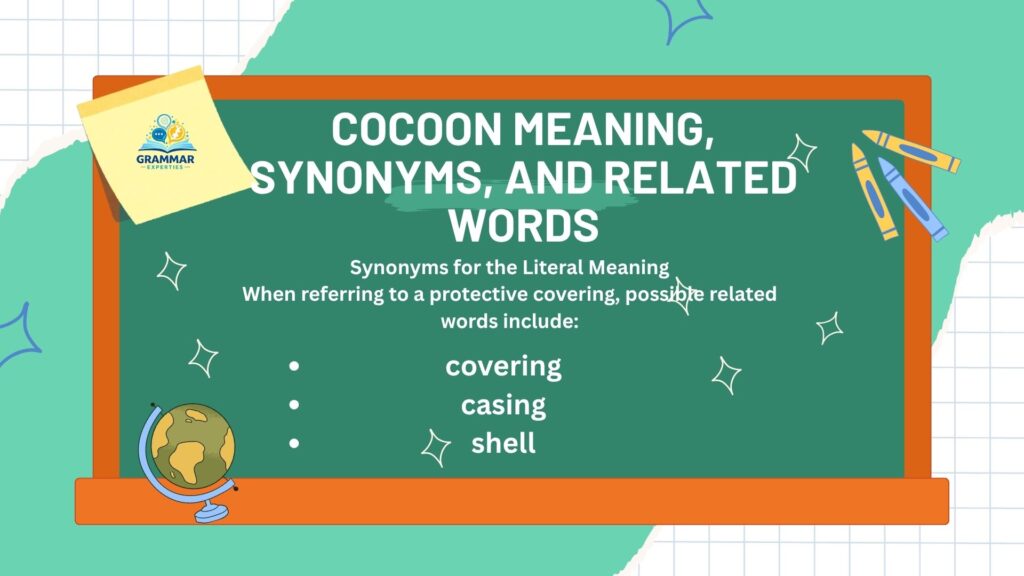
The meaning of cocoon changes slightly depending on context, so the best synonym depends on how you’re using it.
Synonyms for the Literal Meaning
When referring to a protective covering, possible related words include:
- covering
- casing
- shell
- enclosure
- sheath
- casing
- protective layer
Merriam-Webster’s thesaurus lists words such as sheath, casing, housing, shell, covering, pod, capsule, and encasement among related terms.
However, these aren’t always perfect replacements. A cocoon has a specific biological meaning that a general word such as “covering” may not fully capture.
Synonyms for the Figurative Meaning
When cocoon is used metaphorically, related words can include:
- shelter
- refuge
- haven
- sanctuary
- protection
- enclosure
- comfort zone
For example:
Her home became a cocoon from the stressful outside world.
You could replace cocoon with haven, but the emotional effect would be slightly different.
Related Words
Some useful forms and related expressions include:
- cocoon
- cocoons
- cocooned
- cocooning
- cocoon-like
Learning these forms helps you use the word naturally rather than memorizing only one spelling.
Real-Life Example: How the Cocoon Confusion Happens
Imagine a student writing a science assignment about the life cycle of a moth. The student has heard the word many times in class but has rarely written it. While preparing the assignment, the student types:
“The moth stays inside a cacoon until it becomes an adult.”
At first glance, cacoon may look reasonable. The student may even read it aloud and hear no obvious problem because the pronunciation of cocoon doesn’t clearly reveal the spelling.
After checking a reliable dictionary, however, the student discovers that the standard spelling is cocoon. The sentence becomes:
“The moth stays inside a cocoon until it becomes an adult.”
The lesson goes beyond correcting one typo. The student can now recognize the word in future reading and remember its spelling through the pattern CO + COON.
The same issue can happen outside school. Imagine someone writing a travel blog about relaxing at home after a busy vacation. They might write:
“After the trip, I wanted to return to my cozy cacoon.”
The intended meaning is clear, but the spelling still needs correction:
“After the trip, I wanted to return to my cozy cocoon.”
This example shows why spelling matters even when readers can understand what you mean. Correct spelling makes writing look polished, professional, and trustworthy. It also helps search engines and readers connect your content with the standard word.
Cocoon Usage and Dictionary Evidence: 2025–2026 Update
When checking a spelling question, one of the most reliable approaches is to look at established dictionaries rather than relying on search results alone.
As of 2026, major dictionary references continue to recognize cocoon as the standard English word. Merriam-Webster’s current entry gives the noun meaning, pronunciation, etymology, and first-known-use information, while Cambridge provides both literal and figurative definitions as well as verb usage.
Merriam-Webster’s current entry reports that the noun cocoon was first known in English in 1699 and traces the word through French and Occitan. Its 2026 entry also documents the verb as an established English usage.
What Current Evidence Tells Us
There isn’t a single authoritative public statistic that establishes an exact 2025–2026 percentage of searches for “cacoon” versus “cocoon.” Search engines don’t provide a universal spelling-error rate that can responsibly be presented as an official statistic.
However, the dictionary evidence is clear: cocoon is the established standard spelling, while “cacoon” should not be used as the normal spelling of this English word.
That distinction is more useful than inventing a search-volume percentage.
A Practical Research Rule
When you’re unsure about a spelling in 2026:
- Check a major dictionary.
- Confirm the definition.
- Check pronunciation.
- Look at example sentences.
- Compare the word’s grammatical forms.
- Use the established spelling in your final text.
For cacoon vs. cocoon, this process consistently points to cocoon.
Common Mistakes With Cocoon
Even after learning the correct spelling, writers can make other mistakes.
Mistake 1: Writing “Cacoon”
Incorrect:
The insect made a cacoon.
Correct:
The insect made a cocoon.
Mistake 2: Confusing Cocoon With Chrysalis
Incorrect in a general butterfly context:
The butterfly came out of its cocoon.
Better:
The butterfly came out of its chrysalis.
For a moth, however, cocoon is often the appropriate term.
Mistake 3: Using Cocoon Only for Insects
The figurative use is perfectly legitimate.
For example:
The small apartment felt like a peaceful cocoon.
Here, you’re using cocoon to suggest safety, privacy, and comfort.
Mistake 4: Assuming the Word Is Pronounced Like It Looks
The pronunciation is approximately kuh-KOON, not something like “cuh-con.”
Hearing the word correctly can help, but seeing and remembering its written form is still important.
Easy Memory Trick: Never Spell Cocoon as Cacoon Again
Here’s a quick trick:
Think “CO + COON”
Break the word into two parts:
CO + COON = COCOON
Now imagine a little insect inside its COCOON.
The word contains four o’s? No be careful here.
The correct spelling is:
C O C O O N
That means there are three o’s, not four.
A useful visual pattern is:
CO + COON
This gives you the correct sequence without guessing.
You can also connect the word to:
Cocoon = cover + protection
Once you remember both the spelling and meaning together, the word becomes much easier to recall.
Cacoon vs. Cocoon: Quick Comparison Checklist
Before publishing or submitting your writing, use this checklist:
| Question | Correct Answer |
|---|---|
| Is “cocoon” the standard spelling? | Yes |
| Is “cacoon” the normal spelling? | No |
| Does cocoon have a biological meaning? | Yes |
| Can cocoon be used figuratively? | Yes |
| Can cocoon be used as a verb? | Yes |
| What is the plural? | Cocoons |
| Can “cocoon” describe a safe environment? | Yes |
| Is cocoon the same as chrysalis? | No |
| Does “cocoon” have double o’s at the end? | Yes |
| Which spelling should you use in standard English? | Cocoon |
Mini Quiz: Cacoon or Cocoon
1. Spell It Right!
Which spelling is correct?
A) Cacoon
B) Cocoon
C) Cacone
D) Cocoune
Answer: B) Cocoon
2. Quick Spelling Check
Choose the correctly spelled word:
A) Cocoon
B) Cacoon
C) Cocunne
D) Cocone
Answer: A) Cocoon
3. Fill the Gap
The moth stayed inside its ______.
A) cacoon
B) cocone
C) cocoon
D) cacoune
Answer: C) cocoon
4. Meaning Match
What does cocoon commonly refer to?
A) A type of leaf
B) A protective insect covering
C) A flying insect
D) A flower
Answer: B) A protective insect covering
5. Spot the Mistake
Which sentence contains the spelling mistake?
A) The moth formed a cocoon.
B) We found a cocoon on the branch.
C) The insect stayed inside its cacoon.
D) The cocoon protected the insect.
Answer: C) The insect stayed inside its cacoon.
6. True Word Challenge
Which word is the standard English spelling?
A) Cacoon
B) Cocoon
C) Cacoun
D) Cocoune
Answer: B) Cocoon
7. Meaning Matters
In “Her home was a peaceful cocoon,” what does cocoon mean?
A) An insect
B) A protective or comfortable environment
C) A garden
D) A nest
Answer: B) A protective or comfortable environment
8. Choose the Correct Sentence
Which sentence uses cocoon correctly?
A) The butterfly built a cocoon tree.
B) She cocooned herself in a warm blanket.
C) He found a cocooning insect in his book.
D) The cocoon was a type of flower.
Answer: B) She cocooned herself in a warm blanket.
9. Plural Power
What is the correct plural of cocoon?
A) Cocoones
B) Cocoonies
C) Cocoons
D) Cacoons
Answer: C) Cocoons
10. Verb or Noun?
Which sentence uses cocoon as a verb?
A) The cocoon was attached to a branch.
B) The moth entered its cocoon.
C) She cocooned herself in a blanket.
D) The cocoon was small.
Answer: C) She cocooned herself in a blanket.
11. Don’t Get Tricked!
Which spelling should you avoid in standard English?
A) Cocoon
B) Cocoons
C) Cocooned
D) Cacoon
Answer: D) Cacoon
12. Letter Pattern Challenge
Which letter sequence correctly spells cocoon?
A) C-O-C-O-O-N
B) C-A-C-O-O-N
C) C-O-C-A-O-N
D) C-O-C-O-U-N
Answer: A) C-O-C-O-O-N
13. Pronunciation Pick
Which pronunciation is closest to the standard pronunciation of cocoon?
A) kuh-KOON
B) KOH-kahn
C) kuh-KOWN
D) KOK-un
Answer: A) kuh-KOON
14. Science Check
Which insect is commonly associated with making a cocoon?
A) Moth
B) Eagle
C) Frog
D) Fish
Answer: A) Moth
15. Cocoon or Chrysalis?
Which term is generally associated with the pupal casing of a butterfly?
A) Cocoon
B) Chrysalis
C) Capsule
D) Shell
Answer: B) Chrysalis
16. Sentence Saver
Choose the correctly spelled sentence:
A) The caterpillar made a cacoon.
B) The caterpillar made a cocoon.
C) The caterpillar made a cocoune.
D) The caterpillar made a cacoune.
Answer: B) The caterpillar made a cocoon.
17. Vocabulary Boost
Which word is closest in meaning to cocoon when used figuratively?
A) Refuge
B) Argument
C) Journey
D) Machine
Answer: A) Refuge
18. Find the Correct Form
Which form is correctly spelled?
A) Cocooned
B) Cacooned
C) Cocouned
D) Cacoond
Answer: A) Cocooned
19. Memory Trick
Which memory trick helps you spell cocoon correctly?
A) CO + COON
B) CA + COON
C) CO + COUN
D) CA + COUN
Answer: A) CO + COON
20. Context Clue
“The blankets created a warm ______ around her.”
Which word best completes the sentence?
A) cacoon
B) cocoon
C) cocone
D) cacoune
Answer: B) cocoon
21. Grammar Challenge
Which sentence uses cocoon correctly as a noun?
A) She cocooned herself warmly.
B) The moth emerged from its cocoon.
C) He cocooned the blanket.
D) They were cocooning themselves.
Answer: B) The moth emerged from its cocoon.
22. Spelling Detective
You see the sentence: “The insect formed a cacoon.” What should you change?
A) Change “cacoon” to “cocoon”
B) Change “cacoon” to “cocoune”
C) Change “cacoon” to “cacoun”
D) Leave it unchanged
Answer: A) Change “cacoon” to “cocoon”
23. Definition Dash
Which definition best describes cocoon?
A) A protective covering made by certain insects
B) A colorful type of butterfly
C) A plant that attracts moths
D) A small flying animal
Answer: A) A protective covering made by certain insects
24. Final Spelling Showdown
Which pair is correct?
A) Cacoon — incorrect; Cocoon — correct
B) Cocoon — incorrect; Cacoon — correct
C) Both are equally standard
D) Neither is an English word
Answer: A) Cacoon — incorrect; Cocoon — correct
25. The Ultimate Challenge!
Complete the sentence correctly:
“After a tiring day, she retreated into a cozy ______ of comfort.”
A) cacoon
B) cocoon
C) cacoune
D) cocoune
Answer: B) cocoon
Frequently Asked Questions
Q1:Is “cacoon” or “cocoon” correct?
Cocoon is the correct spelling. Cacoon is a common misspelling when referring to the insect covering or the figurative idea of a protective environment.
Q2:Is cacoon a real English word?
Cacoon is not the standard spelling of the everyday English word “cocoon.” If you’re referring to the protective covering made by certain insects, use cocoon.
Q3:What does cocoon mean?
A cocoon is a protective covering made by certain insects during development. Figuratively, it can mean a safe, comfortable, or isolated environment.
Q4:How do you pronounce cocoon?
Cocoon is pronounced approximately kuh-KOON, with the main stress on the second syllable. Cambridge and Merriam-Webster provide pronunciation guides for the word.
Q5:What is the plural of cocoon?
The plural is cocoons.
Example:
We found three cocoons attached to the branches.
Q6:Is a butterfly inside a cocoon?
Generally, butterflies develop inside a chrysalis, while many moths form cocoons. Although the terms are sometimes used loosely in everyday speech, they aren’t biologically identical.
Q7:Can cocoon be a verb?
Yes. Cocoon can be used as a verb meaning to surround or protect someone or something.
Example:
She cocooned herself in a warm blanket.
Q8:What is an easy way to remember the spelling of cocoon?
Remember:
CO + COON = COCOON
Don’t replace the first o with a. When you’re referring to this word, cocoon is the spelling you want.
Conclusion: Cacoon or Cocoon?
So, cacoon or cocoon which spelling is correct?
The answer is cocoon. It is the standard English spelling for the protective covering made by certain insects and for the related figurative idea of a safe, enclosed, or comfortable environment. Major dictionaries such as Cambridge and Merriam-Webster recognize cocoon and provide both noun and verb uses.
Cacoon is best treated as a spelling mistake. If you catch yourself writing it, remember the simple pattern:
CO + COON = COCOON
Whether you’re writing a school assignment, blog post, email, or everyday message, choosing cocoon will keep your spelling accurate and your writing polished.
If you’re working on improving your English spelling, don’t just memorize the correction learn the meaning, pronunciation, word forms, and examples too. That’s the easiest way to make the correct spelling stick.
Explore more easy grammar lessons and improve your English with Grammar Expertise
Referneces

Maimoona Mughal is an English grammar enthusiast dedicated to simplifying confusing words, grammar rules, and vocabulary through clear, accurate, and learner-friendly content that helps readers write and communicate with confidence.