Introduction
Have you ever typed “disregulated” and then stopped because it didn’t look quite right? If so, you’re not alone. The confusion between dysregulated vs disregulated is easy to understand because the two spellings sound almost identical.
The good news is that the answer is straightforward: dysregulated is the standard and dictionary-recognized form. It is the adjective and past-participle form of dysregulate, a verb used when something is not being regulated normally or appropriately. Cambridge Dictionary, for example, defines dysregulated in medical and psychological contexts and gives examples involving body processes, emotions, and behavior.
By contrast, disregulated is generally treated as a misspelling of dysregulated, rather than the standard spelling you should choose in formal English.
In this guide, you’ll learn exactly what dysregulated means, why “disregulated” causes confusion, how the prefixes dys- and dis- differ, and how to use the correct word naturally in everyday and professional writing.
Dysregulated vs Disregulated: Which Word Is Correct?
The short answer is simple:
Dysregulated is correct. Disregulated is generally considered a misspelling.
The word dysregulated describes something whose normal regulation has become impaired, disrupted, or abnormal. It can refer to emotions, behavior, biological processes, metabolism, immune activity, and other systems.
Dysregulated: The Correct Spelling
Dysregulated is a recognized English word. Cambridge Dictionary lists it as an adjective used in medical and psychological contexts. It describes something that is not controlled or regulated in the way it normally should be.
For example:
- The patient had dysregulated glucose metabolism.
- The child became emotionally dysregulated after the stressful event.
- Researchers observed dysregulated immune activity.
- Stress can contribute to a dysregulated emotional response.
Merriam-Webster Medical also recognizes dysregulation and defines it in relation to impairment of physiological regulatory mechanisms.
Disregulated: Usually a Spelling Mistake
Disregulated is not the standard form used when you mean “regulated improperly.”
It may appear online because people often construct it by analogy with familiar dis- words such as:
- disconnected
- disorganized
- dissatisfied
- disabled
- disrupted
However, that pattern does not make disregulated the appropriate spelling for this meaning.
Wiktionary specifically labels disregulated as a misspelling of dysregulated.
Quick Comparison
| Word | Standard usage? | Meaning |
|---|---|---|
| Dysregulated | Yes | Not properly regulated or controlled |
| Disregulated | Generally no | Usually a misspelling of dysregulated |
So if you’re writing an essay, article, report, email, medical document, or educational resource, choose dysregulated.
What Does Dysregulated Mean?
The simplest definition of dysregulated is “not regulated properly.”
The word can describe a system that still operates but does not maintain normal balance, control, or response.
Dysregulated Meaning in Simple English
Think about a thermostat.
A properly regulated thermostat keeps a room near the desired temperature. If its control mechanism stops responding appropriately, the room may become far too hot or too cold.
The thermostat hasn’t disappeared. It simply isn’t regulating temperature properly.
That is the basic idea behind dysregulated.
In psychology, the same concept can apply to emotions. Someone experiencing emotional dysregulation may have difficulty managing the intensity, duration, or expression of emotional responses.
The American Psychological Association’s Dictionary of Psychology describes dysregulation as an excessive or poorly managed mechanism or response.
Dysregulated in Psychology
You’ll frequently see dysregulated in discussions about:
- emotional responses
- behavior
- stress
- attention
- impulse control
- trauma
- mental health
- nervous-system regulation
For example:
After receiving the unexpected news, she felt emotionally dysregulated and needed some time to calm down.
This does not necessarily mean the person has a particular diagnosis. Dysregulated is a descriptive term, and its meaning depends on context.
Dysregulated in Medicine and Biology
The word isn’t limited to psychology.
Scientists and medical professionals use dysregulated to describe biological processes that aren’t functioning normally.
For example:
Researchers found evidence of dysregulated immune activity.
Recent scientific literature continues to use the word in this technical sense. For example, 2026 PubMed-indexed research uses dysregulated when discussing molecular and physiological processes.
This is important because dysregulated doesn’t simply mean emotional. Its broader meaning is connected to impaired or abnormal regulation.
Why Do People Write “Disregulated” Instead?
The confusion isn’t surprising. English contains many common words beginning with dis-, so writers may instinctively choose disregulated.
Dys- vs Dis-: The Prefix Difference
The prefixes have different histories and functions.
Dys- is associated with meanings such as abnormal, impaired, difficult, or faulty.
Examples include:
- dysfunction
- dyslexia
- dysphagia
- dysregulation
Dis-, on the other hand, can express ideas such as separation, negation, reversal, or removal in many English words.
Examples include:
- disagree
- disconnect
- dislike
- disapprove
- disorganized
Therefore, dysregulated communicates the idea of impaired or abnormal regulation.
Why “Disregulated” Sounds Natural
Imagine hearing the word rather than seeing it.
“Dysregulated” and “disregulated” are extremely close in pronunciation. When someone learns the term through conversation, they may naturally spell it with dis-.
There is another reason, too: English speakers are familiar with words such as disorganized, disordered, and disconnected. The brain often uses familiar patterns when producing unfamiliar or specialized words.
That makes disregulated understandable as a mistake but it doesn’t make it the preferred standard spelling.
A Simple Memory Trick
Use this rule:
Dysregulated = regulation isn’t working properly.
Think of dys- as signaling something abnormal or impaired.
So:
dys + regulated → dysregulated
That simple connection can help you avoid the spelling mistake.
How to Use Dysregulated Correctly
Understanding the definition is useful, but seeing the word in context makes it much easier to remember.
Examples of Dysregulated in Sentences
Here are several natural examples:
- The stressful situation left him feeling emotionally dysregulated.
- The researchers investigated dysregulated gene expression.
- Poor sleep may affect systems involved in emotional regulation.
- The study examined behavioral patterns associated with dysregulation.
- The doctor discussed the possibility of an abnormal or dysregulated physiological response.
- The child became dysregulated when the familiar routine suddenly changed.
- Scientists observed dysregulated immune activity in the affected tissue.
Notice that the word works across several fields.
Dysregulated vs Unregulated
These words are related, but they aren’t always interchangeable.
Unregulated generally means something isn’t being regulated at all or is not subject to regulation.
Dysregulated suggests that a regulatory process exists but is functioning abnormally or improperly.
For example:
The industry is unregulated.
This means there may be little or no formal regulation.
Compare that with:
The body’s inflammatory response became dysregulated.
Here, the body’s regulatory mechanisms exist, but they aren’t functioning normally.
Dysregulated vs Deregulated
Deregulated is another legitimate word, but it has a different meaning.
It commonly refers to removing or reducing rules, controls, or government regulation.
For example:
The government deregulated the industry.
That does not mean the industry became biologically or emotionally dysregulated.
The distinction is:
- Dysregulated = regulation is impaired or abnormal.
- Deregulated = regulation has been reduced or removed.
- Unregulated = not regulated.
- Disregulated = generally a misspelling of dysregulated.
2025–2026 Evidence: How Dysregulated Is Used Today
The continued use of dysregulated in recent medical and psychological research provides strong evidence that the term is established well beyond casual internet language.
Recent Research Snapshot
A 2025 systematic review examined what processes are dysregulated among emotionally dysregulated youth and noted that dysregulation has become a widely used term in psychology and psychiatry. The review also discussed different forms, including affective, behavioral, cognitive, autonomic, and sleep dysregulation.
A 2025 meta-analysis examining the relationship between dissociation and emotion dysregulation included 120 studies, demonstrating how extensively the concept is represented in contemporary psychological research.
Another 2026 systematic review and meta-analysis examined mindfulness-based interventions for emotion regulation and dysregulation. Researchers identified 19 randomized controlled trials, with 16 included in the meta-analyses and 988 participants in total.
The word also remains active in biological research. For example, PubMed-indexed studies published in 2026 use dysregulated in research on lung biology, metabolism, cancer, and cellular processes.
What This Evidence Tells Us
The important point isn’t that dysregulated is merely popular online.
It is established across dictionaries, psychology, medicine, neuroscience, biology, and academic research.
That gives writers a reliable reason to choose dysregulated rather than disregulated in formal contexts.
A Real-Life Example: Dysregulated vs Disregulated in Context
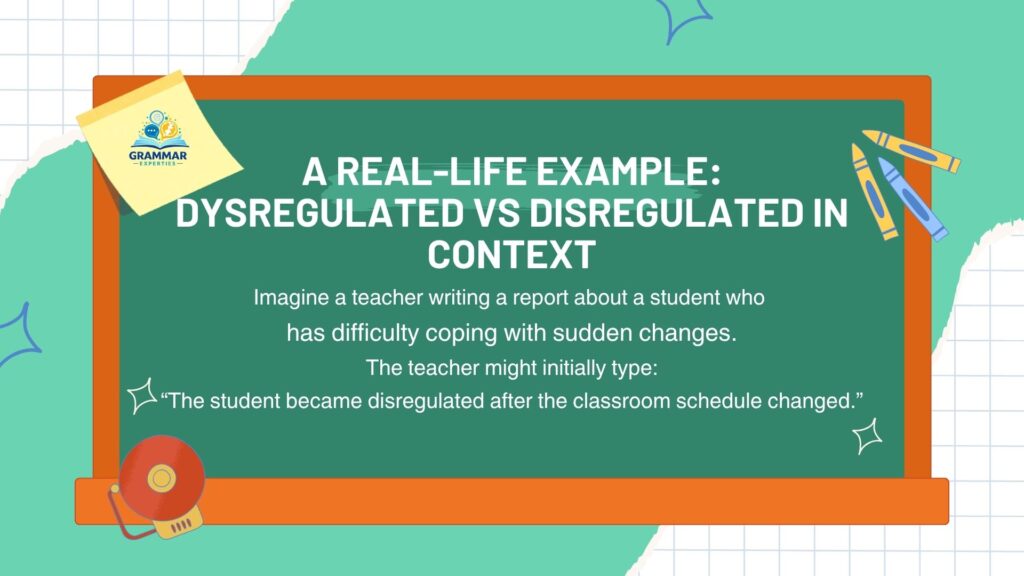
Imagine a teacher writing a report about a student who has difficulty coping with sudden changes.
The teacher might initially type:
“The student became disregulated after the classroom schedule changed.”
The sentence sounds understandable, but the spelling is incorrect.
After checking a reliable dictionary, the teacher changes it to:
“The student became dysregulated after the classroom schedule changed.”
The revised sentence is more appropriate because dysregulated is the established term for impaired or abnormal regulation.
Now consider a different situation. A biology student is writing a research assignment:
“The experiment showed disregulated immune activity.”
Again, the intended word is dysregulated:
“The experiment showed dysregulated immune activity.”
This example demonstrates why the distinction matters. The term isn’t restricted to emotional health. It can describe many types of regulatory processes.
In professional writing, spelling accuracy matters because readers use terminology as a signal of credibility. A researcher, teacher, editor, or healthcare professional who consistently uses the established form makes the text easier to understand and more trustworthy. Current dictionaries and recent academic literature all support the established use of dysregulated.
Dysregulated vs Disregulated: Quick Comparison Guide
Use this table whenever you’re unsure which form belongs in your sentence.
| Feature | Dysregulated | Disregulated |
|---|---|---|
| Standard English form | Yes | Generally no |
| Dictionary-recognized | Yes | Not as the standard form |
| Means impaired regulation | Yes | Intended meaning, but incorrect spelling |
| Used in psychology | Yes | No |
| Used in medicine | Yes | No |
| Used in scientific research | Yes | No |
| Recommended in formal writing | Yes | No |
| Example | “He became emotionally dysregulated.” | “He became emotionally disregulated.” ❌ |
The Three-Second Test
When you’re writing quickly, ask:
Am I describing something that is regulated abnormally or poorly?
If yes, write:
DYSREGULATED
Not:
DISREGULATED
Common Mistakes With Dysregulated
Even experienced writers can make spelling mistakes with specialized vocabulary.
Mistake 1: Writing Disregulated
Incorrect:
The child became disregulated.
Correct:
The child became dysregulated.
Mistake 2: Confusing Dysregulated With Deregulated
Incorrect meaning:
The company became dysregulated after government rules were removed.
If you mean the removal of government controls, deregulated is usually the appropriate word.
Mistake 3: Assuming Dysregulated Only Refers to Emotions
Although emotional dysregulation is common in psychology, dysregulated has broader applications.
You can describe:
- metabolic processes
- immune responses
- cellular activity
- gene expression
- behavior
- emotions
- physiological systems
Mistake 4: Treating Dysregulated as a Diagnosis
The word dysregulated describes a state or pattern of functioning. It doesn’t automatically identify a specific medical or psychological diagnosis.
For example:
“He appeared emotionally dysregulated.”
This describes what was observed. It does not, by itself, establish a diagnosis.
Mini Quiz: Dysregulated vs Disregulated
1. Which spelling is correct?
A) Dysregulated
B) Disregulated
C) Dysreggulated
D) Disreggulated
Answer: A) Dysregulated
2. What does “dysregulated” generally mean?
A) Not regulated properly
B) Completely regulated
C) Recently regulated
D) Officially regulated
Answer: A) Not regulated properly
3. Which sentence is correct?
A) She became emotionally dysregulated.
B) She became emotionally disregulated.
C) She became emotionally dysreggulated.
D) She became emotionally disregulatted.
Answer: A) She became emotionally dysregulated.
4. Which prefix appears in “dysregulated”?
A) dys-
B) dis-
C) de-
D) mis-
Answer: A) dys-
5. Which phrase is standard?
A) Emotionally dysregulated
B) Emotionally disregulated
C) Emotionally dysreggulated
D) Emotionally dis-regulated
Answer: A) Emotionally dysregulated
6. Which word should you use in formal writing?
A) Dysregulated
B) Disregulated
C) Dysregulized
D) Disregulized
Answer: A) Dysregulated
7. What noun is related to “dysregulated”?
A) Dysregulation
B) Disregulation
C) Dysregulance
D) Deregulishment
Answer: A) Dysregulation
8. Which sentence best demonstrates dysregulation?
A) His emotional response became difficult to control.
B) His emotional response was officially removed.
C) His emotional response was scheduled.
D) His emotional response was translated.
Answer: A) His emotional response became difficult to control.
9. In which field is “dysregulated” commonly used?
A) Psychology
B) Typography only
C) Architecture only
D) Cartography only
Answer: A) Psychology
10. Can “dysregulated” describe biological processes?
A) Yes
B) No
C) Only in literature
D) Only in casual speech
Answer: A) Yes
11. Pick the correctly spelled sentence:
A) Stress can cause dysregulated behavior.
B) Stress can cause disregulated behavior.
C) Stress can cause dysregulatted behavior.
D) Stress can cause dysregullated behavior.
Answer: A) Stress can cause dysregulated behavior.
12. What is the difference between “dysregulated” and “deregulated”?
A) Dysregulated means impaired regulation; deregulated means controls are reduced or removed.
B) They always mean exactly the same thing.
C) Dysregulated means legally deregulated.
D) Deregulated only refers to emotions.
Answer: A
13. Which spelling belongs in an academic essay?
A) Dysregulated
B) Disregulated
C) Dysreggulated
D) Disregulatted
Answer: A) Dysregulated
14. Which term can describe impaired emotional regulation?
A) Dysregulation
B) Deregulation
C) Disconnection
D) Disapproval
Answer: A) Dysregulation
15. Complete the sentence: “Researchers studied ______ immune activity.”
A) Dysregulated
B) Disregulated
C) Dysregulatted
D) Disregulatted
Answer: A) Dysregulated
16. If you’re unsure between “dysregulated” and “disregulated,” which should you choose?
A) Dysregulated
B) Disregulated
C) Both equally
D) Neither
Answer: A) Dysregulated
17. Which sentence sounds natural and uses the correct spelling?
A) The sudden change left him emotionally dysregulated.
B) The sudden change left him emotionally disregulated.
C) The sudden change left him emotionally deregulated.
D) The sudden change left him emotionally reguless.
Answer: A
18. What does the prefix “dys-” generally suggest?
A) Abnormal or impaired functioning
B) Complete approval
C) Location
D) Measurement
Answer: A) Abnormal or impaired functioning
19. Which is the adjective form?
A) Dysregulated
B) Dysregulation
C) Regulation
D) Deregulation
Answer: A) Dysregulated
20. Which sentence is correct?
A) The report describes dysregulated stress responses.
B) The report describes disregulated stress responses.
C) The report describes dysregulatted stress responses.
D) The report describes dis-regulated stress responses.
Answer: A
21. Which term is appropriate for abnormal regulation in biology?
A) Dysregulation
B) Disregulation
C) Dysregulance
D) Disregulance
Answer: A) Dysregulation
22. Why do people often mistakenly write “disregulated”?
A) It resembles familiar words beginning with “dis-.”
B) Dysregulated is only used in poetry.
C) Both spellings are officially identical.
D) Disregulated is always the scientific spelling.
Answer: A
23. Which sentence should an editor recommend?
A) The patient appeared emotionally dysregulated.
B) The patient appeared emotionally disregulated.
C) The patient appeared emotionally dysregulatted.
D) The patient appeared emotionally dis-regulated.
Answer: A
24. Which definition correctly matches “dysregulated”?
A) Impaired or abnormal regulation
B) Removal of all laws
C) Complete agreement
D) A type of spelling correction
Answer: A) Impaired or abnormal regulation
25. Correct this sentence: “The child became disregulated after the routine changed.”
A) The child became dysregulated after the routine changed.
B) The child became deregulated after the routine changed.
C) The child became disorganized after the routine changed.
D) The child became dysregulatted after the routine changed.
Answer: A) The child became dysregulated after the routine changed.
Frequently Asked Questions About Dysregulated vs Disregulated
Q1: Is “disregulated” a correct English word?
Disregulated is generally treated as a misspelling of dysregulated when the intended meaning is impaired or abnormal regulation. For standard formal English, use dysregulated.
Q2: What does dysregulated mean in simple terms?
Dysregulated means not being regulated properly. It can describe an emotional, behavioral, biological, physiological, or other system that isn’t functioning within its normal regulatory pattern.
Q3: Is dysregulated a real word?
Yes. Dysregulated is a recognized word, and major dictionaries provide definitions for it. Cambridge lists medical and psychological meanings, while Merriam-Webster Medical recognizes dysregulation and dysregulated.
Q4: What is the difference between dysregulated and unregulated?
Dysregulated generally means regulation is impaired or functioning abnormally. Unregulated usually means something isn’t regulated or controlled by a particular system or authority.
Q5: What is the difference between dysregulated and deregulated?
Dysregulated means regulation isn’t working properly. Deregulated usually means a regulatory system or set of controls has been reduced or removed.
Q6: Can you say someone is emotionally dysregulated?
Yes. Emotionally dysregulated is a common phrase in psychology and mental-health discussions. It generally describes difficulty managing or modulating emotional responses. The APA Dictionary of Psychology uses dysregulation for poorly managed or excessive responses.
Q7: Is dysregulated only used in psychology?
No. The word is also widely used in medicine, biology, neuroscience, and other scientific fields. Recent 2026 research, for example, uses dysregulated to describe biological and molecular processes.
Q8: How can I remember the correct spelling?
Remember:
DYSREGULATED = regulation is impaired.
If you’re talking about something being regulated abnormally or poorly, choose dysregulated.
Conclusion: Dysregulated Is the Word You Want
When comparing dysregulated vs disregulated, the answer is clear: dysregulated is the standard and correct form for formal English.
It describes something that isn’t being regulated normally or appropriately. The term appears in dictionaries and is widely used in psychology, medicine, biology, and scientific research.
Disregulated, meanwhile, is generally a spelling mistake created by the similarity between dys- and the much more familiar dis- prefix.
So, the next time you need the word, remember:
Dysregulated = impaired or abnormal regulation.
Whether you’re writing about emotions, behavior, metabolism, immune activity, or another regulatory system, dysregulated is the spelling to choose.
Explore more easy grammar lessons and improve your English with Grammar Expertise
References
Cambridge Dictionary — “Dysregulated”
Merriam-Webster Medical — “Dysregulation”

Maimoona Mughal is an English grammar enthusiast dedicated to simplifying confusing words, grammar rules, and vocabulary through clear, accurate, and learner-friendly content that helps readers write and communicate with confidence.