Have you ever typed “foward” and then wondered whether you accidentally left out a letter? If so, you are not alone. The confusion between foward vs forward is easy to understand because the two spellings look almost identical.
However, there is a clear answer: forward is the correct spelling. Foward is a misspelling and should not be used in standard English.
The correct word has two r’s:
F-O-R-W-A-R-D = forward
For example:
- Correct: I look forward to hearing from you.
- Incorrect: I look foward to hearing from you.
In this guide, you’ll learn what forward means, why foward is incorrect, how to remember the spelling, and how to use forward naturally in everyday and professional writing.
Foward vs Forward: Which Spelling Is Correct?
The short answer is simple: Forward is correct, while foward is incorrect.
Major English dictionaries recognize forward as a standard English word. Cambridge Dictionary lists forward as an adverb, adjective, verb, and noun, with meanings related to direction, progress, sending something onward, and sports.
Is “Foward” a Real Word?
No. Foward is not the standard spelling of the English word.
It is generally a spelling mistake created by leaving out the first r in forward.
Compare:
| Spelling | Status | Example |
|---|---|---|
| forward | Correct | We need to move forward. |
| foward | Incorrect | We need to move foward. |
Therefore, whenever you mean ahead, toward the front, onward, or toward the future, use forward.
Does Forward Have Two Rs?
Yes.
The spelling is:
F-O-R-W-A-R-D
The two r’s are important:
FOR + WARD = FORWARD
A useful memory trick is to pronounce the first part as “for” rather than mentally reducing it to “fo.”
What Does “Forward” Mean?
The word forward has several meanings depending on how it functions in a sentence.
Cambridge Dictionary gives forward meanings connected with moving toward the front, moving toward the future, sending something to another person, and describing a position in sports.
Forward as an Adverb
As an adverb, forward usually describes movement toward the front or ahead.
Examples:
- She stepped forward.
- The car moved forward slowly.
- He leaned forward to hear the speaker.
- Please move forward in the line.
It can also describe progress:
- The project is moving forward.
- We need to look forward, not backward.
- The research has moved forward significantly.
Forward as an Adjective
Forward can describe something positioned toward the front or something associated with the future.
Examples:
- The forward section of the aircraft was damaged.
- We need better forward planning.
- The company has a forward-looking strategy.
Forward as a Verb
As a verb, forward means to send something onward, particularly a message, email, letter, or package.
Examples:
- Please forward the email to me.
- I will forward the document to the manager.
- Could you forward this message to the team?
This meaning is especially common in workplace communication.
Forward as a Noun
In sports, a forward is a player positioned toward the attacking end of the field or court.
For example:
The team’s forward scored two goals.
So, forward is a versatile word with several grammatical functions.
Why Is “Foward” So Commonly Misspelled?
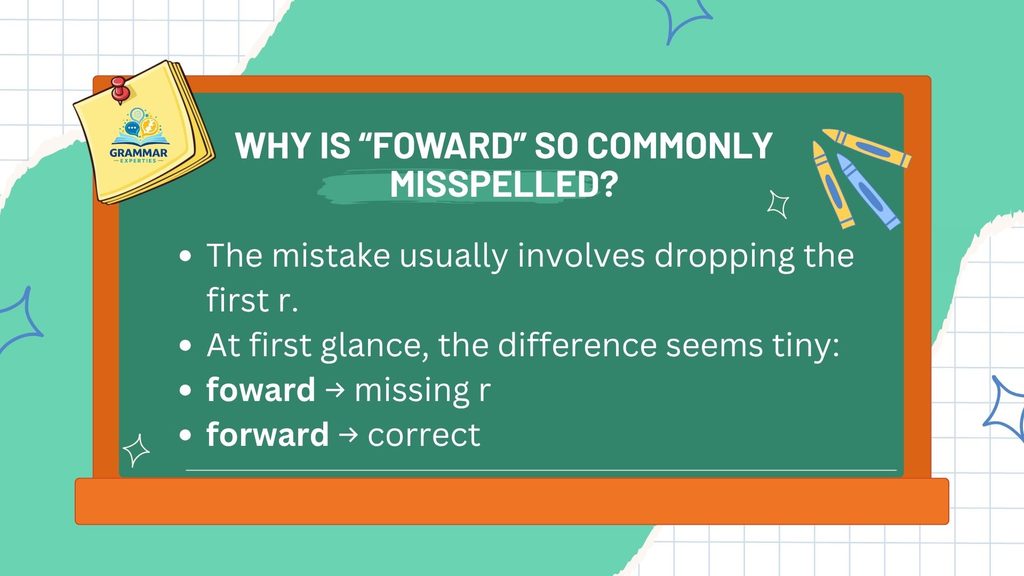
The mistake usually involves dropping the first r.
At first glance, the difference seems tiny:
foward → missing r
forward → correct
Because people often read familiar words quickly, the missing letter can be overlooked during typing or proofreading.
Fast Typing Can Cause the Error
When you’re typing quickly, especially on a phone, it is easy to skip a letter.
For example:
I look foward to your reply.
The writer probably knows the correct spelling but simply missed the r.
The same thing happens with many other familiar words. A person can know the spelling perfectly and still make a typing error.
The Word Looks Familiar Either Way
Another reason is visual familiarity.
When you see:
foward
your brain may recognize the intended word immediately and fail to notice that one letter is missing.
This is one reason proofreading matters, even when you are writing simple sentences.
Pronunciation Can Add Confusion
In natural speech, unstressed sounds can become less distinct. The word forward is commonly pronounced approximately as “FOR-werd” in English, so the written r may not feel as prominent as it looks on the page.
That does not change the spelling.
The written form remains:
forward
How to Remember the Correct Spelling of Forward
The easiest way to remember forward is to break it into two parts:
FOR + WARD = FORWARD
The word ward appears in other words connected with direction, such as:
- toward
- afterward
- backward
- inward
- outward
- onward
Foward vs Forward Memory Trick
When you are unsure, say:
Go FOR-WARD, not FO-WARD.
Another simple trick is to remember that forward has two Rs.
foRwaRd
The visual pattern makes the missing letter easier to spot.
A Quick Spelling Check
Before submitting an email, essay, assignment, or article, check for:
- ❌ foward
- ✅ forward
- ❌ looking foward
- ✅ looking forward
- ❌ move foward
- ✅ move forward
- ❌ step foward
- ✅ step forward
Once you connect forward with for + ward, the spelling becomes much easier to remember.
Forward in American and British English
One useful point is that forward is correct in both American and British English.
There is no American-versus-British spelling difference that changes forward into foward.
American English
American English commonly uses forward as an adverb.
For example:
We moved forward with the plan.
British English
British English also uses forward. In some adverbial contexts, forwards is also common.
For example:
The car moved forwards slowly.
Cambridge specifically notes forwards as an alternative adverbial form, particularly in British usage.
However, this does not make foward correct.
The distinction is:
| Word | Standard? | Typical use |
|---|---|---|
| forward | Yes | Standard English |
| forwards | Yes | Adverbial alternative, especially British English |
| foward | No | Misspelling |
So whether you write for American or British readers, foward should be corrected to forward.
Real-Life Example: Catching “Foward” Before Sending an Email
Imagine that Sara is applying for a new job. She writes an email to a potential employer after an interview.
Her first draft says:
Dear Mr. Khan,
Thank you for taking the time to speak with me yesterday. I look foward to hearing from you.
Kind regards,
Sara
Sara knows what the sentence means. She has also used the word many times before. But while proofreading her email, she notices the missing r.
She changes the sentence to:
I look forward to hearing from you.
That small correction matters because professional communication depends on clarity and attention to detail.
Now imagine a different situation. A manager receives an email saying:
Please foward the attached report to the finance department.
The meaning is still understandable. The recipient will probably know what the writer intended. Nevertheless, the standard spelling is:
Please forward the attached report to the finance department.
This example demonstrates an important point about spelling mistakes: a misspelling does not necessarily make a sentence impossible to understand, but correcting it makes the writing more polished and professional.
The same principle applies to students, job applicants, bloggers, customer-service representatives, and business writers. A single missing letter may seem insignificant, but repeated spelling mistakes can distract readers.
A good proofreading habit is to slow down when checking familiar words. Familiar words are often the ones we read automatically. If you frequently type foward, search specifically for that spelling before publishing or sending your text.
Forward Usage and 2025–2026 Language Data
Current online evidence continues to show that forward is the established English form, while spelling-checking resources identify foward as an error.
For example, a September 2026 spelling analysis of a current software source archive identified foward as a spelling error and suggested forward as the correction. The report found two occurrences of the typo in that particular code archive. This is not a measure of general English usage, but it provides a current real-world example of the misspelling appearing in digital text.
Current 2026 dictionary resources likewise continue to document forward as the standard word. Cambridge lists its uses as an adverb, adjective, verb, and noun.
A separate current spelling index based on Wiktionary data, analyzed in September 2026, lists forward as an English headword and tracks multiple spelling variants associated with it. Again, this is an index rather than a general population survey, so it should not be interpreted as a percentage of all English writing.
What the Current Evidence Shows
The evidence supports three practical conclusions:
- Forward remains the standard dictionary spelling in 2026.
- Foward continues to appear as a spelling error in digital text.
- There is no standard English variety in which foward replaces forward.
It is important not to turn individual typo counts into claims about how frequently all English speakers make this mistake. A spelling-check report or website search is evidence of occurrence, not a comprehensive linguistic survey.
Forward vs Foward: Quick Comparison
| Feature | Forward | Foward |
|---|---|---|
| Correct spelling | ✅ Yes | ❌ No |
| Standard English word | ✅ Yes | ❌ No |
| Has two Rs | ✅ Yes | ❌ No |
| Means toward the front | ✅ Yes | ❌ No |
| Can mean to send something | ✅ Yes | ❌ No |
| Used in professional writing | ✅ Yes | ❌ No |
| Used in American English | ✅ Yes | ❌ No |
| Used in British English | ✅ Yes | ❌ No |
| Recommended for essays | ✅ Yes | ❌ No |
| Recommended for emails | ✅ Yes | ❌ No |
Correct Examples
- I took a step forward.
- We need to move forward.
- I look forward to your response.
- Please forward this email.
- The car moved forward.
- She plays as a forward.
- We are looking forward to the event.
Incorrect Examples
- ❌ I took a step foward.
- ❌ We need to move foward.
- ❌ I look foward to your response.
- ❌ Please foward this email.
- ❌ The car moved foward.
Common Phrases With “Forward”
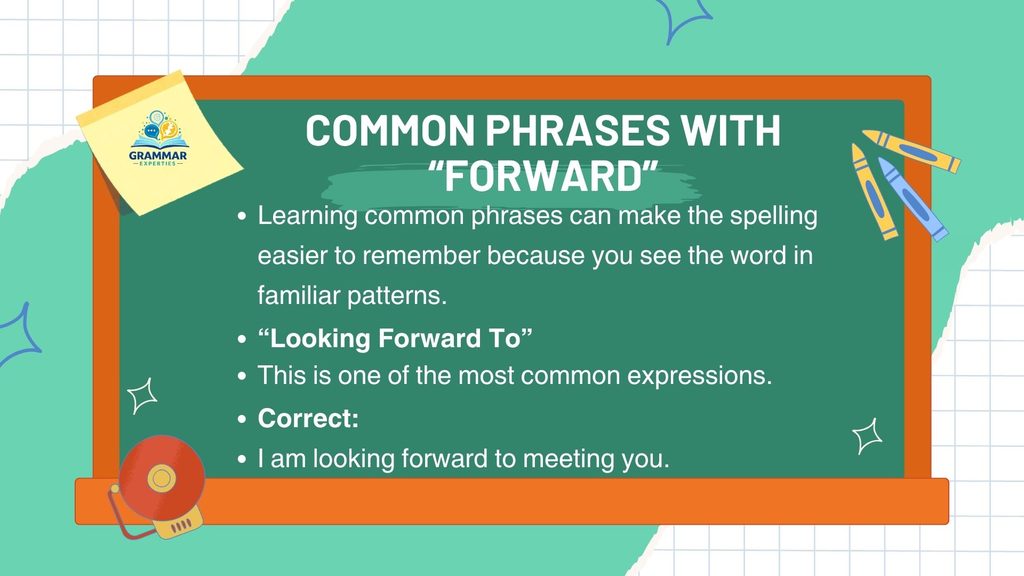
Learning common phrases can make the spelling easier to remember because you see the word in familiar patterns.
“Looking Forward To”
This is one of the most common expressions.
Correct:
I am looking forward to meeting you.
We are looking forward to the weekend.
She is looking forward to starting her new job.
A common mistake is:
❌ I am looking foward to meeting you.
The correct version always uses forward.
“Move Forward”
This phrase can describe physical movement or progress.
Please move forward.
The company decided to move forward with the project.
We need to move forward after reviewing the results.
“Forward an Email”
Here, forward is a verb.
Can you forward the email to me?
I’ll forward the documents this afternoon.
This is particularly common in professional communication.
Mini Quiz:Foward vs Forward
1. Which spelling is correct?
A. Foward
B. Forward
C. Forword
D. Forwad
Answer: B. Forward
2. Choose the correct sentence.
A. I look foward to meeting you.
B. I look forward to meeting you.
C. I look forword to meeting you.
D. I look forwad to meeting you.
Answer: B. I look forward to meeting you.
3. Is “forward” the correct spelling?
A. Yes
B. No
Answer: A. Yes
4. Complete the sentence: “Please _____ this email to Sarah.”
A. foward
B. forword
C. forward
D. forwad
Answer: C. forward
5. How many “r” letters are in “forward”?
A. One
B. Two
C. Three
D. None
Answer: B. Two
6. Which sentence uses “forward” correctly?
A. We need to move forward.
B. We need to move foward.
C. We need to move forword.
D. We need to move forwad.
Answer: A. We need to move forward.
7. What is wrong with “I look foward to your reply”?
A. “Reply” is incorrect.
B. “Look” is incorrect.
C. “Foward” is misspelled.
D. Nothing is wrong.
Answer: C. “Foward” is misspelled.
8. Which word means “toward the front”?
A. Foward
B. Forward
C. Forword
D. Forwad
Answer: B. Forward
9. True or False: “Foward” is the standard spelling of the word.
A. True
B. False
Answer: B. False
10. Which phrase is correct?
A. Looking foward to
B. Looking forword to
C. Looking forward to
D. Looking forwad to
Answer: C. Looking forward to
11. Complete the sentence: “The project is moving _____.”
A. foward
B. forward
C. forword
D. forwad
Answer: B. forward
12. Which spelling should you use in a professional email?
A. Foward
B. Forward
C. Forword
D. Forwad
Answer: B. Forward
13. Which sentence correctly uses “forward” as a verb?
A. I will foward the document.
B. I will forword the document.
C. I will forward the document.
D. I will forwad the document.
Answer: C. I will forward the document.
14. What is a useful way to remember the spelling of “forward”?
A. FO + WARD
B. FOR + WARD
C. FOR + WORD
D. FO + WORD
Answer: B. FOR + WARD
15. Which phrase is spelled correctly?
A. Move foward
B. Move forward
C. Move forword
D. Move forwad
Answer: B. Move forward
16. Choose the correct sentence.
A. She stepped foward.
B. She stepped forword.
C. She stepped forwad.
D. She stepped forward.
Answer: D. She stepped forward.
17. Which spelling is incorrect?
A. Forward
B. Forwarding
C. Forwards
D. Foward
Answer: D. Foward
18. Which sentence is correct?
A. We are looking foward to the event.
B. We are looking forward to the event.
C. We are looking forword to the event.
D. We are looking forwad to the event.
Answer: B. We are looking forward to the event.
19. Replace the misspelled word: “Please foward my application.”
A. Forword
B. Forwad
C. Forward
D. Foward
Answer: C. Forward
20. Which sentence uses “forward” correctly?
A. The player is a foward.
B. The player is a forword.
C. The player is a forward.
D. The player is a forwad.
Answer: C. The player is a forward.
21. Which spelling is correct in this sentence?
“Please _____ the message to the manager.”
A. foward
B. forward
C. forword
D. forwad
Answer: B. forward
22. True or False: “Forward” can be used as a verb meaning “to send something onward.”
A. True
B. False
Answer: A. True
23. Which sentence contains a spelling mistake?
A. Please move forward.
B. I look forward to your response.
C. She walked forward.
D. Please move foward.
Answer: D. Please move foward.
24. Which is the correct spelling?
A. F-O-W-A-R-D
B. F-O-R-W-A-R-D
C. F-O-R-W-O-R-D
D. F-O-W-A-D
Answer: B. F-O-R-W-A-R-D
25. Which sentence is completely correct?
A. I look foward to hearing from you.
B. I look forword to hearing from you.
C. I look forwad to hearing from you.
D. I look forward to hearing from you.
Answer: D. I look forward to hearing from you.
FAQs About Foward vs Forward
Q1:Is “foward” a correct spelling?
No. Foward is an incorrect spelling. The correct word is forward, with two r’s.
Q2:Is it “foward” or “forward”?
Forward is correct. Foward is a misspelling.
Q3:How do you spell forward correctly?
The correct spelling is:
F-O-R-W-A-R-D
A useful way to remember it is FOR + WARD = FORWARD.
Q4:Is “foward” a word in English?
No. Foward is not the standard English spelling. It is generally treated as a misspelling of forward.
Q5:Why do people spell forward as foward?
The error can happen when someone types quickly, skips the first r, or recognizes the familiar word visually without carefully checking every letter.
Q6:Is “looking foward to” correct?
No.
The correct phrase is:
I am looking forward to hearing from you.
Not:
❌ I am looking foward to hearing from you.
Q7:Is “forward” spelled the same in British and American English?
Yes. Forward is standard in both varieties. British English can also use forwards as an adverb in some contexts, but foward is not the standard spelling.
Q8:Does “forward” have two Rs?
Yes. Forward contains two r’s:
foRwaRd
That is one of the easiest ways to remember the spelling.
Final Conclusion: Foward vs Forward
When comparing foward vs forward, the answer is straightforward: forward is the correct spelling.
Foward is a misspelling caused by dropping the first r. The correct form is:
FORWARD
Remember the simple pattern:
FOR + WARD = FORWARD
Use forward when you mean moving toward the front, making progress, referring to the future, sending something onward, or describing a sports position.
For example:
I look forward to hearing from you.
That sentence is correct in both American and British English.
So the next time you hesitate between foward or forward, choose forward. Check those two r’s, proofread your writing, and you’ll avoid this common spelling mistake.
Explore more easy grammar lessons and improve your English with Grammar Expertise
References
Cambridge Dictionary — Forward
Learner’s Dictionary — Forward

Maimoona Mughal is an English grammar enthusiast dedicated to simplifying confusing words, grammar rules, and vocabulary through clear, accurate, and learner-friendly content that helps readers write and communicate with confidence.