Have you ever wondered whether to write girlie or girly? Both spellings look correct, sound almost identical, and appear in everyday English. However, choosing the right version can be confusing, especially when writing social media captions, blog posts, messages, or formal content.
The good news is that both girlie and girly are accepted English spellings. They generally describe something associated with girls or traditional femininity. However, they can differ slightly in tone, context, and usage.
In this guide, you’ll learn what girlie and girly mean, whether one spelling is more correct, how to use each word, and which version works best in different situations. You’ll also find practical examples to help you avoid common mistakes.
What Is the Difference Between Girlie and Girly?
The main difference between girlie and girly is their spelling preference and usage context. Both are recognized English words, but girly is generally the more straightforward choice for describing feminine styles, interests, or characteristics.
Girlie is also correct, although it can sound more playful, informal, or old-fashioned depending on the expression.
For example:
- Girly: She loves wearing girly clothes.
- Girlie: We planned a girlie weekend together.
Both sentences communicate something associated with women or girls. The spelling does not create a completely different meaning.
Meaning of Girly
Girly is an informal adjective that describes something traditionally associated with girls or femininity.
It can refer to clothing, colors, decorations, hobbies, activities, or personal preferences.
Examples:
- She has a beautiful girly bedroom.
- Pink dresses are her favorite girly outfits.
- My sister enjoys girly accessories.
- We watched a girly movie last night.
The word can also describe someone who enjoys traditionally feminine activities. However, these associations are cultural rather than rules about what girls or women should enjoy.
Meaning of Girlie
Girlie is an alternative spelling of girly. It can describe feminine things, activities, or styles in informal English.
It also appears in certain established expressions, including girlie magazines. In this context, the word can refer to publications featuring sexually suggestive photographs of women.
Examples:
- We had a girlie conversation over coffee.
- She organized a girlie night with her friends.
- They planned a girlie weekend at the spa.
- The store sells girlie accessories and gifts.
The meaning depends on the surrounding words and situation.
Are Girlie and Girly Interchangeable?
In many everyday situations, yes. Both words can describe something traditionally associated with girls or women.
However, some expressions have an established spelling or a particular historical meaning.
| Expression | Preferred spelling |
|---|---|
| Girly clothes | Girly |
| Girly personality | Girly |
| Girlie weekend | Girlie |
| Girlie magazines | Girlie |
| Girly girl | Both spellings appear |
| Girly accessories | Girly |
Therefore, although the words are interchangeable in many contexts, you should consider common expressions before choosing one.
Is Girlie or Girly the Correct Spelling?
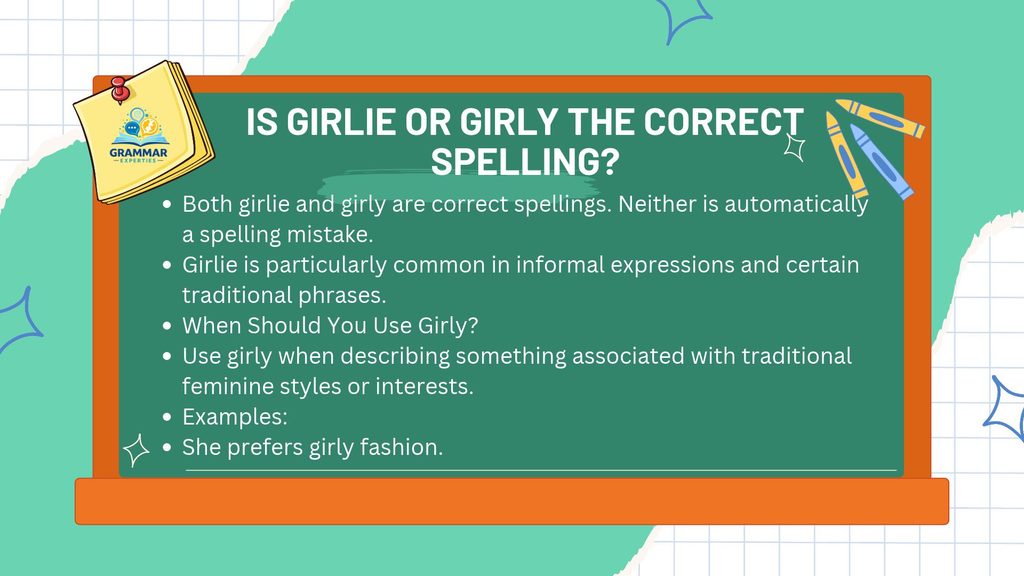
Both girlie and girly are correct spellings. Neither is automatically a spelling mistake.
However, girly is often the more practical choice when you need a general adjective describing feminine fashion, appearance, interests, or style.
Girlie is particularly common in informal expressions and certain traditional phrases.
Major dictionaries recognize both spellings. For example, Cambridge Dictionary lists girlie as an alternative spelling of girly. Oxford Learner’s Dictionaries also recognizes both forms.
When Should You Use Girly?
Use girly when describing something associated with traditional feminine styles or interests.
Examples:
- She prefers girly fashion.
- My daughter wants a girly birthday party.
- Her bedroom has a soft and girly appearance.
- I bought some girly stationery for my desk.
This spelling is a good general choice for everyday writing.
When Should You Use Girlie?
Use girlie when it fits a familiar informal expression or when you intentionally want a playful or traditional tone.
Examples:
- We enjoyed a girlie night out.
- It was a lovely girlie weekend.
- They had a girlie chat after work.
- She collects vintage girlie magazines.
Remember that expressions involving girlie can have different connotations. In particular, girlie magazines has a distinct historical meaning.
Which Spelling Is Better for Professional Writing?
Neither spelling is ideal for every professional situation because both are informal.
If you’re writing an academic paper, business report, or formal article, consider more precise alternatives.
| Informal expression | More neutral alternative |
|---|---|
| Girly clothes | Feminine clothing |
| Girlie accessories | Women’s accessories |
| Girly personality | Feminine style or personality |
| Girlie party | Women’s social gathering |
| Girly decoration | Feminine decoration |
For example:
- Informal: She prefers girly clothing.
- More neutral: She prefers clothing with traditionally feminine designs.
The second sentence is more precise and avoids suggesting that certain styles belong exclusively to women.
How to Use Girlie and Girly in Sentences
Understanding definitions is helpful, but seeing both words in real sentences makes their usage easier to remember.
Here are practical examples from everyday situations.
Examples of Girly in Sentences
Use girly as an adjective before a noun or after a linking verb.
Examples:
- She bought a beautiful girly dress for the party.
- My sister loves girly decorations.
- Her bedroom looks colorful and girly.
- I prefer simple outfits instead of girly clothes.
- We planned a girly picnic for Saturday.
- She enjoys wearing pink and other girly colors.
- The shop sells girly handbags and accessories.
- My friend has a very girly fashion style.
- They organized a girly birthday celebration.
- Her new phone case has a cute, girly design.
In these examples, girly describes the appearance, style, or character of something.
Examples of Girlie in Sentences
The spelling girlie works in similar informal contexts.
Examples:
- We had a girlie night at my friend’s house.
- She invited everyone to a girlie weekend.
- They enjoyed a long girlie chat.
- My friends organized a girlie shopping trip.
- She bought a few girlie gifts for her sister.
- We spent the afternoon discussing girlie things.
- The magazine featured old-fashioned girlie photographs.
- They planned a girlie spa day.
- She loves hosting girlie get-togethers.
- It was a fun girlie evening with friends.
Notice that several expressions sound natural with either spelling. Your choice can depend on the tone you want to create.
Common Sentence Mistakes to Avoid
Some writers assume that girlie is incorrect because it ends in ie. That assumption is wrong.
Consider these examples:
| Incorrect assumption | Correct explanation |
|---|---|
| Girlie is always misspelled | Girlie is a recognized spelling |
| Girly is the only correct form | Both forms are accepted |
| Both spellings are always interchangeable | Some expressions favor one spelling |
| Girly is a formal adjective | It is generally informal |
| Girlie always means a young girl | It can also describe feminine styles and things |
The best approach is to understand the context instead of treating one spelling as universally wrong.
Real-Life Example: Choosing Between Girlie and Girly
Imagine that a lifestyle blogger named Sarah is preparing a blog post about fashion, personal style, and weekend activities.
While editing her article, she writes the following sentence:
“I love wearing girlie dresses and decorating my room with pink accessories.”
Her editor suggests changing girlie to girly because the sentence describes clothing and decorations associated with a feminine aesthetic.
The revised sentence becomes:
“I love wearing girly dresses and decorating my room with pink accessories.”
Both versions are understandable, but girly is a natural choice in this particular context.
Later, Sarah writes another sentence:
“My friends and I are planning a girlie weekend at a beautiful spa.”
Here, the editor keeps girlie because it is a familiar informal expression. Changing it to girly weekend would still be understandable, but the original wording has a slightly different conversational feel.
Sarah then prepares a formal description for a fashion business. Instead of writing:
“Our collection features beautiful girly outfits.”
She decides to write:
“Our collection features clothing with elegant, feminine designs.”
This version sounds more professional and communicates the style more precisely.
The example demonstrates an important writing lesson: choosing between girlie and girly is not always about spelling correctness. It is also about context, tone, and audience.
When writing casually, either form may work. When writing professionally, more specific vocabulary can make your message clearer.
Girlie vs. Girly: Language Trends and Usage Statistics (2025–2026)
English vocabulary continues to evolve through online conversations, social media, entertainment, and everyday communication.
Words that describe fashion, personality, and personal identity often appear in informal digital conversations. However, it is important to distinguish general language trends from verified statistics about a particular word.
What Recent Language Research Shows
A 2025 study published in the International Journal of Research and Innovation in Social Science examined slang used by Gen Z female influencers on Instagram and X (formerly Twitter).
The research highlights how social media encourages informal vocabulary and creative language choices. It also examines the role of slang in online communication.
A separate 2025 study published in the Journal of Media Horizons analyzed 2,000 public Instagram posts from Pakistani users aged 18–35.
Its findings highlighted the use of abbreviations, emojis, code-switching, and stylized spellings in digital communication.
These studies provide useful context for understanding why informal spellings and expressions remain visible in modern online writing.
What the 2025–2026 Data Does and Does Not Tell Us
There is an important distinction between research about general social media language and research specifically measuring the popularity of girlie versus girly.
The studies mentioned above do not establish which spelling is more frequently used worldwide.
Similarly, there is no verified figure here showing the exact percentage of writers who prefer one spelling over the other.
What can be established from dictionary references is:
- Both spellings are recognized.
- Both can describe traditionally feminine characteristics or styles.
- Girly is a useful general-purpose spelling.
- Girlie appears in established informal expressions.
- Context can influence which spelling sounds more natural.
Why Context Matters in Modern English
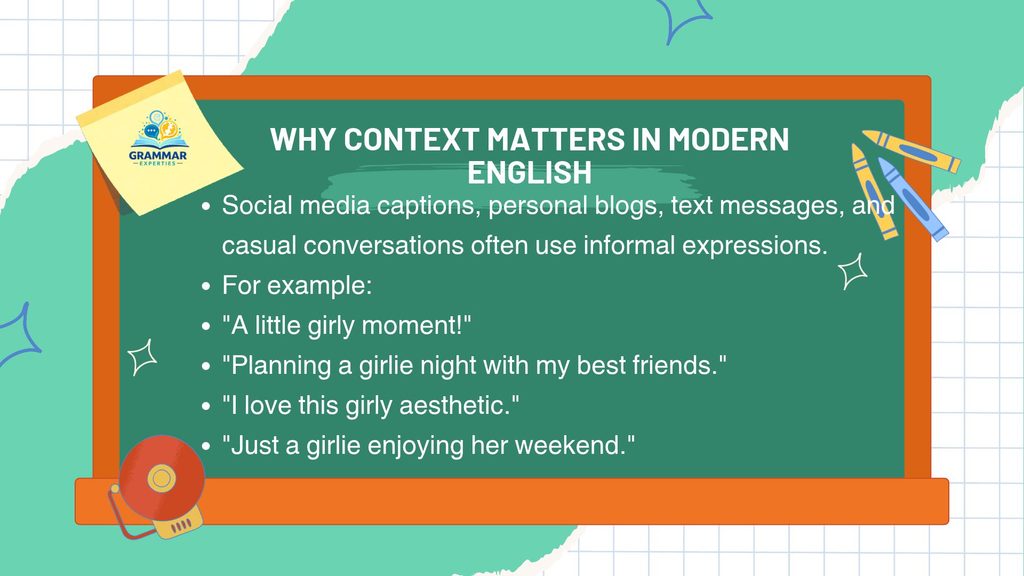
Social media captions, personal blogs, text messages, and casual conversations often use informal expressions.
For example:
- “A little girly moment!”
- “Planning a girlie night with my best friends.”
- “I love this girly aesthetic.”
- “Just a girlie enjoying her weekend.”
These examples illustrate different informal uses, not measured frequency rankings.
For clear writing in 2026, choose the spelling that fits your sentence and maintain consistency throughout your article.
Mini Quiz:Girlie or Girly
1. Which spelling is commonly used to describe a feminine style?
A. Girlie
B. Girly
C. Girlye
D. Girliey
Answer: B. Girly
2. Are both “girlie” and “girly” accepted English spellings?
A. Yes
B. No
Answer: A. Yes
3. What does “girly” generally mean?
A. Masculine
B. Feminine
C. Formal
D. Serious
Answer: B. Feminine
4. Choose the correct spelling:
She loves wearing ______ dresses.
A. Girlie
B. Girly
C. Girliey
Answer: B. Girly
5. Which word is often used in casual expressions such as “girlie night”?
A. Girlie
B. Girly
C. Girlness
Answer: A. Girlie
6. True or False: “Girly” can describe clothes, colors, or activities associated with femininity.
Answer: True
7. Fill in the blank:
We planned a fun ______ weekend with our friends.
Answer: Girlie
8. Which word is more commonly used as a general adjective?
A. Girly
B. Girlies
C. Girl
Answer: A. Girly
9. What is the plural form of “girlie” when referring to girls informally?
A. Girlys
B. Girlies
C. Girlie’s
Answer: B. Girlies
10. True or False: “Girlie” and “girly” always have exactly the same usage.
Answer: False
11. Choose the correct sentence:
A. She has a girly personality.
B. She has a girliey personality.
C. She has a girlys personality.
Answer: A. She has a girly personality.
12. Which word is suitable for a casual phrase like “girlie chat”?
A. Girly
B. Girlie
C. Girlishly
Answer: B. Girlie
13. What is the meaning of “girlish”?
A. Having qualities associated with a young girl
B. Having a professional personality
C. Being masculine
Answer: A. Having qualities associated with a young girl
14. Fill in the blank:
Pink is often considered a ______ color.
Answer: Girly
15. True or False: “Girly” is generally an informal adjective.
Answer: True
16. Which sentence uses “girlie” correctly?
A. We enjoyed a girlie night together.
B. We enjoyed a girlies night together.
C. We enjoyed a girlieing night together.
Answer: A. We enjoyed a girlie night together.
17. What is a more formal alternative to “girly”?
A. Feminine
B. Girl
C. Girlie
Answer: A. Feminine
18. Which word is commonly used in the phrase “girly outfit”?
A. Girlie
B. Girly
C. Girlies
Answer: B. Girly
19. True or False: “Girlie” can be used as an informal noun when addressing or referring to a girl.
Answer: True
20. Fill in the blank:
They organized a ______ party with pink decorations.
Answer: Girly
21. Which spelling should you use when describing something feminine in general writing?
A. Girly
B. Girliey
C. Girlly
Answer: A. Girly
22. What is the main difference between “girlie” and “girly”?
A. They have completely unrelated meanings.
B. Their meanings overlap, but their usage and context can differ.
C. One is always incorrect.
Answer: B. Their meanings overlap, but their usage and context can differ.
23. Choose the correct phrase:
A. Girly clothes
B. Girlie clothes
C. Both can be used, depending on context.
Answer: C. Both can be used, depending on context.
24. True or False: “Girlie” is always the correct spelling, while “girly” is incorrect.
Answer: False
25. Complete the sentence:
My friends and I had a lovely ______ evening.
A. Girlie
B. Girly
C. Both may work depending on the intended meaning and style.
Answer: C. Both may work depending on the intended meaning and style.
Frequently Asked Questions About Girlie or Girly
Q1:Is It Girlie or Girly?
Both spellings are correct. Girly is a common general-purpose adjective, while girlie is an alternative spelling frequently used in informal expressions.
Q2:Is Girlie a Real Word?
Yes. Girlie is a recognized English word found in major dictionaries. It can describe something traditionally associated with girls or women.
For example: “We planned a girlie weekend together.”
Q3:What Does Girly Mean in Slang?
In informal communication, girly describes something associated with traditionally feminine interests, fashion, colors, or aesthetics.
For example: “I love your girly style!”
It can also be used playfully to describe a person who enjoys traditionally feminine things.
Q4:Is Girly More Correct Than Girlie?
No. Both spellings are correct. However, girly is often a convenient choice for general descriptions, while girlie is common in certain informal expressions.
Q5:What Is the Plural of Girlie?
When girlie is used as a noun referring informally to a girl or woman, its plural is girlies.
Example: “The girlies are getting ready for the party.”
However, referring to adult women as girlies can sound patronizing or disrespectful in some situations. Consider your audience and relationship with the people you’re addressing.
Q6:Can I Use Girlie in Formal Writing?
It is generally better to avoid girlie in formal writing because it has an informal tone.
Depending on your sentence, use alternatives such as:
- Feminine
- Womanly
- Female-oriented
- Traditionally feminine
For example, instead of “girlie fashion,” you could write “feminine fashion.”
Q7:What Is the Difference Between Girly and Girlish?
Both words describe qualities associated with girls, but their meanings are slightly different.
- Girly: Usually describes styles, interests, or things traditionally associated with femininity.
- Girlish: Often describes youthful qualities, behavior, or characteristics associated with a young girl.
Examples:
- She loves girly accessories.
- She has a girlish laugh.
Q8:Is Girly an Informal Word?
Yes. Girly is generally considered an informal adjective. It is suitable for casual conversations, blogs, social media captions, and everyday writing.
For formal communication, words such as feminine may be more appropriate.
Conclusion: Girlie or Girly – Which One Should You Choose?
So, should you write girlie or girly?
The answer is that both spellings are correct English words. They share a similar meaning and are often interchangeable when describing things traditionally associated with girls or femininity.
However, girly is a practical choice for general descriptions, such as girly clothes, girly accessories, and girly decorations. On the other hand, girlie works naturally in informal expressions such as girlie weekend, girlie chat, and girlie night.
Remember that neither spelling is automatically wrong. Your choice should depend on the sentence, intended meaning, and audience.
Explore more easy grammar lessons and improve your English with Grammar Expertise
References

Maimoona Mughal is an English grammar enthusiast dedicated to simplifying confusing words, grammar rules, and vocabulary through clear, accurate, and learner-friendly content that helps readers write and communicate with confidence.