Have you ever typed “grately” and wondered whether it should actually be “greatly”? This spelling confusion is easy to understand because both forms look and sound very similar. However, there is a clear answer: greatly is the correct spelling in standard English, while grately is a misspelling when you mean “very much” or “to a great extent.”
If you’re writing an email, essay, article, business message, or social media post, you should use greatly.
In this guide, you’ll learn the difference between grately vs greatly, what greatly means, how to use it correctly, why people make this mistake, and several practical examples that will help you remember the correct spelling.
Grately vs Greatly: Which Spelling Is Correct?
The correct spelling is greatly.
Grately is not the standard spelling of the adverb that means “very much,” “considerably,” or “to a great extent.”
| Word | Correct? | Meaning | Example |
|---|---|---|---|
| Greatly | ✅ Yes | Very much; to a great extent | Your help is greatly appreciated. |
| Grately | ❌ No | Common misspelling of greatly | Your help is grately appreciated. |
The easiest way to remember the correct form is:
GREAT + LY = GREATLY
Don’t remove the e from great when adding -ly.
Quick Answer: Grately or Greatly?
If you’re asking whether to write “grately appreciated” or “greatly appreciated,” choose:
✅ Your support is greatly appreciated.
❌ Your support is grately appreciated.
The same rule applies when you’re describing something that has changed, improved, increased, decreased, affected someone, or mattered to a significant degree.
For example:
- The new system has greatly improved productivity.
- She was greatly affected by the news.
- We greatly appreciate your assistance.
- His confidence has greatly increased.
- The experience greatly influenced her career.
Why Is Greatly Correct?
Greatly is formed from the adjective great plus the suffix -ly.
great → greatly
The word functions as an adverb, meaning it modifies a verb or describes the degree or extent of an action, feeling, or change.
Cambridge Dictionary defines greatly as meaning “very much,” particularly when describing how strongly someone feels or experiences something.
What Does Greatly Mean?
Greatly means very much, considerably, significantly, or to a large extent.
It is an adverb commonly used to emphasize the degree of an action, emotion, change, effect, or improvement.
For example:
We greatly appreciate your support.
This sentence means that we appreciate your support very much.
Another example is:
The company has greatly improved its customer service.
Here, greatly tells us that the improvement was substantial.
Greatly as an Adverb
The grammatical category of greatly is important because it helps explain how the word works in a sentence.
Consider these examples:
- She greatly admired her teacher.
- The situation greatly concerned the residents.
- The new software greatly reduced processing time.
- I greatly regret my decision.
- They greatly benefited from the training.
In each example, greatly modifies the verb and communicates a strong degree.
Cambridge lists greatly as an adverb and gives examples involving regret, improvement, appreciation, and benefit.
Common Meanings of Greatly
Depending on context, greatly can mean:
- Very much
- To a great extent
- Considerably
- Significantly
- Strongly
For example:
I greatly appreciate your help.
= I appreciate your help very much.
The decision greatly affected the business.
= The decision affected the business to a significant extent.
Her writing has greatly improved.
= Her writing has improved a lot.
Why Do People Confuse Grately and Greatly?
The confusion between grately vs greatly is understandable. English spelling doesn’t always perfectly match pronunciation, and people often write words based on how they sound.
In this case, the two spellings are visually close and can sound similar in rapid speech.
Great + Ly Makes Greatly
The most useful spelling rule is simple:
great + ly = greatly
The base word is great, not grate.
This matters because grate is a completely different English word.
A grate can refer to a framework of metal bars, while to grate can mean to shred food or irritate someone.
For example:
- She placed the vegetables on the grate.
- Grate the cheese before adding it to the dish.
- His rude voice began to grate on everyone.
None of these meanings has anything to do with greatly.
The Missing-E Problem
One common spelling error is accidentally removing the e from great:
❌ great + ly → grately
But the correct spelling is:
✅ great + ly → greatly
Think of greatly as keeping the entire word great intact.
Pronunciation Can Cause Confusion
When people speak quickly, greatly may not sound exactly as clearly as it looks when written.
That’s one reason someone might spell it phonetically as grately.
However, pronunciation should not determine the spelling here.
If you’re unsure, remember:
great → greatly
Not:
grate → grately
Greatly Meaning and Usage in Everyday English
Greatly appears in everyday, professional, academic, and formal English. It is especially common when expressing appreciation, describing changes, or explaining the impact of something.
Greatly Appreciated
One of the most common expressions is:
greatly appreciated
Examples:
- Your cooperation is greatly appreciated.
- Your patience is greatly appreciated.
- Any assistance would be greatly appreciated.
- Your feedback is greatly appreciated.
This phrase is particularly useful in emails, workplace communication, customer-service messages, and formal notices.
The correct spelling is always:
✅ greatly appreciated
Not:
❌ grately appreciated
Greatly Improved
Another frequent expression is greatly improved.
Examples:
- Her English has greatly improved.
- The latest version has greatly improved performance.
- His confidence has greatly improved since joining the course.
Here, greatly emphasizes the extent of the improvement.
Greatly Affected
You can also use greatly to describe a strong effect.
Examples:
- The storm greatly affected local businesses.
- The decision greatly affected the community.
- The experience greatly affected her outlook.
Greatly Appreciate
The expression greatly appreciate is also very common.
Examples:
- I greatly appreciate your advice.
- We greatly appreciate your continued support.
- I greatly appreciate the time you spent helping me.
Notice that greatly comes before the verb appreciate.
Grately vs Greatly: Comparison Table
The following table makes the distinction easy to remember:
| Feature | Greatly | Grately |
|---|---|---|
| Standard English word? | ✅ Yes | ❌ No |
| Correct spelling? | ✅ Yes | ❌ No |
| Part of speech | Adverb | — |
| Meaning | Very much; to a great extent | — |
| Base word | Great | — |
| Common phrase | Greatly appreciated | Grately appreciated ❌ |
| Example | She greatly improved. | She grately improved. ❌ |
Correct and Incorrect Examples
Here are some quick corrections:
❌ I grately appreciate your kindness.
✅ I greatly appreciate your kindness.
❌ The new method grately improved results.
✅ The new method greatly improved results.
❌ Your support is grately appreciated.
✅ Your support is greatly appreciated.
❌ The experience grately influenced him.
✅ The experience greatly influenced him.
❌ She was grately affected by the decision.
✅ She was greatly affected by the decision.
Real-Life Writing Example: Correcting “Grately Appreciated”
Imagine that a student is preparing an email to a professor after receiving help with an important assignment.
The student writes:
“Thank you for taking the time to review my paper. Your feedback was grately appreciated.”
At first glance, the sentence looks understandable. The intended meaning is also clear. However, grately is not the standard spelling.
The corrected version is:
“Thank you for taking the time to review my paper. Your feedback was greatly appreciated.”
This small correction makes the sentence appropriate for formal written English.
The same issue can appear in workplace communication. Imagine an employee writing to a manager:
“Your guidance has grately helped me improve my presentation skills.”
The sentence contains a spelling mistake. A better version is:
“Your guidance has greatly helped me improve my presentation skills.”
In both examples, the writer probably knows the meaning of the word but has confused the spelling. That’s an important distinction: a spelling mistake doesn’t necessarily mean the writer doesn’t understand the word.
A useful proofreading technique is to identify the base word before adding -ly. In this case, the base word is great. Once you see that connection, the correct spelling becomes much easier to remember:
great → greatly
This simple habit can help prevent the same mistake in emails, school assignments, professional documents, blog posts, and other forms of writing.
2025–2026 Data and Search-Quality Perspective
There is an important point about current online content: spelling accuracy remains part of creating useful, trustworthy material.
Google’s current Search guidance emphasizes helpful, reliable, people-first content rather than content written primarily to manipulate rankings. Its guidance also specifically encourages creators to avoid spelling and stylistic issues and to provide accurate, substantial information.
Google’s Search Essentials likewise recommends using the words people actually search for in prominent parts of a page while keeping the content useful for readers.
For this topic, that means an article targeting “grately vs greatly” should not simply repeat the keyword. It should answer the spelling question immediately, explain the grammar, provide examples, distinguish the incorrect form from the correct one, and give readers a reliable way to remember the answer.
Google’s current guidance also notes that its systems can understand language variations and related queries, so natural explanations are preferable to forcing an exact keyword into every paragraph.
As of 2026, this people-first approach is particularly useful for spelling and grammar content because readers usually want a quick, definitive answer followed by practical examples.
What This Means for Grammar Articles
A useful grammar article should:
- Answer the spelling question quickly.
- Explain the meaning clearly.
- Show correct and incorrect examples.
- Explain why the mistake happens.
- Provide a memorable spelling rule.
- Use authoritative dictionary sources.
- Avoid unnecessary keyword repetition.
Therefore, the strongest answer to grately vs greatly isn’t simply “greatly is correct.” It also explains why.
How to Remember the Correct Spelling
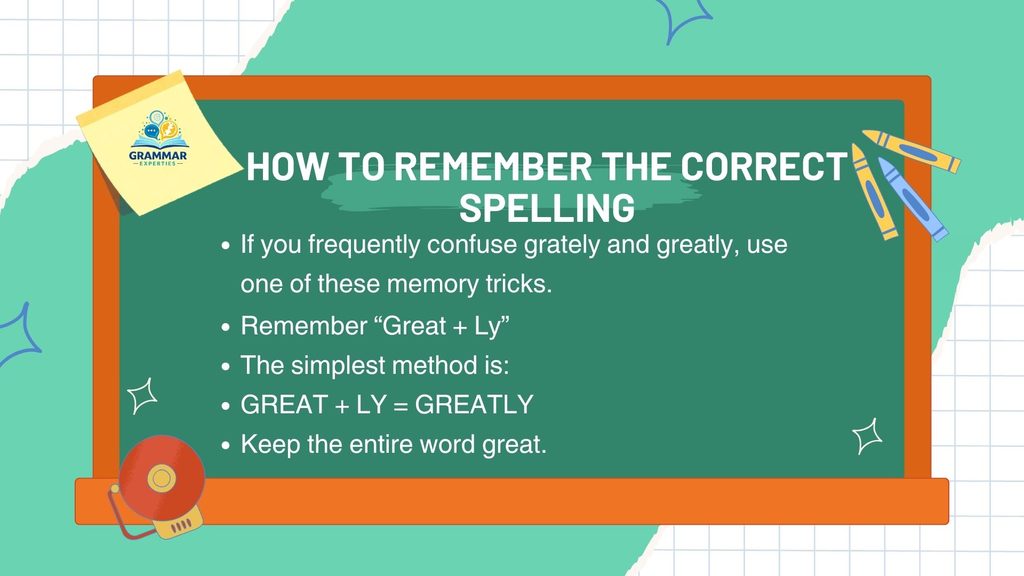
If you frequently confuse grately and greatly, use one of these memory tricks.
Remember “Great + Ly”
The simplest method is:
GREAT + LY = GREATLY
Keep the entire word great.
Remember “Greatly Appreciated”
Think about the very common phrase:
Your help is greatly appreciated.
If you remember this phrase, you’re less likely to write grately appreciated.
Don’t Think of “Grate”
Although grate is a real English word, it isn’t the base of greatly.
Compare:
great → greatly
versus:
grate → grater / grated / grating
These belong to different word families.
Greatly vs Other Similar Words
Understanding synonyms can make the meaning of greatly even clearer.
| Word | Meaning | Example |
|---|---|---|
| Greatly | Very much; considerably | She greatly improved. |
| Very | To a high degree | She is very talented. |
| Considerably | By a significant amount | Costs increased considerably. |
| Significantly | In an important or noticeable way | Results improved significantly. |
| Strongly | With considerable force or intensity | I strongly agree. |
These words aren’t always interchangeable in every sentence, but they can help you understand the general meaning of greatly.
For example:
I greatly appreciate your help.
can be understood as:
I appreciate your help very much.
However, greatly often sounds more formal than simply very much, which is why it frequently appears in professional and academic writing.
Common Mistakes With Greatly
Here are some mistakes to watch for.
Mistake 1: Writing Grately
❌ We grately appreciate your assistance.
Correct:
✅ We greatly appreciate your assistance.
Mistake 2: Removing the E
Some writers remember the sound but forget the spelling of the base word.
Incorrect:
❌ grate + ly
Correct:
✅ great + ly
Mistake 3: Confusing Greatly With Great
Great and greatly aren’t used in exactly the same way.
For example:
✅ She is a great teacher.
Here, great is an adjective.
✅ She greatly helped her students.
Here, greatly is an adverb modifying the verb.
Mistake 4: Assuming Similar-Looking Words Are Related
English contains many words that look similar but have different origins or meanings.
For example, great, grate, and grateful are not interchangeable.
If you’re trying to express strong appreciation, you might write:
✅ I greatly appreciate your help.
or:
✅ I am grateful for your help.
But don’t create the nonstandard form grately.
Is “Grately” Ever Correct?
For standard modern English, grately should not be used as the spelling of the adverb meaning “very much” or “to a great extent.”
If you encounter grately online, it is generally being used as a misspelling of greatly.
That distinction is important because seeing an incorrect spelling on websites, social media, comments, or informal messages doesn’t automatically make it a standard English word.
When writing for school, work, publishing, business, or professional communication, use greatly.
Mini Quiz:Grately vs Greatly
1. Which spelling is correct?
A) Grately
B) Greatly
C) Greatlee
D) Greatley
Answer: B) Greatly
2. Choose the correct sentence.
A) Your help is grately appreciated.
B) Your help is greatly appreciated.
C) Your help is greately appreciated.
D) Your help is grateley appreciated.
Answer: B) Your help is greatly appreciated.
3. What part of speech is “greatly”?
A) Noun
B) Adjective
C) Adverb
D) Verb
Answer: C) Adverb
4. Choose the correctly spelled sentence.
A) The new system grately improved efficiency.
B) The new system greatly improved efficiency.
C) The new system greately improved efficiency.
D) The new system gratefully improved efficiency.
Answer: B) The new system greatly improved efficiency.
5. How can you remember the spelling of “greatly”?
A) Grate + ly
B) Great + ly
C) Great + ley
D) Grate + ley
Answer: B) Great + ly
6. Which sentence is correct?
A) I grately appreciate your advice.
B) I greatly appreciate your advice.
C) I greately appreciate your advice.
D) I gratefully appreciate your advice.
Answer: B) I greatly appreciate your advice.
7. Which sentences use “greatly” correctly?
A) She greatly admired her teacher.
B) The experience greatly influenced him.
C) We greatly appreciate your support.
D) We grately appreciate your support.
Answer: A, B, and C
8. What is the base word of “greatly”?
A) Grate
B) Great
C) Greatness
D) Grateful
Answer: B) Great
9. True or False: “Grately” is the standard spelling of the adverb meaning “very much.”
Answer: False
10. Which phrase is correct in professional writing?
A) Your cooperation is grately appreciated.
B) Your cooperation is greatly appreciated.
C) Your cooperation is great appreciated.
D) Your cooperation is greately appreciated.
Answer: B) Your cooperation is greatly appreciated.
11. In “Her writing has greatly improved,” what does “greatly” indicate?
A) Time
B) Location
C) Extent of improvement
D) Person responsible
Answer: C) Extent of improvemen
12. Choose the correct sentence.
A) The decision grately affected the community.
B) The decision greatly affected the community.
C) The decision great affected the community.
D) The decision greatley affected the community.
Answer: B) The decision greatly affected the community.
13. What does “greatly” mean in “I greatly regret my decision”?
A) Very slowly
B) Very much
C) Slightly
D) At a specific time
Answer: B) Very much
14. Which are possible meanings of “greatly”?
A) Very much
B) Considerably
C) To a great extent
D) At a particular location
Answer: A, B, and C
15. Which pair is correct?
A) Great → greatly
B) Grate → greatly
C) Great → grately
D) Grateful → greatly
Answer: A) Great → greatl
16. Choose the correctly spelled sentence.
A) The training greatly benefited the employees.
B) The training grately benefited the employees.
C) The training greately benefited the employees.
D) The training gratefully benefited the employees.
Answer: A) The training greatly benefited the employees.
17. True or False: In “We greatly appreciate your support,” “greatly” modifies “appreciate.”
Answer: True
18. Which sentence is appropriate for an academic essay?
A) The findings grately influenced later research.
B) The findings greatly influenced later research.
C) The findings greately influenced later research.
D) The findings gratefully influenced later research.
Answer: B) The findings greatly influenced later research.
19. Which sentence correctly uses “greatly” to describe an effect?
A) The storm grately affected local businesses.
B) The storm greatly affected local businesses.
C) The storm great affected local businesses.
D) The storm greatley affected local businesses.
Answer: B) The storm greatly affected local businesses.
20. What is the correct spelling rule?
A) Change “great” to “grate” before adding -ly.
B) Keep “great” and add -ly.
C) Remove the “e” before adding -ly.
D) Replace “t” with “d.”
Answer: B) Keep “great” and add -ly.
Bonus Questions
21. Which sentence is correct?
A) Your kindness is grately valued.
B) Your kindness is greatly valued.
C) Your kindness is greately valued.
D) Your kindness is grateley valued.
Answer: B) Your kindness is greatly valued.
22. Which word means “to a significant extent”?
A) Grately
B) Greatly
C) Great
D) Grateful
Answer: B) Greatly
23. Fill in the blank: “The new policy has ______ improved workplace safety.”
A) grately
B) greately
C) greatly
D) gratefully
Answer: C) greatly
24. Which sentence contains a spelling mistake?
A) We greatly appreciate your patience.
B) Her confidence greatly increased.
C) The changes greatly benefited students.
D) I grately appreciate your assistance.
Answer: D) I grately appreciate your assistance.
25. Which sentence correctly summarizes the difference between “grately” and “greatly”?
A) Both are standard English words.
B) Grately is correct only in formal writing.
C) Greatly is the standard spelling; grately is a misspelling.
D) Grately is British English and greatly is American English.
Answer: C) Greatly is the standard spelling; grately is a misspelling.
Frequently Asked Questions About Grately vs Greatly
Q1:Is grately a correct spelling?
No. Grately is not the standard spelling of the adverb meaning “very much” or “to a great extent.” The correct spelling is greatly.
Q2:Is it greatly appreciated or grately appreciated?
The correct phrase is greatly appreciated.
For example:
Your help is greatly appreciated.
Grately appreciated is a spelling error.
Q3:What does greatly mean?
Greatly means very much, considerably, significantly, or to a great extent. It is an adverb used to show the degree or extent of an action, feeling, change, or effect.
Q4:Is greatly an adverb?
Yes. Greatly is an adverb.
For example:
The company has greatly improved its service.
Here, greatly modifies the verb improved.
Q5:How do you spell greatly?
The correct spelling is:
G-R-E-A-T-L-Y
A simple way to remember it is:
GREAT + LY = GREATLY
Q6:Why do people spell greatly as grately?
The mistake may occur because greatly and grately look and sound similar, particularly when the word is spoken quickly. Some writers may also mistakenly treat grate as the base word.
The correct base word is great.
Q7:Can I use greatly in formal writing?
Yes. Greatly is appropriate in formal, academic, professional, and everyday writing.
For example:
We greatly appreciate your cooperation.
Q8:What is the difference between great and greatly?
Great is commonly an adjective, while greatly is an adverb.
For example:
She is a great writer.
Her writing has greatly improved.
The first describes the writer; the second describes the extent of the improvement.
Final Verdict: Grately or Greatly?
When choosing between grately vs greatly, the answer is straightforward: greatly is the correct spelling.
Use greatly when you mean very much, considerably, significantly, or to a great extent.
Remember the simple formula:
GREAT + LY = GREATLY
So write:
✅ I greatly appreciate your help.
✅ Your support is greatly appreciated.
✅ The new system greatly improved efficiency.
Avoid:
❌ I grately appreciate your help.
❌ Your support is grately appreciated.
❌ The new system grately improved efficiency.
Getting this small spelling detail right can make your writing clearer and more professional. If you’re unsure about another confusing English spelling, check the base word, meaning, and grammatical role before choosing a form.
For the correct spelling, always choose “greatly,” not “grately.”
Explore more easy grammar lessons and improve your English with Grammar Expertise
References
Cambridge Dictionary – Greatly
Merriam-Webster – Greatly

Maimoona Mughal is an English grammar enthusiast dedicated to simplifying confusing words, grammar rules, and vocabulary through clear, accurate, and learner-friendly content that helps readers write and communicate with confidence.