
Introduction
Have you ever seen inter– and intra- in words and wondered whether they mean the same thing?
They look almost identical, but the difference between them is important. In simple terms, inter- usually means “between” or “among,” while intra- means “within” or “inside.” Oxford defines inter- as meaning “between; from one to another,” while intra– means “inside; within.”
That one distinction can completely change a word’s meaning.
For example:
- Interstate = between or among states
- Intrastate = within one state
- Interpersonal = between people
- Intrapersonal = within one person
- International = involving different nations
- Intranational = occurring within one nation
So, what is the real difference between inter vs intra?
The easiest way to remember it is:
INTER = BETWEEN
INTRA = WITHIN
Once you understand that basic idea, many complicated-looking words become much easier to decode.
What Do Inter and Intra Mean?
Both inter- and intra- are prefixes. A prefix is placed at the beginning of a word to modify or add to its meaning.
Although the two prefixes look and sound similar, they point in different directions.
What Does Inter- Mean?
Inter- generally means between, among, or involving more than one group, place, person, or thing.
Cambridge defines inter- as “between or among,” giving examples such as international and interdepartmental.
Consider these examples:
- International = between or among nations
- Interstate = between states
- Interdepartmental = between departments
- Interpersonal = between people
- Interconnected = connected with one another
- Intercontinental = between continents
The key idea is connection or interaction across boundaries.
For example:
The company held an interdepartmental meeting.
This means the meeting involved more than one department.
What Does Intra- Mean?
Intra- generally means within, inside, or occurring inside a particular group, place, system, or boundary.
Cambridge describes intra- as a prefix used to form adjectives meaning “within” a stated place or group.
Examples include:
- Intrastate = within one state
- Intramural = within an institution or organization
- Intranet = a private network within an organization
- Intrapersonal = occurring within one person
- Intravenous = within a vein
- Intracellular = within a cell
For example:
The company uses an intranet for internal communication.
The network operates within the organization, rather than connecting the organization to the outside world.
The Simplest Rule
If you’re unsure which prefix to use, ask one question:
Is the action happening between separate groups, or within one group?
If it’s between or among, think inter-.
If it’s within or inside, think intra–.
Inter vs Intra: The Key Difference Explained
The most useful way to understand inter vs intra is to visualize a boundary.
Imagine a large company divided into several departments.
If two departments communicate with each other, that’s interdepartmental communication.
If employees within one department communicate with one another, that’s intradepartmental communication.
Inter Means Between Groups
Inter- crosses a boundary or connects separate units.
Examples:
The interdepartmental project required cooperation between the marketing and sales teams.
The school organized an intercollegiate competition.
The treaty encouraged international cooperation.
In each case, more than one distinct group is involved.
Intra Means Within a Group
Intra- stays inside a boundary.
Examples:
The manager organized an intradepartmental training session.
The university held an intramural sports tournament.
The company’s intranet contains internal documents.
Here, the activity remains inside a particular organization, group, or system.
Inter vs Intra Comparison Table
| Feature | Inter- | Intra- |
|---|---|---|
| Basic meaning | Between or among | Within or inside |
| Direction | Across a boundary | Inside a boundary |
| Number of groups | Usually involves separate groups | Usually involves one group |
| Example | Interstate | Intrastate |
| Communication | Interpersonal | Intrapersonal |
| Organization | Interdepartmental | Intradepartmental |
| Network | Internet/interconnected systems | Intranet |
| Memory clue | INTER = between | INTRA = inside |
The distinction is especially useful when two words look almost identical.
Common Inter vs Intra Examples You Should Know
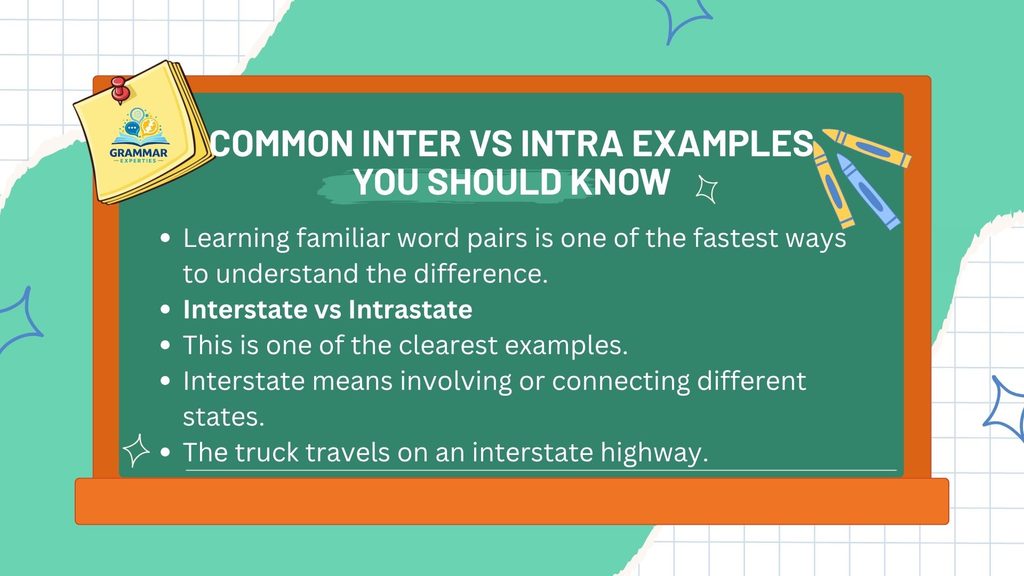
Learning familiar word pairs is one of the fastest ways to understand the difference.
Interstate vs Intrastate
This is one of the clearest examples.
Interstate means involving or connecting different states.
The truck travels on an interstate highway.
Intrastate means occurring within a single state.
The company operates an intrastate delivery service.
Therefore:
Interstate = between states
Intrastate = within one state
The same principle applies to many other words.
Interpersonal vs Intrapersonal
These words are particularly common in psychology, communication, and education.
Interpersonal refers to relationships or interactions between people.
Good interpersonal skills are important in the workplace.
Intrapersonal refers to what happens within an individual.
Journaling can encourage intrapersonal reflection.
So:
Interpersonal = person to person
Intrapersonal = within yourself
This is a useful memory pair because interpersonal describes interaction, while intrapersonal describes internal thought or self-awareness.
International vs Intranational
International refers to relationships or activity involving different countries.
The company has international customers.
Intranational refers to something occurring within one country.
The study examined intranational migration patterns.
Again:
Inter = across countries
Intra = within one country
Interdepartmental vs Intradepartmental
These terms are useful in business writing.
An interdepartmental meeting includes people from different departments.
The finance and marketing teams attended an interdepartmental meeting.
An intradepartmental meeting occurs within one department.
The finance director scheduled an intradepartmental meeting for Friday.
The distinction is small in spelling but significant in meaning.
Intercellular vs Intracellular
These terms are common in science and medicine.
Intercellular means occurring between cells.
Intracellular means occurring inside cells.
For example:
The researchers studied intercellular communication.
The substance accumulates in an intracellular compartment.
The same rule remains unchanged:
Inter = between cells
Intra = inside cells
How to Remember Inter vs Intra
The good news is that you don’t need to memorize every word separately.
You can use a simple memory strategy.
Remember “Inter = Interaction”
Think of the word interaction.
When two or more people interact, something happens between them.
That makes inter- = between/among easier to remember.
For example:
- interaction
- interpersonal
- international
- interdepartmental
- interconnect
These words all involve some kind of relationship, connection, or movement between separate entities.
Remember “Intra = Inside”
The first part of intra- can remind you of inside.
Think:
INTRA → IN
That gives you the basic idea:
Intra = inside or within
Examples:
- intranet = network inside an organization
- intramural = within an institution
- intracellular = inside a cell
- intrapersonal = within a person
Use the Boundary Test
When you’re uncertain, imagine a circle around a group.
If something stays inside the circle, think intra-.
If something crosses the circle and connects with another group, think inter-.
For example:
One department → one department: intra
Department A → Department B: inter
This visual method can make the distinction much easier for English learners.
Inter vs Intra in Modern Writing and Professional Communication
The difference between these prefixes isn’t limited to vocabulary exercises. It appears frequently in professional, academic, technical, medical, and business communication.
Business and Workplace Examples
Businesses often use both terms to describe organizational relationships.
Interdepartmental communication happens between departments.
Intradepartmental communication happens within one department.
For example:
The company needs better interdepartmental communication between sales and customer support.
But:
The manager improved intradepartmental communication within the sales team.
Choosing the correct prefix tells readers exactly where the communication takes place.
Technology Examples
Technology provides another useful contrast.
An intranet is a private network used within an organization.
The broader internet connects networks and users across many locations and organizations.
The words aren’t perfect morphological opposites in every technical sense, but they provide a memorable illustration of the general contrast between internal and broader connection.
Academic Examples
Academic writing frequently uses these prefixes.
Examples include:
- interuniversity
- interdisciplinary
- interschool
- intergovernmental
- intramural
- intracultural
- intradisciplinary
Consider:
The study was an interdisciplinary project involving biology, chemistry, and statistics.
The project crosses disciplinary boundaries.
By contrast:
The research examined intradisciplinary methods.
The focus stays within a particular discipline.
2025–2026 Usage and Dictionary Evidence
When discussing inter vs intra, current dictionary evidence remains consistent: the core distinction has not changed.
Oxford’s current entries define inter- around the ideas of “between” and “from one to another,” while intra- means “inside” or “within.”
Cambridge similarly defines inter– as “between or among” and intra- as “within” a stated place or group.
A useful 2025–2026 evidence snapshot is:
| Source | Inter- | Intra- | Current evidence |
|---|---|---|---|
| Oxford | Between/from one to another | Inside/within | Current dictionary entries |
| Cambridge | Between/among | Within | Current dictionary entries |
| Merriam-Webster | Between, among, reciprocal, shared by two or more | — | Updated inter- entry in 2025 |
| Microsoft 365 | Between groups | Within a group | Article updated March 2025 |
| Grammar.com | Between/among | Within/in | Page dated 2026 |
Merriam-Webster’s current inter- entry gives several related senses, including “between,” “among,” “reciprocal,” and “shared by or involving two or more.” Microsoft 365’s guidance, updated in March 2025, also specifically addresses the difference between the two prefixes and their use in words.
The important takeaway is that current reference sources agree on the central rule:
Inter- points outward or between entities; intra- points inward or within an entity.
There isn’t a reliable universal 2025–2026 statistic showing exactly how many English speakers confuse these prefixes. Therefore, it would be misleading to invent a “confusion rate” or search-volume percentage. Dictionary and usage evidence provide a more dependable basis for explaining the distinction.
Inter vs Intra in Real Life: A Case Study

Imagine a university with five academic departments: English, Biology, Chemistry, Computer Science, and Mathematics.
The university launches a new research project on artificial intelligence and education. Researchers from Computer Science, Mathematics, and English work together to design the project. Because people from different departments are collaborating, the project is interdepartmental.
Now imagine that the Computer Science department holds a separate meeting for its own faculty members to discuss how to organize its research schedule. That meeting is intradepartmental because everyone involved belongs to the same department.
The same university also organizes a sports competition in which students from different universities participate. This is an intercollegiate competition because it occurs between colleges or universities.
However, if students from different dormitories within the same university compete in an internal sports league, the activity may be described as intramural, meaning it occurs within the institution.
This example shows why choosing between inter- and intra– isn’t merely a spelling decision. The prefix communicates the relationship between the parts involved. If you choose the wrong prefix, the reader may understand the entire situation differently.
A useful question is always:
Are the participants, departments, countries, systems, or objects separate from one another, or are they part of the same internal unit?
Separate units usually point toward inter-. One internal unit points toward intra-.
Common Mistakes With Inter and Intra
Because the prefixes look similar, writers sometimes use them interchangeably. That’s usually a mistake.
Mistake 1: Treating Inter and Intra as Synonyms
They aren’t synonyms.
Inter- generally describes relationships between or among separate entities.
Intra- generally describes something within a single entity or defined group.
For example:
❌ The company held an intradepartmental meeting between the sales and marketing departments.
If two departments are involved, interdepartmental is the logical choice.
✅ The company held an interdepartmental meeting between the sales and marketing departments.
Mistake 2: Choosing Based Only on Sound
The prefixes can sound similar when spoken quickly.
Don’t choose based on pronunciation alone.
Instead, focus on the relationship:
Between = inter
Within = intra
Mistake 3: Assuming Every Word Has an Opposite Pair
Not every inter- word has a commonly used intra- counterpart, and not every intra- word has a direct inter- opposite.
For example, intravenous has a specialized medical meaning. You shouldn’t assume that simply adding inter- will produce a normal English word with an opposite meaning.
Prefixes help form established vocabulary. They shouldn’t be mechanically attached to any word.
Mistake 4: Adding Unnecessary Hyphens
Prefix spelling and hyphenation depend on the particular word and style guide.
Many established compounds are written as one word:
- international
- interpersonal
- interstate
- intranet
- intravenous
- intracellular
However, some less-established or potentially confusing compounds may be hyphenated. Cochrane’s style guidance, for example, recommends different hyphenation practices depending on the prefix and following word.
Therefore, don’t assume that every inter- or intra- construction should automatically receive a hyphen.
A Quick Step-by-Step Guide to Choosing Inter or Intra
When you’re writing and aren’t sure which prefix is correct, use this four-step test.
Step 1: Identify the Main Group
Ask what the word is describing.
Is it about:
- people?
- departments?
- states?
- countries?
- cells?
- organizations?
- systems?
- institutions?
Step 2: Find the Boundary
Imagine a boundary around the group.
For example:
One company = one boundary.
Step 3: Ask Whether the Action Crosses It
If the action connects two or more separate groups, choose the inter- concept.
If the action stays inside one group, choose the intra- concept.
Step 4: Check the Established Word
Finally, verify that the resulting word is an established English term.
For example:
between states → interstate
within one state → intrastate
between people → interpersonal
within one person → intrapersonal
This final step matters because English doesn’t allow every possible prefix combination.
Mini Quiz:Inter vs Intra
1. What does the prefix “inter-” generally mean?
A) Within or inside
B) Between or among
C) Before
D) Against
Answer: B) Between or among
2. What does the prefix “intra-” generally mean?
A) Within or inside
B) Between countries
C) Across groups
D) Outside
Answer: A) Within or inside
3. Which word means occurring between different states?
A) Intrastate
B) Interstate
C) Intramural
D) Intrapersonal
Answer: B) Interstate
4. Which word means occurring within one state?
A) Interstate
B) International
C) Intrastate
D) Interpersonal
Answer: C) Intrastate
5. Which word refers to communication between people?
A) Intrapersonal
B) Intrastate
C) Interpersonal
D) Intracellular
Answer: C) Interpersonal
6. Which word describes something occurring within an individual?
A) Interpersonal
B) International
C) Intrapersonal
D) Interdepartmental
Answer: C) Intrapersonal
7. A meeting involving the sales and marketing departments is:
A) Intradepartmental
B) Interdepartmental
C) Intrapersonal
D) Intracellular
Answer: B) Interdepartmental
8. Which term describes activity within one department?
A) Interdepartmental
B) International
C) Intradepartmental
D) Interpersonal
Answer: C) Intradepartmental
9. Which word describes a private network within an organization?
A) Interstate
B) Intranet
C) Interpersonal
D) Intracellular
Answer: B) Intranet
10. Which term means occurring between cells?
A) Intracellular
B) Intercellular
C) Intrastate
D) Intrapersonal
Answer: B) Intercellular
11. Which term means occurring inside a cell?
A) Intercellular
B) Interpersonal
C) Intracellular
D) Interdepartmental
Answer: C) Intracellular
12. True or False: “Inter-” generally means between or among.
Answer: True
13. True or False: “Intra-” generally means between two separate groups.
Answer: False
14. A company meeting involving finance and marketing is:
A) Intradepartmental
B) Interdepartmental
C) Intrapersonal
D) Intramural
Answer: B) Interdepartmental
15. A sports competition held only within one university can be described as:
A) International
B) Interstate
C) Intramural
D) Interdepartmental
Answer: C) Intramural
16. Which word describes cooperation between different countries?
A) Intranational
B) International
C) Intrapersonal
D) Intramural
Answer: B) International
17. Which word describes something occurring within one country?
A) International
B) Intranational
C) Intercontinental
D) Intergovernmental
Answer: B) Intranational
18. Which statement correctly explains interpersonal and intrapersonal?
A) Interpersonal is within a person; intrapersonal is between people.
B) Interpersonal is between people; intrapersonal is within a person.
C) Both mean exactly the same thing.
D) Both refer to countries.
Answer: B) Interpersonal is between people; intrapersonal is within a person.
19. Which memory trick is correct?
A) Inter = inside; intra = between
B) Inter = before; intra = after
C) Inter = between; intra = within
D) Inter = against; intra = outside
Answer: C) Inter = between; intra = within
20. Which word refers to activity within a country?
A) International
B) Intranational
C) Intercontinental
D) Intergovernmental
Answer: B) Intranational
21. Which word means “between continents”?
A) Intracontinental
B) Intercontinental
C) Intrastate
D) Intrapersonal
Answer: B) Intercontinental
22. Which word means “within a university or institution”?
A) Intramural
B) International
C) Interstate
D) Interpersonal
Answer: A) Intramural
23. If two separate departments communicate, which prefix is usually appropriate?
A) Intra-
B) Inter-
C) Extra-
D) Pre-
Answer: B) Inter-
24. If an activity stays within a single organization, which prefix generally fits the meaning?
A) Inter-
B) Intra-
C) Trans-
D) Re-
Answer: B) Intra-
25. Complete the rule: “Inter- means ___, while intra- means ___.”
A) inside; outside
B) before; after
C) between; within
D) against; before
Answer: C) between; within
Frequently Asked Questions About Inter vs Intra
Q1:What is the difference between inter and intra?
The main difference is simple: inter- means between or among, while intra- means within or inside.
For example, interdepartmental means between departments, while intradepartmental means within one department.
Does inter mean between?
Yes. Inter- generally means between, among, or involving multiple entities. Oxford and Cambridge both define the prefix in terms of relationships between or among things.
Examples include:
- international
- interstate
- interpersonal
- interdepartmental
Does intra mean inside?
Yes. Intra- generally means within or inside a particular place, group, system, or entity.
Examples include:
- intranet
- intramural
- intracellular
- intrapersonal
What is an easy way to remember inter vs intra?
Use this memory trick:
INTER = BETWEEN
INTRA = INSIDE
You can also associate inter- with interaction, which involves multiple entities, and intra- with inside, which points inward.
Is international inter or intra?
International uses inter- because it describes relationships or activities involving different nations.
For example:
The company expanded its international operations.
The activity extends across national boundaries.
Is intranet inter or intra?
Intranet uses the intra- concept because it refers to a private network operating within an organization.
The easiest contrast is:
Internet → broad external network connection
Intranet → internal organizational network
Are inter and intra prefixes?
Yes. Both inter- and intra- are prefixes used to form words.
They are generally attached to a base word or word element to create a new term with a more specific meaning.
Do inter and intra always have opposite meanings?
Not always in a strict dictionary sense. They express contrasting concepts—between/among versus within/inside but not every inter– word has a direct intra- counterpart.
It’s better to learn established words individually while using the core meaning of each prefix as a guide.
Final Verdict: Inter vs Intra
The difference between inter vs intra becomes much easier once you stop focusing on their similar spelling and focus on their direction.
Inter- = between, among, or across separate groups.
Intra- = within, inside, or inside one group.
Think about these pairs:
- interstate → between states
- intrastate → within one state
- interpersonal → between people
- intrapersonal → within one person
- interdepartmental → between departments
- intradepartmental → within a department
- intercellular → between cells
- intracellular → inside cells
The fastest memory trick is:
INTER = BETWEEN
INTRA = WITHIN
Whenever you encounter an unfamiliar word containing one of these prefixes, look for the boundary. If the meaning crosses from one group to another, inter- is likely involved. If the meaning stays inside a particular group, system, or space, intra- is the clue.
Understanding this small distinction can make academic vocabulary, workplace terminology, scientific language, and everyday English much easier to interpret.
Explore more easy grammar lessons and improve your English with Grammar Expertise
References

Maimoona Mughal is an English grammar enthusiast dedicated to simplifying confusing words, grammar rules, and vocabulary through clear, accurate, and learner-friendly content that helps readers write and communicate with confidence.