Have you ever stopped while writing a sentence because you weren’t sure whether to use lieing or lying? You’re not alone. English spelling can be confusing, especially when a verb ends in -ie and you need to add -ing.
The correct spelling is lying, not lieing, when you mean telling an untruth or reclining in a horizontal position. Although lieing might look logical, it does not follow the standard English spelling rule for this verb.
In this guide, you’ll learn why lying is correct, how to use it in different contexts, what makes this spelling confusing, and how to remember the rule. You’ll also find practical examples and answers to common questions so you can write with greater confidence.
What Is the Difference Between Lieing and Lying?
The main difference is that lying is the standard English spelling, while lieing is a misspelling in ordinary modern English.
When you add -ing to the verb lie, the final -ie changes to -y. This spelling change produces lying. The rule applies whether you’re describing someone who isn’t telling the truth or someone who is resting in a horizontal position.
Why Is Lying the Correct Spelling?
English spelling sometimes changes when a suffix is added to a verb. One familiar rule is that verbs ending in -ie change those letters to -y before adding -ing.
For example:
- Lie → Lying
- Die → Dying
- Tie → Tying
Therefore, lieing is not the accepted standard spelling. Even though it may seem reasonable to preserve the original letters, standard English uses lying instead.
What Does Lying Mean?
The word lying has two common meanings, depending on the context.
1. Telling something that is not true
In this sense, lying describes deliberately saying something false or misleading.
Examples:
- He is lying about where he went last night.
- She admitted to lying to her parents.
- I knew he was lying because his story kept changing.
2. Resting or being in a horizontal position
In this sense, lying is the present participle of lie, meaning to recline or rest.
Examples:
- The cat is lying on the sofa.
- She is lying in bed and reading a book.
- The keys are lying on the kitchen table.
The meaning changes with the sentence, but the spelling remains the same: lying.
Why Is Lying Spelled With a Y Instead of IE?
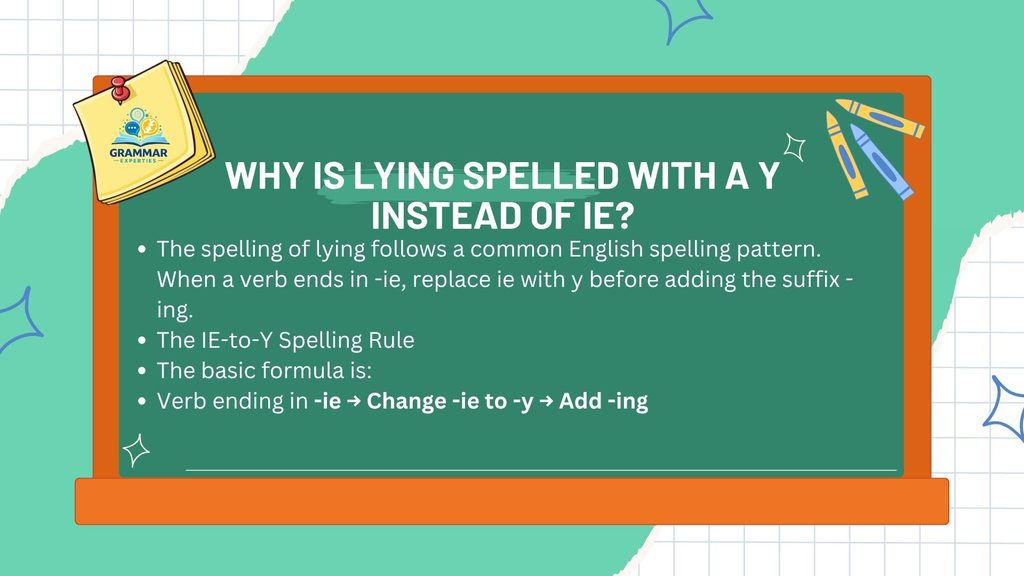
The spelling of lying follows a common English spelling pattern. When a verb ends in -ie, replace ie with y before adding the suffix -ing.
The IE-to-Y Spelling Rule
The basic formula is:
Verb ending in -ie → Change -ie to -y → Add -ing
Here is how the rule works:
| Base verb | Correct -ing form | Incorrect form |
|---|---|---|
| Lie | Lying | Lieing |
| Die | Dying | Dieing |
| Tie | Tying | Tieing |
This rule makes the resulting words easier to recognize and helps maintain conventional English spelling.
How Is This Rule Different From Other Verbs?
Not every verb ending in a vowel follows the same pattern. For instance, verbs such as see and agree simply take -ing:
- See → Seeing
- Agree → Agreeing
- Free → Freeing
However, lie, die, and tie follow the specific -ie to -y pattern.
Compare these examples:
- Correct: The baby is lying in the crib.
- Correct: The plant is dying without water.
- Correct: He is tying his shoelaces.
- Correct: She is seeing a doctor tomorrow.
Understanding the difference helps you avoid applying one spelling rule to every verb.
Is Lieing Ever Correct?
In standard modern English, lieing is considered a misspelling when you intend to write the present participle of lie. It may appear in informal messages, spelling mistakes, or unedited online content, but that doesn’t make it the accepted form.
For school assignments, professional emails, essays, blog posts, and other edited writing, use lying.
Lie or Lying? Understanding the Different Verb Forms
The confusion between lieing and lying often becomes greater when writers try to learn the different forms of the verb lie. The key is to understand how the verb changes according to tense and meaning.
What Are the Different Forms of Lie?
The verb lie has different forms depending on whether you’re talking about the present, past, or an ongoing action.
| Verb form | Correct spelling | Example |
|---|---|---|
| Base form | Lie | I lie on the sofa after work. |
| Third-person singular | Lies | He lies about his age. |
| Present participle | Lying | She is lying on the bed. |
| Past tense (reclining) | Lay | Yesterday, I lay on the couch. |
| Past participle (reclining) | Lain | I have lain here for an hour. |
| Past tense (telling an untruth) | Lied | He lied to his teacher. |
| Past participle (telling an untruth) | Lied | She has lied before. |
Notice that lay and lied have different meanings when used as past-tense forms of lie. If you’re describing someone reclining, the past tense is lay. If you’re describing someone who told an untruth, the past tense is lied.
How Do You Use Lying in a Sentence?
Here are some practical examples that show how to use lying correctly.
- Present continuous: The children are lying on the grass.
- Describing dishonesty: He is lying about his qualifications.
- Describing an object: Your phone is lying beside the laptop.
- Describing a person’s position: I was lying awake all night.
- Using a negative sentence: She isn’t lying about what happened.
In each example, lying is the correct form. The surrounding words help readers understand which meaning applies.
What Is the Difference Between Lying and Laying?
Another common spelling and grammar problem involves lying and laying. Although these words look similar, they come from different verbs.
- Lying comes from lie, meaning to recline or remain in a position.
- Laying comes from lay, meaning to put or place something somewhere.
For example:
- Correct: The dog is lying on the floor.
- Correct: The dog is laying its head on my lap.
The second sentence uses laying because the dog is placing its head somewhere. Remembering this difference can help you avoid a separate but related grammar mistake.
Common Mistakes to Avoid When Using Lying
Knowing that lying is correct is a good start, but other mistakes can still occur. Pay attention to the spelling, the verb’s meaning, and the structure of your sentence.
Mistake 1: Writing Lieing Instead of Lying
This is the main spelling mistake covered in this guide.
Incorrect: She is lieing on the couch.
Correct: She is lying on the couch.
The correction is simple: change ie to y before adding -ing.
Mistake 2: Confusing Lying With Lied
These words come from the same verb when it means telling an untruth, but they serve different grammatical purposes.
Incorrect: He was lied to his friend.
Correct: He was lying to his friend.
Correct: He lied to his friend yesterday.
Use lying for an ongoing action and lied for the past tense or past participle of the verb meaning to tell an untruth.
Mistake 3: Confusing Lying With Laying
Writers sometimes use laying when they mean lying, particularly when describing a person or animal resting.
Incorrect: I am laying on the bed.
Correct: I am lying on the bed.
However, laying is correct when an object is being placed somewhere.
Correct: I am laying the blanket on the bed.
The easiest way to check your sentence is to ask whether someone or something is reclining or whether someone is placing an object.
Mistake 4: Assuming Every Verb Follows the Same Rule
English spelling has several patterns. You cannot apply the -ie to -y rule to every verb ending in a vowel.
For example:
- Lie → Lying
- Die → Dying
- Tie → Tying
- See → Seeing
- Agree → Agreeing
Learning words in small groups makes the rules easier to remember and apply correctly.
A Real-Life Example: Correcting Lieing in Everyday Writing
Imagine a student named Sarah who is preparing an English assignment about healthy sleep habits. She writes the following sentence in her first draft:
After a busy day at school, I enjoy lieing in bed and reading a book.
Sarah understands the meaning of the sentence, and her grammar is otherwise clear. However, she has used the incorrect spelling lieing. Because she remembers that many English verbs take -ing, she assumes that adding the ending without changing the original letters must be correct.
Before submitting her assignment, Sarah checks a reliable English dictionary. She discovers that the present participle of lie is lying. She revises the sentence to read:
After a busy day at school, I enjoy lying in bed and reading a book.
She then notices a similar pattern in the words dying and tying. This helps her recognize the spelling rule rather than memorizing a single correction.
Later, Sarah applies the same knowledge when writing a school email: I was lying awake because I had an important exam the next morning.
This example illustrates why understanding a spelling rule is more useful than correcting one word in isolation. Once you know that verbs ending in -ie change to -y before -ing, you can apply that knowledge to other words. The result is more accurate writing in assignments, emails, articles, and everyday communication.
What Do Current References Say About the Spelling Rule?
When deciding between two spellings, a reliable dictionary or an established writing guide is more useful than relying on what looks right.
Evidence From Established English Language References
The following references support the standard spelling and explain the relevant grammar:
These references establish the standard spelling rule. They do not, however, provide a verified 2025–2026 count of how frequently people misspell lying as lieing.
What Do the 2025–2026 Data Tell Us?
There is no verified, representative 2025–2026 statistic available in the references consulted here that measures the percentage of English writers who use lieing instead of lying. Giving a specific percentage without reliable evidence would be misleading.
Nevertheless, current reference material confirms the spelling rule. The Government of Canada’s Language Portal, for example, published its guidance on verbs ending in -ie in 2026, explicitly identifying lying as the correct form.
For practical writing, the evidence leads to a clear conclusion: use lying in standard English, and consult a trusted dictionary whenever you’re uncertain about a word’s spelling or grammatical form.
How Can You Check Your Writing Quickly?
Use this short checklist whenever you are unsure about lieing or lying:
- Identify the base verb: Is it lie?
- Check whether you need the -ing form.
- Replace the ending -ie with -y.
- Add -ing to form lying.
- Read the sentence again to confirm that the verb fits its meaning.
For example, lie + ing becomes lying, not lieing.
Mini Quiz:Lieing or Lying
1. Which spelling is correct?
A) Lieing
B) Lying
Answer: B) Lying
2. Choose the correct word: She is _____ on the sofa.
A) Lieing
B) Lying
Answer: B) Lying
3. Which spelling follows the standard English rule?
A) Dieing
B) Dying
Answer: B) Dying
4. Fill in the blank: He is _____ about his age.
A) Lieing
B) Lying
Answer: B) Lying
5. What happens to “ie” when adding “-ing” to “lie”?
A) It stays unchanged
B) It changes to “y”
Answer: B) It changes to “y”
6. Choose the correct sentence.
A) The cat is lieing on the bed.
B) The cat is lying on the bed.
Answer: B) The cat is lying on the bed.
7. Which is the correct present participle of “tie”?
A) Tieing
B) Tying
Answer: B) Tying
8. Fill in the blank: She admitted to _____ to her friend.
A) Lieing
B) Lying
Answer: B) Lying
9. Is “lieing” the standard spelling in modern English?
A) Yes
B) No
Answer: B) No
10. Choose the correct word: I was _____ awake all night.
A) Lieing
B) Lying
Answer: B) Lying
11. Which word means telling something that is not true?
A) Lying
B) Laying
Answer: A) Lying
12. Fill in the blank: He _____ about the incident yesterday.
A) Lied
B) Lying
Answer: A) Lied
13. Which sentence uses “laying” correctly?
A) I am laying on the sofa.
B) I am laying the book on the desk.
Answer: B) I am laying the book on the desk.
14. Choose the correct spelling: The plant is _____ because it lacks water.
A) Dieing
B) Dying
Answer: B) Dying
15. What is the past tense of “lie” when it means to recline?
A) Lied
B) Lay
Answer: B) Lay
16. Fill in the blank: Your keys are _____ on the table.
A) Lying
B) Lieing
Answer: A) Lying
17. Which word is the correct present participle of “lie”?
A) Lying
B) Lieing
Answer: A) Lying
18. Choose the correct sentence.
A) She is tying her shoelaces.
B) She is tieing her shoelaces.
Answer: A) She is tying her shoelaces.
19. Fill in the blank: The dog is _____ beside the fireplace.
A) Lying
B) Laying
Answer: A) Lying
20. Which word is the past tense of “lie” meaning to tell an untruth?
A) Lay
B) Lied
Answer: B) Lied
21. Choose the correct spelling: The patient is _____ in bed.
A) Lieing
B) Lying
Answer: B) Lying
22. Which word correctly completes the sentence? She is _____ the blanket on the bed.
A) Lying
B) Laying
Answer: B) Laying
23. What is the correct spelling of the -ing form of “die”?
A) Dying
B) Dieing
Answer: A) Dying
24. Choose the correct sentence.
A) He has been lying about the results.
B) He has been lieing about the results.
Answer: A) He has been lying about the results.
25. Which statement is correct?
A) “Lieing” is the standard spelling.
B) “Lying” is the standard spelling.
Answer: B) “Lying” is the standard spelling.
Frequently Asked Questions About Lieing or Lying
Q1: Is Lieing or Lying Correct?
Lying is correct. In standard modern English, lieing is a misspelling when used as the present participle of lie. Write She is lying on the bed, not She is lieing on the bed.
Q2: Why Is Lieing Spelled Lying?
English spelling changes the final -ie to -y before adding -ing to certain verbs. Therefore, lie becomes lying. The same pattern appears in die → dying and tie → tying.
3. Is Lying a Real Word?
Yes. Lying is a standard English word with several uses. It can describe telling an untruth, reclining in a horizontal position, or something remaining in a particular place.
Examples include He is lying to me and The book is lying on the table.
Q4: What Is the Past Tense of Lying?
The past tense depends on the meaning of the base verb lie.
- When lie means to recline, the past tense is lay: Yesterday, I lay on the sofa.
- When lie means to tell an untruth, the past tense is lied: He lied about the results.
Q5: Is Laying the Same as Lying?
No. Lying usually describes reclining or remaining in a position, or telling an untruth. Laying means placing something somewhere and normally takes an object.
For example, I am lying on the bed is correct when you are reclining. I am laying a book on the desk is correct when you are placing the book there.
Q6: Is Lieing Ever Accepted in English?
Lieing is not the standard spelling of the present participle of lie in modern English. Although you may encounter it in informal writing or online, use lying in schoolwork, professional documents, and published content.
Q7: How Can I Remember the Difference Between Lieing and Lying?
Remember this simple pattern: IE changes to Y before ING.
- Lie → Lying
- Die → Dying
- Tie → Tying
Practise writing these three pairs together until the correct forms become familiar.
Q8: Does Lying Have More Than One Meaning?
Yes. It can refer to making a deliberately untrue statement or to being in a horizontal position. It can also describe an object or place occupying a particular position.
For example, He is lying about his age describes dishonesty, while The cat is lying near the window describes position.
Conclusion: Lying Is the Correct Spelling
When choosing between lieing or lying, always use lying in standard modern English. The spelling follows a simple pattern: change the -ie at the end of lie to -y before adding -ing.
This rule also explains why we write dying and tying, rather than dieing and tieing. Understanding it will help you avoid common spelling errors and write more confidently.
Whether you’re preparing a school assignment, writing an email, or publishing a blog post, accurate spelling makes your message easier to understand and your writing more professional.
Explore more easy grammar lessons and improve your English with Grammar Expertise
References

Maimoona Mughal is an English grammar enthusiast dedicated to simplifying confusing words, grammar rules, and vocabulary through clear, accurate, and learner-friendly content that helps readers write and communicate with confidence.