Have you ever typed “loosing” when you meant “losing”? You’re not alone. These two words look almost identical, but they come from different verbs and have completely different uses.
The correct word in sentences such as “I’m losing my keys” or “Our team is losing the game” is losing, not loosing. Cambridge Dictionary identifies losing as the present participle of lose, while loosing is the present participle of loose, a different verb with meanings such as releasing, setting free, or making something less tight.
The good news is that you don’t need to memorize complicated grammar rules. Once you understand the difference between lose, loose, losing, and loosing, the confusion becomes much easier to avoid.
This guide explains the meanings, grammar, pronunciation, examples, common mistakes, and a simple memory trick that can help you choose the right word every time.
Loosing or Losing: Which One Is Correct?
In most everyday sentences, losing is the correct spelling when you mean “no longer having something,” “being defeated,” “having less,” or “failing to keep something.”
Loosing is a real English word, but it is much less common. It comes from the verb loose, meaning to release, set free, fire, or make something less tight. Cambridge Dictionary lists loosing as the present participle of loose.
The Quick Answer
| Word | Comes from | Main meaning | Example |
|---|---|---|---|
| Losing | lose | No longer having, being defeated, decreasing | I am losing my keys. |
| Loosing | loose | Releasing, freeing, or making less tight | He was loosing the rope. |
| Lose | — | To no longer have or fail to win | Don’t lose your phone. |
| Loose | — | Not tight; free or released | My shirt is loose. |
So, if you are talking about losing a phone, losing money, losing weight, losing a game, losing interest, or losing time, use losing.
Easy rule:
Lose → Losing
Loose → Loosing
Cambridge’s grammar guidance also gives the distinction directly: lose is a verb, while loose is commonly an adjective meaning “not tight.”
What Does Losing Mean?
Losing is the present participle or -ing form of the verb lose.
The verb lose has several common meanings. You can lose something because you cannot find it, lose something because it has been taken away, lose a competition, lose weight, lose interest, or lose time.
Cambridge Dictionary lists meanings including no longer having something, having less of something, stopping a feeling, wasting time, and being defeated in a competition.
Losing Something
Use losing when you cannot find something or no longer have it.
Examples:
- I keep losing my keys.
- She is losing her phone chargers.
- He is worried about losing his passport.
- We are losing valuable documents.
- I think I’m losing my wallet.
Here, losing means no longer having or being unable to find something.
Losing a Competition
Losing can also mean being defeated.
Examples:
- Our team is losing the match.
- They are losing the game by two points.
- She hates losing an argument.
- We were losing badly in the first half.
The opposite is winning.
Winning ↔ Losing
This is one of the easiest ways to recognize the correct spelling.
Losing Weight, Time, or Interest
The word also appears in many common expressions:
- losing weight
- losing time
- losing interest
- losing patience
- losing confidence
- losing control
- losing money
- losing hope
- losing focus
For example:
She is losing confidence after several unsuccessful attempts.
The company is losing money this year.
I’m losing interest in the project.
These all use losing, not loosing.
What Does Loosing Mean?
Loosing is a legitimate English word, but it has a different origin and meaning.
It is the present participle of loose, which can function as a verb. Cambridge Dictionary gives several meanings for the verb loose, including releasing something, setting something free, firing an arrow or shot, and making something less tight.
Because loosing is relatively uncommon in everyday writing, many readers may initially assume it is simply a spelling mistake for losing.
Loosing Means Releasing
One meaning of loose as a verb is to release or set free.
Therefore:
The hunter was loosing the dogs.
Here, loosing means releasing the dogs.
Another example:
The soldiers were loosing arrows toward the target.
In this context, loosing refers to releasing or firing arrows.
Loosing Means Making Something Less Tight
The verb loose can also mean to make something less tight.
For example:
She was loosing the knot.
This means she was making the knot less tight or undoing it.
However, in ordinary modern English, loosening is often a more natural choice for this meaning.
For example:
She was loosening the knot.
That sentence sounds more familiar to most readers than:
She was loosing the knot.
Why You Rarely Need “Loosing”
Although loosing is grammatically valid in certain contexts, you probably won’t need it often.
If your sentence means:
- no longer having something
- being defeated
- decreasing
- failing to keep something
- wasting time
- becoming less successful
then you almost certainly want losing.
If your sentence means:
- releasing
- setting free
- firing
- making something less tight
then loosing may be appropriate, although releasing or loosening may often sound more natural.
Losing vs. Loosing: The Simple Difference
The easiest way to understand losing vs. loosing is to start with their base verbs.
Lose → Losing
Lose becomes losing.
Examples:
- lose → losing
- choose → choosing
- use → using
- move → moving
When the verb ends in a silent e, the e is normally dropped before -ing.
So:
lose + ing = losing
Not:
lose + ing = loosing
This is why losing has only one o after the l.
Loose → Loosing
Loose becomes loosing.
The base word is loose, not lose.
So:
loose + ing = loosing
This form retains the oo from loose.
The important point is that the spelling difference reflects a difference in the base verb:
LOSE → LOSING
LOOSE → LOOSING
A Memory Trick That Works
Try this:
Lose has one “o,” so losing has one “o.”
Loose has two “o”s, so loosing has two “o”s.
You can also connect loose with something that is not tight.
Think:
Loose = room
A loose shirt has extra room.
Then think:
Lose = no longer have
If you lose your shirt, you don’t have it anymore.
This simple meaning-based distinction can help you remember the spelling rather than relying only on visual similarity.
Common Examples of Losing and Loosing
Seeing the words in context makes the difference much easier to understand.
Correct Examples With Losing
Here are common sentences using losing:
- I am losing my patience.
- She keeps losing her keys.
- We are losing the match.
- He is losing weight.
- They are losing money.
- I don’t want to keep losing valuable time.
- The company is losing customers.
- She is losing interest in the subject.
- Our team is losing confidence.
- He is afraid of losing his job.
In every example, the word comes from lose.
Correct Examples With Loosing
Although less common, loosing can also be correct:
- The archer was loosing an arrow.
- They were loosing the dogs into the field.
- The warrior was loosing arrows at the enemy.
- He was loosing the rope from the post.
- The character was loosing his anger upon the crowd.
- She was loosing the knot.
The meaning in these sentences relates to release, setting free, firing, or making something less tight.
Incorrect and Correct Sentences
| Incorrect | Correct | Why? |
|---|---|---|
| I am loosing my phone. | I am losing my phone. | You mean you no longer have it. |
| She is loosing the game. | She is losing the game. | She is being defeated. |
| He is loosing weight. | He is losing weight. | His weight is decreasing. |
| We are loosing money. | We are losing money. | The company is experiencing financial loss. |
| I keep loosing my keys. | I keep losing my keys. | You cannot find your keys. |
| The rope is loosing. | The rope is loosening. | “Loosening” is normally more natural here. |
A Simple Step-by-Step Test for Choosing the Right Word
When you’re unsure whether to write losing or loosing, don’t guess.
Use this three-step test.
Step 1: Find the Base Verb
Ask yourself:
Is the original verb “lose” or “loose”?
If it is lose, use losing.
If it is loose, the form can be loosing.
Step 2: Ask What You Mean
Does the sentence mean:
- no longer having something?
- being defeated?
- having less?
- wasting time?
- stopping a feeling?
- failing to maintain something?
If yes, choose losing.
Does it mean:
- releasing something?
- setting something free?
- firing something?
- making something less tight?
If yes, loosing may be correct.
Step 3: Read the Sentence Aloud
Consider:
I’m losing my keys.
That sounds natural.
Now compare:
I’m loosing my keys.
The second sentence sounds wrong because the intended verb is lose, not loose.
This quick mental check can catch many spelling mistakes before you publish or send your writing.
Real-Life Case Study: How One Extra “O” Changes the Meaning
Imagine a student writing an email to a teacher after an examination.
She wants to say:
“I am worried about losing marks because I made several mistakes.”
While typing quickly, she writes:
“I am worried about loosing marks because I made several mistakes.”
The sentence may look almost correct at first glance. After all, loosing and losing sound similar when spoken quickly. However, the intended meaning is to no longer have something or to suffer a reduction. The student is not “releasing” the marks. Therefore, losing is the correct word.
Now consider a completely different sentence:
“The archer was loosing arrows at the target.”
Here, loosing can be correct because the action involves releasing arrows.
This example shows why simply memorizing “loosing is wrong” isn’t quite accurate. Loosing is a real word. The problem is that people often use it when they actually mean losing.
A useful editing habit is to replace the -ing form temporarily with the base verb. If your sentence says “I am ___ my keys,” ask: “Am I loseing my keys or looseing my keys?” The intended base verb is lose, so the answer is losing.
The same test works in professional emails, school assignments, blog posts, social media captions, and everyday messages. Once you start identifying the base verb, the spelling becomes much easier to control.
2025–2026 Language and Search Guidance: What the Evidence Shows
There is an important distinction between language evidence and made-up search statistics.
Dictionaries establish how words are defined and used. Current Cambridge Dictionary entries identify losing as the present participle of lose and loosing as the present participle of loose.
Google’s current Search Essentials guidance, updated in December 2025, emphasizes helpful, reliable, people-first content and recommends using the words people naturally use to search for information. It also warns against producing content primarily for search-engine manipulation.
Google’s guidance on helpful content also specifically encourages substantial, accurate information, original value, clear sourcing, and content that leaves readers feeling their question has been satisfactorily answered.
That matters for a spelling guide like this because the goal isn’t simply to repeat that losing is correct. A useful explanation should also show why, identify the legitimate meaning of loosing, and provide examples readers can apply immediately.
A Practical 2026 Data Snapshot
| Evidence point | Current finding |
|---|---|
| Losing | Present participle of lose |
| Loosing | Present participle of loose |
| Common everyday choice | Losing |
| Main everyday meaning | No longer having, decreasing, or being defeated |
| Less-common word | Loosing |
| Main special meanings | Releasing, setting free, firing, or making less tight |
| Google content guidance | People-first, helpful, reliable information |
| Current Google Search Essentials update | December 10, 2025 |
The takeaway is simple: the two spellings are not interchangeable.
Losing or Loosing in Everyday Writing
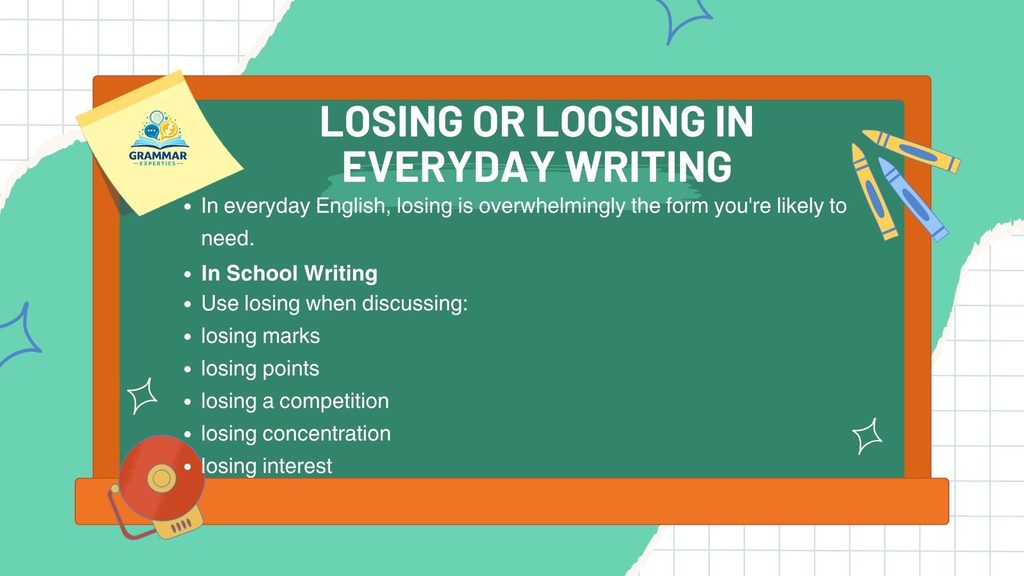
In everyday English, losing is overwhelmingly the form you’re likely to need.
In School Writing
Use losing when discussing:
- losing marks
- losing points
- losing a competition
- losing concentration
- losing interest
- losing confidence
For example:
Students often worry about losing marks because of spelling mistakes.
In Business Writing
You may encounter:
The company is losing customers.
We are losing valuable time.
The business is losing money.
The brand is losing market share.
Again, all of these use losing because they come from lose.
In Casual Conversation
Common expressions include:
- “I’m losing my mind.”
- “Don’t lose hope.”
- “You’re losing me.”
- “We’re losing time.”
- “I keep losing my phone.”
- “I’m losing track of time.”
These all require losing when used in the -ing form.
Why Do People Confuse Losing and Loosing?
The confusion is understandable because the words are visually similar.
They Sound Similar
Lose and loose can be confusing for learners because their spellings differ from their pronunciation in ways that aren’t immediately obvious.
The vowel sound in lose is represented differently from the vowel sound in loose, even though the written forms differ by only one letter.
They Look Almost Identical
Compare:
lose
loose
Then:
losing
loosing
The extra o is easy to overlook while typing quickly.
English Has Many Similar-Looking Words
English spelling contains many pairs that differ by only one letter but have completely different meanings.
For example:
- advice / advise
- affect / effect
- breath / breathe
- loose / lose
- then / than
The best solution isn’t simply to memorize isolated spellings. Understanding the meaning and grammatical role of each word is more reliable.
Losing vs. Loose: Don’t Confuse the Base Words
Another common mistake is confusing lose with loose before even reaching losing.
Lose
Lose is a verb.
It can mean:
- stop having something
- fail to win
- have less
- waste
- stop experiencing something
Examples:
Don’t lose your keys.
We might lose the match.
She doesn’t want to lose her job.
Loose
Loose is commonly an adjective meaning not tight or firmly fixed.
Examples:
My shoes are loose.
The screw is loose.
He wore a loose jacket.
It can also be a verb, which is where loosing comes from.
Cambridge specifically contrasts lose as a verb with loose as an adjective in its grammar guidance.
The Best Memory Trick for Losing
If you only remember one rule from this article, remember this:
Lose = no longer have it.
Loose = not tight.
Now apply it to the -ing forms:
Lose → Losing
Loose → Loosing
For example:
I am losing my keys.
You no longer have your keys.
My shoelaces are loose.
The shoelaces are not tight.
The archer was loosing an arrow.
The archer was releasing an arrow.
Once you connect spelling to meaning, the extra o becomes much easier to remember.
Quick Checklist: Losing or Loosing?
Before publishing or sending your sentence, ask:
- Am I talking about no longer having something? → losing
- Am I talking about being defeated? → losing
- Am I talking about having less of something? → losing
- Am I talking about wasting time? → losing
- Am I talking about losing interest or confidence? → losing
- Am I talking about releasing something? → loosing
- Am I talking about setting something free? → loosing
- Am I talking about firing an arrow? → loosing
- Am I talking about making something less tight? → loosing, although loosening is often more natural.
When in doubt, identify the base verb first.
Mini Quiz:Loosing or Losing
- I keep ______ my keys.
A) loosing
B) losing
C) lossing
D) looseing
Answer: B) losing - She is ______ weight.
A) loosing
B) losing
C) lossing
D) looseing
Answer: B) losing - Our team is ______ the match.
A) loosing
B) losing
C) lossing
D) looseing
Answer: B) losing - Which word is the -ing form of lose?
A) loosing
B) losing
C) lossing
D) looseing
Answer: B) losing - The archer was ______ arrows at the target.
A) losing
B) loosing
C) lossing
D) looseing
Answer: B) loosing - Which word means “no longer having something”?
A) loose
B) loosing
C) losing
D) loosen
Answer: C) losing - True or False: Losing comes from the verb lose.
Answer: True - True or False: Loosing and losing have exactly the same meaning.
Answer: False - I don’t want to ______ my phone.
A) loose
B) lose
C) losing
D) loosing
Answer: B) lose - My shirt is too ______.
A) lose
B) losing
C) loose
D) loosing
Answer: C) loose - The company is ______ customers.
A) loosing
B) losing
C) lossing
D) looseing
Answer: B) losing - Which sentence is correct?
A) I am loosing my wallet.
B) I am losing my wallet.
C) I am lossing my wallet.
D) I am looseing my wallet.
Answer: B) I am losing my wallet. - Which word comes from loose?
A) losing
B) lost
C) loosing
D) loss
Answer: C) loosing - She is ______ interest in the subject.
A) loosing
B) losing
C) lossing
D) looseing
Answer: B) losing - Which sentence is correct?
A) He is loosing confidence.
B) He is losing confidence.
C) He is looseing confidence.
D) He is lossing confidence.
Answer: B) He is losing confidence. - The hunter was ______ the dogs into the field.
A) losing
B) loosing
C) lossing
D) looseing
Answer: B) loosing - Which phrase is correct?
A) losing time
B) loosing time
C) lossing time
D) looseing time
Answer: A) losing time - Which phrase is correct?
A) loosing money
B) losing money
C) lossing money
D) looseing money
Answer: B) losing money - If something is not tight, which word describes it?
A) lose
B) losing
C) loose
D) loosing
Answer: C) loose - Which sentence uses loosing correctly?
A) She is loosing her keys.
B) He is loosing the game.
C) The archer is loosing an arrow.
D) They are loosing money.
Answer: C) The archer is loosing an arrow. - Which sentence is correct?
A) Don’t loose hope.
B) Don’t lose hope.
C) Don’t loosing hope.
D) Don’t loss hope.
Answer: B) Don’t lose hope. - “Losing” can mean:
A) Being defeated
B) Being released
C) Becoming tighter
D) Making something loose
Answer: A) Being defeated - Which word is usually more natural for making something less tight?
A) losing
B) loosing
C) loosening
D) lossing
Answer: C) loosening - Complete the sentence: “I’m ______ patience.”
A) loosing
B) losing
C) looseing
D) lossing
Answer: B) losing - What is the easiest way to remember the difference?
A) Lose = no longer have; Loose = not tight
B) Lose = not tight; Loose = no longer have
C) Both always mean the same thing
D) Loosing should always replace losing
Answer: A) Lose = no longer have; Loose = not tight
ChatGPT can make mistakes. Check important info.
Frequently Asked Questions About Loosing or Losing
Q1:Is “loosing” a real word?
Yes. Loosing is a real English word. It is the present participle of the verb loose. It can mean releasing, setting free, firing, or making something less tight.
Q2:Is “losing” the correct spelling?
Yes, when you mean the -ing form of lose, the correct spelling is losing.
For example:
I am losing my phone.
She is losing the game.
They are losing money.
Q3:Is it “losing weight” or “loosing weight”?
The correct phrase is losing weight.
The base verb is lose:
lose → losing
Therefore:
She is losing weight.
Not:
She is loosing weight.
Q4:Is it “losing my mind” or “loosing my mind”?
The correct phrase is losing my mind.
Here, losing comes from lose.
I’m losing my mind trying to solve this problem.
Q5:Is “loosing” ever correct?
Yes. For example:
The archer was loosing arrows.
Here, loosing means releasing or firing arrows.
However, the word is much less common than losing in everyday English.
Q6:What is the easiest way to remember losing vs. loosing?
Remember:
Lose → losing
Loose → loosing
Then connect the meanings:
lose = no longer have
loose = not tight
This makes the spelling easier to remember.
Q7:Why is “loosing” often considered wrong?
It’s often considered wrong because people use it when they actually mean losing. The word itself isn’t wrong; the problem is using it in the wrong context.
For example:
I keep loosing my keys.
is incorrect because the intended verb is lose.
The correct sentence is:
I keep losing my keys.
Q8:Is “loosening” better than “loosing”?
Often, yes, especially when you mean making something less tight.
For example:
She is loosening the knot.
This is generally more natural in modern everyday writing than:
She is loosing the knot.
However, loosing remains a legitimate word in appropriate contexts.
Final Verdict: Loosing or Losing?
The difference between loosing and losing becomes simple once you look at the base words.
Losing comes from lose and is the word you need when you mean no longer having something, being defeated, decreasing, wasting something, or stopping a feeling.
Loosing comes from loose and can mean releasing, setting free, firing, or making something less tight.
The easiest rule is:
Lose → Losing
Loose → Loosing
So if you’re writing “I am ___ my keys,” “We are ___ the game,” “She is ___ weight,” or “They are ___ money,” choose losing.
Don’t let the extra o trick you.
Before you finish your next email, assignment, article, or social media post, pause for one second and ask: Am I talking about losing something, or loosening/releasing something?
That tiny check can prevent a surprisingly common spelling mistake.
Explore more easy grammar lessons and improve your English with Grammar Expertise
References

Maimoona Mughal is an English grammar enthusiast dedicated to simplifying confusing words, grammar rules, and vocabulary through clear, accurate, and learner-friendly content that helps readers write and communicate with confidence.