Have you ever typed “offerred” and then stopped because the word suddenly looked wrong? If you’re confused about offered vs offerred, the answer is straightforward: offered is the correct spelling.
Offerred is a misspelling. It adds an unnecessary second r to the word.
The correct form is:
- ✅ Offered
- ❌ Offerred
Offered is the past tense and past participle of offer. It can mean presented, provided, suggested, proposed, or made something available. Major dictionaries, including Cambridge, Merriam-Webster, and Oxford, recognize offered as the correct form.
In this guide, you’ll learn why offered is correct, why offerred is wrong, how the consonant-doubling rule works, and how to use the word naturally in everyday and professional writing.
Offered vs Offerred: What Is the Correct Spelling?
The correct spelling is offered, with only one r after the e.
Offered Is Correct
Offered is formed from the base verb offer:
offer + ed = offered
Examples:
- She offered me some coffee.
- The company offered him a new position.
- They offered their support.
- He offered to drive us home.
- The school offered additional classes.
Cambridge Dictionary identifies offered as the past simple and past participle of offer.
Merriam-Webster likewise gives the verb forms as offered; offering.
Offerred Is Incorrect
Offerred contains an unnecessary second r.
Incorrect:
She offerred me a job.
Correct:
She offered me a job.
The same applies in formal writing, emails, essays, resumes, websites, reports, and everyday messages.
There is no standard English spelling offerred as an alternative form of offered.
Quick Comparison
| Word | Correct? | Explanation |
|---|---|---|
| offered | ✅ Yes | Past tense and past participle of offer |
| offerred | ❌ No | Misspelling |
| offer | ✅ Yes | Base form |
| offering | ✅ Yes | -ing form |
So, if you’re wondering “Is it offered or offerred?”, always choose offered.
What Does “Offered” Mean?
The meaning of offered depends slightly on the context, but the central idea is presenting or making something available.
Offered as “Gave or Presented”
When someone offered something, they presented it for another person to accept or reject.
For example:
Maria offered me a cup of tea.
This means Maria presented or gave the opportunity to have tea.
Other examples include:
- He offered me his seat.
- They offered food to the guests.
- She offered her assistance.
- The nurse offered some useful advice.
Merriam-Webster defines offer in several related ways, including presenting something for acceptance or rejection and making something available.
Offered as “Suggested”
The word can also mean proposed or suggested something.
Examples:
She offered a possible solution.
The manager offered a different explanation.
He offered several suggestions during the meeting.
Here, the person isn’t necessarily physically giving something. Instead, they are putting an idea forward for consideration.
Offered as “Was Willing to Do Something”
Offered can also describe someone’s willingness to perform an action.
For example:
James offered to help with the project.
She offered to drive us to the airport.
The neighbor offered to watch the children.
This structure is especially common:
offered + to + verb
For example:
- offered to help
- offered to pay
- offered to explain
- offered to assist
- offered to stay
Cambridge’s grammar guidance also explains that offer is commonly used when someone says they are willing to do something for another person.
Why Is “Offered” Correct and “Offerred” Wrong?
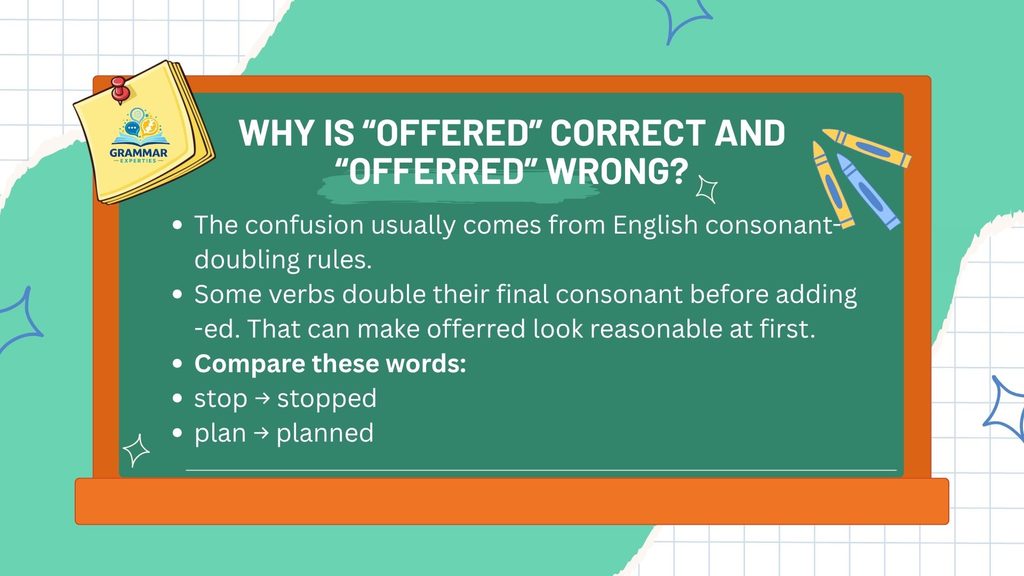
The confusion usually comes from English consonant-doubling rules.
Some verbs double their final consonant before adding -ed. That can make offerred look reasonable at first.
Understanding the Spelling Pattern
Compare these words:
- stop → stopped
- plan → planned
- admit → admitted
- refer → referred
- prefer → preferred
Because some verbs double a final consonant, writers sometimes assume:
offer → offerred
But that is not the correct formation.
The correct form is simply:
offer → offered
The Oxford Advanced Learner’s Dictionary lists the verb forms as offer → offered → offered, confirming that both the past simple and past participle use offered.
Why the Extra “R” Is Unnecessary
The spelling of offer already contains a double f:
o-f-f-e-r
When you add -ed, you do not add another r:
o-f-f-e-r + e-d = o-f-f-e-r-e-d
Therefore:
offered ✅
not:
offerred ❌
The mistake becomes easier to understand when you compare offer with verbs such as refer and prefer.
| Base Verb | Correct Past Form |
|---|---|
| offer | offered |
| refer | referred |
| prefer | preferred |
| occur | occurred |
| stop | stopped |
| plan | planned |
The spelling of each verb needs to be learned according to its actual English word-formation pattern rather than by analogy with a different verb.
Offered vs Offerred Grammar Rule
A useful practical rule is:
Do not automatically double the final consonant of every verb before adding -ed.
Instead, consider the spelling and pronunciation pattern of the base verb.
For offer, the standard form is:
offer + ed = offered
This is the form you should use in all standard English varieties.
How to Use “Offered” Correctly in Sentences
Knowing the spelling is only half the job. You also need to know how offered functions in a sentence.
Everyday Examples
Here are some natural examples:
- She offered me some water.
- He offered to carry my bag.
- They offered us a ride home.
- I offered my seat to an elderly passenger.
- The waiter offered us the dessert menu.
- Sarah offered helpful advice.
- My friend offered to explain the problem.
Business and Professional Examples
Offered is extremely common in workplace communication.
Examples:
The company offered me a full-time position.
The manager offered several practical solutions.
The organization offered training to new employees.
The employer offered flexible working hours.
The client offered a reasonable price.
Merriam-Webster gives examples involving jobs, assistance, suggestions, payment, and making something available, showing how widely the verb is used.
Academic Examples
You can also use offered in essays, research papers, and educational writing.
For example:
The study offered a new explanation for the results.
The professor offered additional resources to students.
The research offered valuable insight into the problem.
Formal vs Informal Usage
There is no need to avoid offered in formal writing. It is a completely standard English verb form.
You can use it in:
- Academic papers
- Business emails
- Job applications
- Reports
- News writing
- Websites
- Contracts
- Everyday conversations
The important point is simply to avoid the incorrect spelling offerred.
2026 Evidence Snapshot: What Do Major Dictionaries Show?
When a spelling question has two competing forms, reputable dictionaries provide a useful reality check.
2025–2026 Reference Check
A current reference check in 2026 shows consistent treatment of the word:
| Reference | Form Listed | Result |
|---|---|---|
| Cambridge Dictionary | offered | ✅ Correct |
| Merriam-Webster | offered | ✅ Correct |
| Oxford Advanced Learner’s Dictionary | offered | ✅ Correct |
That gives a 3 out of 3 agreement among these three major dictionary references checked for this article.
This is not a measurement of Google search volume or the frequency of spelling mistakes. It is a dictionary-reference snapshot showing that the standard form is consistently offered.
Cambridge lists offered as the past simple and past participle of offer. Merriam-Webster lists offered among the verb forms of offer. Oxford lists both the past simple and past participle as offered.
Dictionary.com also identifies offered as both the past tense and past participle form of offer, with recent examples from major publications.
What This Evidence Tells Us
The evidence is clear:
- Offered is the standard spelling.
- Offerred is not an alternative British or American spelling.
- The same spelling is used in major English varieties.
- The word is actively used in modern English.
- The past tense and past participle are both offered.
Therefore, there is no reason to use offerred in standard English writing.
A Real-Life Writing Example: Fixing “Offerred” in a Job Email
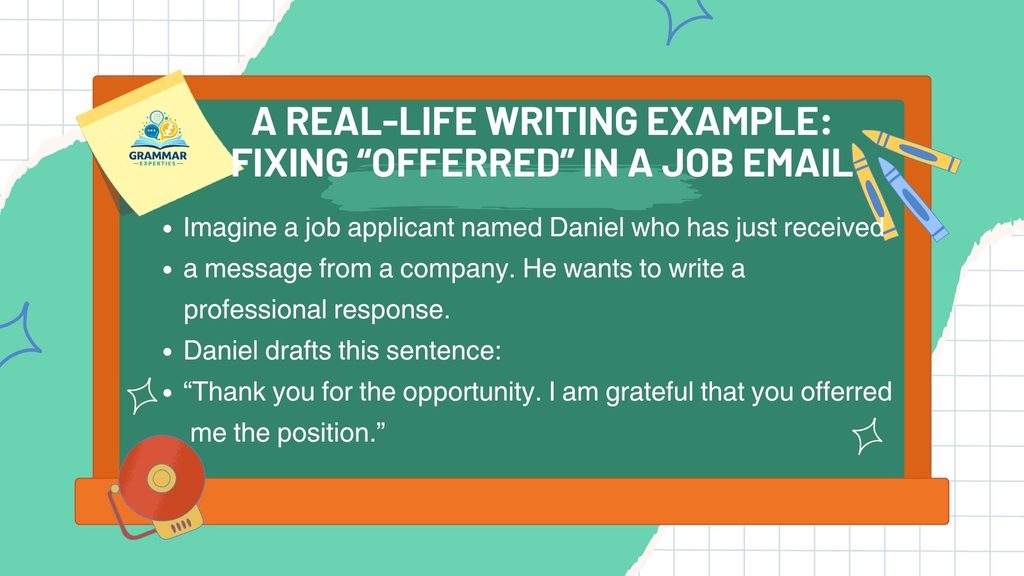
Imagine a job applicant named Daniel who has just received a message from a company. He wants to write a professional response.
Daniel drafts this sentence:
“Thank you for the opportunity. I am grateful that you offerred me the position.”
At first glance, the sentence seems fine. The meaning is clear, and most readers would understand it. However, the spelling offerred is incorrect.
Daniel changes it to:
“Thank you for the opportunity. I am grateful that you offered me the position.”
Now the sentence uses the standard form.
This small correction matters because professional writing is often judged on details. A spelling mistake doesn’t necessarily change the meaning of a sentence, but repeated errors can make an otherwise polished email look less careful.
The same issue could occur in a university assignment. A student might write:
“The professor offerred several explanations for the result.”
The corrected sentence is:
“The professor offered several explanations for the result.”
The lesson is not simply to memorize one spelling. Daniel and the student can both use the base-word method: identify the verb offer, then form its past tense as offered.
This is particularly useful when proofreading emails, cover letters, assignments, reports, and website content. Rather than relying only on how a word looks, check the base form and its recognized verb forms. Oxford specifically lists offer → offered → offered → offering, making the pattern easy to verify.
Common Mistakes With Offered
Understanding common errors can make the correct spelling easier to remember.
Mistake 1: Writing “Offerred”
❌ The company offerred me a job.
✅ The company offered me a job.
The second r is unnecessary.
Mistake 2: Confusing It With “Referred”
Writers sometimes associate offered with words such as referred and preferred.
Compare:
- refer → referred
- prefer → preferred
- offer → offered
These forms look similar, but you cannot simply apply the spelling pattern of one verb to another.
Mistake 3: Adding Too Many Letters
Another common problem is trying to spell the word based on pronunciation.
The safest visual pattern is:
OFFER + ED
not:
OFFER + RED
So remember:
offer → offered
Mistake 4: Assuming British English Uses “Offerred”
It doesn’t.
Oxford and Cambridge both list offered as the standard form.
There are genuine differences between American and British spelling in some words, but offered is not one of them.
How to Remember the Correct Spelling
A simple memory trick can prevent the mistake.
Use the “Offer + ED” Trick
Think of the word in two parts:
OFFER + ED
That gives:
OFFERED
Don’t insert another R.
You can also remember this sentence:
I offer something, and I offered something yesterday.
For example:
- Today: I offer help.
- Yesterday: I offered help.
Learn the Word Family
It also helps to see the related forms together:
| Form | Example |
|---|---|
| offer | I offer help. |
| offers | She offers advice. |
| offered | He offered assistance. |
| offering | They are offering support. |
Notice that none of these forms becomes offerred.
Mini Quiz: Offered vs Offerred
1. Which spelling is correct?
A) Offerred
B) Offered
C) Offerd
D) Offerrd
Answer: B) Offered
2. What is the past tense of “offer”?
A) Offerred
B) Offerd
C) Offered
D) Offering
Answer: C) Offered
3. Choose the correct sentence.
A) She offerred me some tea.
B) She offerd me some tea.
C) She offered me some tea.
D) She offerrd me some tea.
Answer: C) She offered me some tea.
4. True or False: “Offered” is the standard past-tense form of “offer.”
Answer: True
5. Which sentence uses “offered” correctly?
A) The company offerred him a job.
B) The company offered him a job.
C) The company offerd him a job.
D) The company offering him a job.
Answer: B) The company offered him a job.
6. What does “offered” mean in “He offered me his seat”?
A) He removed his seat.
B) He refused his seat.
C) He made the seat available to me.
D) He forgot his seat.
Answer: C) He made the seat available to me.
7. Which word is correctly spelled?
A) Offerred
B) Offered
C) Offerd
D) Offerreded
Answer: B) Offered
8. Complete the sentence: “They _____ to help us.”
A) offerred
B) offerd
C) offered
D) offering
Answer: C) offered
9. Which spelling should be used in a formal email?
A) Offerred
B) Offered
C) Offerd
D) Offerrd
Answer: B) Offered
10. Complete the sentence: “The manager _____ me a promotion.”
A) offer
B) offerd
C) offerred
D) offered
Answer: D) offered
11. Which is NOT a standard form of “offer”?
A) Offer
B) Offers
C) Offered
D) Offerred
Answer: D) Offerred
12. True or False: “Offerred” is an accepted British English spelling.
Answer: False
13. Which sentence uses “offered” to mean “suggested”?
A) She offered a possible solution.
B) She offerred a possible solution.
C) She offerd a possible solution.
D) She offers yesterday a solution.
Answer: A) She offered a possible solution.
14. Complete the sentence: “The school has _____ extra classes.”
A) offerred
B) offerd
C) offered
D) offering
Answer: C) offered
15. Which sentences use “offered” correctly?
A) He offered to pay the bill.
B) She offered some helpful advice.
C) They offered us a discount.
D) He offerred to call later.
Answers: A, B, and C
16. What is the correct spelling formula?
A) offer + ed = offered
B) offer + red = offerred
C) offer + d = offerd
D) offer + ed = offerred
Answer: A) offer + ed = offered
17. Which sentence contains a spelling mistake?
A) The teacher offered extra help.
B) The company offered training.
C) She offerred her assistance.
D) They offered us a choice.
Answer: C) She offerred her assistance.
18. What is the past participle of “offer”?
A) Offerred
B) Offerd
C) Offered
D) Offers
Answer: C) Offered
19. Complete the sentence: “She had _____ to drive us home.”
A) offerred
B) offered
C) offer
D) offers
Answer: B) offered
20. Why do people sometimes spell “offered” as “offerred”?
A) They confuse it with verbs that double a final consonant.
B) Because “offer” has three syllables.
C) Because British English requires two r’s.
D) Because “offered” is pronounced with two r sounds.
Answer: A) They confuse it with verbs that double a final consonant.
21. Choose the correct sentence.
A) I offerred my seat to the passenger.
B) I offerd my seat to the passenger.
C) I offered my seat to the passenger.
D) I offering my seat yesterday.
Answer: C) I offered my seat to the passenger.
22. Complete the sentence: “The service was _____ to all customers.”
A) offerred
B) offerd
C) offered
D) offer
Answer: C) offered
23. Which meanings can “offered” have depending on context?
A) Presented something for acceptance
B) Suggested an idea or solution
C) Made something available
D) Always refused something
Answers: A, B, and C
24. Which sentence contains the spelling error?
A) The hotel offered free breakfast.
B) The hotel offerred free breakfast.
C) The hotel offered comfortable rooms.
D) The hotel offered several services.
Answer: B) The hotel offerred free breakfast.
25. What is the easiest way to remember the correct spelling?
A) offer + ed = offered
B) offer + red = offerred
C) Double the r whenever you add -ed
D) Replace the final r with rr
Answer: A) offer + ed = offered
Frequently Asked Questions About Offered vs Offerred
Q1:Is “offered” or “offerred” correct?
Offered is correct. Offerred is a misspelling and should not be used in standard English.
Q2:Is “offerred” a real word?
Offerred is not the standard spelling of the past tense or past participle of offer. The correct form is offered.
Q3:What is the past tense of “offer”?
The past tense of offer is offered.
Example:
She offered me some helpful advice.
Q4:What is the past participle of “offer”?
The past participle is also offered.
Example:
The company has offered him a new position.
Oxford lists offered as both the past simple and past participle form.
Q5:Why doesn’t “offer” become “offerred”?
Because the standard past form of offer is formed as offer + ed, producing offered. The spelling does not add another r.
Q6:Is “offered” correct in British English?
Yes. Offered is correct in British English as well as American English. Cambridge and Oxford both use the form offered.
Q7:What does “offered” mean?
Offered can mean presented, provided, suggested, proposed, or made something available.
For example:
The company offered her a promotion.
Here, the company presented her with the opportunity.
Q8:Is “offering” also correct?
Yes. Offering is the correct -ing form of offer.
Example:
The company is offering free training.
Merriam-Webster and Cambridge both recognize offering as a standard form of offer.
Conclusion: Always Choose “Offered”
When comparing offered vs offerred, the answer is clear: offered is the correct spelling.
The word is the past tense and past participle of offer, and major dictionaries consistently list offered as the standard form.
Remember the simple pattern:
offer + ed = offered
Not:
offer + red = offerred
Whether you’re writing a school assignment, professional email, job application, blog post, report, or everyday message, use offered.
Once you remember that the base verb is offer and its past form is offered, you won’t need to second-guess this spelling again.
Explore more easy grammar lessons and improve your English with Grammar Expertise
References

Maimoona Mughal is an English grammar enthusiast dedicated to simplifying confusing words, grammar rules, and vocabulary through clear, accurate, and learner-friendly content that helps readers write and communicate with confidence.