Have you ever wondered whether to write outting or outing? Thse words look similar, so it is easy to assume that both spellings are acceptable. However, only one is the standard spelling of the word used to describe a short trip, outdoor activity, or social excursion.
The correct spelling is outing, with one “t.” The spelling “outting” is generally a misspelling in standard English. Understanding why this happens can help you avoid similar spelling mistakes in emails, school assignments, blog posts, and everyday conversations.
In this guide, you will learn the meaning of outing, why the spelling rule matters, how to use the word in sentences, and how to remember the correct spelling.
What Is the Correct Spelling: Outting or Outing?
Outing is the correct spelling in standard English. It is a noun that usually refers to a short trip, recreational activity, or social event away from home. “Outting” is not the standard spelling of this word.
Why Is Outing Correct?
The word outing comes from the verb out combined with the suffix -ing. When this suffix is added, the final consonant is not doubled because the word does not follow the usual consonant-doubling pattern.
For example:
- Correct: We planned a family outing for Sunday.
- Incorrect: We planned a family outting for Sunday.
The correct form retains the single “t” in out.
Is Outting Ever Acceptable?
In ordinary English writing, you should use outing, not outting. You might occasionally encounter “Outting” as a surname, brand name, username, or intentional creative spelling. Such special uses do not make it the correct spelling of the common noun.
If you are writing an essay, article, business email, or social media post, choose outing.
Quick Comparison
| Word | Correct? | Explanation |
|---|---|---|
| Outing | Yes | Standard English spelling |
| Outting | No, in ordinary usage | Common misspelling of outing |
Quick answer: If you mean a trip, excursion, or recreational activity, always write outing.
What Does Outing Mean?
The word outing has several related meanings. Its exact meaning depends on the context in which you use it.
1. A Short Trip or Excursion
The most common meaning of outing is a short trip taken for enjoyment, relaxation, or recreation.
Examples:
- Our family enjoyed an outing to the beach.
- The school organized an outing to the science museum.
- We are planning a weekend outing with our friends.
In these examples, outing describes an activity that takes people away from their usual surroundings.
2. A Social or Recreational Activity
An outing can also mean a planned social activity, such as a picnic, a group visit, or a day spent with colleagues.
Examples:
- The company arranged a team outing for its employees.
- Our class went on an educational outing.
- The hiking outing was both exciting and relaxing.
This meaning is common in workplaces, schools, and family conversations.
3. Revealing Someone’s Private Information
The word outing can also describe the act of revealing someone’s sexual orientation or another private identity without that person’s consent.
For example:
– The article discussed the harmful effects of outing someone without permission.
This meaning is different from a recreational trip. Context determines which definition applies.
How to Use Outing in Everyday English
Use outing when talking about an excursion, group activity, or the act of revealing private information.
Compare these examples:
- Family outing: We went on a family outing last weekend.
- School outing: The students visited a historical site.
- Work outing: The team enjoyed an outing after completing the project.
In each case, the spelling remains the same: outing.
Why Do People Misspell Outing as Outting?
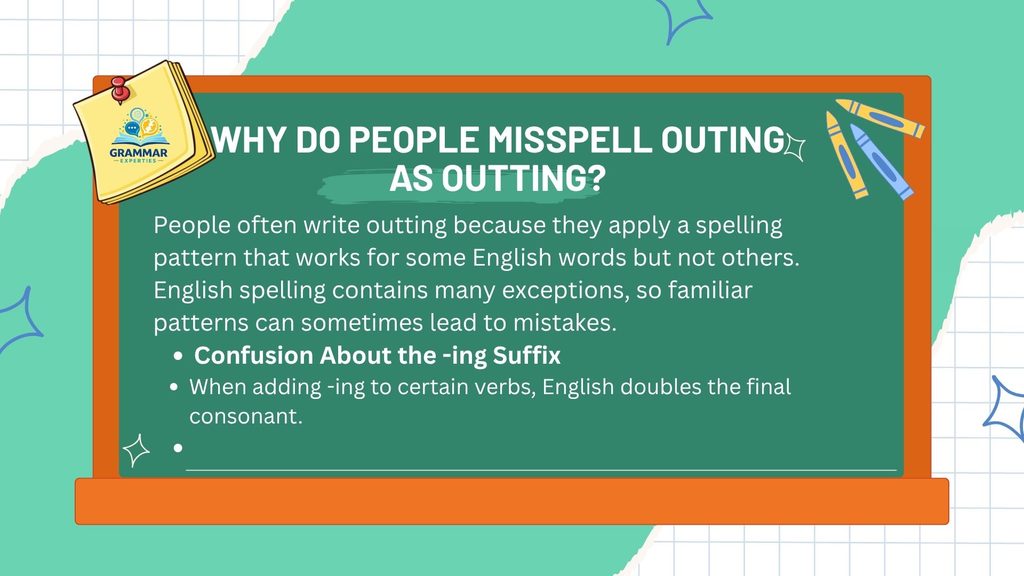
People often write outting because they apply a spelling pattern that works for some English words but not others. English spelling contains many exceptions, so familiar patterns can sometimes lead to mistakes.
Confusion About the -ing Suffix
When adding -ing to certain verbs, English doubles the final consonant.
For example:
- Run → running
- Sit → sitting
- Stop → stopping
Because sitting contains a double “t,” some writers mistakenly assume that out should become outting.
However, this is not how the word is formed. The correct spelling is out + ing = outing.
Understanding the Consonant-Doubling Rule
Consonant doubling commonly occurs when a short, stressed consonant-vowel-consonant pattern meets the relevant spelling conditions.
For example:
- Hop → hopping
- Plan → planning
- Admit → admitting
The word out does not fit this pattern because its vowel spelling includes the vowel combination “ou.” Therefore, its final “t” is not doubled when forming outing.
Other Common Spelling Mistakes
The same kind of confusion can occur with other English words.
| Incorrect spelling | Correct spelling |
|---|---|
| Outting | Outing |
| Stoping | Stopping |
| Runing | Running |
| Sittting | Sitting |
| Planing (when referring to making plans) | Planning |
Note that some spellings, such as planing, are correct in other contexts. For example, planing can refer to smoothing a surface with a plane. Meaning matters as well as spelling.
Outing in Sentences: Correct Examples and Common Errors
The easiest way to learn a spelling is to see how it works in real sentences. The following examples show how outing fits into everyday communication.
Correct Sentences With Outing
- We arranged a family outing to the countryside.
- The children were excited about their school outing.
- Our office organized a team outing last Friday.
- They enjoyed a peaceful outing near the lake.
- The museum outing helped students learn about history.
- We canceled the picnic outing because of the rain.
- Her weekend outing included lunch and a visit to the park.
- The club plans to organize a hiking outing next month.
Each sentence uses the standard spelling outing.
Incorrect Sentences and Their Corrections
Here are examples of common mistakes and their correct versions.
| Incorrect sentence | Correct sentence |
|---|---|
| We planned an outting to the beach. | We planned an outing to the beach. |
| The school outting was enjoyable. | The school outing was enjoyable. |
| Our team went on a company outting. | Our team went on a company outing. |
| They canceled the weekend outting. | They canceled the weekend outing. |
| The family outting lasted all day. | The family outing lasted all day. |
The correction is straightforward: replace outting with outing.
Real-Life Example: Planning a Family Outing
Imagine that a family is planning a day trip to a nearby park. One family member sends a message to a group chat:
“We are organizing a family outting this Saturday. Please bring snacks and comfortable shoes.”
Although the message is understandable, outting is misspelled. A corrected version would read:
“We are organizing a family outing this Saturday. Please bring snacks and comfortable shoes.”
Now imagine that another family member is preparing an invitation for the same event. They write, “Join us for a fun family outing this weekend!” This version is correct and suitable for an invitation.
The example illustrates why spelling matters even when the intended meaning is clear. In casual messages, a reader may understand the mistake without difficulty. However, in a formal invitation, company announcement, school newsletter, or published blog post, correct spelling creates a more professional impression.
The family can also use the word in different grammatical constructions: “We are planning an outing,” “Our outing begins at nine,” and “The outing was enjoyable.” In all three sentences, the spelling remains unchanged.
The lesson is simple: whether you are writing a quick message or a formal announcement, use outing with one “t.”
Outing vs. Similar Words: Meaning and Usage
Understanding related words can help you select the most accurate term for your sentence. Although outing is commonly used for recreational trips, other words may be more appropriate in specific situations.
Outing vs. Excursion
An outing is usually a casual trip or social activity. An excursion often refers to an organized short journey, particularly one taken for educational, recreational, or sightseeing purposes.
Examples:
- We enjoyed a family outing at the beach.
- The students took an excursion to a historical monument.
Both words can describe short trips, but excursion often sounds more formal.
Outing vs. Trip
A trip is a broad term for travel from one place to another. An outing usually suggests a shorter recreational or social activity.
Examples:
- We took a business trip to London.
- We went on a family outing to the zoo.
A business journey is generally called a trip, while a leisure visit to the zoo can naturally be called an outing.
Outing vs. Outing Out
The phrase going out describes leaving home or spending time outside, often for entertainment or social activities. Outing is a noun that can describe the event itself.
Examples:
- We are going out for dinner.
- Our dinner outing was enjoyable.
The words are related, but their grammatical roles differ.
What Do Spelling References and Current Data Tell Us?
Reliable spelling guidance helps writers distinguish established English words from common typing errors. However, it is important to separate verified linguistic facts from statistics that have not been independently established.
Spelling Trends in 2025–2026
As of October 2026, no verified, representative statistic is provided here that measures how many people misspell outing as outting in 2025 or 2026. It would be misleading to invent a percentage or claim a specific increase in spelling errors without reliable data.
Nevertheless, the spelling distinction can be explained using established English spelling rules. Words such as running and sitting double their final consonants under particular conditions, while outing does not.
If you want to investigate search interest in the two spellings,google trends can help you compare search patterns over time. Keep in mind that search interest is not the same as a measured spelling-error rate, and a trend chart does not automatically establish which spelling is correct.
For everyday writing, the practical conclusion remains unchanged: use outing, not outting.
Mini Quiz:Outting or Outing
1. Which spelling is correct in standard English?
A. Outting B. Outing C. Outtingg D. Outinng
Answer: B. Outing
2. Choose the correct spelling: We planned a family _____.
A. outting B. outinng C. outing D. outtinng
Answer: C. outing
3. Which sentence is correct?
A. We enjoyed a family outting. B. We enjoyed a family outing. C. We enjoyed a family outtting. D. We enjoyed a family outinng.
Answer: B. We enjoyed a family outing.
4. What does “outing” usually mean?
A. A short trip or recreational activity B. A written examination C. A cooking method D. A type of building
Answer: A. A short trip or recreational activity
5. Which spelling should you use in a formal email?
A. Outting B. Outtting C. Outing D. Outinng
Answer: C. Outing
6. Complete the sentence: The school organized an _____ to the museum.
A. outting B. outing C. outtting D. outtingg
Answer: B. outing
7. What is the plural of “outing”?
A. Outtings B. Outinges C. Outings D. Outtingies
Answer: C. Outings
8. Which sentence uses “outing” correctly?
A. Our company planned a team outing. B. Our company planned a team outting. C. Our company planned a team outtting. D. Our company planned a team outinng.
Answer: A. Our company planned a team outing.
9. Why is “outting” generally incorrect for a recreational trip?
A. It uses too many vowels. B. It doubles the final consonant unnecessarily. C. It is a plural noun. D. It is always a verb.
Answer: B. It doubles the final consonant unnecessarily.
10. Select the correct sentence.
A. The weekend outting was fun. B. The weekend outing was fun. C. The weekend outtting was fun. D. The weekend outinng was fun.
Answer: B. The weekend outing was fun.
11. Which word completes the sentence? “We went on several weekend _____ last summer.”
A. outtings B. outinges C. outings D. outtting
Answer: C. outings
12. Which word is commonly used for a short recreational trip?
A. Outting B. Outing C. Outtinng D. Outtingg
Answer: B. Outing
13. Choose the correctly spelled phrase.
A. A school outting B. A school outtting C. A school outing D. A school outinng
Answer: C. A school outing
14. Which word is spelled correctly?
A. Outting B. Outing C. Outtting D. Outinng
Answer: B. Outing
15. Complete the sentence: Our family _____ was canceled because of the rain.
A. outting B. outing C. outtting D. outtingg
Answer: B. outing
16. True or False: “Outing” is the standard spelling for a recreational trip.
Answer: True.
17. True or False: “Outting” is the standard spelling of the noun meaning a short trip.
Answer: False. The correct spelling is outing.
18. Which word is correctly formed from “out” and “-ing”?
A. Outtting B. Outing C. Outinng D. Outtingg
Answer: B. Outing
19. Choose the correct sentence for a school newsletter.
A. Students enjoyed an educational outting. B. Students enjoyed an educational outing. C. Students enjoyed an educational outtting. D. Students enjoyed an educational outinng.
Answer: B. Students enjoyed an educational outing.
20. Which sentence uses the plural correctly?
A. We enjoyed two outings this month. B. We enjoyed two outing this month. C. We enjoyed two outtings this month. D. We enjoyed two outinges this month.
Answer: A. We enjoyed two outings this month.
21. Fill in the blank: “The office arranged a team _____ for Friday.”
A. outting B. outtting C. outing D. outinng
Answer: C. outing
22. Which word should replace the misspelled word in this sentence? “Our family outting was wonderful.”
A. Outtinge B. Outing C. Outtting D. Outinng
Answer: B. Outing
23. True or False: “Running” and “sitting” follow consonant-doubling patterns that do not apply to “outing.”
Answer: True. The word outing keeps one “t.”
24. Which sentence is grammatically and orthographically correct?
A. The children went on a picnic outing. B. The children went on a picnic outting. C. The children went on a picnic outtting. D. The children went on a picnic outinng.
Answer: A. The children went on a picnic outing.
25. What is the easiest way to remember the correct spelling?
A. Write “out” with two t’s before adding “-ing.” B. Add “-ing” and keep the single “t” in “out.” C. Replace the “t” with “d.” D. Remove the “ou” before adding “-ing.”
Answer: B. Add “-ing” and keep the single “t” in “out.”
FAQs About Outting or Outing
1. Is Outting or Outing Correct?
Outing is correct in standard English. Outting is generally a misspelling when used to refer to a trip, excursion, or social activity.
2. Why Is Outing Spelled With One T?
The word is formed from out and the suffix -ing. The spelling does not require doubling the final “t,” so the correct form is outing.
3. What Is the Plural of Outing?
The plural is outings.
Example: “Our family enjoys weekend outings during the summer.”
4. What Is the Meaning of Outing?
An outing is usually a short trip, excursion, or recreational activity. The word can also refer to revealing someone’s private identity or information without their consent.
5. Is Outing a Noun or a Verb?
Outing is most commonly used as a noun when describing a trip or event. It can also function as a form of the verb out in contexts involving revealing information.
6. Can I Use Outting in Formal Writing?
No. For ordinary English writing, use outing. The spelling outting should be avoided in essays, professional emails, articles, and formal documents.
7. What Is an Example of Outing in a Sentence?
“Our school organized an outing to the local museum.” In this sentence, outing refers to an organized visit for students.
8. How Can I Remember the Correct Spelling of Outing?
Remember that out + ing = outing. Unlike sit → sitting, the word out does not double its final consonant when forming outing.
Conclusion: Outting or Outing — Which Should You Use?
When choosing between outting or outing, the correct spelling is outing. It is the standard English word for a short trip, recreational activity, or social event. The spelling outting is generally incorrect in this context.
Remember that English sometimes doubles the final consonant before adding -ing, as in running and sitting. However, this rule does not apply to outing. Keeping this distinction in mind will help you avoid a common spelling mistake.
Use outing in sentences such as “We planned a family outing,” “The school outing was enjoyable,” and “Our company organized a team outing.”
Explore more easy grammar lessons and improve your English with Grammar Expertise
References

Maimoona Mughal is an English grammar enthusiast dedicated to simplifying confusing words, grammar rules, and vocabulary through clear, accurate, and learner-friendly content that helps readers write and communicate with confidence.