Introduction
Have you ever wondered whether the correct spelling is privilege or priviledge? You are not alone. Many English learners and even experienced writers accidentally add an extra “d” when spelling this word.
The correct spelling is privilege, while priviledge is a misspelling. The word refers to a special right, advantage, or benefit available to a particular person or group. It can also describe an opportunity that someone considers an honor.
Although the difference looks small, using the wrong spelling can affect the quality of your emails, essays, blog posts, and professional documents.
In this guide, you will learn the correct spelling, understand the meaning of privilege, explore practical examples, and discover simple tricks to avoid this mistake.
What Is the Correct Spelling: Privilege or Priviledge?
The correct spelling is privilege. The spelling priviledge is incorrect in standard English.
The confusion often occurs because people mistakenly insert a “d” before the final “g” sound. However, the word does not contain that extra letter.
Privilege vs. Priviledge: Quick Comparison
| Word | Correct or Incorrect? | Explanation |
|---|---|---|
| Privilege | Correct | Standard English spelling |
| Priviledge | Incorrect | Contains an extra “d” |
| Privileges | Correct | Plural form of privilege |
| Privileged | Correct | Adjective meaning having a privilege |
| Privileging | Correct | Verb form of privilege |
Remember: Write privilege, not priviledge. The base word ends in “lege,” not “ledge.”
Why Do People Misspell Privilege?
Several factors contribute to this common spelling error:
- Pronunciation confusion: The ending may sound different from how it is written.
- Familiar spelling patterns: Writers sometimes associate the word with other English words containing “dge.”
- Typing too quickly: People may not notice an extra letter when writing emails or messages.
- Limited exposure: Learners who rarely read the word may struggle to remember its spelling.
For example:
Incorrect: It is a priviledge to work with you.
Correct: It is a privilege to work with you.
Is Priviledge Ever Correct?
No. In standard modern English, priviledge is not an accepted spelling of the word. Whether you use American English or British English, the correct spelling remains privilege.
What Does Privilege Mean?
The word privilege is a noun that describes a special right, advantage, benefit, or opportunity available to someone. It can also express the honor of having a particular experience.
According to the Cambridge Dictionary, privilege can refer to an advantage that only a person or group has, or an opportunity to do something special or enjoyable.
Privilege as a Special Right or Advantage
A privilege can be something a person receives because of their position, status, membership, or circumstances.
Examples:
- Having access to a private library is a privilege.
- Employees may have the privilege of working remotely.
- Some people enjoy educational privileges because of their financial circumstances.
- Members receive special privileges under the organization’s rules.
In these examples, privilege refers to an advantage or opportunity that may not be available to everyone.
Privilege as an Honor or Opportunity
The word can also express gratitude or respect when someone receives a valuable opportunity.
Examples:
- It is a privilege to meet such a talented teacher.
- Serving my community has been a privilege.
- I consider it a privilege to work with this team.
- It was a privilege to attend the international conference.
In these sentences, privilege communicates appreciation rather than simply describing a special right.
What Does Privileged Mean?
Privileged is an adjective that describes someone who has a particular advantage, special right, or favorable opportunity.
Examples:
- She comes from a privileged background.
- I feel privileged to be part of this project.
- The students were privileged to attend the special event.
Notice that privileged contains a “d” before the final “g.” This is correct because it is a different grammatical form of the word.
The base word remains privilege, not priviledge.
How to Remember the Spelling of Privilege
Learning the correct spelling becomes easier when you connect it with a simple memory technique and practice using it in context.
Use the “No D” Memory Trick
The easiest way to remember the correct spelling is:
Privilege has no “d” in its base form.
Focus on the ending:
- Correct: privilege
- Incorrect: priviledge
Whenever you are unsure, remember that adding a “d” creates the incorrect spelling priviledge.
Practice With Correct Sentences
Reading and writing the word in meaningful sentences can help reinforce its spelling.
Here are five examples:
- It is a privilege to help others.
- Education should be an opportunity available to everyone.
- She considers teaching a privilege.
- The manager gave us the privilege of choosing our schedules.
- I feel privileged to represent my school.
Try writing two or three of these sentences from memory. Then check whether you spelled privilege correctly.
Follow This Quick Spelling Checklist
Before submitting an essay, email, or article, check the following:
- Have I written privilege without an extra “d”?
- Have I used privileges when referring to more than one privilege?
- Have I used privileged when describing someone who has a privilege?
- Have I checked the spelling in my document?
This simple habit can help prevent the same mistake from appearing in future writing.
Real-Life Example: How One Letter Changes a Professional Message
Consider a university student named Sara who is preparing an email to thank her professor for an academic opportunity.
In her first draft, she writes:
“It has been a great priviledge to participate in your research project. Thank you for giving me this opportunity.”
The message communicates gratitude, but the spelling error may distract the reader from its purpose. Sara wants to make a positive impression, particularly because the email relates to an academic experience.
Before sending the message, she reviews the text and notices the word priviledge. She checks a dictionary and confirms that the correct spelling is privilege. She then revises the email:
“It has been a great privilege to participate in your research project. Thank you for giving me this opportunity.”
The revised version is polished and uses the standard spelling.
This example demonstrates why spelling matters in academic and professional communication. A single incorrect letter does not necessarily change the intended meaning, but it can make a document look less polished. Proofreading helps writers identify these errors before their work reaches its audience.
The lesson is simple: learn the correct spelling, understand how the word functions in a sentence, and review important messages before sending them. These habits are useful not only for privilege but also for many other commonly misspelled English words.
Privilege in Modern English: Usage and Spelling Facts
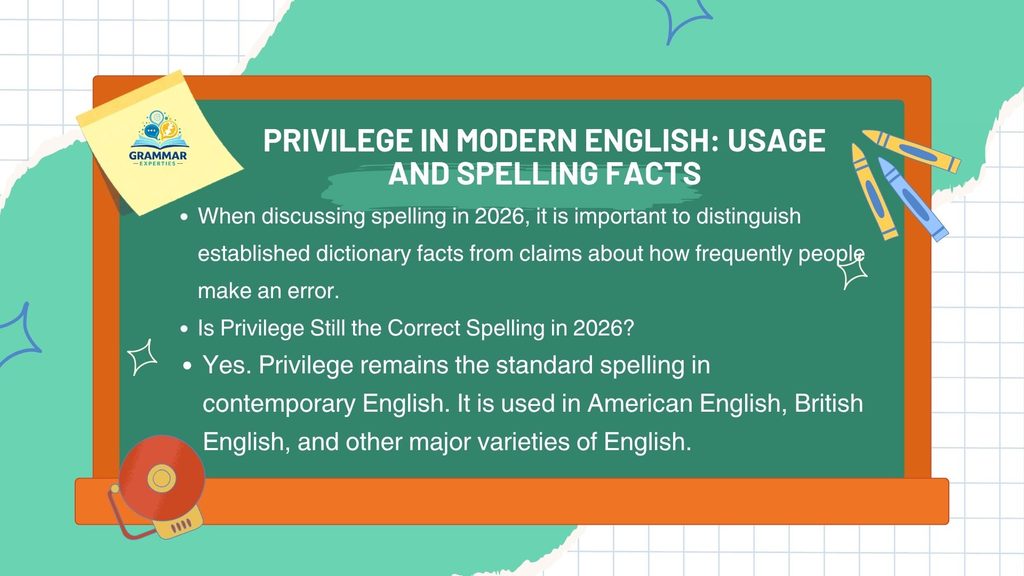
When discussing spelling in 2026, it is important to distinguish established dictionary facts from claims about how frequently people make an error.
Is Privilege Still the Correct Spelling in 2026?
Yes. Privilege remains the standard spelling in contemporary English. It is used in American English, British English, and other major varieties of English.
The spelling does not change based on the country or region.
Common forms include:
| Word Form | Example |
|---|---|
| Privilege | It is a privilege to attend. |
| Privileges | Members receive additional privileges. |
| Privileged | She feels privileged to participate. |
| Privileging | The policy risks privileging one group over another. |
What Do Reliable Language Resources Say?
Established dictionaries are appropriate sources for confirming the spelling, pronunciation, and meaning of a word.
The following references can help you verify your writing:
What Do the 2025–2026 Statistics Show?
There is no verified statistic established here that measures the exact percentage of writers who misspell privilege as priviledge during 2025–2026. Therefore, assigning a numerical error rate or claiming that the mistake has increased would be misleading.
For writers and publishers, the practical approach is to verify the word using a reputable dictionary and proofread published content.
A website that wants to measure this particular error could analyze a defined collection of documents and compare occurrences of priviledge against correctly spelled uses of privilege. Any resulting statistic should identify its sample, collection period, and counting method.
This approach avoids presenting unsupported figures as established facts.
Mini Quiz:Privilege or Priviledge
1. Which spelling is correct?
A) Priviledge B) Privilege C) Privelege D) Privillage
Answer: B) Privilege
2. Fill in the blank: It is a _____ to represent my school.
A) Priviledge B) Privilege C) Privelege D) Privillage
Answer: B) Privilege
3. True or False: “Priviledge” is the correct spelling.
A) True B) False
Answer: B) False
4. What does “privilege” mean?
A) A special right or advantage B) A serious punishment C) A daily obligation D) A public disagreement
Answer: A) A special right or advantage
5. Complete the sentence: Having access to education is a _____.
A) Priviledge B) Privilege C) Privelege D) Privillage
Answer: B) Privilege
6. Which sentence is correct?
A) It was a privilege to meet the author. B) It was a priviledge to meet the author. C) It was a privelege to meet the author. D) It was a privillage to meet the author.
Answer: A) It was a privilege to meet the author.
7. True or False: The word “privilege” contains the letter d.
A) True B) False
Answer: B) False
8. Fill in the blank: I consider it a _____ to help others.
A) Priviledge B) Privilege C) Privilage D) Privelege
Answer: B) Privilege
9. Which spelling should you use in a formal essay?
A) Priviledge B) Privilege C) Privelege D) Privillage
Answer: B) Privilege
10. What is the plural form of “privilege”?
A) Priviledges B) Privileges C) Privilegies D) Privilegs
Answer: B) Privileges
11. Choose the correct spelling: She has the _____ of working remotely.
A) Privilege B) Priviledge C) Privelege D) Privillage
Answer: A) Privilege
12. Which spelling is incorrect?
A) Privilege B) Privileges C) Priviledge D) Privileged
Answer: C) Priviledge
13. Which is the correct adjective meaning “having a special advantage”?
A) Privileged B) Priviledged C) Priveleged D) Privillaged
Answer: A) Privileged
14. Choose the correctly spelled sentence.
A) Everyone deserves equal priviledge. B) Everyone deserves equal privilege. C) Everyone deserves equal privelege. D) Everyone deserves equal privillage.
Answer: B) Everyone deserves equal privilege.
15. Which letters follow “priv” in the word “privilege”?
A) ile B) iled C) ele D) ill
Answer: A) ile
16. Fill in the blank: It is a _____ to serve the community.
A) Priviledge B) Privilege C) Privilage D) Privillage
Answer: B) Privilege
17. Which spelling is correct in both American and British English?
A) Priviledge B) Privilege C) Privelege D) Privillage
Answer: B) Privilege
18. Which phrase is spelled correctly?
A) A priviledge of membership B) A privilege of membership C) A privelege of membership D) A privillage of membership
Answer: B) A privilege of membership
19. Which sentence is appropriate for a professional email?
A) I appreciate this privilege. B) I appreciate this priviledge. C) I appreciate this privelege. D) I appreciate this privillage.
Answer: A) I appreciate this privilege.
20. Which is the correct spelling of the noun meaning a special benefit?
A) Priviledge B) Privilege C) Privillage D) Privelege
Answer: B) Privilege
21. Complete the sentence: “It was a great _____ to work with you.”
A) Priviledge B) Privilege C) Privelege D) Privillage
Answer: B) Privilege
22. Which word is spelled correctly?
A) Priviledges B) Privileges C) Privilages D) Priveleges
Answer: B) Privileges
23. Choose the correct sentence.
A) She feels privileged to attend the event. B) She feels priviledged to attend the event. C) She feels priveleged to attend the event. D) She feels privillaged to attend the event.
Answer: A) She feels privileged to attend the event.
24. What is the most effective way to avoid misspelling “privilege”?
A) Write it as “priviledge.” B) Memorize its correct letter sequence. C) Replace it with “privelege.” D) Add a d before the final letters.
Answer: B) Memorize its correct letter sequence.
25. Which spelling should you remember in 2026 and beyond?
A) Priviledge B) Privillage C) Privilege D) Privelege
Answer: C) Privilege
Frequently Asked Questions (FAQs)
Q1: Is it privilege or priviledge?
Privilege is correct. Priviledge is a misspelling because the base word does not contain a “d” before the final “g.”
Q2: What is the meaning of privilege?
Privilege means a special right, advantage, benefit, or opportunity available to a person or group. It can also describe an experience considered an honor.
Q3: Why do people spell privilege incorrectly?
People often add an extra “d” because of pronunciation confusion, familiar spelling patterns, or typing mistakes. Remembering the ending lege can help prevent this error.
Q4: Is privileged spelled with a d?
Yes. Privileged is the correct spelling of the adjective. Although the base word is privilege, its adjective form includes a “d” before the final “g.”
Q5: Is privilege spelled differently in British and American English?
No. Both British and American English use privilege. There is no regional spelling difference for this word.
Q6: What is the plural of privilege?
The plural is privileges. For example, “The membership includes several privileges.”
7. How can I remember how to spell privilege?
Remember this rule: Privilege has no “d” in its base form. Practice writing the word in sentences and check your spelling when proofreading important documents.
Q8: Can privilege be used in a formal sentence?
Yes. For example: “It is a privilege to contribute to this important research project.” The word is appropriate for professional emails, academic writing, speeches, and formal correspondence.
Conclusion
When choosing between privilege or priviledge, the correct answer is always privilege in standard English. The incorrect version, priviledge, contains an extra “d” and should be avoided in academic, professional, and everyday writing.
Privilege refers to a special right, advantage, benefit, or valued opportunity. Its related forms include privileges and privileged, each with its own correct spelling and grammatical use.
The easiest way to remember the difference is to focus on the ending: privilege, not priviledge.
Whether you are writing a school assignment, preparing a professional email, or publishing an online article, correct spelling makes your writing clearer and more polished.
Explore more easy grammar lessons and improve your English with Grammar Expertise
Reference
Cambridge Dictionary: Privilege

Maimoona Mughal is an English grammar enthusiast dedicated to simplifying confusing words, grammar rules, and vocabulary through clear, accurate, and learner-friendly content that helps readers write and communicate with confidence.