Have you ever wondered whether to write drier or dryer when describing something with less moisture or referring to a machine that removes water? These two words sound exactly alike, which makes them easy to confuse. However, their meanings and typical uses are different.
The good news is that both drier and dryer are correct English words. The difference depends on the context. Generally, drier is the comparative form of the adjective dry, while dryer refers to a machine or device that removes moisture.
For example, you would say, “The weather is getting drier,” but “I put my clothes in the dryer.”
In this guide, you’ll learn the meanings, spelling rules, grammatical differences, and practical examples of drier and dryer so you can choose the right word confidently.
What Is the Difference Between Drier and Dryer?
Although drier and dryer have the same pronunciation, they usually perform different grammatical jobs in a sentence.
Drier: The Comparative Form of Dry
Drier is the comparative form of the adjective dry. It describes something that has less moisture than another thing.
When you compare two objects, places, conditions, or situations based on their dryness, drier is generally the correct spelling.
Examples:
- The weather is drier this summer than it was last year.
- This towel is drier than the one hanging outside.
- The soil becomes drier during the hot season.
- My skin feels drier in winter.
- The northern region is drier than the southern region.
In each sentence, drier describes a condition rather than a machine.
Dryer: A Machine That Removes Moisture
Dryer is generally a noun referring to a machine or device that removes moisture from something.
A dryer may use heat, moving air, or another drying process to remove water.
Examples:
- I bought a new clothes dryer.
- She uses a hair dryer every morning.
- The dryer stopped working yesterday.
- Put the wet towels in the dryer.
- Our kitchen has a hand dryer near the sink.
The word dryer is commonly used for household appliances and other drying equipment.
Quick Comparison Table
| Word | Meaning | Part of Speech | Example |
|---|---|---|---|
| Drier | Less wet or more dry | Adjective | The air is drier today. |
| Dryer | A machine that removes moisture | Noun | The dryer needs repair. |
The easiest way to remember the difference is to associate drier with comparison and dryer with equipment.
When Should You Use Drier?
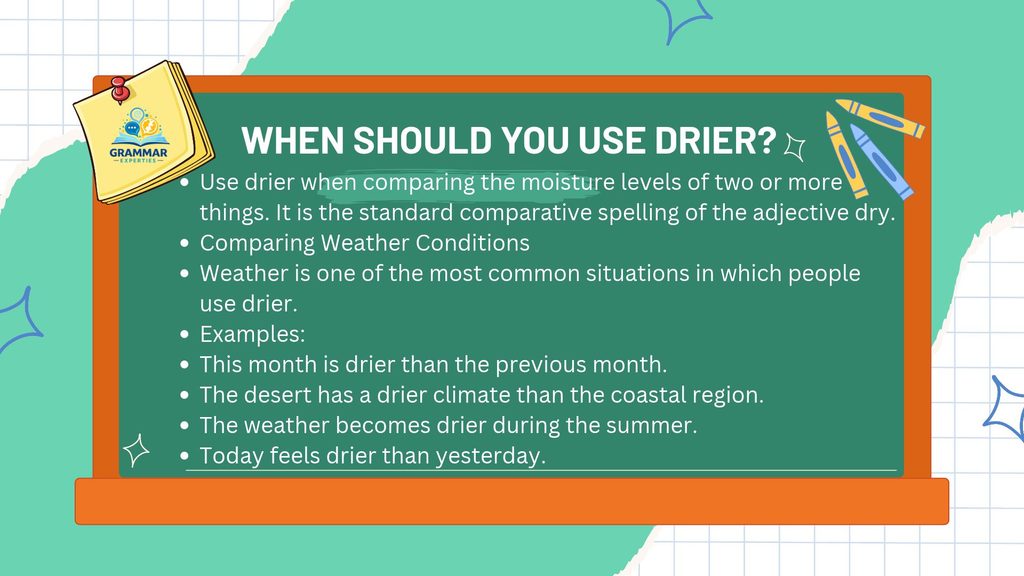
Use drier when comparing the moisture levels of two or more things. It is the standard comparative spelling of the adjective dry.
Comparing Weather Conditions
Weather is one of the most common situations in which people use drier.
Examples:
- This month is drier than the previous month.
- The desert has a drier climate than the coastal region.
- The weather becomes drier during the summer.
- Today feels drier than yesterday.
Notice that drier describes the amount of moisture in the atmosphere or environment.
Describing Skin, Hair, and Other Materials
You can also use drier when describing physical conditions.
Examples:
- My hands become drier after washing them frequently.
- Her hair looks drier after spending time in the sun.
- This fabric feels drier than the other one.
- The paint is drier than it was an hour ago.
These examples compare the dryness of different conditions or objects.
Using Drier in Everyday Comparisons
Drier is not limited to weather or physical objects. You can use it whenever you want to describe something as having less moisture.
Examples:
- This bread is drier than the fresh loaf.
- The ground is drier near the road.
- The second towel feels drier.
- The air inside the room is drier than outside.
Remember: When you mean more dry, choose drier.
When Should You Use Dryer?
Use dryer when referring to a machine or device that removes moisture. It is especially common in everyday conversations about household appliances.
Clothes Dryer
A clothes dryer is an appliance that dries wet clothing, towels, and other washable fabrics.
Examples:
- The clothes dryer is making a strange noise.
- Please remove the shirts from the dryer.
- We need to repair our old dryer.
- My new dryer uses less electricity.
In these examples, dryer names a piece of equipment.
Hair Dryer
A hair dryer is an electrical device that blows warm or cool air to dry hair.
Examples:
- I forgot to pack my hair dryer.
- Her hair dryer stopped working.
- This hair dryer has three temperature settings.
- He uses a hair dryer after taking a shower.
You may also see the one-word spelling hairdryer, which is accepted in English.
Other Types of Dryers
The word dryer can describe several types of equipment, including:
- Hand dryer: A machine that dries hands after washing.
- Tumble dryer: An appliance that dries clothes by rotating them.
- Food dryer: Equipment used to remove moisture from food.
- Industrial dryer: Machinery used in manufacturing processes.
- Spin dryer: A device that removes water from clothes through spinning.
For example:
“The restaurant installed a new hand dryer in the restroom.”
Here, dryer clearly refers to equipment rather than a comparison.
Drier or Dryer: Spelling Rules and Common Mistakes
Understanding a few basic spelling and grammar rules can help you avoid confusion.
The Y-to-I Spelling Rule
In English, the final y in certain adjectives changes to i when adding the comparative suffix -er.
For example:
- Dry → Drier
- Happy → Happier
- Easy → Easier
- Busy → Busier
- Heavy → Heavier
The same pattern explains why drier is the standard comparative form of dry.
However, dryer follows a different pattern because it is formed as a noun using the base word dry and the suffix -er.
Common Spelling Mistakes
Here are some mistakes that English learners and writers should avoid.
| Incorrect or Less Suitable | Preferred Form | Explanation |
|---|---|---|
| The weather is dryer today. | The weather is drier today. | Use drier for comparison. |
| Put your clothes in the drier. | Put your clothes in the dryer. | Dryer is the usual appliance spelling. |
| My skin is dryer now. | My skin is drier now. | Drier is the standard comparative adjective. |
| I purchased a new hair drier. | I purchased a new hair dryer. | Dryer is the familiar appliance spelling. |
One important detail: dictionaries also recognize drier as an alternative noun spelling for a drying machine. Similarly, dryer can occasionally appear as an alternative adjective spelling. Nevertheless, keeping the two conventional spellings separate makes your writing clearer.
A Simple Trick to Remember the Difference
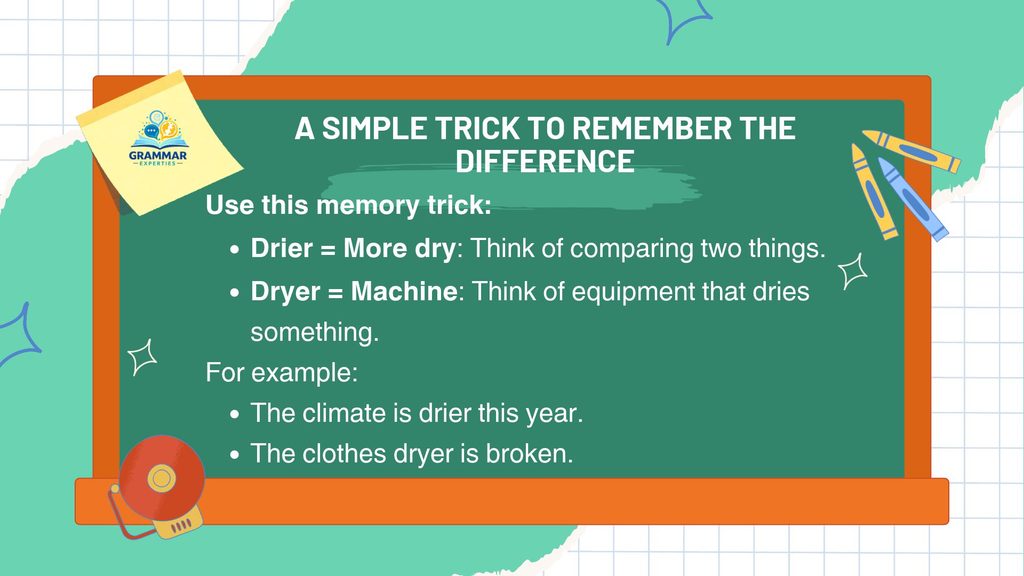
Use this memory trick:
- Drier = More dry: Think of comparing two things.
- Dryer = Machine: Think of equipment that dries something.
For example:
- The climate is drier this year.
- The clothes dryer is broken.
This simple association will help you select the appropriate spelling in most everyday situations.
Real-Life Example: How to Choose Between Drier and Dryer
Consider a situation involving someone writing a short blog post about summer weather and household appliances.
Sarah is preparing an article about taking care of clothes during hot weather. While editing her first draft, she notices that she has used drier and dryer several times without considering their meanings.
Her original sentence reads:
“Summer weather is becoming dryer, so people can hang their clothes outside. However, some families prefer using a clothes drier when it rains.”
At first glance, both spellings might look acceptable because they sound identical. However, Sarah needs to correct the words according to their intended meanings.
The improved version reads:
“Summer weather is becoming drier, so people can hang their clothes outside. However, some families prefer using a clothes dryer when it rains.”
Why is the second version better?
In the first sentence, Sarah is comparing the weather conditions. She means that summer weather is becoming less humid or more dry. Therefore, drier is the standard comparative adjective.
In the second sentence, she is discussing a household appliance used to remove moisture from clothing. Therefore, dryer is the conventional noun spelling.
Sarah then checks the rest of her article for similar mistakes. She also finds sentences such as “My towels are drier today” and “The dryer needs cleaning.” Both are appropriate.
This example demonstrates why context matters more than pronunciation. Even when two words sound identical, their grammatical roles can determine which spelling communicates the intended meaning most clearly.
The lesson is simple: understand what you want to describe before choosing between drier and dryer.
Drier or Dryer: Dictionary and Usage Evidence
English spelling conventions are not always as straightforward as they appear. Sometimes, dictionaries recognize alternative spellings even when one form is more common in everyday writing.
What Do Modern Dictionaries Say?
The following dictionary references help explain the distinction:
- Cambridge Dictionary: Identifies drier as the comparative form of dry and also recognizes its use as a noun referring to a dryer.
- Oxford Advanced Learner’s Dictionary: Lists dryer as a machine used for drying something and acknowledges drier as an alternative spelling.
- Collins English Dictionary: Recognizes drier as the comparative form of dry and also records it as an alternative noun spelling of dryer.
What Does Recent Evidence Tell Us?
A useful distinction is needed when discussing 2025–2026 spelling data.
There is no reliable, widely established annual statistic showing what percentage of English writers choose drier versus dryer. It would therefore be misleading to invent a percentage or claim that one spelling has a specific popularity advantage based on unsupported figures.
However, the 2025 fifth digital edition of Webster’s New World College Dictionary, reported by Collins, continues to recognize drier as the comparative of dry. Oxford and Cambridge also document the established distinction between the two words.
A 2026 academic study published in Written Language & Literacy examines how word frequency influences the standardization of English spelling. Although it does not provide a specific drier-versus-dryer usage percentage, it offers broader evidence about how spelling conventions become established over time.
The practical conclusion remains clear: use drier for comparisons and dryer for machines in ordinary modern writing.
Mini Quiz:Drier or Dryer
1. Which word is correct when describing weather with less moisture?
A. Dryer
B. Drier
C. Dryest
D. Drying
Answer: B. Drier
2. Which spelling refers to a machine used to dry clothes?
A. Drier
B. Dryest
C. Dryer
D. Drying
Answer: C. Dryer
3. Complete the sentence: “My skin feels _____ during winter.”
A. Dryer
B. Drier
C. Dryest
D. Drying
Answer: B. Drier
4. Which sentence uses dryer correctly?
A. The weather is getting dryer.
B. My hair feels dryer today.
C. I bought a new clothes dryer.
D. The soil is dryer than before.
Answer: C. I bought a new clothes dryer.
5. What is the comparative form of dry?
A. Dryest
B. Dryer
C. Drier
D. Drying
Answer: C. Drier
6. Complete the sentence: “Please put the wet towels in the _____.”
A. Drier
B. Dryer
C. Driest
D. Drying
Answer: B. Dryer
7. Which word should describe a desert climate with less rainfall?
A. Dryer
B. Drier
C. Drying
D. Dryest
Answer: B. Drier
8. What does the word dryer usually refer to?
A. A comparative adjective
B. A wet surface
C. A drying machine
D. A weather condition
Answer: C. A drying machine
9. Complete the sentence: “This towel is _____ than the other one.”
A. Dryer
B. Drier
C. Dryest
D. Drying
Answer: B. Drier
10. Which spelling is standard for an electrical device used to dry hair?
A. Hair drier
B. Hair dryer
C. Hair driest
D. Hair drying
Answer: B. Hair dryer
11. What is the superlative form of dry?
A. Dryer
B. Drier
C. Driest
D. Drying
Answer: C. Driest
12. Complete the sentence: “The air inside this room is _____ than outside.”
A. Dryer
B. Drier
C. Dryest
D. Drying
Answer: B. Drier
13. Which sentence uses drier correctly?
A. She purchased a new drier machine.
B. The weather is drier this year.
C. Put the clothes in the drier.
D. He repaired the hair drier.
Answer: B. The weather is drier this year.
14. What happens to the final “y” when dry becomes drier?
A. It remains unchanged.
B. It changes to “i.”
C. It changes to “e.”
D. It is removed completely.
Answer: B. It changes to “i.”
15. Complete the sentence: “My new _____ has three temperature settings.”
A. Drier
B. Dryer
C. Driest
D. Drying
Answer: B. Dryer
16. Which word is appropriate when comparing two pieces of fabric?
A. Drier
B. Dryer
C. Dryest
D. Drying
Answer: A. Drier
17. Are drier and dryer pronounced the same in standard English?
A. Yes
B. No
C. Only in American English
D. Only in British English
Answer: A. Yes
18. Complete the sentence: “The ground became _____ after several sunny days.”
A. Dryer
B. Drier
C. Driest
D. Drying
Answer: B. Drier
19. Which is the conventional spelling for a machine that dries hands?
A. Hand drier
B. Hand dryer
C. Hand driest
D. Hand drying
Answer: B. Hand dryer
20. Which statement about drier and dryer is correct?
A. Both words always mean the same thing.
B. Drier is only a noun.
C. Dryer is only an adjective.
D. Both are correct words with different common uses.
Answer: D. Both are correct words with different common uses.
21. Complete the sentence: “This bread is _____ than yesterday’s bread.”
A. Dryer
B. Drier
C. Dryest
D. Drying
Answer: B. Drier
22. Which word is commonly used in the phrase “tumble _____”?
A. Drier
B. Dryer
C. Driest
D. Drying
Answer: B. Dryer
23. Which sentence contains the standard spelling?
A. My hair is getting drier.
B. My hair is getting dryer.
C. My hair is getting driest than yours.
D. My hair is getting drying.
Answer: A. My hair is getting drier.
24. Can drier also be used as an alternative spelling for a drying machine?
A. Yes, some dictionaries recognize it.
B. No, it is never accepted.
C. Only in scientific writing.
D. Only when describing weather.
Answer: A. Yes, some dictionaries recognize it.
25. Choose the correctly completed sentence: “The climate is becoming _____, but our clothes _____ is still working.”
A. Dryer, drier
B. Drier, dryer
C. Driest, drying
D. Drying, drier
Frequently Asked Questions About Drier and Dryer
Q1: Is drier or dryer the correct spelling?
Both spellings are correct, but they have different primary uses. Drier is the standard comparative form of dry, while dryer usually refers to a machine that removes moisture.
Q2: Is it drier or dryer when talking about weather?
Drier is the preferred spelling when discussing weather conditions.
Example: “The weather is getting drier as summer approaches.”
Q3: Is a clothes drier or clothes dryer correct?
Clothes dryer is the conventional spelling. It refers to an appliance that removes moisture from clothing.
Although some dictionaries recognize drier as an alternative noun spelling, dryer is more familiar and widely used for this appliance.
Q4: Is hair drier or hair dryer correct?
Hair dryer is the standard and most recognizable spelling for an electrical device used to dry hair.
Example: “I need to buy a new hair dryer.”
Q5: Why does dry become drier?
The word dry changes its final y to i when forming its standard comparative adjective. Therefore, dry becomes drier, following a common English spelling pattern.
Other examples include happy becoming happier and easy becoming easier.
Q6: Can drier also mean a drying machine?
Yes. Some English dictionaries recognize drier as an alternative spelling of the noun dryer.
However, dryer is the more conventional spelling for household appliances and drying equipment.
Q7: What is the comparative and superlative form of dry?
The comparative form is drier, while the superlative form is driest.
Examples:
- Comparative: This towel is drier than that one.
- Superlative: This is the driest towel in the cupboard.
Q8: Are drier and dryer pronounced the same?
Yes. In standard English, drier and dryer have the same pronunciation. Their meanings and grammatical functions, rather than their sounds, determine which spelling you should use.
Conclusion: Drier or Dryer Which Word Should You Choose?
The difference between drier or dryer becomes simple once you understand their meanings.
Use drier when describing something that is more dry or has less moisture than something else. Use dryer when referring to a machine or device that removes moisture, such as a clothes dryer or hair dryer.
Although dictionaries recognize some overlap between these spellings, keeping their usual meanings separate makes your writing clearer and easier to understand.
Remember this simple rule:
- Drier = More dry.
- Dryer = A drying machine.
Next time you write an English sentence, consider whether you are describing a condition or naming a machine. This small spelling distinction can make a big difference in your writing.
Explore more easy grammar lessons and improve your English with Grammar Expertise
References

Maimoona Mughal is an English grammar enthusiast dedicated to simplifying confusing words, grammar rules, and vocabulary through clear, accurate, and learner-friendly content that helps readers write and communicate with confidence.